
The tipping point arguably arrived when the Tate awarded Grayson Perry the 2003 Turner Prize, praising his use of ceramic and drawing traditions to tackle deeply personal and social themes. Museums followed suit, giving artists like Ken Price and Betty Woodman full sculptural retrospectives.
This article profiles the 30 most important ceramic artists working today. You'll find pioneers who legitimized the medium, artists channeling cultural heritage, material experimentalists, vessel reinventors, and rising global voices reshaping what clay can do.
Key Takeaways
- Ceramics moved from craft to fine art after Grayson Perry's 2003 Turner Prize win
- These 30 artists represent six distinct approaches, from early pioneers to emerging global talents
- Recognition signals like museum acquisitions and ArtFacts rankings anchor the selection
- Imperfection, hybridity, and cultural narrative define nearly every artist on this list
Overview of Ceramics in the Contemporary Art World
What separates a museum-worthy ceramic sculpture from a decorative pot on a shelf? Largely, it's intent.
Artists like Ken Price pushed clay into modern American sculpture's main narrative. LACMA's 2012 retrospective positioned his work outside craft entirely, showing 100 pieces that read as painting and sculpture simultaneously. Betty Woodman achieved similar recognition: the Met's 2006 retrospective, her first US museum survey, treated her ceramic reliefs and lacquer-painted earthenware as wall-based art, not tableware.
That reframing has infrastructure behind it now. Ceramic Brussels launched in January 2024 as the first international contemporary art fair built entirely around the medium.
By its 2026 edition, the fair reported 70 galleries and roughly 200 artists from 14 countries drawing over 19,000 visitors, a documented visibility milestone, though not proof of sales growth on its own.
Museums have backed this up with acquisitions. The Metropolitan Museum of Art added Andile Dyalvane's Umwonyo and Roberto Lugo's Digable Underground to its permanent collection in 2021, both signaling that institutional gatekeepers now treat contemporary ceramics as collectible fine art rather than design objects.
The artists below are the ones driving that transformation, grouped into six thematic categories rather than ranked head-to-head.
The Top 30 Most Important Ceramic Artists Today
These groupings reflect the range of ideas shaping ceramics right now, not a strict hierarchy of importance.
Pioneers Who Brought Ceramics into Fine Art
- Grayson Perry (UK) — Won the 2003 Turner Prize for classically shaped vases covered in autobiographical figures and text. His alter ego, Claire, helped legitimize ceramics as serious social commentary.
- Johan Creten (Belgium) — Working with clay since the late 1980s, Creten champions a "Slow Art" philosophy resisting instant gratification. A 2024 survey of 120 works in Orleans cemented his standing as a bridge between historical and contemporary ceramic sculpture.
Artists Channeling Cultural Heritage and Identity
- Andile Dyalvane (South Africa) — Co-founder of Imiso Ceramics, Dyalvane carves large sculptural vessels with incision marks coded to Xhosa ancestral memory. The Met's 2021 acquisition of Umwonyo marked a major institutional endorsement.
- Simphiwe Mbunyuza (South Africa) — Draws on Xhosa spiritual iconography, using ritual-inspired forms and glazing techniques that root his work in ceremonial tradition rather than decoration.
- Ramesh Mario Nithiyendran (Australia/Sri Lanka) — Builds raw, colorful hybrid deity figures blending South Asian religious tradition with queer identity and pop culture. His five large sculptures headlined the National Gallery of Australia's Mud Men show.
- Roberto Lugo (US) — Reimagines classical pottery forms with hip-hop portraiture, graffiti lettering, and social justice themes. The Met acquired his glazed stoneware piece Digable Underground in 2021.
- Geng Xue (China) — Combines porcelain with stop-motion film, rooting classical Chinese philosophy in a distinctly contemporary media practice.
Abstract Sculptors Pushing Clay's Material Limits
- Aneta Regel (UK/Poland) — Fuses stoneware with volcanic rock to explore metamorphosis and geological time.
- Brian Rochefort (US) — Cratered, thickly glazed forms inspired by ecological expeditions to the Amazon and Galápagos.
- Aaron Angell (UK) — Runs Troy Town Art Pottery, experimenting with glaze chemistry and a "composted" folk-pottery aesthetic.
- Anders Ruhwald (Denmark/US) — Treats clay as an extension of the body through large-scale installation work.
- Mira/Dalma Makai (Hungary) — Creates organism-like forms probing attraction and decay.
- Eric Croes (Belgium) — Builds hybrid ceramic-bronze figures that form a personal, ongoing mythology.
Reinventing the Vessel and Decorative Tradition
- Elisabeth Kley (US) — Black-and-white ceramic environments drawing on Wiener Werkstätte design and Ballets Russes theatricality.
- Francesca DiMattio (US) — Monumental hybrid vessels that mash up Ming, Sèvres, and Wedgwood porcelain references into one object.
- Nicole Cherubini (US) — Excess-laden vessel-objects that deliberately subvert taste hierarchies.
- Matt Wedel (US) — Monumental floral and figurative stoneware sculptures with a naive, almost childlike scale.
- William J. O'Brien (US) — Improvisational practice spanning ceramic and mixed media, resisting a single signature style.
Body, Identity, and Feminist Perspectives in Clay
- Jessica Stoller (US) — Porcelain figures that reclaim Rococo excess as feminist commentary on beauty standards.
- Ruby Neri (US) — Raw, sprayed-glaze vessels rooted in Bay Area Funk art and street art traditions.
- Elizabeth Jaeger (US) — Hybrid organic-geometric sculptures examining the body as both subject and material.
- Brie Ruais (US) — Works with clay equal to her own body weight, registering physical gesture directly in the material.
- Julia Haft-Candell (US) — Recurring symbolic motifs build a personal cosmology across her sculptural output.
- Bari Ziperstein (US) — Translates archival research into propaganda and consumerism into ceramic form.
Rising and Global Voices to Watch
- Cristina Tufiño (Puerto Rico/Mexico) — Multidisciplinary work examining memory and museum display conventions.
- Cesc Abad (Spain) — Narrative vessels inspired by ancient Greek and Sumerian storytelling.
- Shahpour Pouyan (Iran/UK) — Reinterprets Persian historical motifs through glazed ceramic form.
- Salvatore Arancio (Italy/France) — Hybrid mineral-vegetal forms that blur science and myth.
- Woody De Othello (US) — Anthropomorphized domestic objects rooted in spiritual traditions.
- Bruce M. Sherman (US) — Whimsical, totemic figures balancing humor and reverence.
How These Artists Were Selected
Picking 30 names from a global field means combining subjective editorial judgment with harder recognition signals. Neither alone tells the full story.
Criteria used for this list:
- Gallery representation with established, internationally recognized dealers
- Museum exhibitions and permanent collection acquisitions
- Ranking platforms like ArtFacts, which track exhibition history and institutional visibility rather than artistic quality
- Longevity and consistency of practice over time
- Documented influence on younger ceramicists entering the field
One mistake collectors and casual readers often make is treating a high auction result as proof of cultural importance. Auction prices reflect demand at a single moment, not exhibition history or critical writing.
They also don't capture whether an artist's ideas are shaping how the next generation approaches clay. An artist with modest sales but a decade of museum shows and teaching influence often matters more long-term than one riding a single record-breaking lot.
For collectors, the practical takeaway is this: look for artists with staying power. Institutional validation and generational influence tend to hold value better than a single hot auction season.
From Gallery to Home: Why Handmade Craft Is Having a Moment
The same appetite for authenticity driving museum-grade ceramics is showing up in living rooms. Consumers want objects with a human fingerprint on them, not another mass-produced set from a big-box shelf. Grand View Research projects the global handicrafts market to reach $983.12 billion by 2030, growing at a 4.9% annual rate from 2025 onward, driven partly by demand for one-of-a-kind, culturally significant goods.
Collectors increasingly design spaces where a museum-caliber ceramic sculpture sits alongside handcrafted tableware from the dinner table. Both are valued for the same reason: desirable imperfections that signal a human hand was involved, not a machine.
Gemixx Exports manufactures for the brands and retailers supplying exactly this market. At its Khurja ceramics factory, artisans hand-decorate dinnerware, jars, and vases with florals and seasonal prints, using reactive glazes that shift color and texture unpredictably during firing.
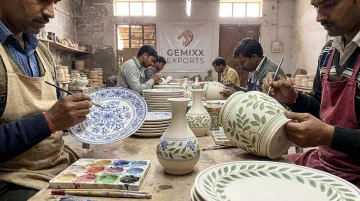
No two pieces come out identical, and that's the intended result rather than a defect. The same instinct pulls collectors toward gallery ceramics: an object that carries evidence of the hands that made it.
Conclusion
These 30 artists show that ceramics has moved well past its old craft-versus-art divide. Some are rewriting cultural narrative through clay. Others are pushing the material itself past recognizable limits. Together, they're proof the medium has real staying power in contemporary art conversations.
Keep an eye on upcoming exhibitions from these artists. Museum shows and gallery representation shift quickly, and this list will look different in five years.
That same appreciation for the handmade extends beyond gallery walls. Manufacturers like Gemixx, guided by the philosophy of "Keeping the Hands in Handicrafts," apply similar values in commercial ceramics and tableware — favoring artisan technique and natural variation over mass automation.
Frequently Asked Questions
What are some famous ceramic artists?
Grayson Perry won the 2003 Turner Prize for autobiographical vases. Roberto Lugo blends classical pottery with hip-hop portraiture, while Andile Dyalvane creates large sculptural vessels rooted in Xhosa heritage.
Who are some famous artists who paint on ceramics?
Grayson Perry decorates classical vase forms with narrative imagery and text. Ai Weiwei paints over historical ceramic vessels, including dipping antique urns in industrial paint, to make political statements about value and heritage.
What are ceramic artists called?
"Potter" typically refers to someone making pottery, often functional. "Ceramicist" or "ceramic artist" describes practitioners whose work leans sculptural, conceptual, or gallery-oriented. The terms overlap and many artists move fluidly between them.
Who are some famous contemporary female ceramic artists?
Jessica Stoller reclaims Rococo excess for feminist commentary. Ruby Neri draws on Bay Area Funk and street art, while Elizabeth Jaeger explores corporeality through hybrid forms. Francesca DiMattio builds monumental vessels referencing porcelain history.
What makes ceramic art valuable or important today?
Critical recognition, museum acquisitions, gallery representation, and cultural narrative all shape an artist's importance. Price alone doesn't capture long-term significance — exhibition history and influence on other artists matter just as much.
How is ceramic art different from traditional pottery?
Traditional pottery centers functional use, like serving food or storing goods. Contemporary ceramic art prioritizes concept, sculpture, and narrative, though many artists today deliberately blur that line between function and fine art.