Grade numbers like 304, 18/10, and 316 get thrown around constantly online, often without context. The real difference doesn't show up in a spec sheet. It shows up years later, in fewer complaints, less rust, and customers who trust your brand enough to reorder.
This article breaks down why 316 stainless steel consistently outperforms other common grades in daily flatware use, and where its advantages actually matter most.
Key Takeaways
- 316 stainless steel contains 2-3% molybdenum, outperforming 304 and 18/10 in pitting resistance
- Toughest common grade against salt, acids, and detergents, though 420 stays standard for knife blades
- Higher upfront cost is often offset by fewer replacements in heavy commercial use
- Food-contact compliance still depends on the finished product, not the alloy name alone
- Ideal for premium hospitality, coastal properties, and luxury retail brands where failures hurt trust
What Is 316 Stainless Steel?
316 is an austenitic stainless steel alloy specified as UNS S31600, containing 16-18% chromium, 10-14% nickel, and 2-3% molybdenum. That molybdenum addition is what separates it from more common grades and originally made it the material of choice for marine hardware and surgical instruments.
In flatware and cutlery, 316 shows up in:
- Premium hospitality lines for hotels and restaurant groups
- Luxury retail flatware collections
- Surgical-grade utensils and medical-adjacent product lines
Gemixx manufactures 316 flatware across all three categories, from hospitality programs to surgical-grade utensil lines. Here's the thing buyers actually care about: nobody's placing a purchase order because they love alloy chemistry. They care about fewer returns, flatware that still looks new after two years of dishwasher cycles, and a dining experience that doesn't put their reputation at risk.
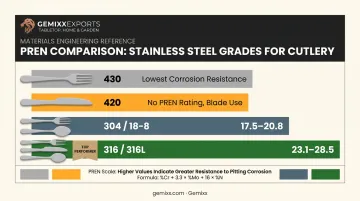
A quick comparison across common cutlery grades, measured by PREN (Pitting Resistance Equivalent Number, a standard scale for corrosion resistance), makes the differences clearer:
| Grade | Corrosion Resistance (PREN Range) | Typical Cutlery Role | Magnetic? |
|---|---|---|---|
| 316 / 316L | 23.1–28.5 | Premium flatware, marine, medical | Generally no |
| 304 / 18-8, 18-10 | 17.5–20.8 | Most common cutlery grade | Weak or none |
| 420 | Not PREN-rated; hardenable martensitic | Forged knife blades | Yes |
| 430 / 18-0 | Lower resistance, no verified PREN | Entry-level flatware | Yes |
Note that 420 isn't inferior across the board. It's simply built for a different job, holding an edge on forged blades, where 316's softer, non-hardenable structure isn't the right fit.
Key Advantages of 316 Stainless Steel for Flatware & Cutlery
The advantages below aren't lab curiosities. They tie directly to numbers buyers already track: return rates, replacement cycles, compliance exposure, and customer trust.
Unmatched Corrosion & Pitting Resistance
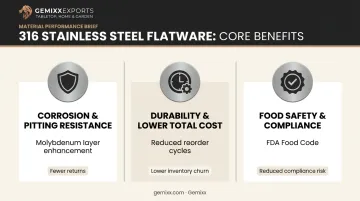
Molybdenum builds a stronger passive oxide layer on the steel's surface, which resists chloride attack from salt, acidic foods, and commercial detergents far better than 304 or 18/10.
A British Stainless Steel Association analysis puts 316L in the 23.1-28.5 range on the Pitting Resistance Equivalent Number scale, compared with 17.5-20.8 for standard 304. That's a meaningful gap in commercial settings like:
- High-volume commercial dishwashers running repeated detergent cycles
- Restaurants serving salt-heavy or high-acid cuisines
- Coastal and humid-climate hospitality properties, where lower grades can show rust spots within months
KPIs this affects: return and replacement rates, warranty claims, complaint volume, and overall product lifespan. For buyers sourcing at scale, that translates directly into fewer angry emails from a hotel's F&B manager.
Long-Term Durability & Lower Total Cost of Ownership
Added molybdenum and higher nickel content also improve hardness and bend resistance. Flatware made from 316 tends to hold its shape through years of daily commercial handling instead of warping or thinning at the tines.
Yes, 316 costs more per unit upfront. But hotel chains, cruise lines, and restaurant groups replacing flatware on a cycle care more about cost per year of service than sticker price. Fewer reorders mean lower inventory churn and less disruption to service standards.
Where this matters most:
- Large-scale hospitality deployments (hotel groups, cruise operators)
- Premium retail lines where consistent quality across years builds repeat customers
- Any program where reorder frequency eats into procurement budgets
Food Safety, Hygiene & Regulatory Compliance
316's history in surgical instruments comes from its non-reactive, biocompatible nature, a real advantage for anything touching food or skin repeatedly.
That said, no alloy name alone grants a compliance stamp. The FDA Food Code requires reusable utensils to be safe, durable, corrosion-resistant, nonabsorbent, and able to withstand repeated warewashing, requirements tied to the finished product, not just the base metal spec. Buyers sourcing across borders still need documentation proving that compliance at the product level.
KPIs this affects: compliance risk exposure, customs and import delays, liability exposure, and long-term brand trust in regulated markets.
Matters most for: cross-border sourcing, retailers targeting health-conscious or luxury shoppers, and any market with strict food-contact material laws.
What Happens When Proper Grading Is Ignored
Skipping grade verification, or trusting an unstamped, unverified alloy, tends to catch up with buyers eventually. Common consequences include:
- Rust spots and pitting appearing within months of regular commercial use
- Rising complaints and returns that erode retailer or brand reputation
- Frequent reordering that erases whatever savings the lower sticker price promised
- Customs or import friction in markets with food-contact safety requirements
- Inconsistent batch quality, since unverified sourcing rarely comes with real traceability
None of this shows up on day one. It shows up six months to two years into a deployment, right when a brand can least afford the reputational hit.
How to Get the Most Value from 316 Stainless Steel Flatware
316's performance only pays off when sourcing is handled correctly. That means verified composition, consistent quality control, and pairing durability with design execution that actually sells.
A few practical steps:
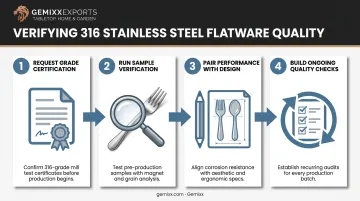
- Request grade certification or mill test reports. Don't rely on marketing language like "surgical steel." Ask for documentation tied to the specific SKU.
- Run basic verification on samples. Check for grade stamps and use a magnet test as a screening tool—annealed 316 and 304 are both generally non-magnetic, though forming can introduce slight magnetism in either grade.
- Pair performance with design capability. Durability shouldn't force a tradeoff with aesthetics. A manufacturing partner offering finish options and fast prototyping keeps both intact.
- Build quality checks into the relationship, not just the first order. Corrosion testing and weight/balance review matter more over a multi-year supplier relationship than as a one-time checkbox.
This is where a vertically integrated manufacturer earns its keep. Gemixx Exports has run its own metalware factory in Moradabad, India for over 40 years, handling forging, grinding, polishing, and plating in-house.
No third-party contract shops are involved, which means fewer unknowns when a buyer needs to confirm material specifications, including 316-grade programs, for a specific SKU.
Gemixx builds its flatware lines around FDA-compliant, California Prop 65-compliant stainless steel, backed by SEDEX membership and SMETA audits for ethical sourcing.
For buyers locking down 316-grade documentation, whether for a coastal hospitality property or a premium retail launch, working through one accountable manufacturer removes the guesswork of juggling several unverified vendors.
Conclusion
316's real value lies in what its chemistry prevents: rust complaints, early replacements, and compliance headaches that eat into margins and trust. Those advantages compound over years of daily use, especially against lower grades that can look identical on a shelf but fail long before their replacement is due.
Grade selection works best as an ongoing sourcing discipline, not a one-time spec decision. That discipline depends on a manufacturing partner like Gemixx, whose SEDEX/SMETA-audited factories and FDA-compliant production treat quality control as a continuous process rather than a single inspection.
Frequently Asked Questions
What is the highest grade of stainless steel flatware?
316 generally offers the strongest corrosion resistance among common flatware grades, thanks to its molybdenum content. It's not universally the best option, though. Hardenable grades like 420 are still preferred for knife blades.
What is the difference between 304 and 316 stainless steel cutlery?
304 (often labeled 18/8 or 18/10) doesn't contain molybdenum, while 316 adds 2-3%. That gives 316 better resistance to chlorides and acids, though it typically costs more.
Is 316 stainless steel food safe?
316 is biocompatible and non-reactive, which is why it's also used in surgical instruments. Food-contact safety still depends on the finished utensil meeting standards like the FDA Food Code, not the alloy name alone.
Does 316 stainless steel rust or tarnish?
316 resists rust and tarnishing significantly better than 304, 18/0, or 430, but no stainless steel is completely immune to corrosion under harsh enough conditions.
Is 316 stainless steel worth the extra cost for flatware?
For commercial, hospitality, or luxury settings facing heavy wear or harsh conditions, yes. For typical home use, standard 18/10 flatware usually performs just fine.
Can 316 stainless steel flatware go in the dishwasher?
Yes. 316's molybdenum content makes it more resistant to dishwasher detergent corrosion than standard 18/10 flatware. Just avoid harsh, low-quality detergents over time, since no stainless steel resists corrosion indefinitely.