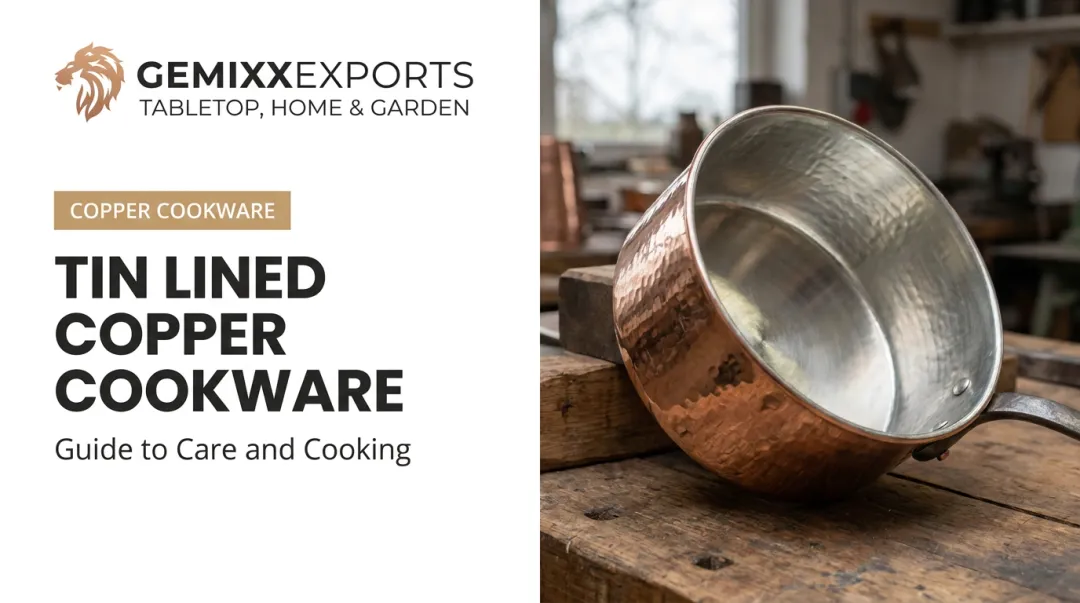
Shine won't tell you. A dealer can hand-polish a 1970s reproduction until it gleams, and a genuine 19th-century saucepan can look dull and neglected after decades in a basement. Real identification means knowing exactly where to look on the piece itself.
This guide walks through the two methods collectors and dealers actually rely on: reading stamps pressed into the metal, and studying how the piece was physically built. Used together, they'll tell you far more than a quick glance ever could.
Key Takeaways
- Stamps reveal maker, retailer, and era — when they remain legible
- Construction clues (handles, rivets, seams) work on every piece, marked or not
- Seam type and handle shape are the clearest fingerprints of age
- Lining condition and wall integrity determine safety, not just age
- Cross-referencing both methods gives the most reliable read on any piece
What You Need Before You Start
Identifying vintage copper correctly means examining the piece methodically in good light, not judging it by shine or patina from across the room. Rushing this step, or cleaning before you look closely, is how real evidence gets lost.
Tools and Indicators You'll Need
Gather these before you start:
- A magnifying glass or jeweler's loupe for faint, worn stamps
- A soft cloth for gently wiping away surface grime — nothing abrasive
- A ruler or caliper to measure wall thickness
- Access to maker and retailer stamp reference directories for comparison
Setting Up the Inspection
Work in bright, natural or white light. Warm ambient lighting hides too much detail in worn stamps and seams.
Only clean the piece if grime is actively blocking your view, and use a soft cloth rather than any polish. According to the Canadian Conservation Institute, polishing removes tarnish along with a layer of original metal, and repeated polishing can erase fine stamp detail permanently. Inspect it dirty first, clean it carefully second.
Check four zones every time: the base, both sides of the handle attachment, the rim, and the interior lining.
Two Ways to Identify Vintage Copper Cookware
Experts rely on two complementary paths. Reading stamps is fastest when a mark is present and legible. Analyzing construction works on every piece, stamped or not, because manufacturing techniques evolved in fairly well-documented ways over time. Use both, and you'll get a far more complete picture than either method alone.
Method 1: Identifying Through Maker's Stamps and Marks
Stamps are impressions pressed into the copper: maker's marks, retailer names, owner initials, or inventory numbers. They can reveal who made the piece, who sold it, and sometimes when.
What you'll need: a magnifying glass, strong lighting, and some familiarity with documented maker or retailer stamps.
- Examine the full exterior, paying close attention to both sides of the handle attachment (the most common stamp location).
- Note the exact wording, font, and any symbols or numbers alongside the stamp. Small details matter more than a name alone.
- Cross-reference the complete stamp (wording, symbols, and placement together) against a dated museum or auction record rather than a name in isolation.
A few documented examples show why exact wording matters so much:
| Stamp | Documented Example | What It Tells You |
|---|---|---|
| J & A GAILLARD, PARIS | Cataloged by Christie's on a 19th-century French pan | Confirms maker and rough period for that specific piece |
| Benham & Froud orb-and-cross, pattern 628 | Bonhams, Victorian jelly mold, circa 1880 | A dated British maker's mark |
| Temple & Crook, Motcomb St. | Bonhams, on graduated saucepans | A retailer stamp, not a maker's mark |
The catch: this is the fastest route when a clear stamp exists, but plenty of genuine vintage pieces carry no stamp at all, or only a retailer stamp that tells you nothing about who actually forged the pan.
Method 2: Identifying Through Construction Methods
Examining how a pan was physically made (seams, handle shape, rivets, hammer marks) narrows down its era and origin even with zero markings. This is the method that works on every single piece.
What you'll need: a loupe for close inspection of joinery, and some reference knowledge of era-specific construction habits.
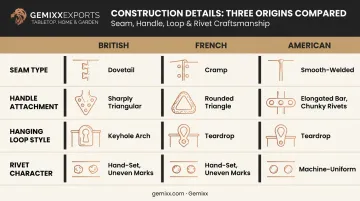
- Look at the body seam. A visible dovetail or cramp seam points to older, hand-formed construction. A smooth welded seam or no seam at all (spun or deep-drawn) suggests more modern manufacturing.
- Study the handle attachment shape. Collectors commonly reference a few general patterns, though none of these are formalized authentication rules — treat them as supporting evidence, not proof on their own:
| Attachment Style | Commonly Associated Origin |
|---|---|
| Sharply triangular | British |
| Rounded triangle | French |
| Elongated, bar-like with chunky rivets | American |
- Check the hanging loop at the handle end. A teardrop shape shows up often on French and American pieces; a keyhole or arch shape is more common on British pieces. Again, this is a collector heuristic, not a certified standard.
- Look at the rivets and any surface hammering. Slightly uneven hammer marks and hand-set rivets suggest older, hand-forged work. Perfectly uniform machine stamping suggests later mass production.
None of this is guesswork invented for this guide — riveted handles, hollowed bodies, and drawn saucepan sides were all documented coppersmithing techniques by the time John Fuller's 1894 coppersmithing manual was published. What that source doesn't give you is an end date, which is exactly why construction clues narrow down a range rather than a specific year.
The catch: this method works on every pan, but it requires familiarity with era-specific hallmarks, and it typically yields an approximate window rather than an exact date.
How to Interpret What You Find
Reading these clues correctly determines whether you've found a genuine antique worth restoring, a later production piece, or a modern decorative item. Misreading them risks overpaying, missing a real find, or damaging a valuable piece during an overzealous "restoration."
Genuine and well-preserved: A legible, period-correct stamp matched with hand-forged details (dovetail seams, hand-set rivets, region-consistent handle shape) points to an authentic older piece. From there, check the lining and structural condition before you use or buy it.
Ambiguous or partial signs: A worn stamp paired with mixed construction clues, such as machine-made rivets on an old-style handle, may mean a later production run or an altered piece. Cross-reference maker directories or get a second opinion before assuming high value.
Red flags for modern reproductions:
- Perfectly uniform, machine-stamped rivets throughout
- No visible seam of any kind
- A "Made in" stamp referencing a modern manufacturing hub
Stainless steel lining alone isn't one of these red flags, though. Both tin and stainless linings appear on legitimately old copper cookware, so lining material by itself proves nothing about age.
Value and usability check: Collectors often cite roughly 2.5–3mm as a general wall-thickness benchmark for quality vintage copper, though it isn't an official authentication standard. Measure it, but don't treat it as gospel.
Lining condition matters more than thickness:
- Naturally darkened tin that's still intact and functioning
- Tin worn through to bare copper, signaling a need for relining
- Warping or loose handles, which suggest display-only condition
Common Mistakes When Identifying Vintage Copper Cookware
Even experienced buyers trip over these:
- Assuming dark patina equals age. Patina can be artificially applied, or it can simply reflect years of neglect rather than genuine history.
- A retailer's stamp isn't a maker's mark. Mixing the two up credits the wrong company entirely for a piece's craftsmanship.
- Cleaning before inspecting. Aggressive polishing before you've examined the piece can wear away a faint stamp or damage a delicate tin lining you needed to evaluate first.
Buying, Using, and Caring for Your Vintage Find
Before buying a piece with a worn-through lining, factor in re-tinning or restoration costs. That expense materially affects both real value and whether the pan is safe to cook in.
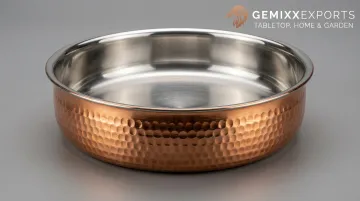
If a genuine vintage piece isn't kitchen-ready, or you simply want that same hand-hammered character in a new, food-safe pan, manufacturers like Gemixx Exports still produce hand-hammered copper cookware using traditional techniques. The copper is worked entirely by hand across 16 stages of production.
Rather than tin, Gemixx's dual-wall construction pairs the hammered copper exterior with an FDA-compliant stainless steel interior, so re-tinning isn't part of the equation. These pieces reach consumers through the retail and wholesale brands Gemixx manufactures for, rather than direct sale.
For the vintage piece itself:
- Wash the interior with mild soap and water only
- Skip harsh abrasives on exterior stamps or hammer marks — they took decades to develop and won't come back
- Store away from excess humidity to slow future tarnishing
Frequently Asked Questions
How can I identify copper cookware: is it solid copper, copper-plated, or lined with tin or stainless steel?
Solid copper shows copper on the exterior and, unless lined, the interior too. Copper-plated pieces show only a thin wash over another base metal. Check a worn interior spot to reveal what's underneath.
Is vintage copper cookware safe to use?
Yes, as long as the tin or other lining is intact. Food safety guidelines warn against cooking or storing food in scratched or uncoated copper, since bare copper can leach into acidic foods.
How can I date antique copper cookware?
Dating relies on the two methods above: cross-referencing a legible maker's stamp against dated records, and reading construction details like seams, handles, and rivets when no stamp exists.
Do all vintage copper pots have maker's stamps?
No. Many genuine vintage pieces carry no stamp at all, which is exactly why construction-based dating works regardless of markings.
What's the difference between "vintage" and "antique" copper cookware?
"Antique" generally means roughly 100+ years old. "Vintage" is broader, covering pieces anywhere from a few decades to a century old. Construction and stamp details help narrow the exact era.
How can I tell if a stamp is a maker's mark or just a store's mark?
Maker's marks usually include a manufacturer's name and production city. Store stamps reference a retailer's name and often appear smaller or in a separate spot from the primary stamp.