
Introduction
Every housewares brand hits the same fork in the road: buy an existing product and slap your logo on it, or design something nobody else can sell. Private label and contract manufacturing are the two paths, and picking the wrong one costs more than money.
The stakes are real. U.S. store-brand sales hit $282.8 billion in 2025, up 3.3% and now claiming a record 23.5% unit share of retail, according to PLMA's 2025 industry report. Private label has grown into a massive, legitimate strategy, no longer just a fallback option.
But contract manufacturing is where brands build something buyers can't find anywhere else.
This article breaks down what separates the two models, where each one fits, and how to decide which path suits your flatware, cookware, barware, or home decor line. We'll also walk through Gemixx's own vertically integrated manufacturing model so you can see the difference in practice.
Key Takeaways
- Private label means branding an existing product quickly and cheaply, but sharing it with competitors
- Contract manufacturing means custom design and production, with higher investment and full exclusivity
- MOQs, timelines, and ownership structures diverge sharply between the two models
- Your budget, launch timeline, and need for differentiation should drive the decision
Private Label vs Contract Manufacturing: Quick Comparison
Before we define each model, here's the side-by-side view most brand owners actually need.
| Factor | Private Label | Contract Manufacturing |
|---|---|---|
| Cost & upfront investment | Lower; no R&D or tooling required | Higher; covers design, prototyping, and tooling |
| Ownership & customization | Manufacturer owns the design; minimal buyer input | Buyer owns the design and controls specifications |
| Time to market | Fast; product is often ready to ship | Slower; involves sampling and production ramp-up |
| Minimum order quantities | Typically lower | Typically higher due to custom tooling |
| Brand differentiation | Limited; same product may sit on a competitor's shelf | High; product is exclusive to your brand |
Why These Differences Matter
The core tension is speed versus ownership: private label gets you shelf-ready inventory in weeks. Contract manufacturing gets you a product nobody else can sell, but you're paying for that exclusivity in both time and dollars.
Neither model is objectively better, though a retailer testing a new category might start with private label. A brand building a premium identity, such as a skincare line moving from big-box shelves to boutique retail, almost always needs contract manufacturing eventually.
What is Private Label Manufacturing?
Private label means selecting a product that already exists in a manufacturer's catalog and putting your own branding on it. The manufacturer built the mold, set the specs, and often sells that same item to several other brands. You're buying access to production, not creating something new.
This model works well for retailers and wholesalers who want to expand a product line without absorbing production risk. There's no R&D to fund, no tooling costs to cover, and no design phase slowing things down. Product lands on shelves in weeks, not months.
Core operational benefits:
- Faster shelf placement since samples are often already approved for other buyers
- Lower startup capital because there's no design phase to fund
- Reduced inventory risk from smaller order minimums
- Minimal technical expertise required to launch
The trade-off is ownership. The manufacturer controls the specifications and quality standards, and that same design might sit in five other companies' catalogs under five different labels. Your differentiation depends entirely on packaging, pricing, and marketing, not the product itself.
Use Cases of Private Label
Private label fits best when a retailer wants to fill out a catalog or test a new category without building manufacturing relationships from scratch. Big-box store brands built entire kitchenware and cookware sections this way, along with supplements and personal care lines.
Demand for this approach keeps climbing. Globally, 53% of consumers say they're buying more private-label products, and 60% say they'd buy even more if retailers offered greater variety, according to NIQ's 2025 Global Outlook. That variety gap is exactly where contract manufacturing starts to look attractive.
What is Contract Manufacturing?
Contract manufacturing flips the relationship. You provide the design specs, sketches, or even a rough concept, and the manufacturer builds it to your requirements. Nothing on the shelf looks like it, because the product is fully custom to your brand.
This model matters most for brands chasing bespoke, design-forward housewares: flatware with a proprietary finish, cookware with a specific handle geometry, barware that photographs differently than anything at a competitor's booth.
Core operational benefits:
- Full design control, down to materials, finish, and packaging
- Product exclusivity that supports premium pricing
- Stronger brand positioning built on something ownable
Not all contract manufacturers operate the same way. Some are production-only, meaning they'll manufacture to spec but leave prototyping, importing, and warehousing to separate vendors. Others are full-package partners who handle the entire lifecycle under one roof.
That distinction matters more than most buyers realize. Coordinating four separate vendors for one product line introduces four separate points of failure.
Use Cases of Contract Manufacturing
This model dominates categories where craftsmanship is the sales pitch: premium flatware, hammered cookware, artisan barware. It's also the natural fit for interior designers and home decor brands building proprietary SKUs that can't be duplicated by a competitor sourcing from the same catalog supplier.
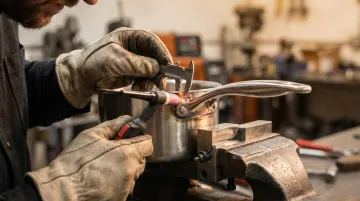
Consider Great Jones, which sourced separate specialist factories for enameled cast iron and stainless nonstick lines. The founders spent nine months developing the product line before launch, making brand-specific decisions on handle grips, colors, and how pieces nested, according to Bon Appétit's account of the company's founding.
Handles were welded without rivets and lab-tested to support 85 pounds. None of that happens through a shared catalog.
Contract manufacturing costs more upfront and takes longer. But it buys something private label structurally cannot: a product only your brand can sell.
Private Label vs Contract Manufacturing: Which One is Right for You?
The decision comes down to four questions:
- What's your budget? Private label needs less capital upfront. Contract manufacturing requires funding design, tooling, and often larger production runs.
- How much involvement do you want? Private label is largely hands-off. Contract manufacturing demands active participation in design and development.
- What's your launch timeline? If you need product on shelves in weeks, private label wins. If you can invest months in development, contract manufacturing pays off.
- How much does differentiation matter to your brand? If your positioning depends on being unique, shared-catalog products will undercut you every time.
Choose private label if: you're testing a new category, prioritizing speed, or working with tight capital.
Choose contract manufacturing if: your brand's value proposition depends on a product competitors can't replicate.
Real-World Example: Building a Differentiated Housewares Line
Here's the challenge most housewares retailers eventually run into: they've built a catalog of private-label flatware, barware, or cookware, and it's starting to look identical to three competitors' catalogs. The products came from the same factory, with the same finishes, sold to whoever placed an order.
Gemixx Exports approaches this problem as a vertically integrated private-label manufacturer with full custom development capabilities, handling prototyping, manufacturing, importing, and warehousing under one roof. Instead of juggling a design studio, a factory, a customs broker, and a warehouse separately, brands work with a single point of contact from concept to delivery.
That consolidation isn't just a convenience play. Gemixx's own manufacturing team puts it plainly: streamlining prototyping through warehousing exists specifically to save clients "time and resources on working with multiple unknown vendors."
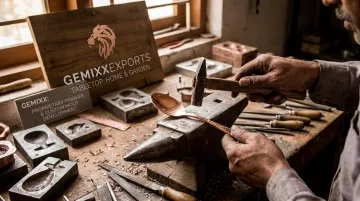
The differentiation comes from technique, not just structure. Gemixx artisans apply hand-hammered copper finishes, hand-blown glass, and custom mold development, methods that a shared-catalog supplier running automated production simply can't offer.
Each flatware piece passes through an average of 16 skilled artisans before it's finished. The company also reinvests 15% of its operating budget into new finishes and processes, roughly five times the industry average. That ongoing investment is how proprietary combinations, such as a marble base with a brass arm and glass hurricane, keep coming to market.
Once samples are approved, typical production lead times run 40 to 60 days for flatware and bar/cheese tools, and 60 to 90 days for barware and cookware.
Brands ready to move past shared-catalog SKUs and build something proprietary can explore custom manufacturing options directly with a team that's spent over four decades doing exactly this.
Conclusion
There's no universal winner between private label and contract manufacturing. Private label suits brands that need speed and lower risk, while contract manufacturing suits brands building long-term equity around a product nobody else can sell.
The practical trade-off is consistent: cost savings and fast turnaround on one side, brand differentiation and pricing power on the other. Before choosing a manufacturing partner, weigh your budget, your timeline, and how much your brand's future depends on owning something unique. That's the model Gemixx builds around: private-label manufacturing only, helping retailers and wholesalers create custom, brand-owned products instead of running contract work for hire.
Frequently Asked Questions
What is private label contract manufacturing?
This term is used loosely, but it generally describes a hybrid model. A manufacturer produces a semi-customized product under your brand, sitting between full private label and full custom contract manufacturing.
What is the difference between contract manufacturing and private labeling?
Private labeling means branding an existing product. Contract manufacturing means directing the design and specifications of a custom-built product from the start.
Is a private label owned by a manufacturer?
Yes, in most arrangements. The manufacturer retains ownership of the product design and formulation, while the buyer owns only the brand identity applied to it.
Which is cheaper: private label or contract manufacturing?
Private label is cheaper upfront since there's no design or tooling investment. Contract manufacturing costs more initially but often delivers better margins through differentiation and pricing power.
Can a brand switch from private label to contract manufacturing later?
Absolutely, and many do. Brands often start with private label to validate demand, then move to contract manufacturing once they want a proprietary product that builds long-term equity.
What is a typical MOQ for contract manufacturing?
MOQs vary widely by product complexity, material, and finish. Request MOQ details directly from prospective manufacturing partners as part of your evaluation.