For retailers, restaurants, and home decor brands sourcing at scale, picking the right manufacturer isn't a cosmetic decision. It shapes lead times, unit costs, consistency across production runs, and how many units come back damaged or off-spec. Many buyers struggle with exactly this: finding a partner whose certifications, capacity, and design flexibility actually match their order volume.
The global ceramic tableware market was valued at $13.43 billion in 2025, according to Fortune Business Insights — a scale that reflects steady demand across hospitality, retail, and residential channels. This guide profiles the ten manufacturers worth knowing, plus how to evaluate them against your own sourcing needs.
Key Takeaways
- Porcelain, bone china, stoneware, and earthenware suit different budgets and use cases
- Certifications, design flexibility, and reliable capacity define the top manufacturers
- This roundup spans heritage luxury brands, design-forward makers, and high-volume producers
- Match manufacturers to your MOQs, lead times, and QC needs, not just brand recognition
- Complete tableware programs pair dinnerware with flatware, barware, and decor partners
Overview of Ceramic Dinnerware in the Global Housewares Market
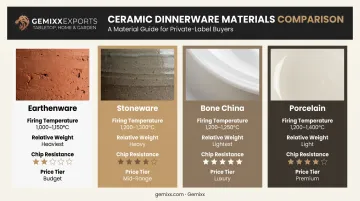
Ceramic dinnerware covers any clay-based, kiln-fired tableware: porcelain, stoneware, bone china, and earthenware all fall under this umbrella. The material and firing temperature determine weight, chip resistance, and where a piece lands on the price spectrum.
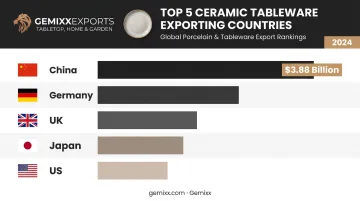
Beyond material composition, production volume shapes the competitive landscape: China dominates global output and export volume by a wide margin. In 2024, the country exported $3.88 billion in porcelain tableware alone, according to the Observatory of Economic Complexity, with additional billions in other ceramic categories.
Other major producers round out the list of top-producing nations:
- Germany
- The UK
- Japan
- The US
Each carves out a niche in luxury, mid-market, or specialty segments.
The manufacturers below represent that spread, spanning centuries-old European ateliers to lean American factories built for volume retail.
Top 10 Ceramic Dinnerware Manufacturers Worldwide
This list weighs four factors: heritage and craftsmanship, production scale, certifications, and design range. Each entry serves a different type of buyer, so match the profile to your program rather than defaulting to the most recognizable name.
Wedgwood
Founded in 1759 in Stoke-on-Trent, England, Wedgwood invented jasperware and has spent over 260 years building a reputation for fine bone china. The brand's hand-finishing craftsmanship and frequent designer collaborations keep it firmly positioned at the top of upscale retail and gifting collections.
| Attribute | Detail |
|---|---|
| Origin/Founded | 1759, Stoke-on-Trent, England |
| Specialty | Fine bone china and jasperware dinnerware |
| Best For | Luxury retail and gifting collections |
Villeroy & Boch
This German manufacturer has operated since 1748, running production across Europe, Asia, and the Americas. Its scratch-resistant glaze technology and sustainability investments make it a strong fit for hospitality groups that need durability alongside a premium look.
| Attribute | Detail |
|---|---|
| Origin/Founded | 1748, Mettlach, Germany |
| Specialty | Functional and luxury porcelain/stoneware collections |
| Best For | Hospitality groups and premium retail chains |
Royal Doulton
Royal Doulton dates back to 1815 and earned a Royal Warrant in 1901, blending traditional English patterns with contemporary lines. Its multi-stage quality inspection process and collectible limited-edition runs build trust with heritage-focused buyers and collector markets.
| Attribute | Detail |
|---|---|
| Origin/Founded | 1815, England |
| Specialty | Traditional and contemporary fine china |
| Best For | Heritage-driven retail and collector markets |
Lenox
Since 1889, this New Jersey-based manufacturer has supplied bone china to institutions including the White House. Lenox pairs hand-painted detailing with modern production and offers a customization program well-suited to gifting and hospitality clients.
| Attribute | Detail |
|---|---|
| Origin/Founded | 1889, New Jersey, USA |
| Specialty | Bone china dinnerware and giftware |
| Best For | American retail, gifting, and institutional buyers |
Rosenthal
Rosenthal was founded in 1879 in Selb, Germany, and built its identity on designer partnerships that treat tableware as functional art. Precision manufacturing and a catalog spanning everyday to luxury lines make it flexible for varied buyer needs.
| Attribute | Detail |
|---|---|
| Origin/Founded | 1879, Selb, Germany |
| Specialty | Designer-collaborated modern porcelain |
| Best For | Design-forward retail and hospitality brands |
Mikasa
Mikasa started in 1948 as an importer before building out a globally distributed catalog. It blends international design inspiration with accessible pricing, a combination that works well for volume retail and e-commerce sellers.
| Attribute | Detail |
|---|---|
| Origin/Founded | 1948, Japan/USA |
| Specialty | Affordable, stylish everyday and formal dinnerware |
| Best For | Mass retail and e-commerce buyers |
Noritake
Founded in 1904 in Nagoya, Noritake created Japan's first Western-style porcelain dinner set and has maintained precision craftsmanship ever since. Its extensive pattern library and manufacturing reliability have made it a go-to for hospitality and airline contracts.
| Attribute | Detail |
|---|---|
| Origin/Founded | 1904, Nagoya, Japan |
| Specialty | Fine porcelain and bone china |
| Best For | Hospitality, airline, and fine dining programs |
Corelle
Corelle launched in 1970 using Vitrelle, a laminated glass-ceramic composite developed by Corning. This technology makes pieces lightweight yet chip-resistant, a practical advantage for busy households and casual dining retailers stocking everyday sets.
| Attribute | Detail |
|---|---|
| Origin/Founded | 1970, Corning, New York, USA |
| Specialty | Lightweight, durable ceramic-glass dinnerware |
| Best For | Everyday-use and value-focused retail |
Heath Ceramics
Based in Sausalito, California since 1948, Heath Ceramics runs a handcrafted, small-batch model built around local sourcing. It uses roughly 30% recycled clay in production, giving boutique retailers and sustainability-minded brands an artisan-grade option with genuine customization capability.
| Attribute | Detail |
|---|---|
| Origin/Founded | 1948, Sausalito, California, USA |
| Specialty | Handcrafted stoneware dinnerware |
| Best For | Boutique retail and sustainability-focused brands |
Fiesta Tableware Company
Fiesta traces its roots to 1936 in West Virginia and has built a loyal following on vibrant, lead-free glazes. Its chip-resistant construction, backed by a five-year warranty, keeps it popular among casual dining retailers and colorful home decor lines.
| Attribute | Detail |
|---|---|
| Origin/Founded | 1936, West Virginia, USA |
| Specialty | Vibrant, chip-resistant everyday dinnerware |
| Best For | Casual dining retail and colorful home decor lines |
How We Chose the Best Ceramic Dinnerware Manufacturers
Many buyers default to unit price as the deciding factor, then get burned by inconsistent certifications, rigid MOQs, or supply disruptions six months into a program. That's the mistake this list is built to help you avoid.
Instead, each manufacturer above was weighed against:
- Food-safety certifications — FDA compliance, LFGB (Germany's food and consumer goods law), and California Prop 65 compliance for anything touching food.
- Production capacity — the ability to scale from a capsule collection to a national retail rollout without quality drift.
- Design and customization flexibility — private-label capability, pattern libraries, and willingness to accommodate seasonal changes.
- Client track record — a manufacturer's history with comparable buyers signals whether it can handle your order size and timeline.
Lead migration limits show why this matters: the FDA caps allowable levels at 0.5 to 3.0 mcg/mL depending on vessel type, making glaze testing non-negotiable.
Each factor ties directly to a business outcome: fewer returns, more consistent brand presentation, and fewer surprises when order volumes climb.
Building a Complete Tableware Program
Sourcing ceramic dinnerware rarely happens in isolation. Retailers, hospitality brands, and e-commerce sellers building a full table-setting program also need flatware, barware, and complementary decor. Coordinating those pieces across separate vendors adds real friction to launch timelines.
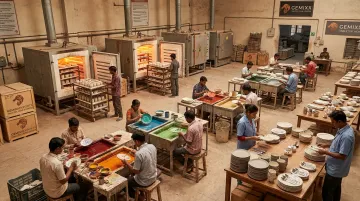
This is where a vertically integrated manufacturer can simplify things considerably. Gemixx Exports, a 40+ year handcrafted housewares manufacturer, works across flatware, barware, cookware, and home decor from its own factories in India. That footprint includes a dedicated ceramics and dinnerware facility in Khurja alongside its metalware, glass, and enamelware operations.
A few specifics worth noting:
- Certifications carry across categories: Gemixx's flatware, barware, and cookware lines are FDA-compliant and Prop 65 compliant, meaning a retailer already managing dinnerware compliance documentation doesn't need to rebuild that framework from scratch for a new product line.
- Coordinated finishes: flatware, barware, and enamelware can be color- and finish-matched to an existing ceramic pattern, turning a single dinnerware SKU into a cohesive tabletop collection.
- Broad partnership base: 250+ global retail and wholesale partnerships span the full 15-category portfolio, not a single product line.
- A single prototyping-to-warehousing process: design, manufacturing, DDP delivery, and US warehousing are handled together, cutting the need to manage a separate designer, factory, customs broker, and 3PL for every new category.
For a buyer already deep into dinnerware sourcing, that kind of consolidation can shave weeks off a program launch.
Conclusion
Brand recognition matters less than operational fit when you're placing a bulk order. Certifications, production capacity, and design flexibility determine whether a manufacturer can actually deliver what your business needs — on time and at consistent quality.
Before committing to a long-term partnership, request samples, run a factory audit if the order size justifies it, and check references from comparable buyers. Performance over several production cycles tells you more than any catalog ever will.
Gemixx manufactures ceramic dinnerware in-house, alongside complementary flatware, barware, and handcrafted home decor, giving you a vertically integrated path to build out your program without adding new vendor relationships to manage.
Frequently Asked Questions
Who makes the best ceramic dinnerware?
There's no single "best" — it depends on your use case. Heritage brands like Wedgwood and Villeroy & Boch lead in luxury retail, while production-scale manufacturers like Mikasa and Corelle serve volume and value segments better.
What are some famous porcelain brands?
Wedgwood is known for bone china and jasperware, Noritake for fine Japanese porcelain and hospitality contracts, Rosenthal for designer-driven modern collections, and Lenox for American bone china and institutional commissions.
What is the most durable ceramic dinnerware?
Vitrified porcelain and high-fired stoneware resist chips and cracks better than earthenware. Corelle's laminated glass-ceramic composite and traditional bone china also rank among the most durable everyday options.
What's the difference between porcelain, stoneware, and bone china?
Porcelain fires at roughly 1,450°C for a dense, translucent finish. Stoneware fires slightly lower and is more casual and chip-resistant. Bone china includes bone ash in its composition, giving it exceptional strength despite being thin and lightweight.
What certifications should I look for when sourcing ceramic dinnerware?
FDA compliance covers lead and cadmium migration limits for food-contact safety in the US market. LFGB compliance matters for European buyers, and California Prop 65 compliance is essential for any product sold in California.
How do I choose a reliable manufacturer for private label or bulk orders?
Run a factory audit or request third-party inspection reports, then test samples from actual production runs rather than showroom pieces. Confirm MOQ flexibility matches your order size, and ask for references from clients with similar volume needs.