Specification
What will hold the panel
What a beaded panel weighs by material and density, and which fixings suit light acrylic against heavy glass.
Specs and sizes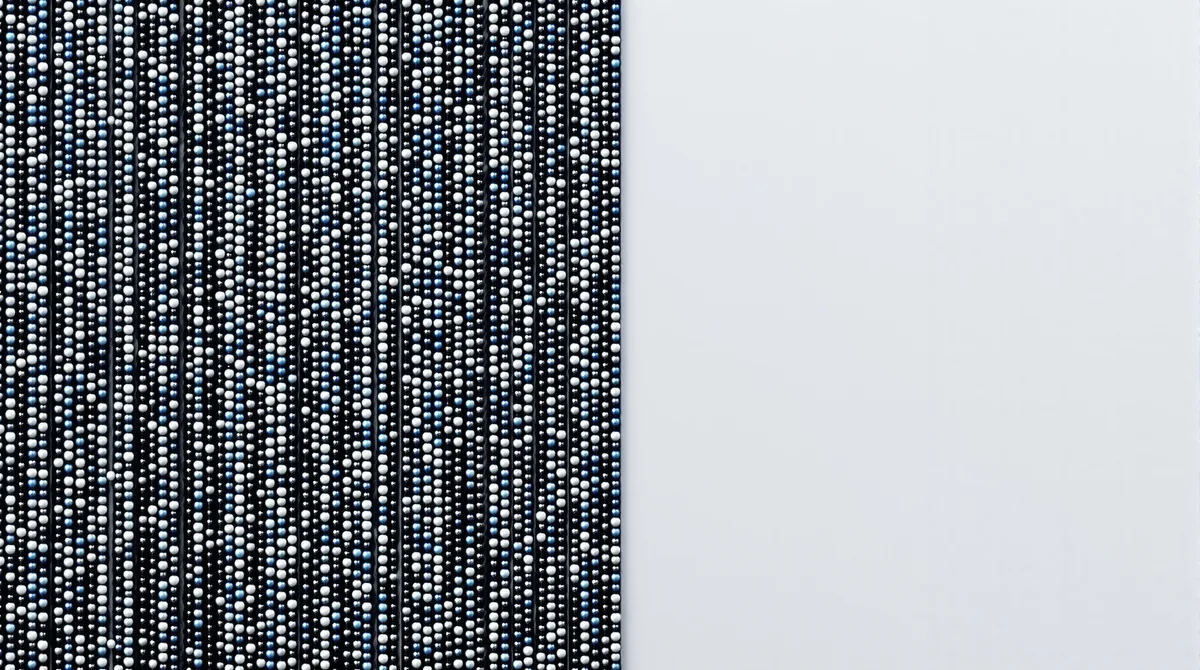
Application · Scale
Past about two metres a bead strand stops being a decorative object and starts being a tension member, governed by cumulative strand weight and cord creep. That is the drop we engineer, and this page is how.
A field of exceptionally long beaded strands in midnight, grey-blue and silver glass, running unbroken off both the top and the bottom of the frame.
Past about three metres the governing limits on a bead drop are cumulative strand weight and cord creep rather than appearance, so a long drop is built as segments on a continuous engineered carrier, stabilised mid-span and accessed for cleaning by design. Because we draw the bead and turn the header ourselves, the whole assembly is specified in one place.
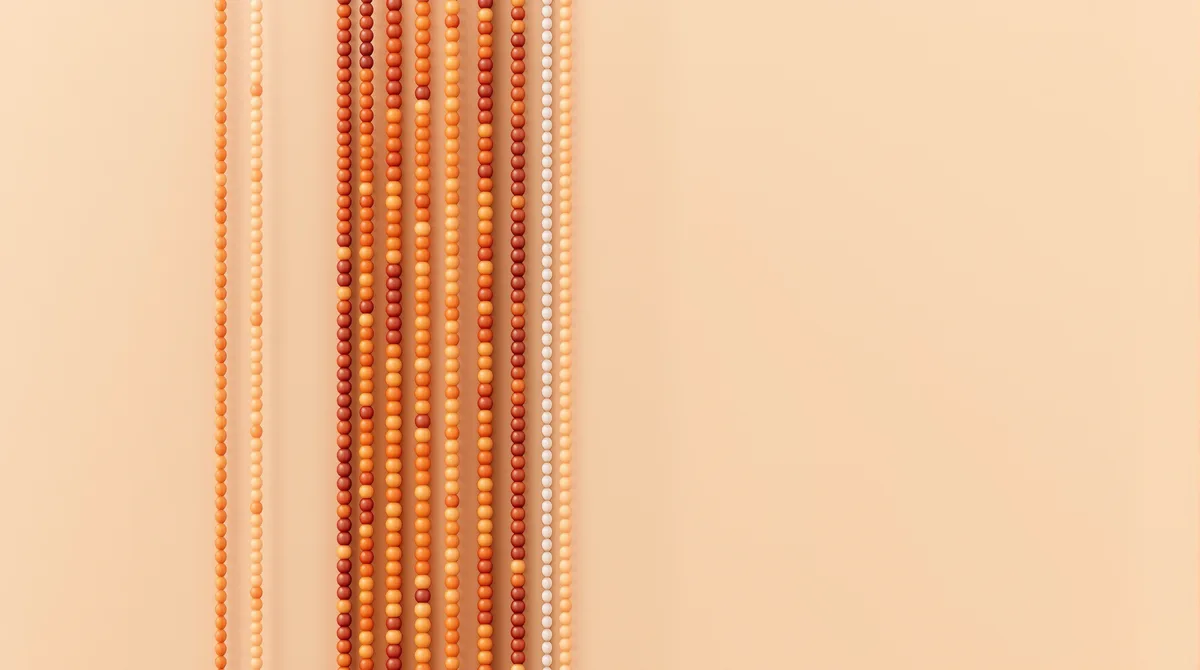
A single vertical gesture in a space where nothing else can hold the volume — over a lobby stair, down an atrium, between two floors of a retail unit. Beadwork is a natural fit because it is light for its visual mass, it moves, and it reads from both floors.
It is also the setting where the physics takes over from the styling. Past about two metres a strand becomes a tension member, governed by cumulative strand weight and cord creep rather than by appearance. We engineer that drop as segments on a continuous carrier, stabilised mid-span and designed for access — and because we draw the bead in Firozabad and turn the header in Saharanpur, the whole assembly is specified in one place. A six-metre drop is programmed and budgeted as the engineering project it is.
Weight discipline. Bead mass is cumulative down a strand, and all of it arrives at the top. Doubling a drop roughly doubles the load per strand.
Cord that will not creep visibly. Sustained tension over years stretches cord. On a 90 cm drop nobody notices. Over several metres, a small proportional change is centimetres of hem drift.
Stabilising mid-span. A long free strand sways in conditioned air and migrates sideways relative to its neighbours.
Serviceability from the start, because a void panel is the hardest surface on this site to reach.
Segments on a continuous engineered carrier, not one enormous strand. Each segment is a conventional strung panel of a length we actually make well; the carrier runs the full height and the segments attach to it. That makes the thing shippable, installable, lowerable and repairable, and it localises any failure.
Material: the lightest bead the design will accept. As general material properties, glass sits around 2.5 g/cm³ and acrylic around 1.2, with most woods below 1 — so an acrylic or wood drop carries roughly half the mass of the same glass drop. Where glass is wanted for its light behaviour, use smaller beads and a wider pitch rather than a lighter colour.
Large feature beads low on a long strand. Surface-dyed beads in an atrium full of daylight. A single unsegmented drop. And any void design that cannot be lowered, because that is a design you can never clean and can never repair.
We would also advise against treating this page as a catalogue entry. It is written to support a development conversation, and the position is that we have not built one.
The structural engineer, first and unusually. In every other setting in this cluster the engineer is a late consultee; in a void they are the gate. Then the fire officer or consultant, then the facilities team who will own the access problem, then the designer.
Our sign-off is a segment sample and the carrier interface, agreed in writing before anything is strung.
One carrier takes everything. It is engineered and supplied by the project. We make the bead-side rail the strands attach to and we supply the measured finished weight of the approved sample segment — a real number, from a scale, which is the only figure worth giving an engineer.
The load table, the creep figure and the safety factor belong to the project engineer and to the hardware's own manufacturer. What we supply into that calculation is the measured finished weight of the approved sample, per module, which is the figure an estimate cannot safely replace at this scale.
The fire question is at its most serious here. A vertical hanging passing through a multi-storey volume can be read as a flame path, and authorities having jurisdiction treat voids more conservatively than rooms. In the US expect NFPA 701 on the hanging material plus a specific conversation with the AHJ about the void itself; UK, EU and Australian regimes have their own equivalents.
Fire performance is tested on the specified build and quoted with the project. It has to be the specified build: bead, cord, header and mount all change the result. Structural and seismic design, fall-arrest provision and the cord-creep trial belong to the project engineering package and are coordinated with it. Our standing certifications — Sedex SMETA, FSC for wood, C-TPAT, Omega social compliance — are labour, chain-of-custody and customs credentials.
Decide the method before the design. Three realistic options: lower the segments from the carrier and clean at floor level; reach them from a lift or cradle hired for the purpose; or accept dry dusting only, from whatever access the building has, at whatever interval the budget allows.
The first is the only one that stays acceptable for twenty years, and it is a design decision rather than a maintenance one. If the segments cannot come down, the design has committed the building to the third option.
Cord, through creep, showing as a hem that has dropped out of line. Then mid-span sway and strand migration, which looks like the panel has been combed sideways. Then dust, which on a void panel is permanent in practice.
None of those is a bead failure. The beads will be the last thing standing, which is exactly why the specification effort belongs on cord, carrier and access.
The published lead times still apply to the production step: sampling at 16 to 20 days from an agreed brief, production 40 to 60 days after sample approval. But a void project has three phases in front of that — development of the segment and carrier interface, a mid-span stabilising method, and flammability testing if the project requires a report — and each is quoted and scheduled separately.
Formal quotes follow within 48 hours of a specification. For a void, expect a discovery call first, and expect us to ask for the engineer's name early.
Full drop, measured from the carrier line, and the segment breakdown within it. Segment length and count. Strand count and pitch, written as the strand count and pitch schedule. Bead material, shape, size and hole diameter. Cord specification against total load per strand. Colour as Pantone references or physical chips. The carrier interface, with responsibility named. The mid-span stabilising detail. The lowering method and its clearances.
Then the two clauses a void drawing must not omit: the re-tensioning provision, and a fire-performance clause naming the test, the build, the lab and who pays for it.
Expect a development phase in front of the build, and expect the same cost engineering as everything else: bead size is the largest lever, then strand count and tightness, then pitch, then bead material, then carrier and packing, then height — except that here height is not a minor lever, it is the dominant one.
Packing is also real cost engineering at this scale, because carton cube decides the freight. A long segmented drop ships as a set of controlled bundles with the strand order preserved, and an oversize non-collapsible piece turns its packaging into a line of its own. Minimums and pricing are set per design and confirmed with your quote. The rough cost sheet comes before any sample, which on a project like this is the most useful document in the file.
Specifying beadwork at this scale draws on exactly the same bead materials and the same beaded curtains construction as a domestic panel. Only the carrier is new.
Extractable data
| Item | Position | Note |
|---|---|---|
| Standard full drop | 200 cm (≈79 in) door curtain | Standard format, ≈90 × 200 cm |
| Library maximum drop | 210 cm on a 120 cm width | A current design-library format |
| Anything over ~2.1 m | Engineered per project | Costed and specified as a development phase |
| Build approach past 3 m | Segments on a continuous engineered carrier | Stabilised mid-span, designed for access |
| Mid-span stabilising | Required, method designed per project | Prevents sway and strand migration |
| Bead material | Lightest acceptable: acrylic ≈1.2 g/cm³ vs glass ≈2.5 | Material density; panel weight is taken off the approved sample |
| Glass at length | Body-coloured pressed glass, smaller sizes | Weight is cumulative down the strand |
| Cord | Specified against hole diameter and total load per strand | Creep under sustained load is the design issue |
| Re-tensioning | Designed in from the start | A long drop will need it once |
| Cleaning access | Specified before the design is fixed | If it cannot be reached it cannot be cleaned |
| Top fixing | Engineered carrier by others; we make the bead-side rail | Weight is taken off the approved sample for the project engineer |
| Sampling | 16–20 days from an agreed brief | A segment sample, not a full drop |
| Production | 40–60 days after sample approval | Published lead time for beaded décor |
| Flammability | Tested on the specified build and quoted with the project | NFPA 701 or the local equivalent |
Good to know
Everything hangs from one line, so the carrier is the whole job. It is engineered and supplied by the project; we make the bead-side rail the strands attach to and give the measured weight of the approved sample segment. The panel is weighed on the approved sample, and the project's structural engineer sizes the carrier against that measured weight rather than against arithmetic over bead counts.
The fire question is sharper in a void than anywhere else, because a vertical hanging in a multi-storey space can be treated as a potential flame path. Expect NFPA 701 in the US or the local equivalent, and expect the authority having jurisdiction to take an interest. Fire performance is tested on the specified build and quoted with the project. At this scale the structural, seismic and fall-arrest work belongs to the project engineer, and cord creep under sustained load is proved on a hung trial before the full run is committed.
However the building already reaches that height, and the answer is usually a lift or a cradle hired for the purpose. Decide this before the design is fixed. If the realistic cycle is once every two or three years, the specification should move towards smaller body-coloured glass beads with little upward-facing surface, and towards a segmented build that can be lowered rather than reached.
Sampling is 16 to 20 days from an agreed brief and production is 40 to 60 days after sample approval, but a void project has a development phase in front of both. The segment build, the carrier interface, the mid-span stabilising method and any flammability testing are each their own milestone and are quoted separately. Treat the published figures as the production window, not the programme.
Cord, through creep. A strand carrying its own bead weight for years stretches slightly, the hem drops out of line, and on a long drop a small percentage change is a visible distance. Second is sway and strand migration mid-span, which is what the stabilising is for. Third is dust, because a void panel is the hardest thing on this site to clean.
As engineered work rather than a shelf item. The standard door curtain runs to about 200 cm and the design library to 210 cm on a 120 cm width; past that the drop is built as segments on a continuous carrier, stabilised mid-span and designed for access. The sample segment is weighed, the project engineer sizes the carrier against that weight, cord creep is proved on a hung trial, and fire performance is tested on the specified build. Ask any maker on a project like this for the engineering rather than the mood board.
Keep exploring
Specification
What a beaded panel weighs by material and density, and which fixings suit light acrylic against heavy glass.
Specs and sizesPillar
Twenty settings, from a closet front to a hotel lobby, each with the format that suits it, the fixing it needs and the standard that applies.
How it is madeSpecification
The small-parts and cord questions, the children’s-product boundary, and the builds we will and will not make for a nursery.
See the detailSpecification
UV on dyed surfaces, water on cord and wood, wind on strand order — and the covered-only answer we give for every material we make.
See the detailSpecification
Panel size, rigging, strand order on reassembly and a realistic set-up time for beadwork that travels to every show.
Specs and sizes
Start a conversation
Send a reference, a colour chip or a sketch. Minimums are set per design and confirmed per quote; sampling is quoted separately and usually runs 16 to 20 days from an agreed brief.