Specification
Packing and tangle prevention
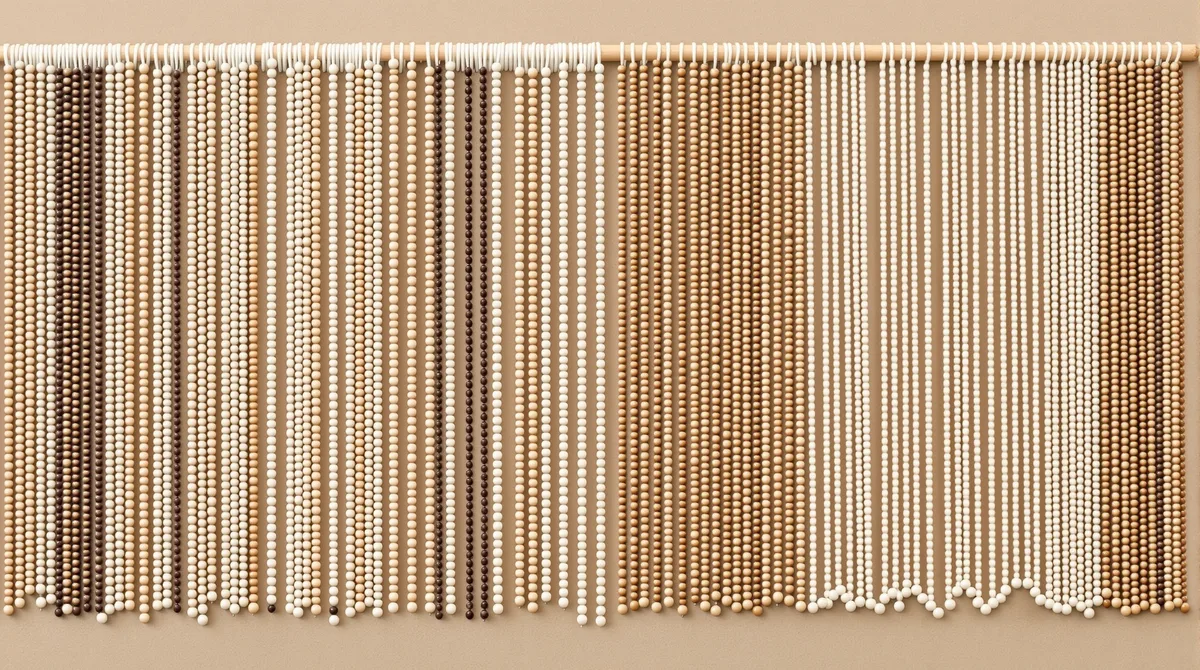
Strand order, inner packing, header protection and labels — how a panel arrives untangled and sells from the box.
See the detail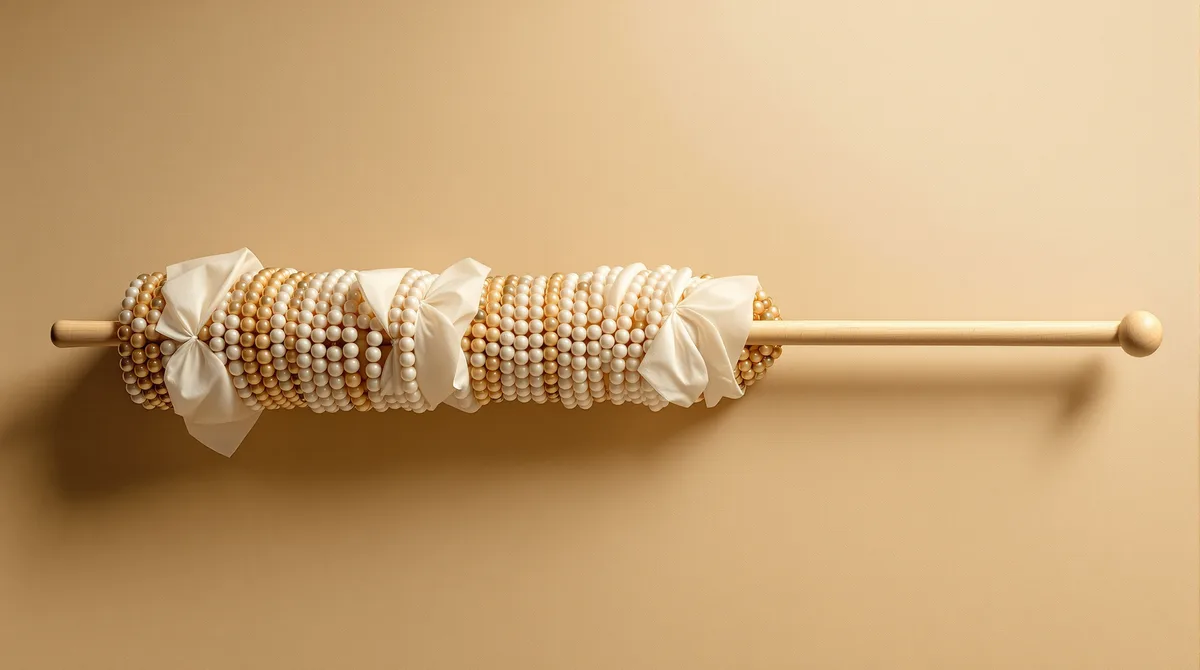
Application · Events
A booth panel is built for reassembly, not for longevity. It will be hung and struck twenty times by people who have never seen it before, in a hall where the schedule has no slack.
A beaded panel rolled down onto its turned wooden dowel and tied with plain tape for transport, the glass beads visible all the way round the roll.
Booth beadwork is governed by travel and reassembly rather than by service life: panels small enough to pack flat in a case, end suspension loops so a contractor hangs them level without instruction, strand order preserved in the packing, and a published set-up time the stand builder can put in a schedule.
Make the stand look like it was designed rather than ordered, and do it with something that reads from across a hall. Beadwork works well on a booth: it is unusual among exhibition materials, it catches hall lighting, and it moves when people walk past, which is exactly what a static stand lacks.
The brief that matters is the one underneath: this panel has to go up and come down repeatedly, in different halls, assembled by contractors who were handed it an hour ago.
Packability. The panel's dimensions are decided by the case before they are decided by the booth.
Idiot-proof rigging, in the kindest sense: the person hanging it has no briefing and no time.
Tangle resistance, which is a packing and pitch question.
A realistic set-up time, published, so a stand builder can put a number in the build schedule.
Repeating narrow panels, around 90 cm wide, with the drop set to the booth height. A portal at 76 × 140 cm makes a good entrance gesture. A valance at around 120 × 35 cm works as a header band above a counter and is the cheapest unit here to replace.
Material: moulded acrylic is the right default. Light to freight, dyed to any colour including a brand palette matched to a Pantone reference, and it does not shatter when a case goes down a loading ramp. Body-coloured pressed glass where the look demands it, accepting heavier freight and more careful handling. Avoid surface-dyed beads, which mark where they are handled, and large fragile feature beads.
Case dimensions first — genuinely first — then panel module width and count, then drop. Strand count and pitch, set slightly wider than an interior build for tangle resistance. Bead material and size with hole diameter. Colour as Pantone references or physical chips, matched to the brand palette.
Then rigging: suspension loops, header rail type and length, and the booth frame interface. Then the retail packing specification the panels ship in, the spares and repair kit, a stated set-up time per panel, and a fire-performance clause naming the test, the build and the lab.
Cost per show, not cost per panel. A booth panel that survives three seasons is cheap; one that is replaced every year is not, whatever it cost.
The cost levers in order: bead size and material, then strand count and tightness, then pitch, then rail and packing, then height. Freight is a real line on booth work and acrylic saves meaningfully on it. Repetition saves more: identical modules mean one bead map and one packing solution. Minimums and pricing are set per design and confirmed with your quote, and the rough cost sheet comes before any sample.
Event and display companies are a published buyer type for the category, and the formats are shipped in volume. The construction details that matter most on a stand — end suspension loops, flexible mounts, spares strung with the run — are things we already make.
The booth application is reasoning from that construction. Said plainly rather than dressed up as experience.
One large bespoke panel. Fragile feature beads. Glass on a stand that travels weekly. A tight decorative pitch, which tangles. And tight bundling in the case, which is the single biggest cause of a bad build.
We would also advise against ordering booth beadwork six weeks before a show. It does not fit the lead time and the result will be a compromise on the design rather than on the date.
The stand designer owns the look; the stand builder owns the build time and will ask, correctly, how long the panel takes to hang. Get them a real number from the sample rather than an estimate.
The show organiser's fire inspector has a veto on the day. Our sign-off is the sample, and for booth work the useful test is to pack it, unpack it and rig it once, timed.
The booth frame, a beam or a rail, all supplied by the stand builder. We make the panel, the header rail and the loops.
The loops matter more here than anywhere else on this site, because the person rigging is not the person who specified. A panel with loops hangs level immediately. A panel with a fixed knot pattern gets adjusted, or does not, and a crooked hem is what the client sees from the aisle.
The panel is weighed on the approved sample and the fixing is sized to that weight.
Show-organiser regulations, which are usually the strictest and most actively enforced rules in this entire cluster. Most large halls require a flammability certificate for hanging decorative material, and an inspector walks the floor during build with authority to have something removed.
Fire performance is tested on the specified build — bead, cord and header all affect the result — and the testing is quoted and scheduled with the project. For a travelling stand, testing once on the core design and carrying the certificate with the case is the only workable pattern.
Rigging sits with the stand builder, and the panel is weighed on the approved sample so they can design to a real number.
Between shows. Hall dust is fine, grey and comprehensive, and a panel coming back from a four-day show needs a clean before the next one.
Dry dusting down each strand, header to hem. Damp spot-clean of the beads with the cloth wrung nearly dry, dried in the same pass. Cord kept dry. Then the storage discipline, which is the part that matters: loose tied bundles, lifted and carried by the rail, settled after hanging, never stored compressed.
Tangle, in the case — tangle prevention is the whole of the packing brief. Then strand loss at the header from repeated rigging and de-rigging. Then bead loss from drops.
All three are predictable and all three are handled by the same two measures: a packing specification that preserves strand order, and spares strung with the production run so a repair takes five minutes in the hall instead of a reorder.
The bead materials, the hand-strung construction and the design library a booth design can be drawn from are each covered on their own pages.
Extractable data
| Item | What booth work needs | Note |
|---|---|---|
| Panel size | Set by the case first, the booth second | Pack flat; avoid oversize freight |
| Typical module | ≈90 cm wide, drop to suit the booth height | Repeating identical units |
| Shipped formats | Door curtain ≈90 × 200 cm; portal 76 × 140 cm; valance 120 × 35 cm | Valance figure from the current design library |
| Bead material | Moulded acrylic | Light to freight, does not shatter in a case |
| Alternative | Body-coloured pressed glass | Heavier freight; careful handling |
| Avoid | Surface-dyed beads; large fragile feature beads | Handling marks and breakage in transit |
| Rigging | End suspension loops per strand | Level hang by a contractor with no briefing |
| Top fixing | Booth frame, beam or rail, by the project | We make the panel and its rail |
| Packing | Loose tied bundles, strand order preserved, flat case | Never compressed |
| Handling rule | Lift by the rail; settle after hanging | Printed on the case, not just the care card |
| Spares | Beads and cord in the case | Strung with the production run |
| Sampling | 16–20 days from an agreed brief | Photographs approved before the sample ships |
| Production | 40–60 days after sample approval | Order against a season, not a show |
| Flammability | Tested on the specified build and quoted with the project | Show-organiser regulations usually require a report |
Good to know
Tangle, every time, and it happens in the case rather than in the hall. A panel bundled tightly and freighted arrives as a mass of crossed strands, and a stand contractor with four hours left will pull it straight rather than untangle it. The specification answer is packing discipline and a slightly wider pitch than a decorative interior panel would use.
Event and display companies are a published buyer type and the formats are shipped in volume. What transfers to a stand is the construction: end suspension loops, flexible mounts and spares strung with the run are all things we already build, and they are what make a travelling piece survive its third rebuild.
Repeating narrow panels, around 90 cm wide, sized so they pack flat in the case the stand already travels in. A portal at 76 × 140 cm works as an entrance gesture; a valance at around 120 × 35 cm works as a header band above a counter and is the cheapest thing on this list to replace. Avoid one large bespoke panel: it will be the most expensive item to freight and the easiest to ruin.
The booth frame, a beam or a rail, supplied by the stand builder. We make the panel, the header rail and the end suspension loops. The loops do the real work here, because the person hanging the panel is a hall contractor who has never seen it: loops let them hang it level with no briefing and no adjustment. The panel is weighed on the approved sample and the fixing is sized to that weight.
Show-organiser fire regulations, and they are usually stricter and more actively enforced than an ordinary fit-out. Most large halls require a flammability certificate for hanging decorative material and an inspector walks the floor during build. Fire performance is tested on the specified build and quoted with the project, and for a stand that travels, testing once on the core design is the sensible route.
Between shows. Dry dusting down each strand from header to hem, and a damp spot-clean of the beads with the cloth wrung nearly dry, dried in the same pass. Hall dust is fine and grey and gets everywhere, so a panel coming back from a four-day show will need a clean before the next one, which is a scheduling item for whoever owns the stand.
Sampling is 16 to 20 days from an agreed brief and production is 40 to 60 days after sample approval, so booth beadwork is ordered against a show season rather than against one show. If a stand is being designed for a date three months out, the beadwork decision has to be made in the first week of that design, not the last.
Keep exploring
Specification
Strand order, inner packing, header protection and labels — how a panel arrives untangled and sells from the box.
See the detailPillar
Twenty settings, from a closet front to a hotel lobby, each with the format that suits it, the fixing it needs and the standard that applies.
Specs and sizesSpecification
A backdrop that reads on camera, an aisle that survives being walked, rigging one person can hang, and a repair kit that travels in the case.
See the detailSpecification
Panel width, repair strategy, strand replacement and swap-out speed — the properties that actually decide a shop-entrance specification.
Specs and sizesSpecification
The privacy limit of a bead panel, the cases where it works as a secondary screen, and where a solid panel is the only right answer.
Specs and sizes
Start a conversation
Send a reference, a colour chip or a sketch. Minimums are set per design and confirmed per quote; sampling is quoted separately and usually runs 16 to 20 days from an agreed brief.