Specification
Privacy and sightlines
How pitch, diameter and opacity combine into a sightline — and the distance at which concealment stops working.
See the detail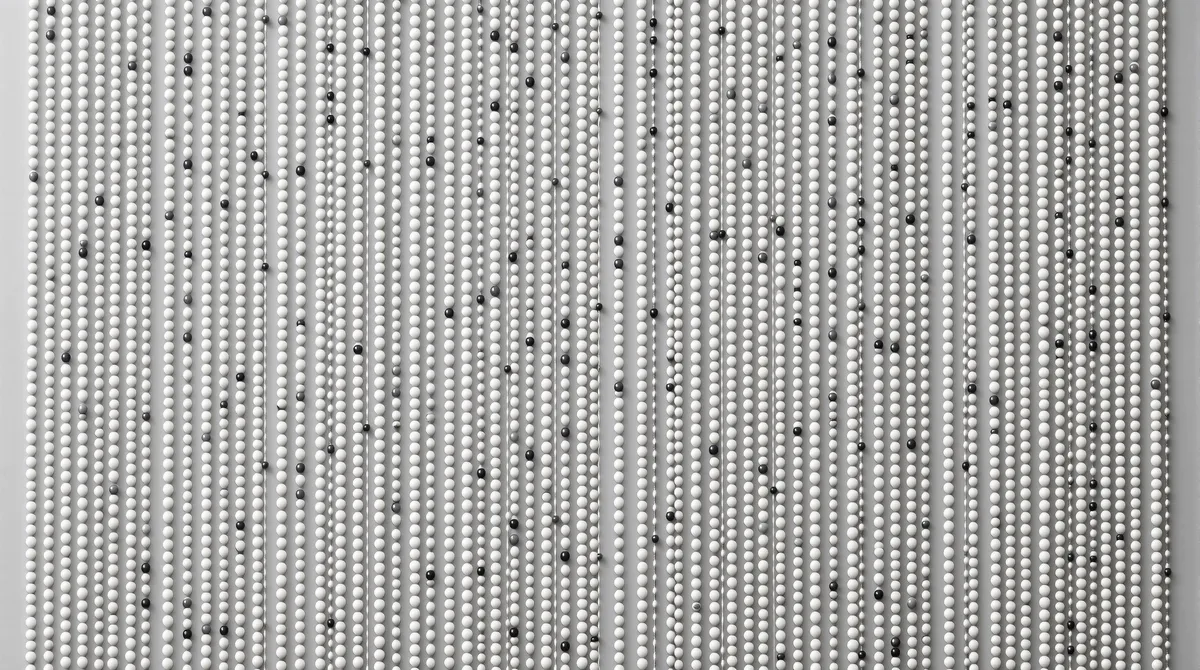
Application · Retail
A bead panel breaks a sightline. It does not block one. At a fitting room that distinction is not an aesthetic nuance — it is the whole decision, and most of the time it goes against us.
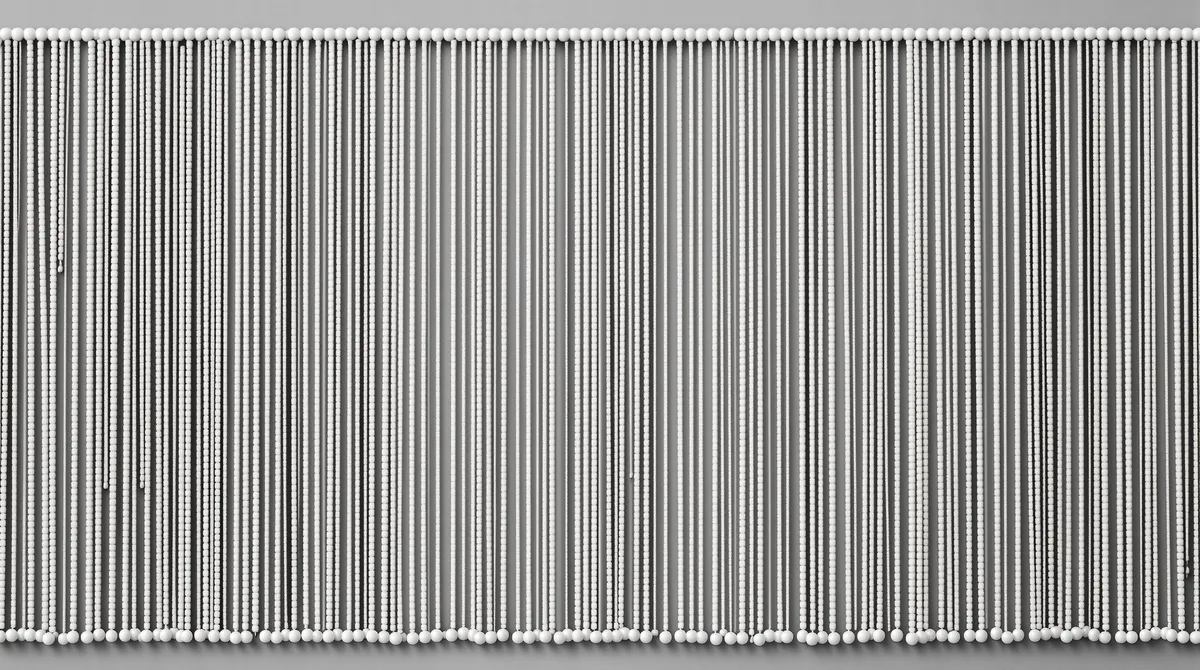
A beaded panel strung at the tightest pitch in chalk white and smoke grey glass with pewter spacers, the surface solid enough to close off the view.
Beadwork is the wrong answer at a changing cubicle and a good one at a service screen. A strung panel breaks a sightline rather than blocking it: at any pitch, movement behind it remains legible, so it should never be the only barrier where someone undresses. As a second layer, or screening a till or stockroom, it works well.

Two quite different briefs get filed under the same heading. One is "screen the person changing", which is a privacy requirement with a legal and a reputational edge to it. The other is "screen the mess" — a till, a stockroom entrance, a staff corridor — which is a visual requirement.
Beadwork is a poor answer to the first and a good answer to the second. Most pages in this category will not tell you that, because the first brief is the bigger order.
For a service screen: a surface that reads as deliberate, survives being pushed through, and lets staff see out along the working sightlines. All achievable.
For a cubicle: opacity. A strung panel cannot deliver it. The gaps between strands are what give beadwork its light and movement, and those same gaps mean a silhouette and any motion behind the panel remain legible. Tightening the pitch reduces the effect and does not remove it, and a pitch tight enough to approach opacity interlocks, tangles and gets pulled.
Shipped formats do the work. A door curtain at about 90 × 200 cm — thirty hand-strung strands on a wooden dowel — at a stockroom or back-of-house doorway. A portal at 76 × 140 cm with an arched-cut drop where staff carry things through. A short drop at a cash wrap. Both are standard beaded portals rather than bespoke screen products.
Material: opaque beads, not translucent. Opaque versions of patterned bead builds have been made at buyer request, and in a screening application the opaque version is always the right one. Pitch as tight as the budget and the traffic allow, with the understanding that it improves screening without ever achieving it.
Flammability. Retail interiors are commercial interiors. Expect NFPA 701 in the US or the local equivalent, plus the landlord's fit-out guide and often a brand standard. Fire performance is tested on the specified build and quoted with the project.
Privacy. There is no standard for privacy through beadwork. No test method, no classification, no certificate exists anywhere for the screening performance of a hanging panel, and any supplier implying otherwise is inventing it. So it is a judgement call, and ours is on the record: beadwork is not a cubicle barrier.
House policy. Many retailers have a written changing-room policy covering what the barrier must be. Read it before the sample; it usually settles the question faster than any specification discussion.
Monthly dry dusting, down each strand from header to hem, fits most retail cleaning contracts. The specific soiling here is handling — fingerprints and hand oils on beads at chest height — rather than airborne dust.
Spot-clean those beads with a cloth wrung nearly dry and dry in the same pass. No solvent, no bleach, no abrasive cream: a surface-dyed bead will not survive them, and the cord will not survive the water.

Handling damage. Customers push a fitting-room screen aside with a hand full of garments, and sometimes with a hanger. Strands part at the header more often here than anywhere else on this site.
That is a specification problem with a specification answer: spares strung with the production run, a header knot detail that can be re-tied, and an accepted maintenance task rather than a surprise. Second failure is fingerprint marking, which is cosmetic and cleanable.
Sampling 16 to 20 days from an agreed brief, photographs approved first; production 40 to 60 days after sample approval. A roll-out of identical screens across many stores runs on the same window, with the approved sample as the control for every unit. Add the flammability test schedule if a landlord or brand standard requires a report — quoted and scheduled separately, and worth starting at sample approval rather than at store hand-over.
State the function explicitly: "visual screen, not a privacy barrier". That sentence on a drawing has saved more projects than any dimension on it.
Then opening dimension, finished width and drop, strand count or pitch, bead material and size with hole diameter, opaque or translucent stated as a choice rather than left to the maker, colour as Pantone references or physical chips, header type and length, hem shape, and the spares allowance. For a free-standing screen, the frame interface and who designs it.
Screens are small and short, which makes them one of the cheaper formats here — but the screening brief pushes towards tight pitch and opaque beads, and both of those push cost up. A tight pitch means more strands and more beads per strand.
The rough cost sheet comes before any sample, so the pitch can be traded against price while it is still a drawing.
The formats are in continuous production — portals, curtains, café curtains, valances and wall hangings — and we build opaque bead fields whenever a buyer asks for one.
That is the construction settled. How much a given pitch and bead actually screens is confirmed on the approved sample, in the light the cubicle will have.
Beadwork as the only barrier at a changing cubicle, a WC or a shower. A tight pitch in a position customers push through. Translucent beads anywhere the job is screening. And accepting a verbal assurance from anyone — including us — that a bead panel "gives enough privacy", because there is no measure behind that phrase.
Where a client insists, the workable compromise is two layers: a solid door or blackout curtain that does the privacy work, with beadwork in front of it doing the design work. That is a specification we are happy to make.
A beadwork specification for a screen still rests on the same bead materials and the same routine care as any other panel; only the honesty about screening is particular to it.
Extractable data
| Use | Is beadwork right? | Why |
|---|---|---|
| Changing cubicle, sole barrier | No | Movement and silhouette remain legible at any pitch |
| Changing cubicle, second layer | Yes | In front of a solid door or a blackout curtain |
| Fitting-room corridor entrance | Yes | Marks the threshold without closing the sightline |
| Till or cash-wrap screen | Yes | Screens clutter, keeps staff visible to customers |
| Stockroom or back-of-house doorway | Yes | Door curtain ≈90 × 200 cm, the shipped standard |
| Treatment-room threshold | Case by case | Only where a solid door also exists |
| WC or shower screening | No | Same reason as a cubicle, plus humidity |
| Best format | Door curtain, or portal 76 × 140 cm | Both shipped formats |
| Pitch for maximum screening | Tightest the budget allows, ≈2 cm on 120 cm | From the current design library |
| Bead choice for screening | Opaque beads, not translucent | Opaque versions have been made to buyer request |
| Privacy rating | None exists | No standard, no test, no certificate — from anyone |
| Flammability | Tested on the specified build and quoted with the project | NFPA 701 or the local equivalent |
| Sampling | 16–20 days from an agreed brief | Photographs approved before the sample ships |
| Production | 40–60 days after sample approval | Published lead time for beaded décor |
Good to know
A door curtain or portal hangs from the wooden dowel or header rail we make, on brackets or hooks fixed above the opening into solid substrate. A screen in the middle of a floor — in front of a cash wrap, for instance — needs a free-standing frame or a ceiling-fixed rail into structure, both designed and supplied by the project. The panel is weighed on the approved sample and the fixing is sized to that weight.
Two. Flammability: a hanging decorative panel in a retail interior is normally asked to meet NFPA 701 in the US or the local equivalent, and fire performance is tested on the specified build and quoted with the project. Privacy: no standard or test method exists for the screening performance of a hanging panel, from anyone, so it is a judgement — and ours is firm. Beadwork must never be the sole barrier at a changing cubicle.
Dry dusting down each strand, header to hem, on whatever cycle a retail cleaning contract allows — monthly is typical. A fitting-room position is handled by customers, so expect more fingerprint marking than dust, and spot-clean the beads with a cloth wrung nearly dry, dried in the same pass. The cord never gets wet.
Sampling is 16 to 20 days from an agreed brief, with photographs approved before the sample ships, and production is 40 to 60 days after sample approval. A retail roll-out of identical screens runs on the same window; what adds time is flammability testing if the landlord or brand standard requires a report, which is quoted and scheduled separately.
Handling damage. A fitting-room screen is touched, pushed and occasionally pulled by customers who are not being careful, so strands part at the header more often than in any other setting on this site. Specify spares strung with the production run and accept that strand replacement is routine maintenance here, not an exception.
Not as a specified fitting-room installation. The formats are shipped ones — door curtains at around 90 × 200 cm and portals at 76 × 140 cm — and opaque bead versions have been made where a buyer wanted less translucency. What we do not have is a retail screening reference, and this page is written as material judgement rather than installed experience.
A door curtain at about 90 × 200 cm at a stockroom or back-of-house doorway; a portal at 76 × 140 cm where staff need a clear walk-through; and a shorter drop in front of a cash wrap, where the job is to screen clutter at waist height rather than to close an opening. Specify opaque beads rather than translucent ones wherever screening matters.
Keep exploring
Specification
How pitch, diameter and opacity combine into a sightline — and the distance at which concealment stops working.
See the detailPillar
Twenty settings, from a closet front to a hotel lobby, each with the format that suits it, the fixing it needs and the standard that applies.
Read moreSpecification
Panel width, repair strategy, strand replacement and swap-out speed — the properties that actually decide a shop-entrance specification.
See the detailSpecification
Round-the-clock operation, high ceilings, a house fire file and a maintenance window measured in hours — what an entertainment venue demands of beadwork.
Read the guideSpecification
How each bead family sounds, which ones suit a quiet natural interior, and what barefoot traffic changes about the specification.
Specs and sizes
Start a conversation
Send a reference, a colour chip or a sketch. Minimums are set per design and confirmed per quote; sampling is quoted separately and usually runs 16 to 20 days from an agreed brief.