Manufacturing
Visual merchandising teams
Short runs, fast colour changes, reusable rigging and panels that survive being struck and rebuilt scheme after scheme.
See the detail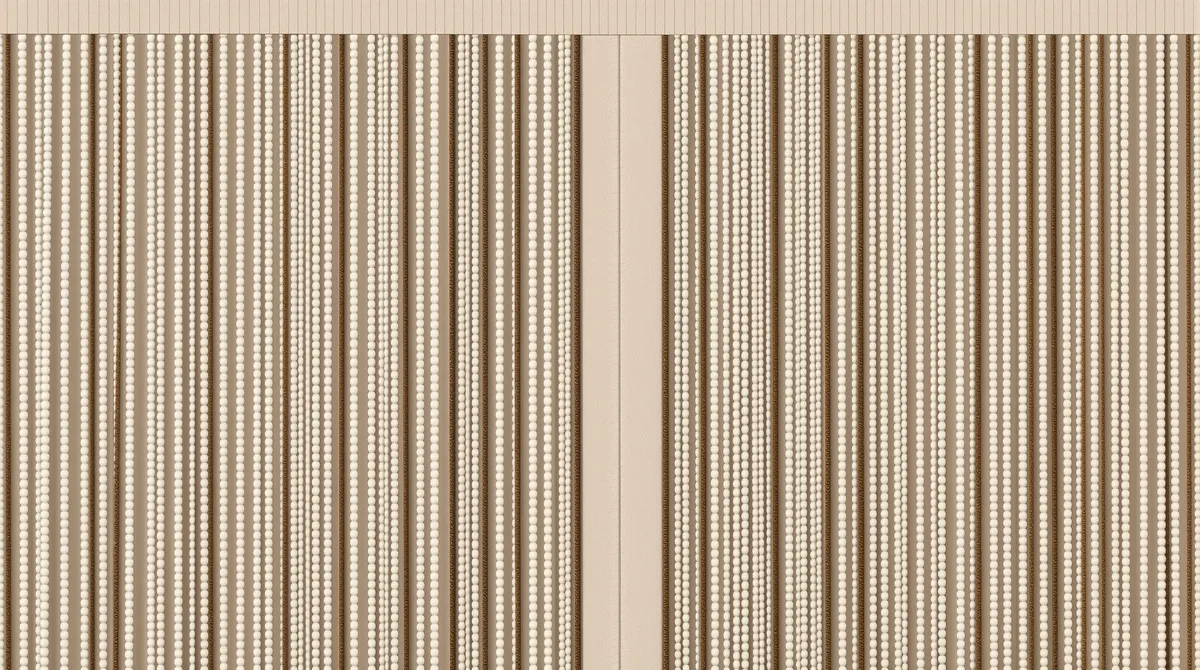
Application · Retail
At a shop entrance, nothing matters as much as how fast a damaged panel can be replaced. The store cannot trade with a torn curtain across the door, and a four-week reorder is not a repair plan.
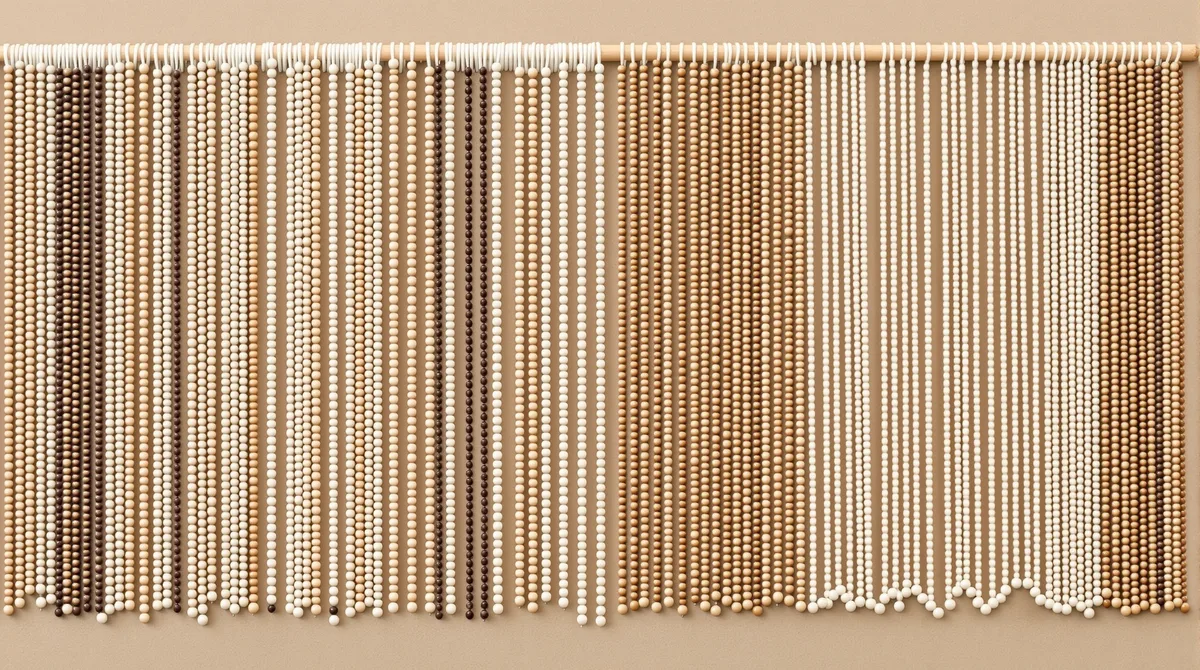
A heavy-duty beaded doorway curtain parted at the centre, each half gathered onto a thick double-stitched header tape in oat, chocolate and chalk white.
A shop entrance walked through all day is specified for repairability and swap-out speed first: narrow panels that can be lifted off individually, suspension loops so a replacement hangs level without adjustment, spares strung with the production run, and a bead map on file so a strand can be rebuilt bead for bead months later.
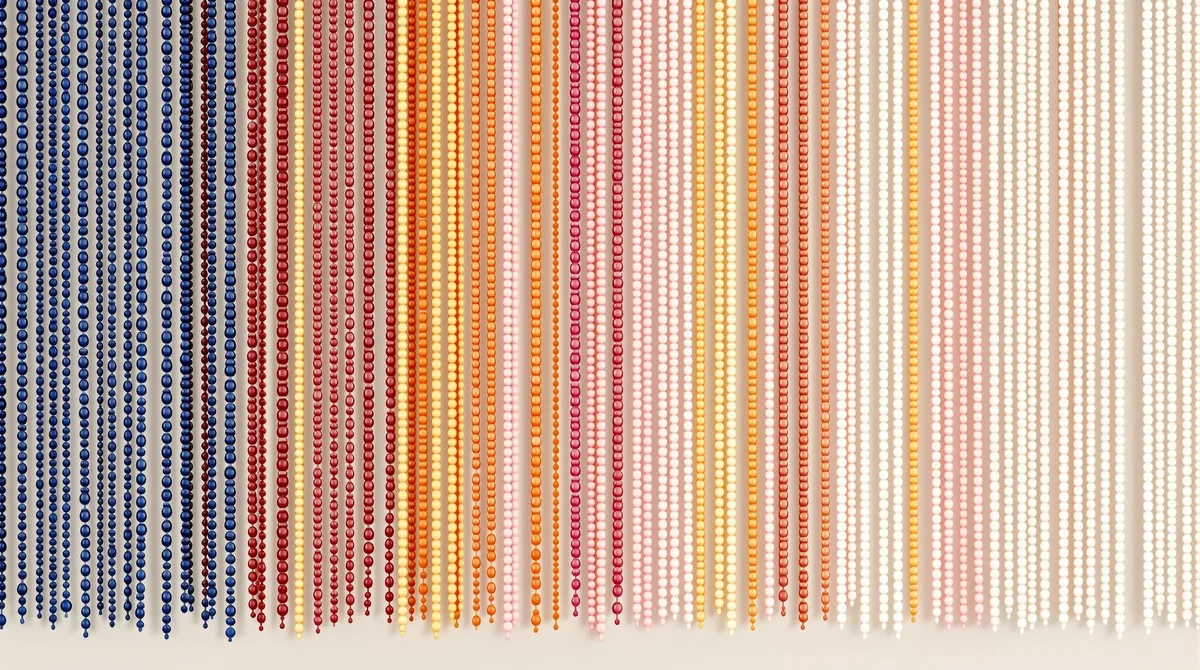
Make the threshold the first thing a customer notices, and keep it looking new. Beadwork is a strong fit: it signals a brand with a point of view, it moves as people enter, and it photographs well from the pavement, which matters when a shopfront is also a social-media asset.
The second half of that brief is the hard half. A shopfront is on display every hour the doors are open. A panel that looks tired, or has a gap where three strands used to be, is worse than no panel at all.
Repairability above everything. Not durability — things will be damaged anyway. The question is how fast normal appearance is restored.
Swap-out speed. A unit should come down and a replacement go up inside a shift change.
A pitch that tolerates crowds. Two people entering together at a tight pitch is how a tangle starts.
A finish that survives street soiling. Road dust, traffic film, and the weekly cleaning that follows.
Beaded portals, generally — 76 × 140 cm in the record — with an arched-cut drop so the centre is clear. Or the standard door curtain at about 90 × 200 cm where the opening is a true doorway.
Across a wide shopfront, specify several narrow panels rather than one wide one. That single decision is the biggest serviceability win available: damage takes out one unit, and one unit is a stock item.
Material: body-coloured pressed glass or moulded acrylic. Acrylic has a specific advantage at a public entrance — it does not shatter. Where a specialty glass bead is wanted, it is annealed for strength and the colours are confirmed as a set, because glass strength is colour-dependent and some pairings are poor where beads knock all day.
Brackets above the opening, into solid substrate. The panel arrives on the wooden header rail or turned dowel we make; the brackets are the project's.
Two details worth insisting on. A quick-release interface, so a unit comes off in one movement with no tools. And end suspension loops knotted at the top of each strand — a construction we already use — which let a replacement hang level immediately instead of needing a technician to adjust it.
The panel is weighed on the approved sample and the fixing is sized to that weight.
The landlord first. Shopping-centre handbooks and high-street lease schedules frequently govern what may hang in a shopfront, and reading that document before the sample is the cheapest hour on the project.
Then flammability: NFPA 701 in the US on hanging decorative material, with UK, EU and Australian equivalents. Fire performance is tested on the specified build — bead, cord and header all affect the result — and the testing is quoted and scheduled with the project.
Then egress. A shop entrance is usually an escape route, and a hanging panel across one is a question for the project's authority having jurisdiction. Settle it with them before the opening is specified.
Weekly or fortnightly dry dusting, down each strand from header to hem. A street-facing panel collects road dust, and in a city it collects a greasy traffic film that binds that dust into a layer.
Then damp spot-cleaning: cloth wrung nearly dry, bead wiped, dried in the same pass. Nothing wet reaches the cord. No solvent, no bleach, no abrasive cream — the shop's cleaning contractor needs that in writing, not on a care card that will be thrown away with the packaging.

Deliveries. A pallet truck, a stock cage or a roll rail going through an entrance takes out a block of strands in one movement, and it will happen. Everything in this specification is arranged around that fact.
Then contact wear on the beads at shoulder height — a dulled band on a surface-dyed bead, nothing at all on body-coloured glass. Then strand drift, which is cosmetic and reads as neglect.
Sampling 16 to 20 days from an agreed brief, photographs approved before the sample ships; production 40 to 60 days after sample approval. For retail, the number that matters is the reorder, and the production lead time is the same 40 to 60 days. That is the argument for buying spares with the original order: a damaged panel at a shopfront cannot wait two months. Landed duty paid delivery to a named US location is available as a single delivered price, which simplifies a multi-store roll-out considerably.
Opening dimensions and the panel module across them. Finished width and drop per panel. Strand count and pitch, or a reference photograph showing the density. Bead material, shape and size with hole diameter. Colour as Pantone references or physical chips. Header type, length and the quick-release detail. Hem shape with longest and shortest drop. Suspension loops, if used.
Then the three retail clauses: the spares quantity, the cleaning method and frequency written as a specification rather than a suggestion, and a fire-performance clause naming the test, the build and the lab.
Narrow panels cost slightly more per square metre than one wide panel, because each needs its own header and its own packing. That premium buys the serviceability, and at a shopfront it is the best money on the drawing.
On a rollout the premium is also the smallest number in the quote. The rough cost sheet comes before any sample, and at shopfront quantities the levers that move it are bead size and pitch, not the header count.
Retail is where the beaded programme lives. Beaded portals, curtains, café curtains, valances and wall hangings run continuously, with the lead portal reordered season after season.
This is retail product manufacturing at volume rather than shopfront installation. The construction is the same one a specifier gets; what the entrance adds is the fixing, the spares and the traffic case.
One wide panel across a wide entrance. Surface-dyed beads at a street threshold. A tight decorative pitch at a busy door. Large feature beads at shoulder height, which are the beads a stock cage catches.
And ordering no spares. Every entrance specification we have seen that failed, failed at the reorder, not at the design.
The brand or design lead owns the look. The store operations team owns the swap plan and will ask who does it at 7 a.m. The landlord owns the shopfront consent. Whoever holds the fire file owns the flammability question.
Our part is the sample and the bead map. Photographs are approved before the sample ships, the sample is approved before production, and the bead map is held on file against the style so a strand can be rebuilt bead for bead long after the original order has shipped.
The hand-strung construction, the bead materials it draws on and the wording for specifying beadwork in a shopfront are each set out separately.
Extractable data
| Item | What a shop entrance needs | Note |
|---|---|---|
| Format | Portal 76 × 140 cm, or door curtain ≈90 × 200 cm | Both shipped formats |
| Wide opening | Several narrow panels, not one wide one | One damaged unit instead of one damaged entrance |
| Walk-through | Arched-cut drop with a clear centre | Shipped construction; halves the contact |
| Top fixing | Wooden header rail, or end suspension loops per strand | Loops give a level mount with no site adjustment |
| Quick release | Panel lifts off its rail in one movement | Specify it; it is a design decision |
| Bead material | Body-coloured pressed glass, or moulded acrylic | Acrylic does not shatter in a public doorway |
| Specialty glass | Annealed, colours confirmed as a set | Glass strength is colour-dependent |
| Spares | Strung with the production run | Later bead-for-bead match is not guaranteed |
| Bead map | Held on file against the style | What makes a rebuild months later possible |
| Pitch | Wider than domestic | A tight pitch interlocks under constant traffic |
| Sampling | 16–20 days from an agreed brief | Photographs approved before the sample ships |
| Production | 40–60 days after sample approval | Published lead time for beaded décor |
| Minimums | Set per design, confirmed per quote | No range-wide figure is published |
| Flammability | Tested on the specified build and quoted with the project | NFPA 701 or the local equivalent |
Good to know
A portal with an arched-cut drop is usually the right answer: the centre is cut away so the walk-through is clear air and far fewer strands are touched on each pass. Across a wide shopfront, specify several narrow panels rather than one wide one — then a trolley or a delivery takes out one unit, which is swapped in minutes, instead of the whole entrance.
The panel hangs from the wooden header rail or dowel we make, on brackets fixed above the opening into solid substrate. Specify a quick-release detail so a unit lifts off in one movement — that is what makes a same-day swap possible. End suspension loops knotted at the top of each strand are available and let a replacement panel hang level without on-site adjustment.
The landlord's fit-out guide first, because shopping-centre and high-street landlords routinely restrict what may hang in a shopfront, and then the usual flammability question — NFPA 701 in the US, local equivalents elsewhere. Fire performance is tested on the specified build and quoted with the project. Egress matters as much: a shop door is usually an escape route, so a hanging panel across one is settled with the project's authority having jurisdiction.
Dry dusting down each strand, header to hem, weekly or fortnightly: a street-facing entrance collects road dust and, in a city, a greasy film from traffic. Then damp spot-cleaning of the beads with a cloth wrung nearly dry, dried in the same pass. Body-coloured glass tolerates this indefinitely; surface-dyed beads do not, which is why they do not belong at an entrance.
Sampling is 16 to 20 days from an agreed brief, with photographs approved before the sample ships, and production is 40 to 60 days after sample approval. For a chain roll-out the useful number is the reorder, not the first order — and the reorder runs the same 40 to 60 days, which is exactly why spares have to be part of the original order rather than something bought when needed.
Mechanical damage, caused by deliveries rather than by customers. A pallet truck or a stock cage takes out a block of strands in one pass. Second is contact wear on bead surfaces at shoulder height, which is why surface-dyed beads are a poor choice here. Third is strand drift, which is cosmetic but makes an entrance look neglected.
Keep exploring
Manufacturing
Short runs, fast colour changes, reusable rigging and panels that survive being struck and rebuilt scheme after scheme.
See the detailPillar
Twenty settings, from a closet front to a hotel lobby, each with the format that suits it, the fixing it needs and the standard that applies.
Read moreSpecification
The privacy limit of a bead panel, the cases where it works as a secondary screen, and where a solid panel is the only right answer.
See the detailSpecification
The small-parts and cord questions, the children’s-product boundary, and the builds we will and will not make for a nursery.
Specs and sizesSpecification
UV on dyed surfaces, water on cord and wood, wind on strand order — and the covered-only answer we give for every material we make.
Specs and sizes
Start a conversation
Send a reference, a colour chip or a sketch. Minimums are set per design and confirmed per quote; sampling is quoted separately and usually runs 16 to 20 days from an agreed brief.