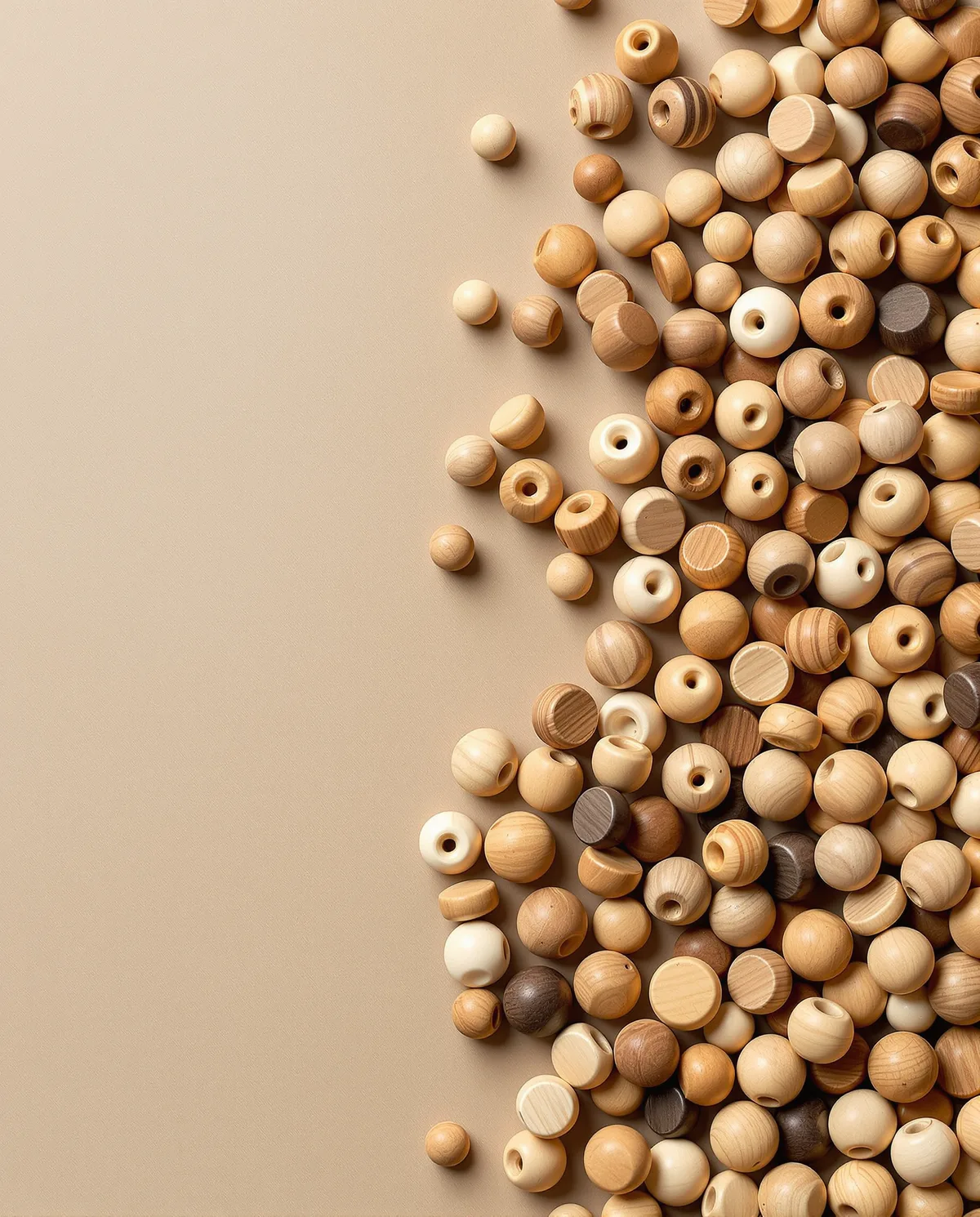
Material
Wood, in detail
Turned and drilled in our own wood factory: grain variation you approve rather than eliminate, the finishes that hold colour, and the dowel from the same plant.
See the detail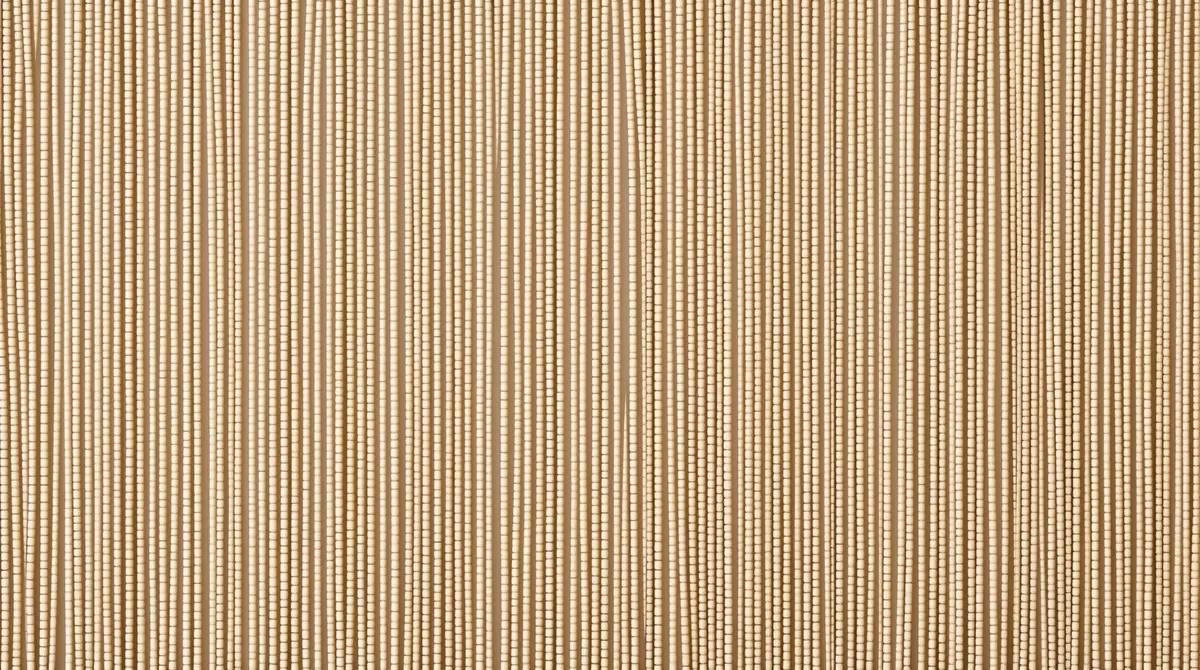
Application · Wellness
A wellness brief is a sound brief that nobody writes down. Every bead family has a voice — a chime, a click, a knock, a rattle — and in a room where people are listening to their own breathing, that is the specification.
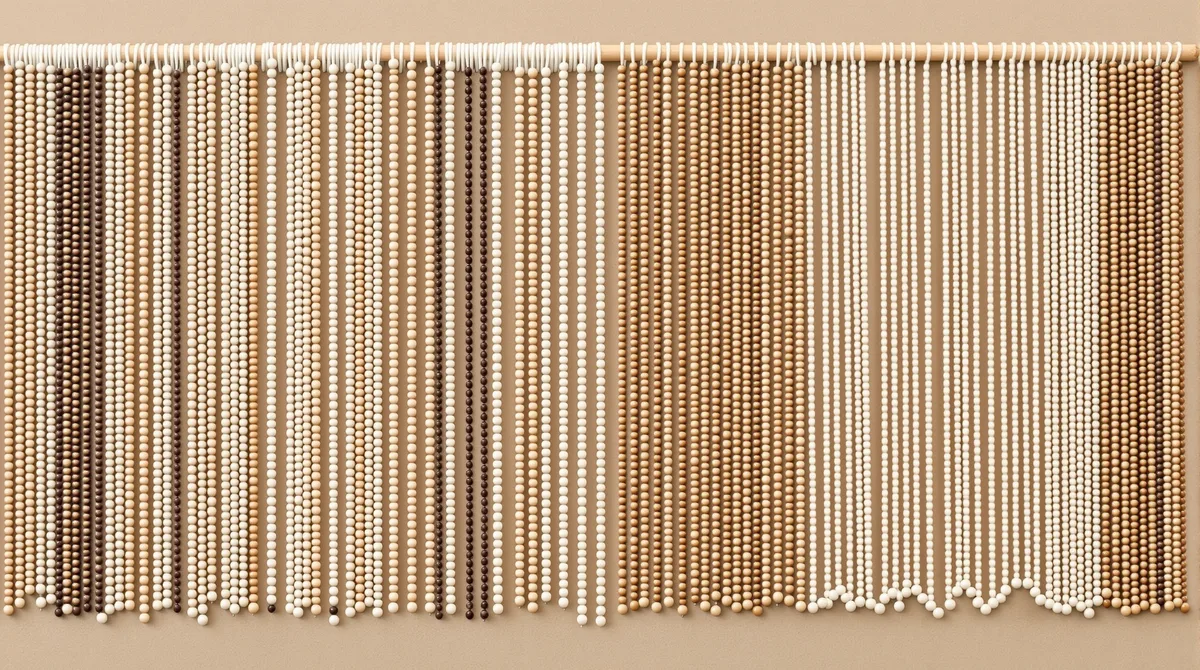
A quiet beaded panel of close strands in warm oat, sand and pale blonde tones, the beads plain rounds all of one size.
A quiet natural interior suits turned wood and matte or frosted glass at a wide pitch, because those are the quietest bead families: wood gives a soft knock and frosted glass a muted note, where clear glass chimes brightly, acrylic clicks and bamboo rattles. Sound and material warmth, not pattern, are what a wellness brief is asking for.

Calm, natural, soft light, nothing shiny. Wellness interiors have a narrow and well-understood material language, and beadwork sits inside it comfortably: hand-made, tactile, not plastic, not printed.
What is almost never written into the brief, and always noticed afterwards, is sound. A room where thirty people are breathing in unison is a room where a bright glass chime at the doorway is an event. Ask about it at the first meeting; the client will know immediately what they want once the question is on the table.
A quiet voice. Each bead family sounds different and the difference is large.
A matte or diffusing surface. Gloss and faceted sparkle read as decorative rather than calm.
Natural material credibility. Wood, bone, horn and frosted glass all pass; bright acrylic reads as what it is.
Floor clearance, because this is the one setting where people are barefoot and lying down.
By sound, from quietest: turned wood gives a soft knock, bone and horn a dense quiet tap, frosted or sea-glass a muted note, matte pressed glass a soft chime, moulded acrylic a light click, clear or faceted glass a bright chime, and bamboo a dry rattle. Those are qualitative comparisons from the bench rather than measured figures; nobody publishes decibel data for bead curtains and neither do we.
Wood is the natural answer and is turned in our own Saharanpur wood factory, dowels included. Frosted glass is the answer where the client wants light play without glitter.
Format: a door curtain at about 90 × 200 cm or a portal at 76 × 140 cm at the threshold of a practice room, at a deliberately wide pitch. Wider pitch means fewer bead-to-bead contacts, which is the real volume control.
Flammability, as in any commercial interior: NFPA 701 in the US or a local equivalent on hanging decorative material. Fire performance is tested on the specified build and quoted with the project.
Two things wellness briefs reach for and should be redirected. Acoustics: beadwork is a visual and spatial device, not an acoustic one. If the brief is acoustic, specify a product that works and let the beadwork hang in front of it. Sustainability: the credential to ask for on a natural-materials brief is Forest Stewardship Council certification, which covers our wood lines, alongside Sedex SMETA, C-TPAT and Omega social compliance.
Dry dusting, down each strand from header to hem, quarterly is usually enough. A studio is a clean room by the standards of this cluster.
Wood needs the gentlest routine of any family: dust or wipe with a dry cloth, do not soak, and keep it away from constant steam — which also means a hot-yoga room is a glass or acrylic room, not a wood one. Glass and bone spot-clean with a barely damp cloth, dried in the same pass.
Honestly, very little. No grease, no solvent, no road dust, light traffic, usually no direct sun on the panel. Dust on upward-facing surfaces is the main service item, and slow cord slackening over years is the long-term one.
In a humid or hot-yoga studio the picture changes and the cord becomes the component with a service life, exactly as it does in a spa. Specify spares and expect a re-string eventually.
Sampling 16 to 20 days from an agreed brief, photographs approved first; production 40 to 60 days after sample approval. One wood-specific note. Natural grain varies, so the tone range is agreed on the sample and production is held to that sample. That makes the sample a tighter control document than it is for a dyed bead, and it makes a rushed sample approval a genuine risk on a wood specification.
Position, with the sound reason noted — "studio threshold, wide pitch for quiet operation" — then opening dimension, finished width and drop, with the hem height above finished floor stated explicitly because of bare feet and mats.
Then strand count or pitch, bead family and species, bead shape and size with hole diameter, finish stated as matte or gloss rather than left open, colour or tone range, header type and length, hem shape. For wood, state that the tone range is sample-approved.
Wood is light, which saves freight, and wood beads are turned rather than moulded or fired, which gives a different cost shape from glass. A wide pitch — which this setting wants anyway — reduces strand count and therefore cost.
Levers in order: bead size and material, then strand count and tightness, then pitch, then dowel and packing, then height. This is one of the few settings where the aesthetic preference and the cost preference agree: quieter, sparser and more natural is also cheaper. Minimums and pricing are set per design and confirmed with your quote, and a rough cost sheet comes before any sample.

Wellness and yoga studios are part of the buyer landscape this category serves, and the formats and materials are shipped ones: door curtains at around 90 × 200 cm, portals, and wall hangings on a turned dowel. What this page adds is where each belongs in a studio plan.
The useful thing we can offer a studio brief is the sound comparison above and a sample to listen to. A physical sample hung in the actual room settles the question in thirty seconds.
Bamboo — the loudest family, and damp-sensitive into the bargain. Clear faceted glass at a tight pitch, which is lovely to look at and chimes every time anyone enters. Wood in a hot-yoga or steam-exposed room. A hem that reaches the floor where mats are rolled out.
And specifying beadwork as acoustic treatment. It is a visual and spatial device, and a room that needs quiet needs an absorbent product.
The designer and the studio owner, and the test is simple: hang the sample at the real threshold and have someone walk through it while the owner sits where a student would. That single trial has more authority than any specification note.
Our part is the sample. Photographs are approved before it ships, the physical sample before production, and production is held to it — which for wood includes holding to the approved tone range.
The bead materials, the hand-strung construction behind the sound this page describes, and the cost levers behind a studio quotation each have a page of their own.
Extractable data
| Bead family | How it sounds | Fit for a wellness interior |
|---|---|---|
| Turned wood | A soft knock | Best fit; warm, matte, quiet |
| Frosted or sea-glass | A muted note | Good; diffuses light rather than flashing it |
| Matte pressed glass | A soft chime | Good; body colour, low gloss |
| Clear or faceted glass | A bright chime | Beautiful and loud; use at wide pitch only |
| Moulded acrylic | A light click | Workable; reads less natural |
| Bamboo | A dry rattle | Avoid; the noisiest family and damp-sensitive |
| Bone and horn | A dense, quiet tap | Good; natural variation, calm surface |
| Ceramic | A low, solid note | Workable; heavy for its size |
| Pitch | Wider pitch, fewer contacts, less sound | The main volume lever |
| Format | Door curtain ≈90 × 200 cm; portal 76 × 140 cm | Both shipped formats |
| Wood manufacture | Turned in our own Saharanpur wood factory | Dowels and beads |
| Acoustic performance | No data held | Beadwork does not reduce sound transmission |
| Sampling | 16–20 days from an agreed brief | Photographs approved before the sample ships |
| Production | 40–60 days after sample approval | Published lead time for beaded décor |
| Flammability | Tested on the specified build and quoted with the project | NFPA 701 or the local equivalent |
Good to know
Sampling is 16 to 20 days from an agreed brief, with photographs approved before the sample ships, and production is 40 to 60 days after sample approval. One scheduling note specific to wood: natural grain varies, so the tone range is agreed on the sample and production is held to that sample, which makes the sample approval step more consequential than it is with a dyed bead.
Very little, which is the good news. A studio is a low-soil, low-traffic, low-chemistry room: no grease, no solvent, light footfall and usually no direct sun on the panel. The realistic failures are dust on upward-facing bead surfaces and, over years, slow cord slackening. In a hot-yoga or humid studio the cord becomes the service item, as it does in any humid room.
The formats a studio would use are shipped in volume, and interior designers specifying wellness spaces are a published buyer type. What this page adds on top of that is the studio-specific judgement: where a panel belongs in the plan, and why beadwork marks a threshold rather than treating a room.
A threshold rather than a wall. A door curtain at about 90 × 200 cm or a portal at 76 × 140 cm marking the entry to a practice room, at a wide pitch so it is quiet and so people pass through it without brushing much of it. A short drop or valance works at a reception. Avoid anything a mat or a body is likely to touch at floor level.
The panel hangs from the wooden dowel or header rail we make, on hooks or brackets fixed above the opening into solid substrate. Fix it high and keep the hem above the floor so a bare foot or a rolled mat never catches it. The panel is weighed on the approved sample and the fixing is sized to that weight; a wood panel is substantially lighter than a glass one of the same size.
Flammability, as in any commercial interior — NFPA 701 in the US or the local equivalent — and fire performance is tested on the specified build and quoted with the project. Two things wellness briefs reach for and should be redirected: acoustics, because beadwork is a visual and spatial device and does not reduce sound transmission between rooms, and product-level sustainability labelling. For wood, Forest Stewardship Council certification covers our wood lines, and that is the credential a natural-materials brief should ask for.
Keep exploring
Material
Turned and drilled in our own wood factory: grain variation you approve rather than eliminate, the finishes that hold colour, and the dowel from the same plant.
See the detailPillar
Twenty settings, from a closet front to a hotel lobby, each with the format that suits it, the fixing it needs and the standard that applies.
Read the guideSpecification
Humidity, product overspray and cleaning chemistry: which bead materials survive a treatment room, and which only look right in one.
See the detailSpecification
Period accuracy for a seventies build, how beads behave under tungsten and LED, noise on a live take, and rigging that strikes in minutes.
Specs and sizesSpecification
Cord creep, cumulative strand weight, splicing, mid-span stabilising, and how a long drop is engineered as segments on a carrier.
Specs and sizes
Start a conversation
Send a reference, a colour chip or a sketch. Minimums are set per design and confirmed per quote; sampling is quoted separately and usually runs 16 to 20 days from an agreed brief.