Manufacturing
Event and wedding companies
Repeatable backdrop panels, rigging that survives a van, fast reorder of one colourway, and real set-up times.
See the detail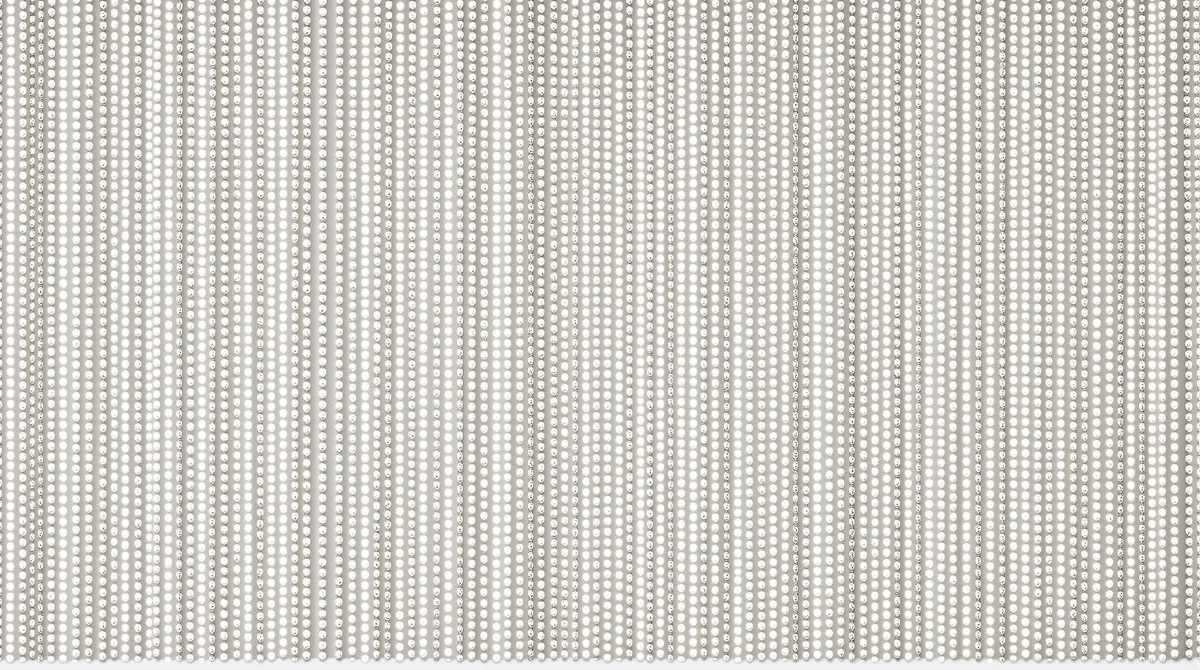
Application · Events
An event panel is judged on one afternoon, from six metres away, through a camera. It then has to come down in twenty minutes and go up again somewhere else next week.
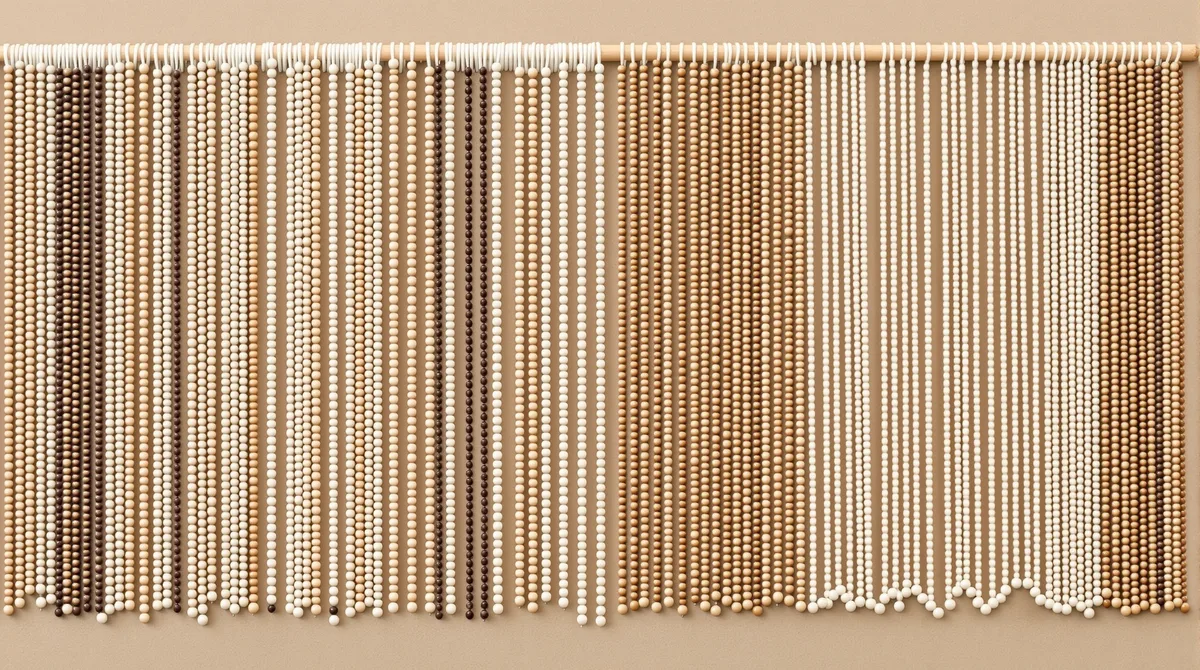
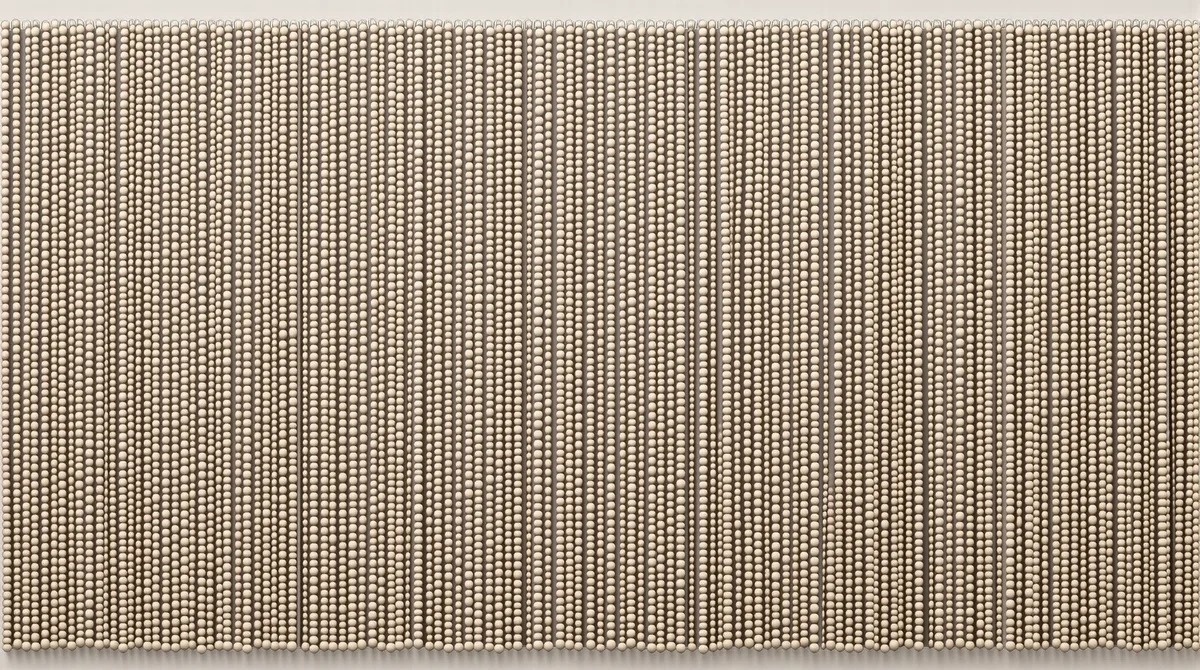
A wide beaded backdrop of close strands in mirrored silver, pearl and chalk white glass, the whole field very high key.
An event backdrop needs to read at distance and on camera, rig in minutes by one person, and survive being packed and rebuilt dozens of times. That pushes the build towards repeating narrow panels with end suspension loops, larger beads than an interior would use, and a travelling repair kit with spare beads and cord.
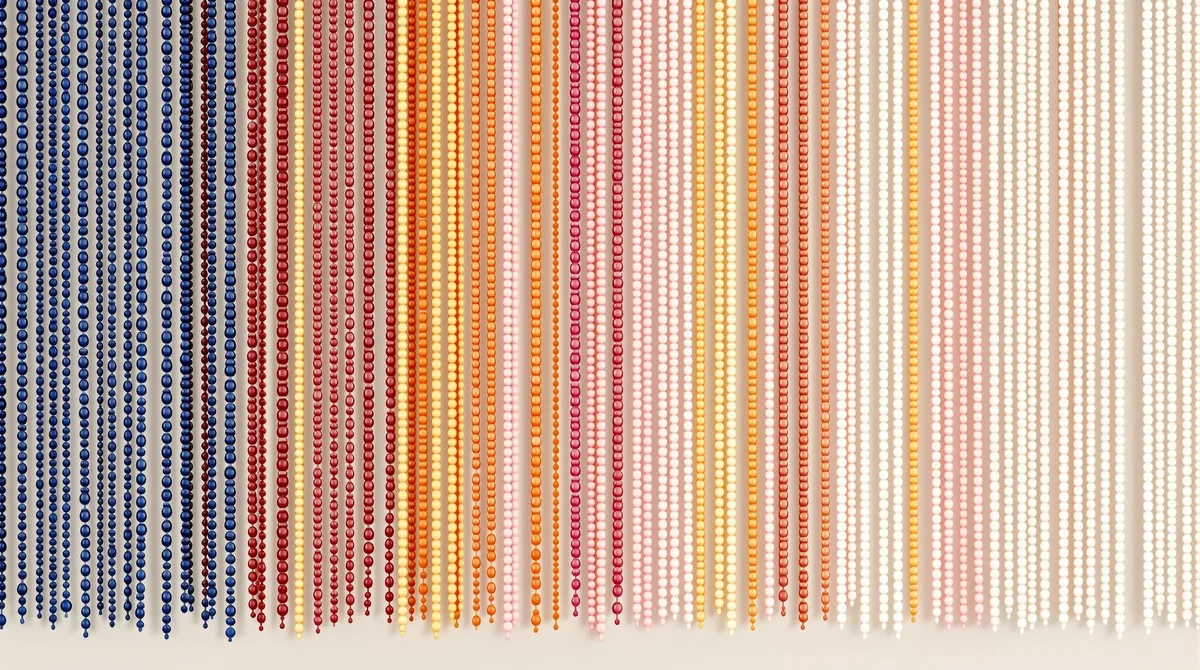
A surface that photographs beautifully behind people, for one afternoon. Event beadwork is bought for the pictures — a ceremony backdrop, a stage surround, an entrance to a marquee — and the pictures are taken from several metres away with people in front of the panel.
That changes the design arithmetic. An interior panel is read at arm's length and rewards fine work. An event panel is read at six metres through a lens, and fine work simply disappears.
Legibility at distance. Bigger beads, bolder contrast, clearer pattern than an interior build.
One-person rigging. Event crews are small and the schedule is tight.
Survivability in transit, which is where event beadwork actually lives: a flight case, a van, a stacked store.
On-site repairability. A strand parts during a build and there is no reorder available. The kit has to be in the case.
Narrow repeating panels, around 90 cm wide, hung side by side. Repetition does everything here: a wall of identical panels can be built one panel short if one fails, rigged in sequence by one person, stored efficiently and extended next season with more of the same.
For an aisle: short drops or valances on frames. A floor-length aisle panel will be trodden on, and it only takes one heel.
Material: moulded acrylic is the first choice for event work — light to freight, dyed to any colour, and it does not shatter when a case is dropped. Body-coloured pressed glass where weight and sparkle are wanted and the handling is careful. Avoid surface-dyed beads, which mark where they are handled.
Event work is bought as an asset rather than per booking, so the number that matters is cost per use. A panel that survives forty bookings at a wedding-scale rate has a different economics from an interior piece that hangs still for ten years.
The cost levers in order: bead size and material, then strand count and tightness, then pitch, then rail and packing, then height. Two event-specific notes. Retail packing is a real cost line, because event panels need protective bundling that an interior piece does not. And a repeating module is dramatically cheaper than a bespoke wall, because the bead map is written once. Minimums and pricing are set per design and confirmed with your quote, and the rough cost sheet comes before any sample.
Event and display companies are a published buyer type for the category, and the formats are shipped in volume: backdrop modules at around 90 cm wide with drops to 200 cm, and linked-disc hangings to 90 × 200 cm.
What we bring on top of that is the construction detail that makes repeat-use work practical, already in our builds: end suspension loops, flexible mounts, and spares strung during the production run.
Floor-length aisle panels. Fine tonal patterns that vanish at camera distance. Small beads in a backdrop. Glass in a build that will be freighted weekly by van. A single wide bespoke backdrop where a repeating module would do the same job with better economics.
And ordering no spares. On an interior job spares are prudent; on an event job they are the difference between a build and a cancellation.
The event producer or designer, and the crew chief who will rig it. Those are different people with different priorities, and the crew chief's view is the one that determines whether the panel gets used again.
In a venue, add whoever holds the fire file. Our sign-off is the sample, and for event work it is worth rigging the sample once, on pipe, with a stopwatch.
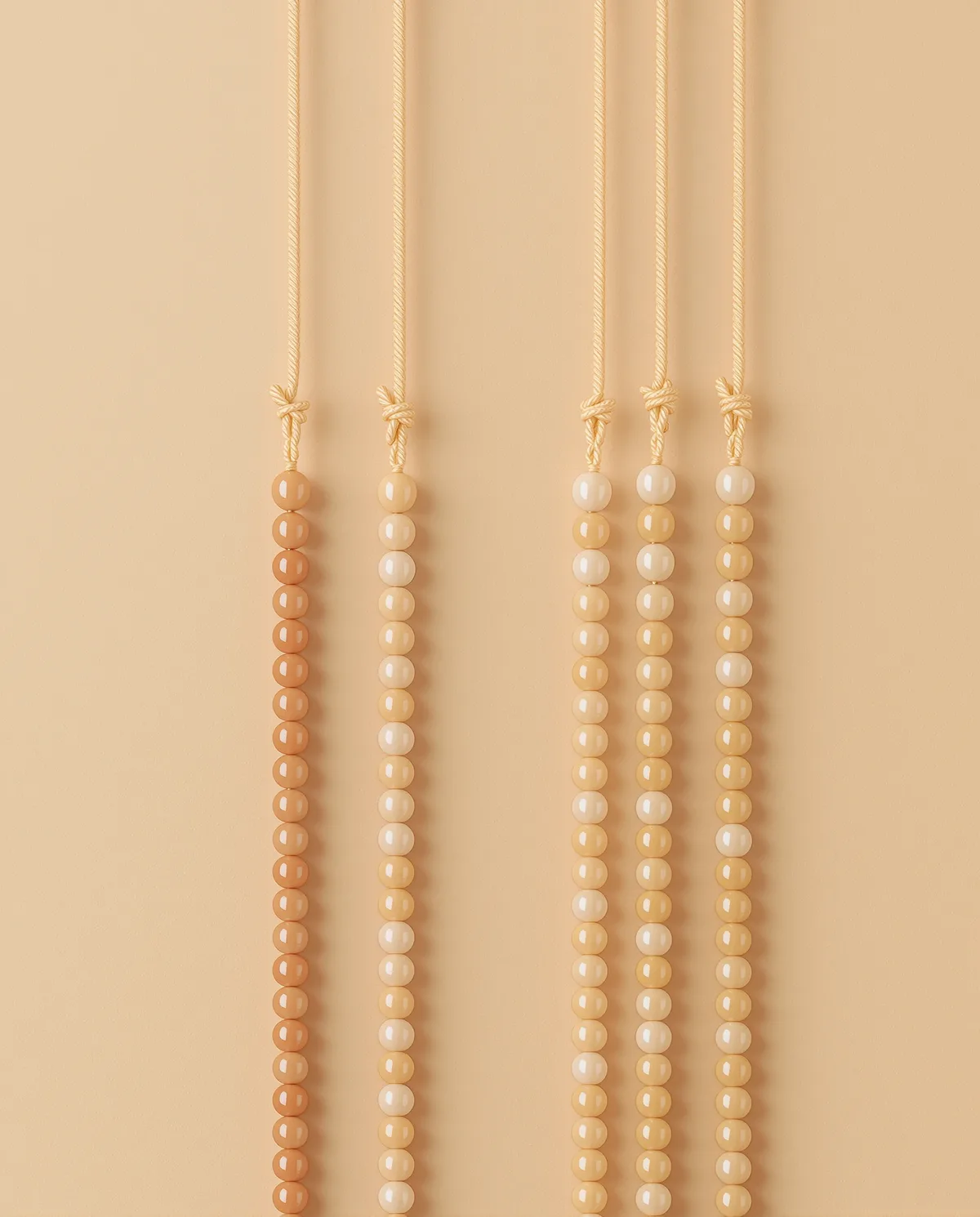
Pipe, truss, a free-standing frame or a venue rail, all the project's. We make the panel, the header rail and the loops.
Suspension loops are the specification detail that matters most here. A panel with loops at each strand hangs level on the first attempt; a panel with a fixed knot pattern needs adjusting on a ladder, which is exactly what a twenty-minute build does not have time for.
The panel is weighed on the approved sample and the fixing is sized to that weight.
Venue fire files, routinely and strictly. Hotels, conference centres, marquee operators and civic venues all commonly require a flammability certificate on anything hung, and the person asking is often the venue's own operations manager with a checklist.
Where a venue's fire file governs, the build is tested for that project and quoted with it. For an event company, test once on a core reusable design rather than per booking.
The rigging responsibility sits with the production: the rig, its certification and its load rating belong to the production that installs it, and the panel is weighed on the approved sample so the rig can be sized to a real number.
Between bookings, not during one. Dry dusting down each strand, header to hem; damp spot-clean of the beads with the cloth wrung nearly dry, dried in the same pass; cord kept dry.
The genuinely important routine is storage. Bundle loosely in tied groups rather than as one mass. Lift and carry by the rail. Never store compressed in a box. That one paragraph will do more for an event company's margin than any material choice on this page.
Tangle, from packing. Then strand loss at the header from repeated rigging. Then bead loss from drops, which is a case-design problem rather than a panel one.
None of those is a manufacturing defect and all of them are predictable, which is why the repair kit — spare beads in the right colours, spare cord, scissors — belongs in the specification and in the flight case.
Sampling runs 16 to 20 days from an agreed brief with photographs approved before the sample ships, and the production lead time is 40 to 60 days after sample approval. Those figures do not serve a single booking and serve a season well. The right pattern for an event company is to order in the quiet months, treat the panels as owned stock, and amortise them across bookings — which is also the only way the flammability test makes commercial sense.
Module width and count across the backdrop, with the panels drawn as identical units. Finished width and drop per panel, with hem height above floor so nothing is walked on. Strand count and pitch. Bead material, shape and size with hole diameter — and specify bead size against viewing distance, not against taste.
Then rigging: suspension loops, header rail type and length, and the pipe or frame interface. Then the spares quantity and repair-kit contents, the packing specification, and a fire-performance clause naming the test, the build and the lab.
The hand-strung construction underneath all of this, the bead materials it uses and the routine care an owned panel needs are each documented on their own pages.
Extractable data
| Item | What event work needs | Note |
|---|---|---|
| Backdrop module | Narrow repeating panels, ≈90 cm wide | One unit struck or swapped, not the whole wall |
| Backdrop height | Shipped formats to 200 cm; 210 cm in the library | Library figure, from the 2027 designs |
| Aisle format | Short drops or valances on frames, not floor-length | A floor-length aisle panel gets walked on |
| Bead size | Larger than an interior build | Small beads disappear at camera distance |
| Bead material | Moulded acrylic; body-coloured pressed glass | Acrylic does not shatter when a case is dropped |
| Contrast | Bolder than an interior palette | Subtle tonal work does not read at six metres |
| Rigging | End suspension loops per strand | Shipped construction; level hang, no adjustment |
| Top fixing | Pipe, truss or frame, by the project | We make the panel and its rail |
| Repair kit | Spare beads, spare cord, in the flight case | Ordered with the run; later matching is not guaranteed |
| Packing | Loose tied bundles, strand order preserved | Never compressed in a box |
| Sampling | 16–20 days from an agreed brief | Photographs approved before the sample ships |
| Production | 40–60 days after sample approval | Published lead time for beaded décor |
| Minimums | Set per design, confirmed per quote | No range-wide figure is published |
| Flammability | Tested on the specified build and quoted with the project | The venue fire file usually wants a report |
Good to know
Event and display companies are a published buyer type for the category and the formats are all shipped ones. What we bring to an event build is the construction detail that makes repeat use practical: suspension loops, flexible mounts, and spares strung with the run so a damaged strand is replaced from stock rather than remade.
Narrow repeating panels, around 90 cm wide, hung side by side on pipe or truss. Repetition is the whole trick: a wall built from identical panels can be built one panel short if one is damaged, rigged by one person in sequence, and extended next season with more of the same. For an aisle, short drops or valances on frames rather than floor-length panels, which get trodden on.
Pipe, truss, a free-standing frame or a venue's own rail, all supplied by the project. We make the panel and its header rail, and end suspension loops at the top of each strand are the detail that makes one-person rigging possible — the panel hangs level immediately instead of needing adjustment on a ladder. The panel is weighed on the approved sample and the fixing is sized to that weight.
The venue's fire file, almost always, and it is usually stricter than a domestic interior would face: hotels, conference centres and marquee operators routinely ask for a flammability certificate on anything hung. Where that file governs, the build is tested for that project and quoted with it — and for an event company it is worth testing once on a core reusable design rather than per booking.
Between bookings rather than during one. Dry dusting down each strand from header to hem, and a damp spot-clean of the beads with the cloth wrung nearly dry, dried in the same pass. The more important routine is storage: bundle loosely in tied groups, lift by the rail, and never store a panel compressed, which is how it arrives tangled at the next booking.
Sampling is 16 to 20 days from an agreed brief and production is 40 to 60 days after sample approval. That does not suit a single booking, and it suits a season perfectly: event companies should treat beadwork as stock they own and amortise across bookings, ordered in the quiet months, rather than as something bought against one date.
Tangle, caused by packing rather than by use. A bead panel that is bundled tightly, stacked and driven two hundred miles will arrive as a knot, and untangling one on site before a ceremony is the worst half hour in this business. Second is strand loss at the header from repeated rigging, which is what the repair kit is for.
Keep exploring
Manufacturing
Repeatable backdrop panels, rigging that survives a van, fast reorder of one colourway, and real set-up times.
See the detailPillar
Twenty settings, from a closet front to a hotel lobby, each with the format that suits it, the fixing it needs and the standard that applies.
Open the referenceSpecification
Panel size, rigging, strand order on reassembly and a realistic set-up time for beadwork that travels to every show.
Read the guideSpecification
Modularisation, substrate fixing, tolerance between modules, cleaning access and a repair plan that does not mean replacing the wall.
See the detailSpecification
Round-the-clock operation, high ceilings, a house fire file and a maintenance window measured in hours — what an entertainment venue demands of beadwork.
Specs and sizes
Start a conversation
Send a reference, a colour chip or a sketch. Minimums are set per design and confirmed per quote; sampling is quoted separately and usually runs 16 to 20 days from an agreed brief.