Material
Moulded and dyed acrylic
Moulded to our dies and dyed to the reference: the widest colour latitude in the library, half the weight of glass, and no shatter risk.
See the detail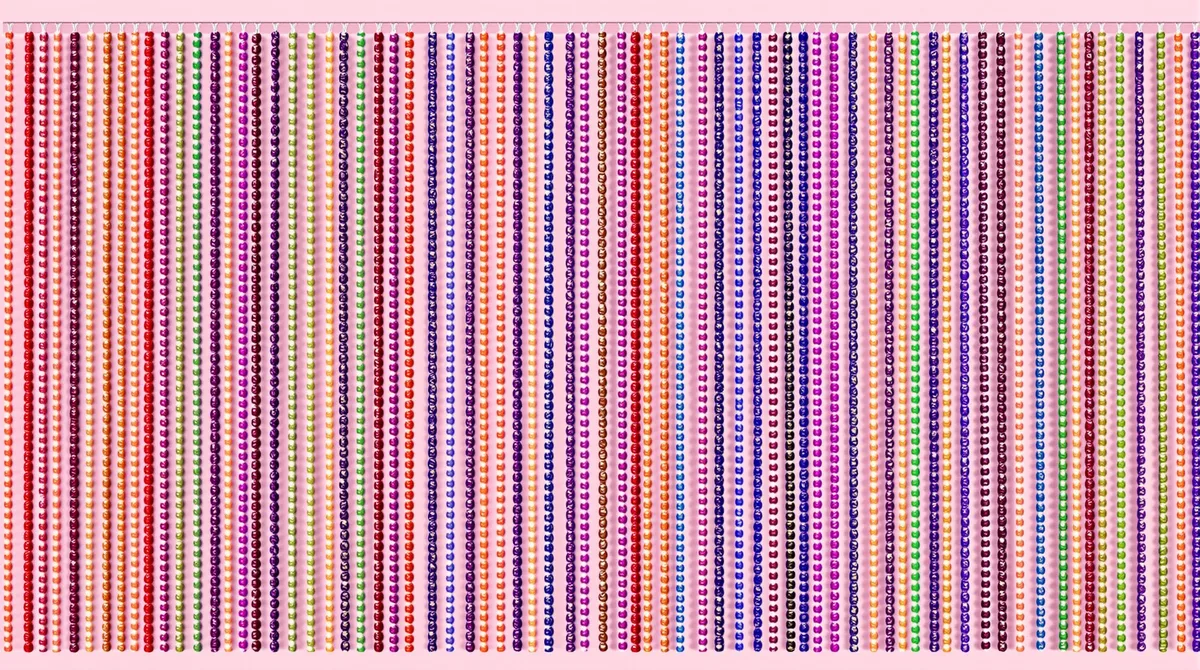
Guide · Material
Acrylic is the bead you choose when the panel has to survive a household rather than decorate one. It is light, it takes any colour you name, and it does not break when a bike handlebar goes through it.
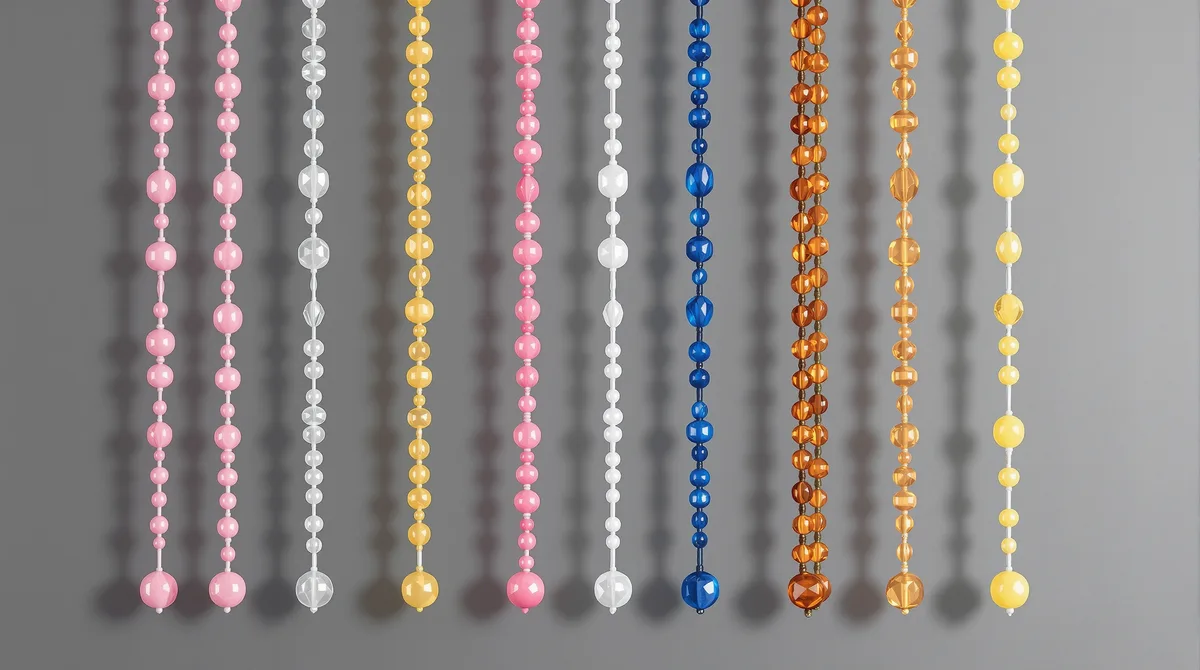
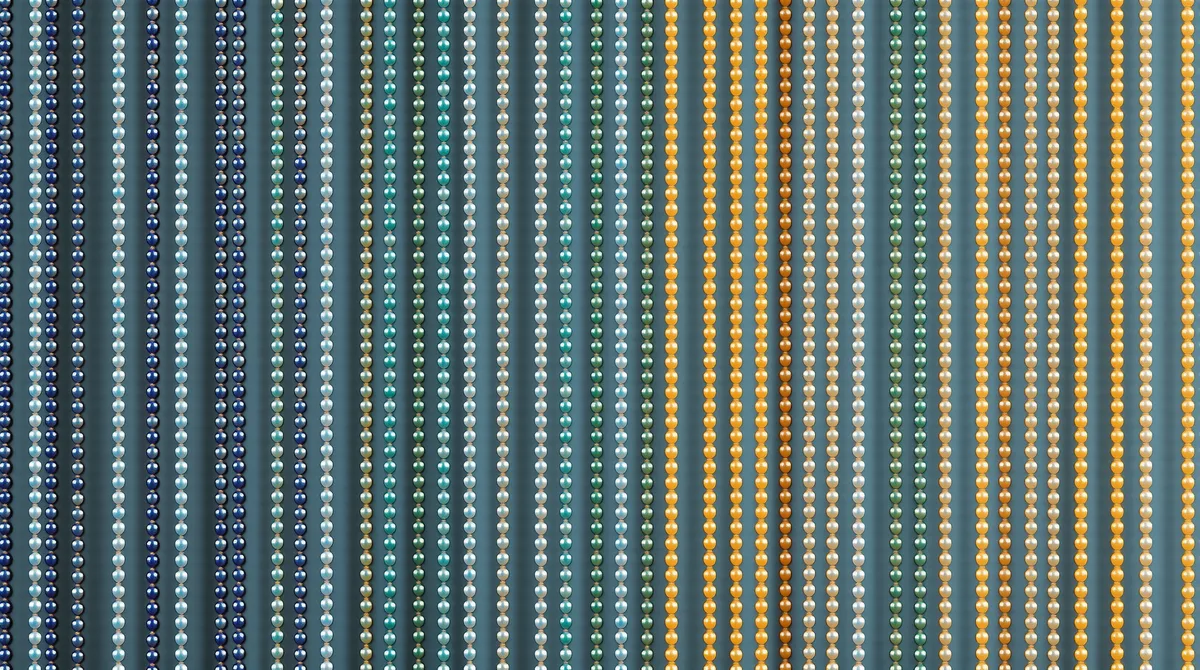
A thirty-strand doorway curtain of moulded translucent acrylic beads in red, cobalt, apple green, amber and violet on a clear base strand, light passing through each bead.
An acrylic beaded curtain hangs moulded, dyed plastic beads on cord. It is the lightest full-size panel available, takes the widest colour range of any bead because the colour is dyed in rather than found, clicks softly instead of chiming, and does not shatter. Its weaknesses are surface scratching and a tendency to hang less straight than glass.

It is a hand-strung panel in which the beads are moulded plastic rather than glass, wood or shell. The beads are injection-moulded and dyed to a named colour, which is the whole point of the material: the colour is a decision rather than a discovery. Strands are threaded on cord, gathered on a single turned wooden dowel, and cut to a hem shape in exactly the same way as any other strung panel. The construction is identical. Only the bead changes — and the bead changes everything downstream.
It moves. An acrylic strand weighs little enough that a door closing across the room will set it swinging, which reads as liveliness in a child's room and as fidget in a quiet hallway. It also reads as colour first and material second: because the dye is in the bead, acrylic panels can be saturated in a way no natural material manages.
What it does not do is settle quickly. A glass panel drops back to still in a second or two. An acrylic panel takes longer, and in a draughty doorway it may never fully stop.
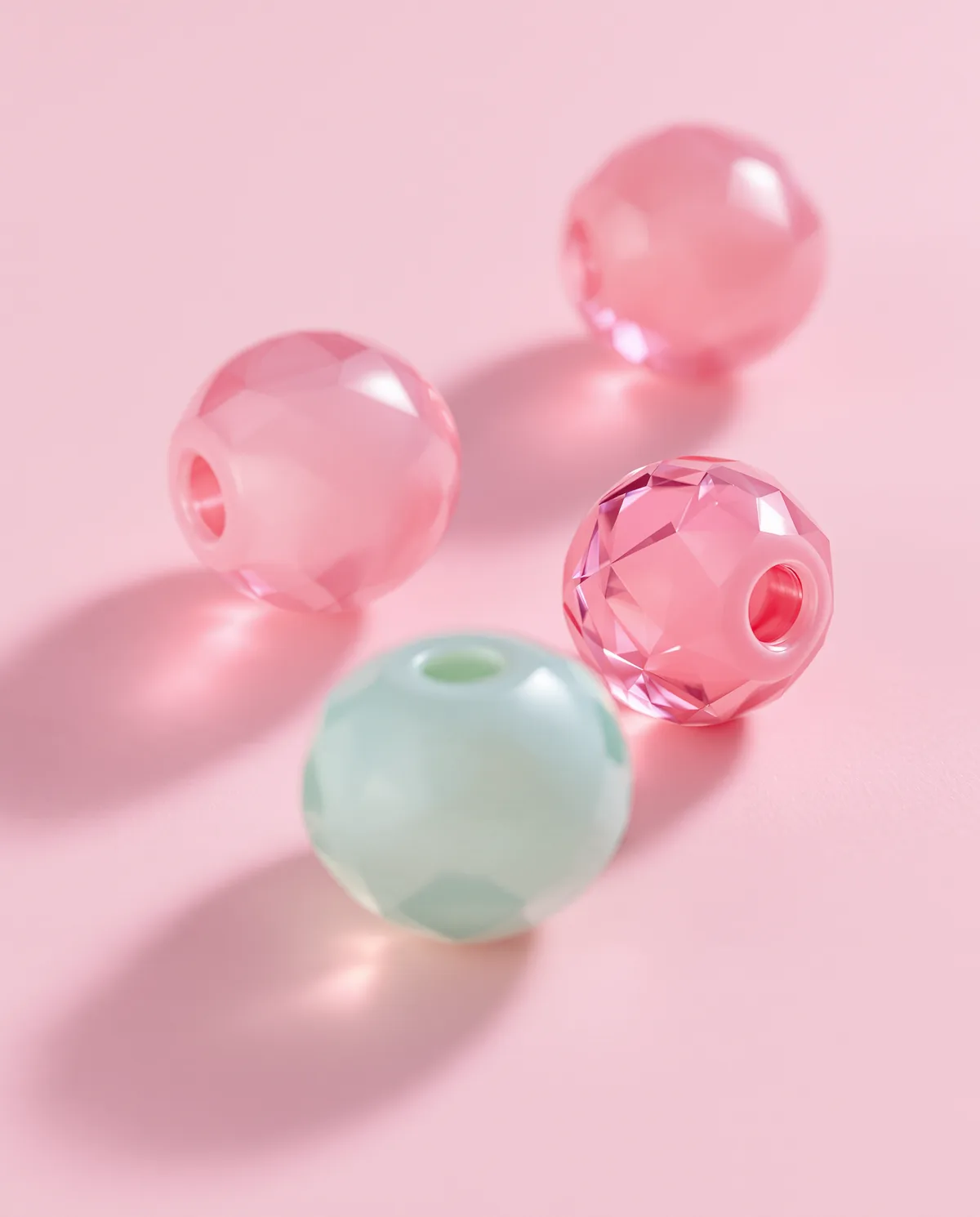
Three comparisons matter. Against glass, acrylic gives up weight, straightness and the chime, and gains colour latitude, impact tolerance and much cheaper freight. Against wood, it is comparable in weight but wholly different in character — one is matte and natural, the other glossy or matte to order. Against faux capiz, which is itself cast resin or dyed cut acrylic, the difference is form rather than material: a disc hangs and sounds nothing like a bead.
The most common real-world answer is neither pure acrylic nor pure glass but a mixed strand, with a few glass beads placed where the light hits.
The sequence is the standard one — bead map, colour match, cord sized to the smallest drill hole, string, gather on the dowel, cut the hem. Two things are handled differently for acrylic.
First, weight at the bottom. A light strand hangs straight only if something pulls it down, so the hem usually carries a larger drop bead. Second, bead size as a cost lever. Acrylic takes custom shapes readily, and the 2025 development programme reached its cost target on a beaded portal by using two bead sizes in one strand rather than one — a bigger bead covers the same drop with fewer units and fewer minutes of stringing.
Six things, and they fit on one line each: finished width and drop; strand count or a reference photo showing the density you want; bead material, shape and size for the main bead and any accent; the colour, as a reference or a physical chip for each bead; whether the colours change across the strands or down each one; and the hem shape.
That last one about direction is the question people forget, and it is the one that decides whether a rainbow panel reads as stripes or as a gradient.
Choose acrylic when the panel is in a child's room, a rental, a student room, an event set or any doorway in constant use; when the colour is the point; or when freight weight matters. Choose glass instead when you want the panel to hang dead straight and throw light, and you have a fixing that will carry it. Choose wood when you want quiet and warmth rather than colour.
If the answer is that you want glass sparkle on an acrylic budget, mixing the two in one strand is not a compromise — it is the usual professional answer.
More than glass at the same density, and differently. Glass refracts: it bends light and throws bright spots on the opposite wall. Acrylic transmits more diffusely, so a translucent acrylic panel glows rather than sparkles, and an opaque one simply blocks its own small patch of the opening.
Translucent and opaque versions of the same bead behave so differently that the 2025 coaster development was sampled in both, because they merchandise differently on a lit shelf. The same is true of a curtain against a window.
A light click, not a chime. The sound is lower, shorter and quieter than glass, because the material is less dense and damps its own ring. Wood gives a soft knock, bamboo a dry rattle, glass a bright chime; acrylic sits between wood and glass and is the easiest of the four to live with in a bedroom doorway.
About 90 × 200 cm, roughly 35 × 79 in, for a single interior door — that is the published standard, and it covers the 28 to 36 in doors common in North America. From 36 in upwards, move to 120 cm, roughly 47 in. Acrylic makes oversize panels easier than glass does, because the weight the header has to carry grows far more slowly.
Three comparisons settle most acrylic briefs. Weigh it against glass bead curtains first, because that is the trade you are actually making: refraction and a straight hang on one side, half the weight and the whole colour spectrum on the other. Then read the page on what the word plastic covers, because a plastic bead curtain is not always acrylic and the difference shows in the smell and the sound. If the room has animals or small children in it, beadwork with pets and child safety around beadwork both turn on bead size rather than material. And if the panel is going up without a drill, no-drill bead curtains is the page that decides the fixing before the bead.
Good to know
The beads outlast the cord by a wide margin. Acrylic does not chip or craze in ordinary indoor use; what ages is the surface, which picks up fine scratches from rubbing against a door frame, and the cord, which is the service item on any strung panel. Keep it out of hard daylight and the colour holds.
Yes, and it is the most tolerant bead in the category. Dust it dry first, then wipe with a cloth damped in lukewarm water with a mild soap, keeping the wooden dowel dry, and let it dry fully while hanging. Avoid solvents and very hot water — both attack the surface before they touch the colour.
It is the best of the hard beads for a doorway that gets used constantly, because nothing in the panel can shatter and the strands are light enough to swing out of the way rather than be shoved. The trade is that light strands need designing to hang straight.
Weight is established on the approved sample, because it depends entirely on bead size, strand count and drop. The useful comparison is density: acrylic is roughly 1.2 g/cm³ against about 2.5 for glass, so the same design in acrylic is somewhere near half the weight of the glass version.
Yes. Width, drop and strand count are set per order and there is no stock programme to work around — every panel is made to order against an approved sample. The standard door size is about 90 by 200 cm, and anything else is simply a different stringing sheet.
More readily than glass, because light strands move further and settle slower. The two fixes are both design decisions made before the sample: a larger bead or a weighted end bead to steady the strand, and a slightly wider strand pitch so neighbouring strands have room.
Yes, and this is acrylic's real advantage. Beads are moulded and dyed to a colour reference or a physical chip, and the colour is confirmed on the sample rather than on a screen. Where a design needs a shape nobody makes, we cut our own die.
Keep exploring
Material
Moulded to our dies and dyed to the reference: the widest colour latitude in the library, half the weight of glass, and no shatter risk.
See the detailGuide
Weight and drape, sound, colour range, breakage, cost and freight, with a verdict by buyer type rather than a neutral shrug.
See the detailPillar
Door curtains, portals, café lengths and valances: the standard sizes, the strand counts and the one question each format answers.
Read the guideGuide
The heaviest panel and the only one that refracts: weight, chime, a straight hang, and the chipping risk that comes with them.
See the detailGuide
A dry rattle, almost no weight, a natural look that marks in damp — and the note that bamboo is confirmed design by design.
See the detailGuide
Acrylic or PVC: the distinction that decides colour depth, smell, chemical compliance and lifespan.
See the detailReference
Nine material families, what each gives in light, weight and colour, and how far our own manufacturing reaches into every one of them.
See the detail
Start a conversation
Send a reference, a colour chip or a sketch. Minimums are set per design and confirmed per quote; sampling is quoted separately and usually runs 16 to 20 days from an agreed brief.