Material
Glass seed beads: sizes, dye lots and cord
How seed beads are drawn, why dye lots are quoted per run, what the drill hole limits, and where seed-bead work earns its cost.
Specs and sizes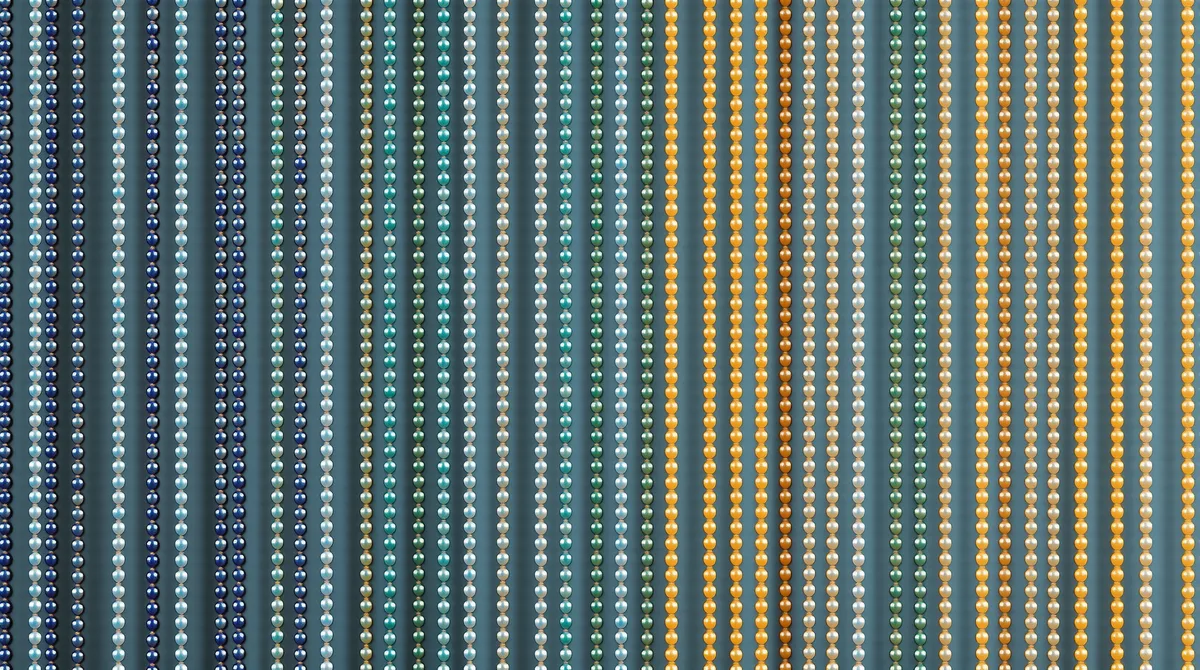
Guide · Material
Glass is the bead material we draw ourselves, and the only one that actually bends light. Everything else about it — the weight, the chime, the chipping — follows from the same density.
A curtain built from large eighteen-millimetre pressed glass rounds packed one hard against the next down every cord, in deep cobalt, bottle green and amber.
A glass beaded curtain is the heaviest panel in the category and the only one that refracts light rather than merely reflecting it. Glass sits near 2.5 g/cm³, so a glass strand hangs dead straight and settles fast; it chimes brightly, and it can chip if knocked hard. Our glass beads are drawn and hand-strung in our own Firozabad glass works.
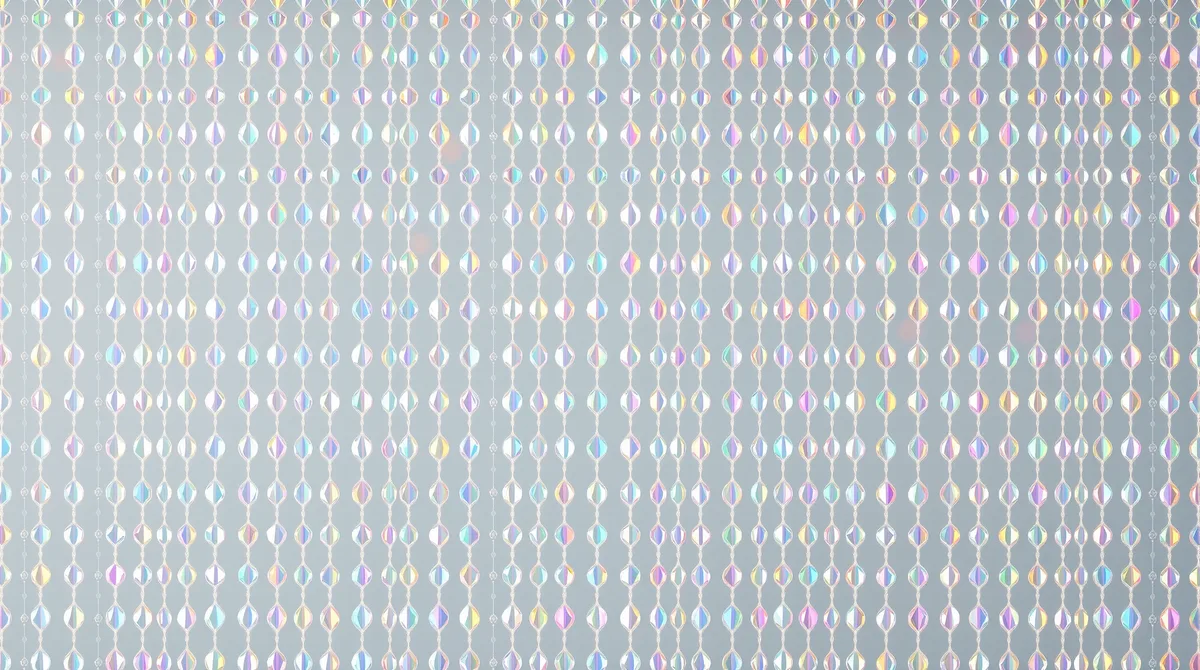
Refraction. Every other bead material reflects light off its surface; glass bends light through its body and throws it somewhere else. In direct sun a glass panel puts moving bright points onto the floor and the opposite wall, and because the strands move, the points move.
That is the whole reason to specify glass, and it is not replicable. Translucent acrylic diffuses — it glows. Faceted glass glints. Only glass refracts, and only glass is worth hanging at a window for that reason alone.
Glass sits near 2.5 g/cm³. Acrylic is around 1.2 and most woods below 1. Almost every other property follows from that ratio.
It hangs straightest, because weight per strand pulls the strand true. It settles fastest after someone walks through, which is why it is the least tangle-prone material in the category. It chimes brightest, because a dense material rings rather than damping its own vibration. And it is the heaviest thing the fixing has to carry, which is why a glass panel needs a rod on brackets rather than a tension rod.
One number, five consequences.
Drawn and hand-strung in our own Firozabad glass works — the same plant that does the mouth-blown and mould-blown glass, the colouring, frosting and ribbing, and the cutting and etching.
This matters practically rather than as a credential. Because the furnace is ours, colour is a thing we can change and annealing is a process we can adjust. On a material we only finished rather than made, both would be constraints handed to us.
Three separate trades hide inside the word, and they are not interchangeable.
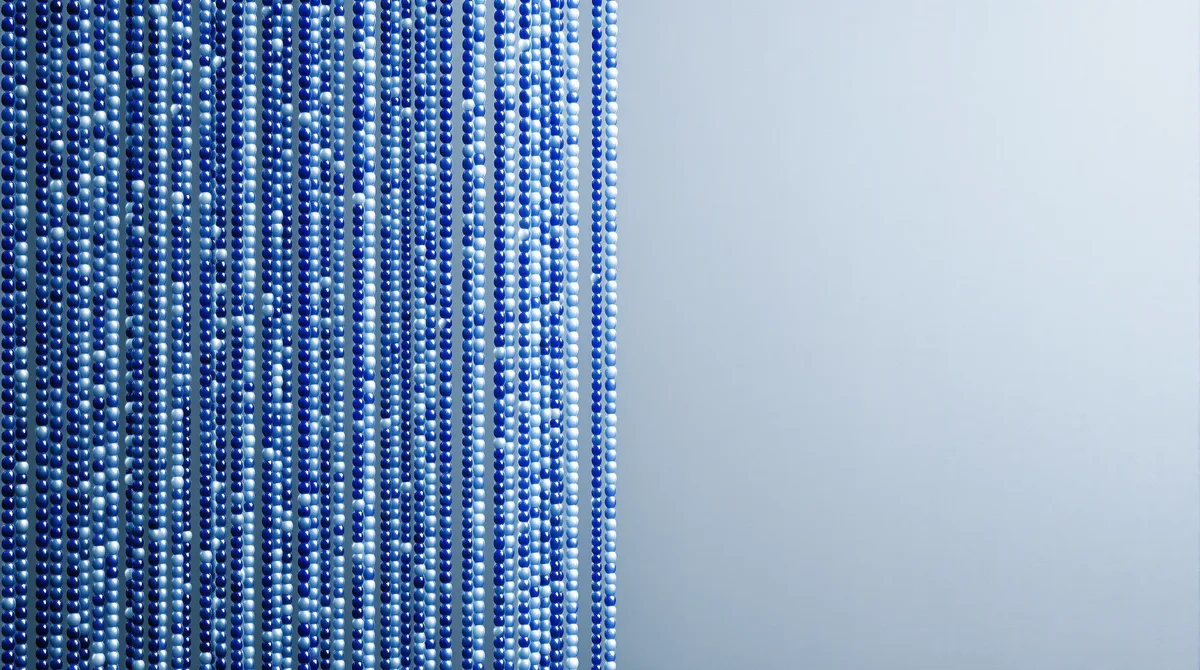
Drawn seed beads are small, made by drawing glass into a tube and cutting it, and they give the finest pattern resolution available — our Naia curtain is built on lime glass seed-bead strands.
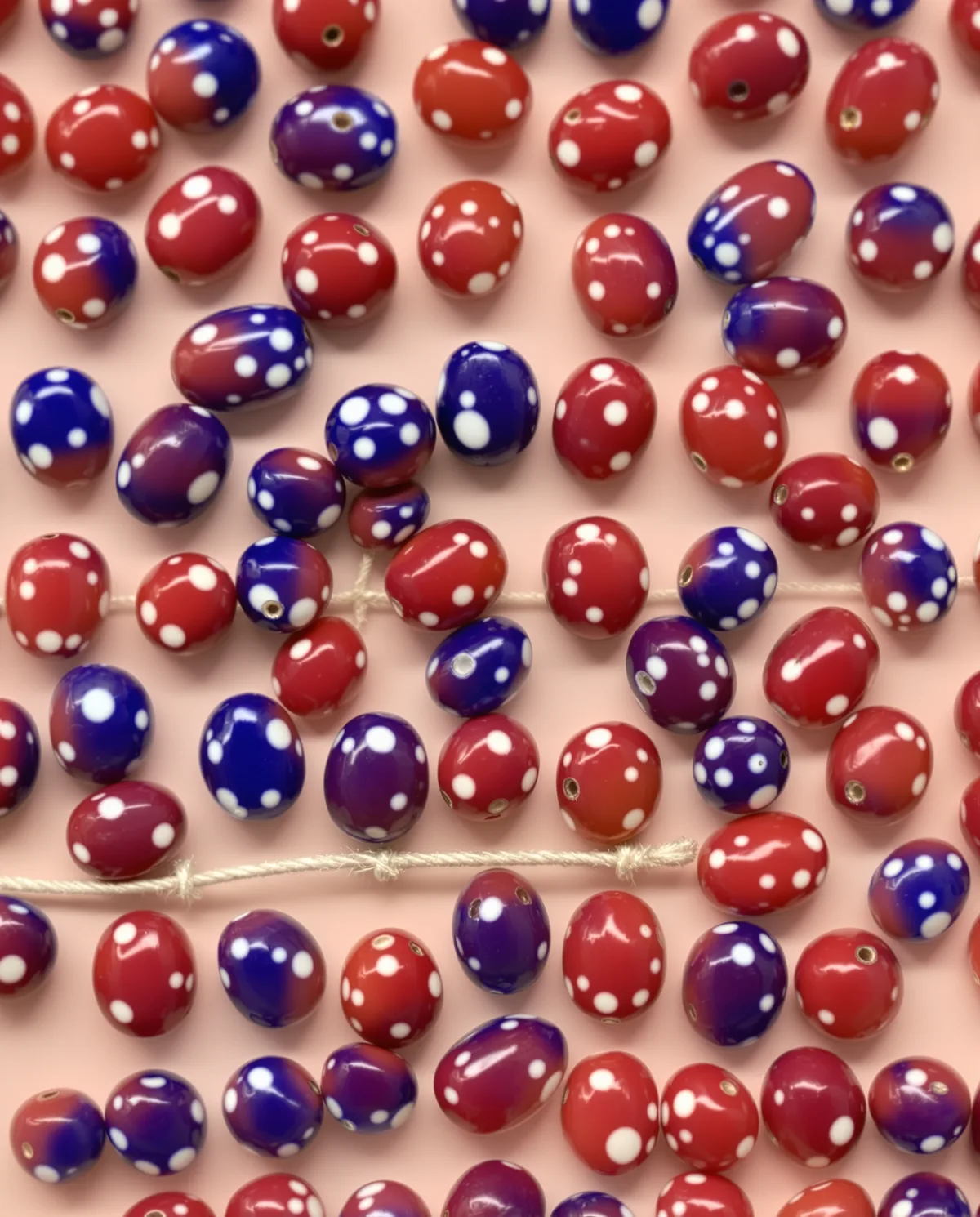
Pressed glass is moulded, so a shape repeats exactly across a run, and the colour is usually in the body of the glass. Our dotted oval beads at 13 × 22 mm are pressed, and about 90 to 120 of them go into a single Polka Dot curtain as scattered accents.
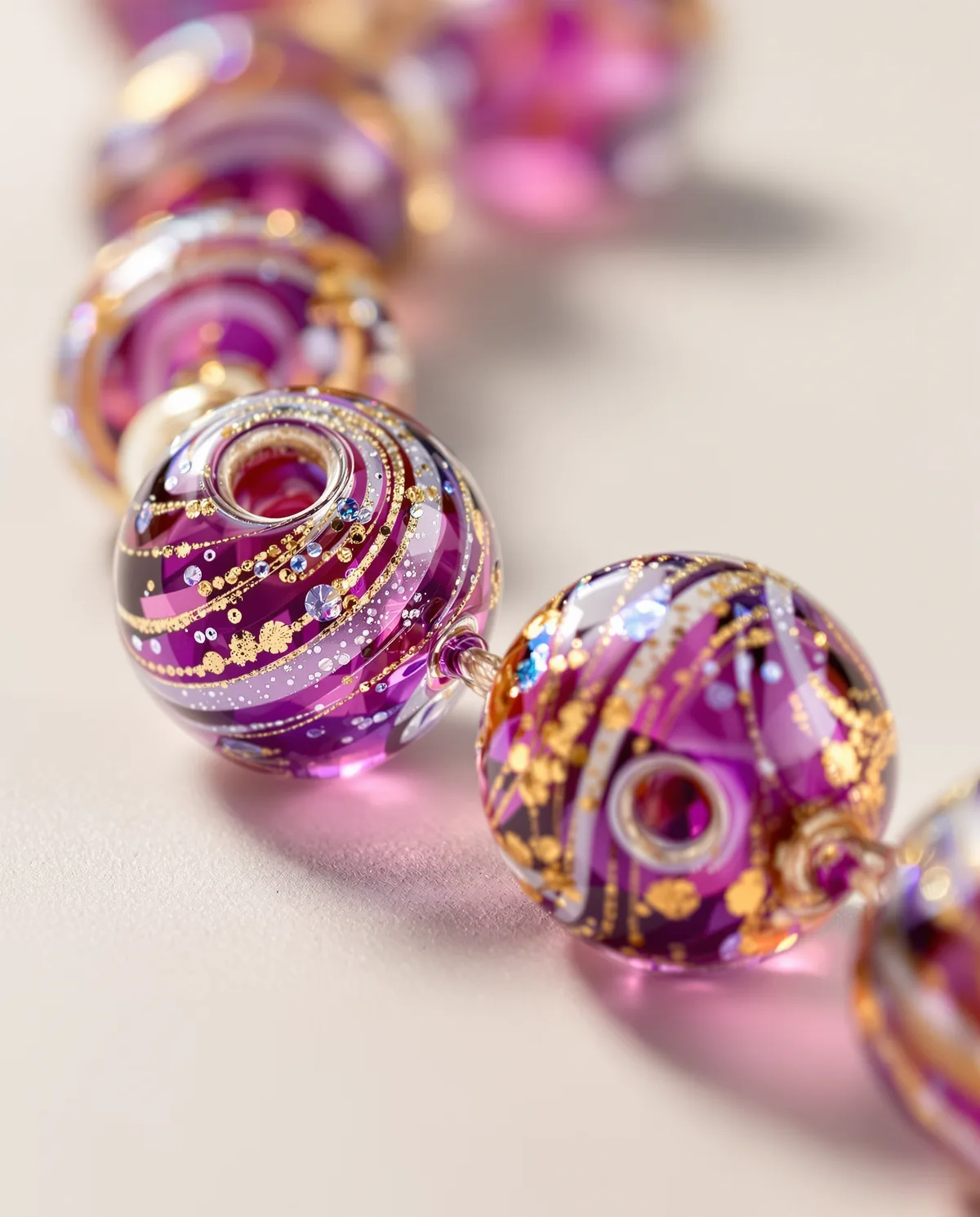
Hand-made lampwork and Venetian-style beads are wound at the torch, so every one is slightly different. They are feature beads, used a few per strand.
Most real designs are a seed-bead or pressed base carrying a feature bead on top. That combination is also the cheapest way to get a glass panel that reads as special.
Here is the genuinely interesting constraint: glass strength is colour-dependent, and some colours are incompatible when beads clink against each other in a hanging curtain.
We met that head-on on the Gigi Venetian portal, which uses large hand-made Venetian glass beads. The first builds had a breakage problem, and it was solved two ways: by changing the furnace process and annealing the beads — heat treatment that relieves internal stress — and by altering the palette, because the weaker colours could not stay in a design where large beads knock together all day.
That is not a story about a defect. It is what owning the furnace lets you do about one.
If it is in the glass, yes. Body-coloured pressed glass is the most tolerant surface in the whole category — effectively permanent in domestic use, unaffected by humidity, daylight or cleaning.
Surface-dyed beads are the exception and the thing to watch. Dye on a bead is a surface property, so solvents lift it and strong daylight fades it. At a sunny window, specify body colour. Frosted and sea-glass beads are matte because the surface is textured, so rubbing hard polishes them into gloss, which cannot be undone.
Weight is established on the approved sample, because it depends entirely on bead size, strand count and drop. What is reliable is the ratio: the same design in glass is roughly double its acrylic weight.
A full 90 × 200 cm glass panel wants a curtain rod on brackets fixed into the door frame or solid wall. Lightening it is a design exercise rather than a hardware one — smaller beads, a wider strand pitch, or a mixed strand with glass only where the light hits it.
A bright chime. Point contact between two dense, hard beads produces a high, ringing note that carries further than acrylic's click, wood's soft knock or bamboo's dry rattle.
In a hallway it is the best sound in the category. Outside a bedroom door it is the worst. It is the most under-specified property in beadwork and the easiest to get right in advance, so decide it before the material.
Dust dry first, drawing a soft brush down each strand from header to hem. Then a barely damp cloth on the beads, dried in the same pass. No solvents, no abrasive cream, no steam, no hot water — and keep the water out of the cord, which is the component that actually fails.
A chipped or parted strand is a repair, not a write-off: re-strung onto new cord in bead-map order and re-knotted at the header. Spare beads specified with the order are what make it practical. On a glass panel that matters more than elsewhere, because glass is the one material where handling damage is a real possibility.
Glass seed beads is the material page for the fine end of the trade, and the crystal bead curtain question covers the cut and faceted beads people usually mean by crystal. Mixing bead materials is how most real glass designs are actually built, because a few glass beads in a lighter strand do most of the visual work. Panel weight is the page the fixing decision comes from. For the other direction, a wood bead curtain and an acrylic bead curtain are the two materials glass is normally weighed against, and bead materials sets out all nine families.
Good to know
Drawn and hand-strung in our own Firozabad glass works, which is also where the colouring, frosting and ribbing happen. That is why glass is the material where colour and annealing are things we can change rather than things we have to accept — the furnace is ours.
Not when the design allows for it. Glass sits near 2.5 g/cm³ against acrylic at about 1.2, so a glass panel is roughly double the weight of the same design in acrylic. Smaller beads or wider accent spacing lighten it, and a rod on brackets fixed into the frame carries it comfortably.
Yes. Tinted glass beads are matched to a colour reference or a physical chip and approved on the sample. There is one real constraint: glass strength is colour-dependent, and some colours are weaker than others when beads clink against each other in a hanging panel.
They can chip if knocked hard against each other, which in a doorway in daily use is an occasional event. We solved a real breakage problem on our Gigi Venetian portal by changing the furnace process and annealing the beads, and by altering the palette, because glass strength varies by colour.
Heat treatment that relieves stress in the glass and makes a bead stronger. It matters on larger feature beads, which take more force when two of them knock together. On Gigi it was the change that made a large hand-made Venetian bead viable in a curtain at all.
Strands are kept in order and protected against knocking in transit, then packed to the carton specification given. On a glass panel this is not a nicety — the beads are the one component that can be damaged by handling, and a panel that arrives chipped is a returns problem.
Three different trades sit inside the word glass. Drawn seed beads give the finest resolution; pressed glass gives repeatable moulded shapes and body colour; hand-made lampwork and Venetian-style beads give large one-off feature beads. Most real designs combine a seed-bead or pressed base with a feature bead on top.
Keep exploring
Material
How seed beads are drawn, why dye lots are quoted per run, what the drill hole limits, and where seed-bead work earns its cost.
Specs and sizesPillar
Door curtains, portals, café lengths and valances: the standard sizes, the strand counts and the one question each format answers.
View the rangeGuide
Glass where the light hits it, lighter beads everywhere else: the arrangement that most good bead panels actually use.
Read the guideGuide
A soft knock instead of a chime, grain that never matches twice, low weight, and the one thing wood cannot tolerate.
Read the guideGuide
Cut or faceted glass, described plainly: the heaviest panel in the category and the only one that genuinely dazzles.
Read the guideGuide
Resolution, weight, repeatability, cost per covered area and breakage risk, with the working figures from production.
See the detail
Start a conversation
Send a reference, a colour chip or a sketch. Minimums are set per design and confirmed per quote; sampling is quoted separately and usually runs 16 to 20 days from an agreed brief.