Guide
Wood against bamboo
Weight, sound, behaviour when cut and damp tolerance — and why the wood route is turned, drilled and finished in our own factory.
See the detail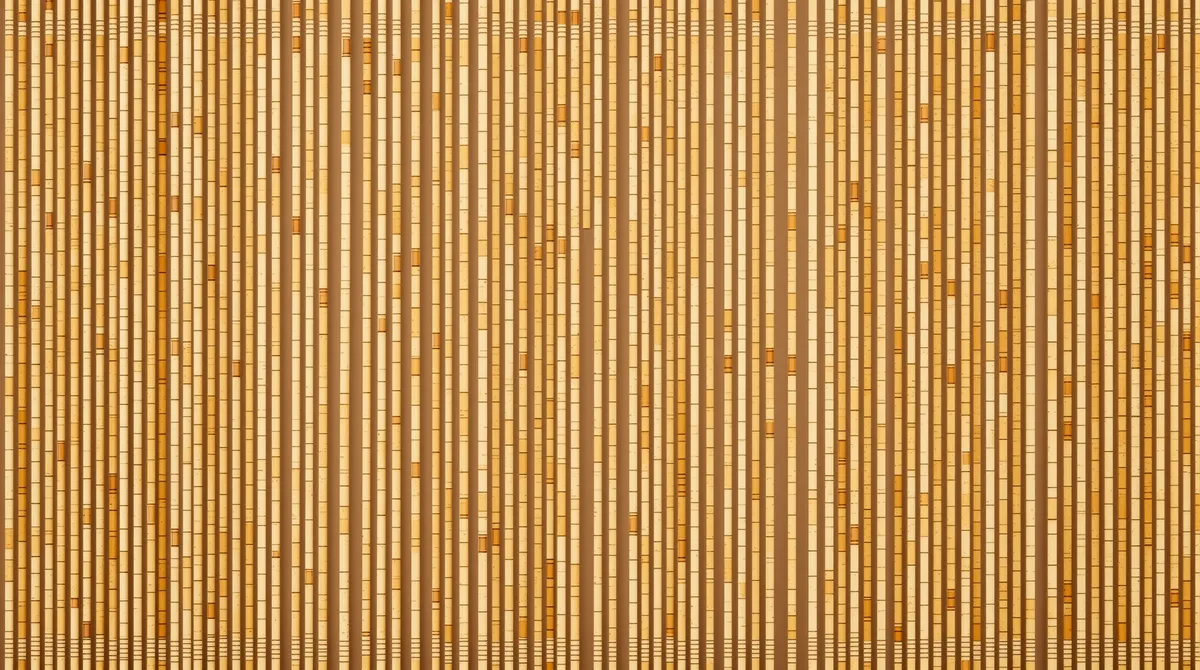
Guide · Material
Bamboo is the lightest and driest-sounding bead in the category, and the only material on this page we will not claim as an owned capability. Both halves of that sentence matter.
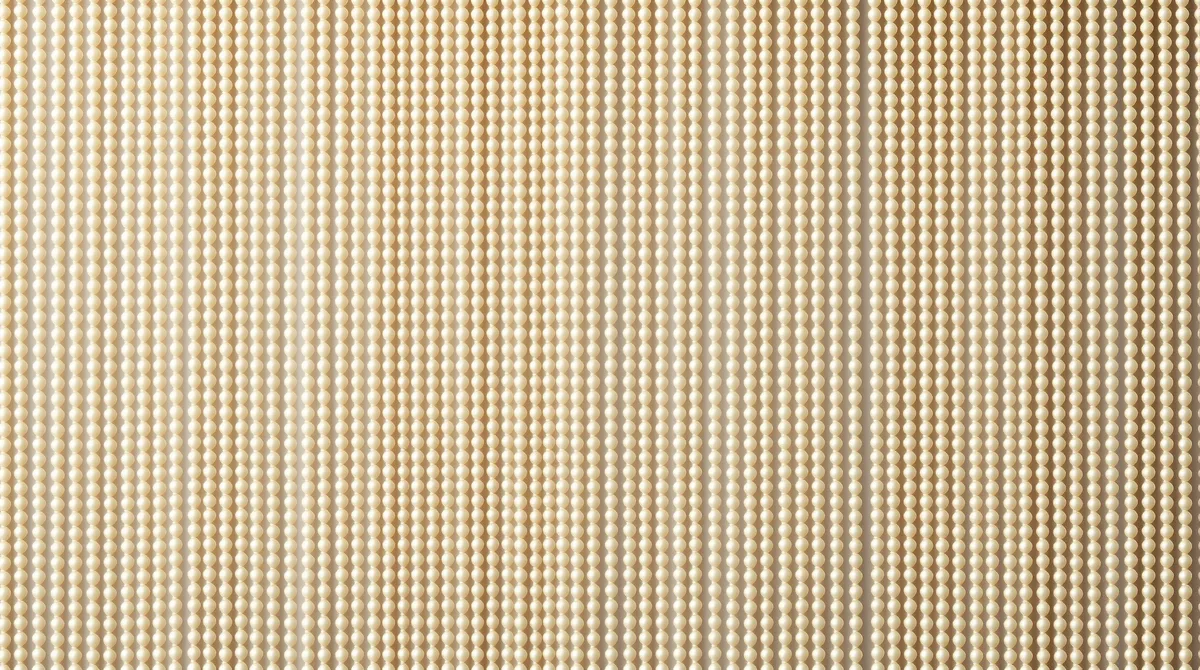
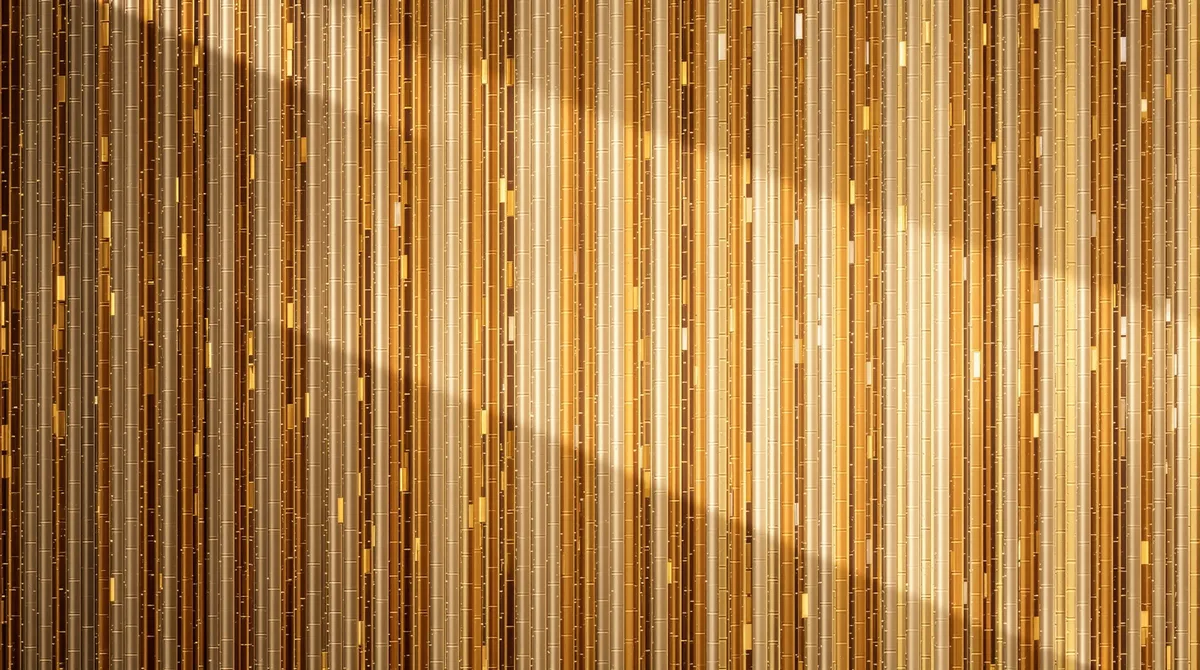
A curtain strung solid with short cut bamboo tube beads, the hollow culm and pale raised node rings readable on every piece, in natural straw, honey and scorched amber.
A bamboo beaded curtain hangs short cut tube beads of natural culm on cord. It is the lightest panel in the category, makes a dry rattle rather than a chime, and marks permanently in rain or constant damp. Unlike glass and wood, bamboo is not something we hold as an owned capability: it is offered alongside wood and confirmed design by design.
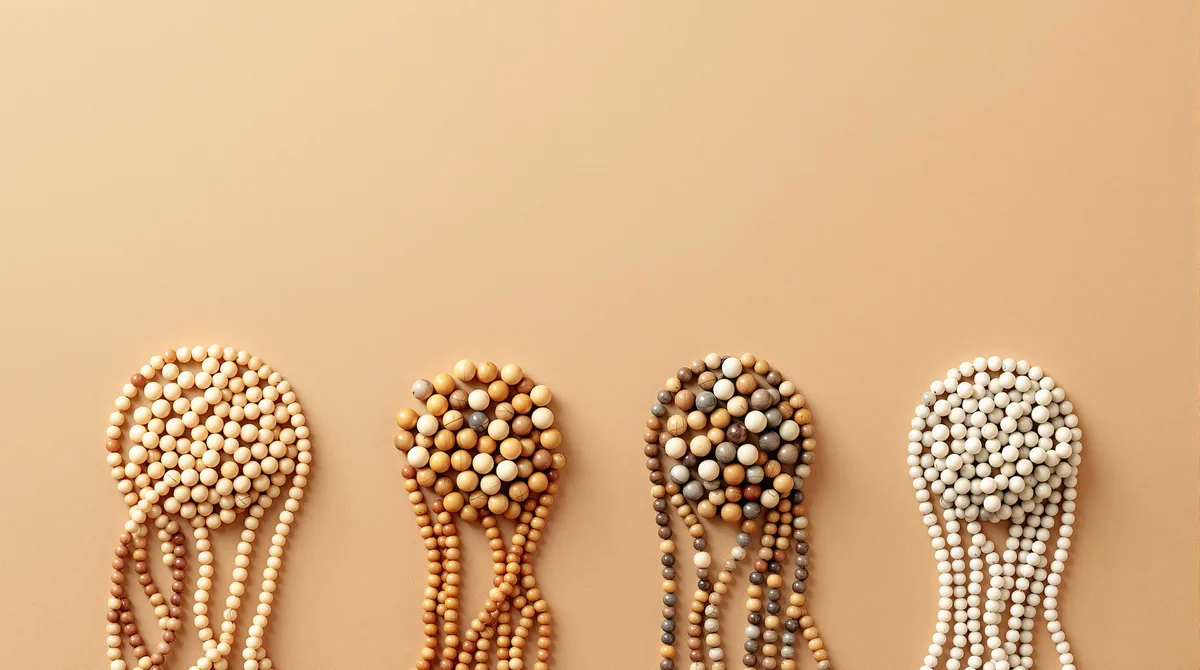
It is a hand-strung panel in which the beads are short lengths of bamboo culm, cut across the stem so the hollow centre becomes the bore. The hard outer skin stays on, which is what gives the bead its colour and its sheen; the pale fibrous interior shows at the cut ends. Strands are threaded on cord and gathered on a dowel exactly as in any other strung panel.
Because the bead is a tube rather than a sphere, a bamboo strand reads as a column of segments rather than as a line of dots — a different visual rhythm from every other material here.
It moves more than anything else in the category and it settles last. A bamboo strand has almost no mass, so a door closing anywhere nearby sets the whole panel going, and in a draughty hallway it may never be entirely still.
Visually it does something no coloured bead manages: it reads as a natural material in a room, in the way a rush mat or a cane blind does, rather than as decoration applied to a room. That is the reason people specify it, and it is a reason worth taking seriously.
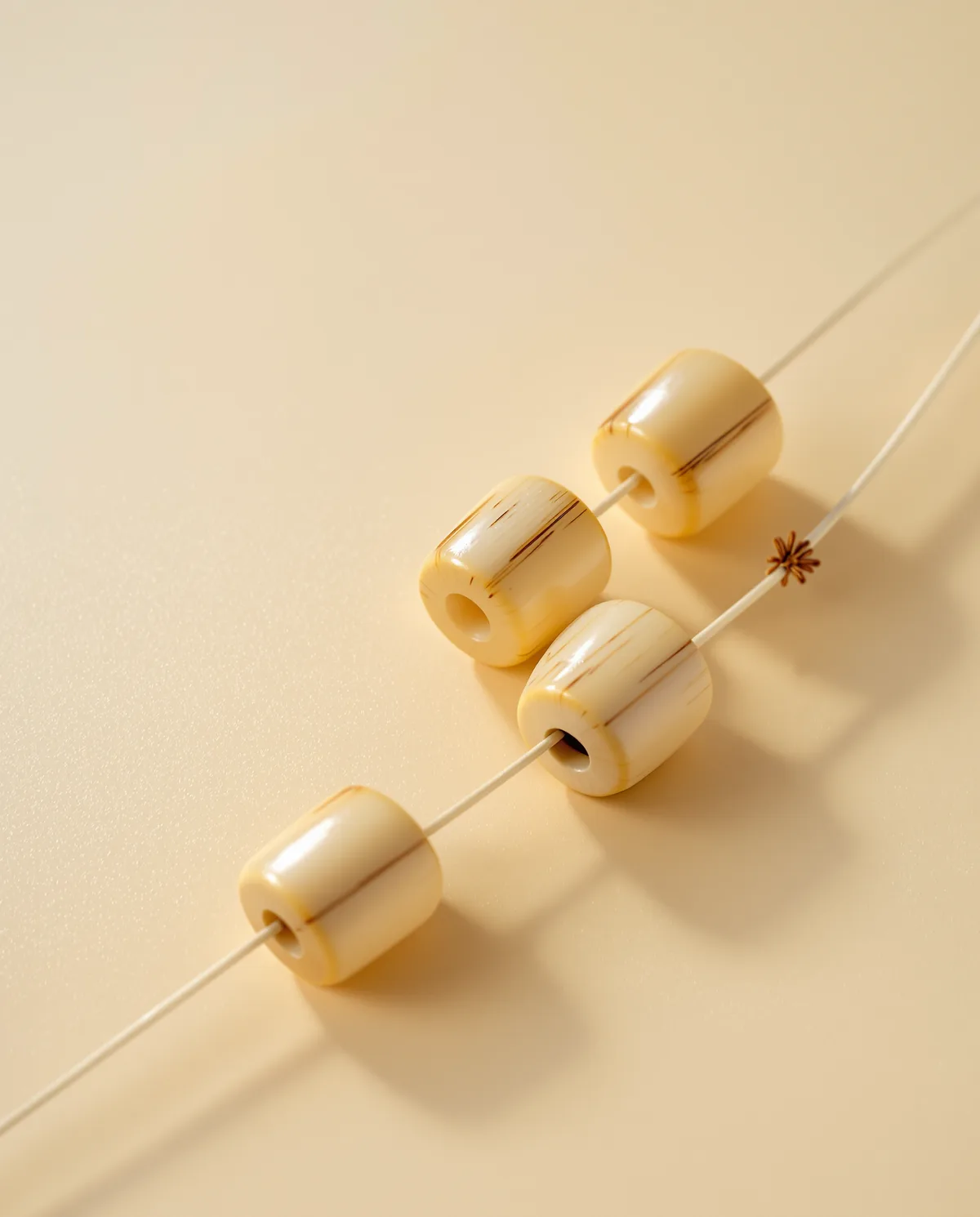
Against wood, bamboo is lighter, hollower-sounding, and more obviously a plant. Turned wood is denser, quieter, and takes stain and lacquer; bamboo is essentially unfinished. Against glass, there is no comparison to make — one is heavy and refractive, the other light and opaque.
The genuinely useful comparison is bamboo plus something. A bamboo strand with glass or acrylic accents gets colour and weight at the same time, and that combination is what most bamboo designs actually are.
The sequence is standard: bead map, colour direction, cord sized to the smallest hole in the build, string, gather on the dowel, cut the hem. Two things differ.
First, the bore is generous, because it is the natural hollow of the culm rather than a drilled hole. That widens the cord choice and makes bamboo one of the easier materials to string.
Second, weight has to be designed in. A bamboo strand will not fall straight by itself. The answer is a deliberately heavier final bead, or wood and glass spacers placed down the strand, and it has to be decided on the sample rather than discovered after hanging.
It is the lightest option available, and that makes it the friendliest to a fixing. A tension rod inside the door frame is adequate for a bamboo panel — one of the few cases where that is genuinely true rather than merely tempting — which is why bamboo and acrylic are the materials people reach for in rentals.
As a rough physical guide, most woods sit below 1 g/cm³ and bamboo is lighter still for its volume because the bead is hollow. Glass sits near 2.5. The same design in the two materials is not the same object on the wall.
None, through the bead. Bamboo is opaque, so a bamboo panel works by covering part of the opening rather than by filtering what passes through it. What you get is a striped effect: solid where the beads are, clear where the gaps between strands are.
That makes pitch the only lever on light with this material. A close pitch gives a dim, warm, slatted effect; a wide pitch reads as an open screen with texture in it. There is no middle path through the bead itself, which is where glass and translucent acrylic differ fundamentally.
Rather more than glass, for the same reason: an opaque bead at a close pitch breaks up a sightline properly. It still gives nothing at close range — nothing in this category does — and it still shows movement clearly.
The practical statement is that an opaque bead at a tight pitch screens who rather than what: someone at the far end of a corridor sees that the doorway is occupied and not much more. At two metres, that protection is gone.
The same standards as any door panel: about 90 × 200 cm, roughly 35 × 79 in, for a single interior door, and 120 cm for openings from 36 in. Bamboo makes a long drop easier than glass does, because the cumulative strand weight that limits a tall glass panel barely applies.
Width, drop and strand count are set per order in any case. There is no stock programme behind beaded décor — every panel is made against an approved sample.
Indefinitely in a dry room, and badly in a wet one. Those are the two answers and the humidity is the whole variable. Bamboo has no protective finish to lose, so the fibre takes up moisture directly: a panel in a bathroom doorway or a kitchen that steams will mark, and the mark stays.
In a dry hallway the cord is the service item, as on every strung panel, and the bamboo will outlive it.
Because the alternative is a claim we cannot support. Glass beads are drawn and hand-strung in our own Firozabad glass works. Wood, including curtain dowels, is turned in our own Saharanpur factory. Ceramic is fired in Khurja; metal is finished and plated in Moradabad.
Bamboo is offered alongside wood and confirmed per design. We do not own a bamboo facility and will not say we do. On a specification that matters — a programme with a repeat schedule behind it — that distinction is the useful information, and a page that hid it would be less helpful to you, not more.
Read wooden beaded curtains next, because wood is the material bamboo is usually being compared against and the two differ more than they look. Mixing bead materials is the page that solves bamboo's weight problem, since glass or acrylic spacers supply what the culm cannot. Steam and beadwork is worth a look if the panel is anywhere near a bathroom, because bamboo is the one material that marks permanently. For the sound, what a beaded curtain sounds like sets the dry rattle against a chime and a knock. And the material library puts bamboo in the context of the other eight bead families.
Good to know
No. We recommend indoor use only. Bamboo marks in rain and in constant damp, and because the mark is in the fibre rather than on a finish it does not clean off. A covered veranda in a dry climate is borderline; an exposed porch is not.
Not on its own. All-bamboo strands are very light, so the design normally adds weight — a larger end bead, or wood or glass spacers down the strand. Without that the panel drifts in any air movement and takes a long time to settle.
Yes, and it is the usual way to get colour into a natural panel. Glass or acrylic accents add both colour and the weight bamboo lacks, which solves two problems with one decision. Mixed strands are standard practice rather than a compromise.
Often it is lighter to ship, which helps a landed cost. The piece price depends on the design, the mix of materials and the amount of stringing rather than on the material alone — on a tube bead, how many beads fill the drop matters more than what each one costs.
Because we will not claim a capability we do not own. Glass beads are drawn in our own Firozabad glass works and wood is turned in our own Saharanpur factory, so those are manufacturing claims we can stand behind. Bamboo is offered alongside wood and confirmed design by design, and saying so is more useful to you than a vaguer claim.
Dust it, or wipe with a dry cloth. Treat it as you would wood but with less tolerance: do not soak it, keep it away from constant steam, and keep water off the cord. There is no finish on a natural culm bead to protect the fibre underneath.
A dry rattle — hollow, woody and quieter than glass but more percussive than solid wood. It is the most recognisable sound in the category, and it is either the reason you want bamboo or the reason you do not.
Keep exploring
Guide
Weight, sound, behaviour when cut and damp tolerance — and why the wood route is turned, drilled and finished in our own factory.
See the detailMaterial
Turned and drilled in our own wood factory: grain variation you approve rather than eliminate, the finishes that hold colour, and the dowel from the same plant.
Specs and sizesPillar
Door curtains, portals, café lengths and valances: the standard sizes, the strand counts and the one question each format answers.
Read moreGuide
A coated surface rather than a body colour: why pearl beads scuff where others dull, and where they are still the right answer.
See the detailGuide
Hundreds of beads to a strand: the finest colour resolution in beadwork, and the longest stringing time in the category.
See the detailGuide
A soft knock instead of a chime, grain that never matches twice, low weight, and the one thing wood cannot tolerate.
See the detailGuide
Glass where the light hits it, lighter beads everywhere else: the arrangement that most good bead panels actually use.
See the detailGuide
Which materials tolerate steam, which mark permanently, and why the cord rather than the bead sets the lifespan.
See the detail
Start a conversation
Send a reference, a colour chip or a sketch. Minimums are set per design and confirmed per quote; sampling is quoted separately and usually runs 16 to 20 days from an agreed brief.