Reference
When to place the order
Counting backwards from a floor-set date through sampling, production, inspection, freight and receiving.
See the detail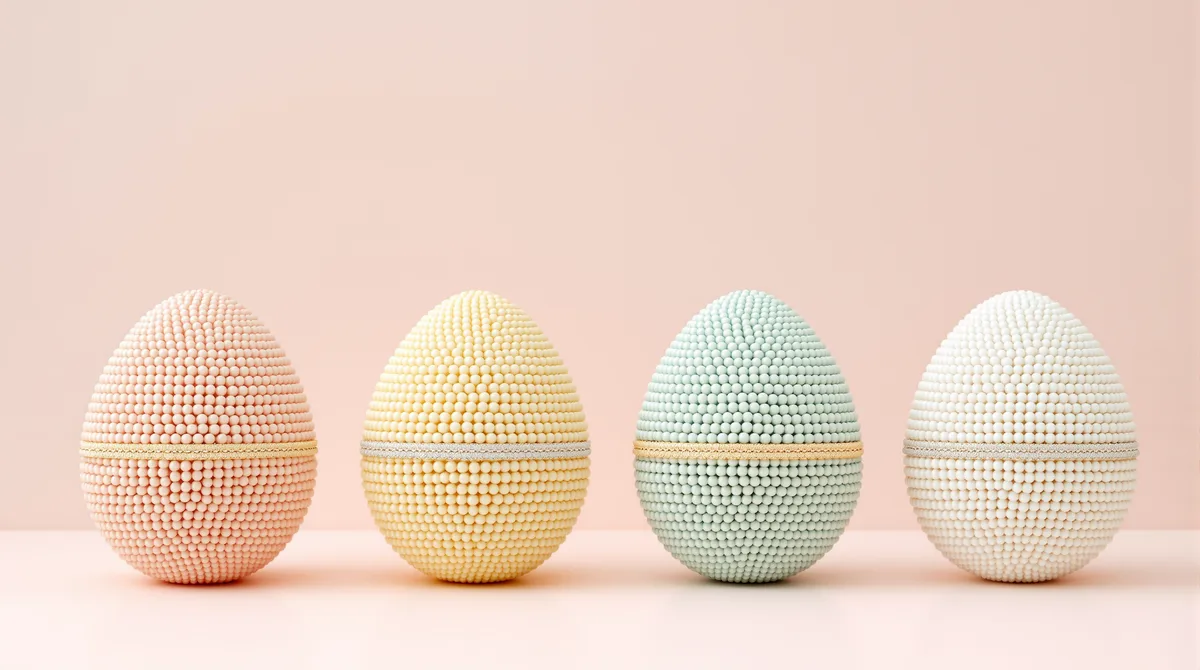
Craft topic
Easter moves. Its date shifts by more than a month between years, the season is short, and the palette is the opposite of autumn's — three facts that between them decide what beadwork can sensibly be made for it.
Four beaded egg forms in a row, each covered in tiny glass seed beads worked in close rows following the curve, in pale blush, butter yellow, mint and chalk white with a couched…
Easter beadwork is small-format work: eggs, flowers, birds and bunting at roughly 7 to 18 cm. A short season and a date that moves by more than a month between years rule out large developments, and the pastel palette is harder to hold across a dye lot than any strong colour is.

Three things about Easter shape every decision, and none of them is aesthetic.
It moves. The date shifts by more than a month between years, which means a range that will sell for more than one season has to be delivered against the earliest Easter in that window, not the average.
It is short. The core sell is four to six weeks; a spring range framed more broadly stretches to eight or ten.
It is pale. The palette is the inverse of autumn's, and pale colours are much harder to hold across a production run than strong ones.
Because the risk and the calendar both point that way. A six-week window will not amortise a large-format development: a beaded wall hanging or a portal is a 40 to 60 day production run after sampling and freight, and a short season cannot carry the inventory risk if it misses.
Small forms also suit the display habit. Easter is a grouped-display season — eggs on a branch, a bowl of small objects, a cluster of flowers — so the retail unit is a set, and a set of small pieces is a better bet than one large statement.
The sizes that work are the documented ones: ornament-scale pieces at roughly 7 to 11 cm, and wire-wrapped figural birds and animals at 12 to 18 cm.
Because it is one, only worse. On a sphere, bead rows converge at two poles. On an egg they converge at two poles of different radius, so the two ends need different solutions.
Every good beaded egg closes those ends deliberately — a beaded cap, a pinned rosette worked outwards from the tip, a change of bead size through the last few rows so the count can reduce without crowding. A poor one lets the rows pile, and because an egg hangs from its narrow end, that is precisely where the eye goes.
This is the same geometry that makes a spherical ornament difficult, and it is the single most reliable thing to inspect on any egg.
Because a small shift is proportionally large in a pale colour. Surface-dyed glass seed beads shift between dye lots — a batch property of the material, not a fault — and a half-step of shift that would be invisible in a deep cobalt is obvious in a pale blush or a mint.
Three practical consequences. Specify whether a single dye lot is required at the brief, because it constrains how a run is scheduled. Approve against the sample rather than the original chip. And where a pale field carries an accent, dye the field to match the accent so the relationship between them survives the shift even if the absolute colour moves.
Where a palette has to be exact, moulded acrylic is worth considering instead: acrylic is dyed to colour rather than surface-dyed, so it repeats more tightly.
Couched bead and thread embroidery for eggs and flat pieces, on a stiffened or stretched ground over a form. Dimensional couched florals at 9 to 12 cm for flowers. Wire-wrapped beadwork over a shaped brass armature for birds, animals and anything that has to hold a silhouette. Crochet and amigurumi for the soft versions, which sit in the same reference catalogue.
Glass seed beads carry the detail; moulded acrylic carries an exact pastel; cast resin shapes carry a petal or a blossom form where a bead cannot.
An Easter programme is available to develop: the constructions already exist, and the seasonal range is the new part.
The constructions are ours and documented: bead and thread embroidery at coaster and floral scale, wire-wrapped work including figural birds and animals at 12 to 18 cm, and crochet including ornaments at 7 to 11 cm. This page is those constructions applied to a seasonal brief, which is how a programme would actually begin.
From the shelf date, and against the earliest Easter in the range's life.
Our published figures are sampling at 16 to 20 days from an agreed brief and production at 40 to 60 days after sample approval, with sampling quoted separately. Add colour approval, the buyer's own approval cycle, ocean freight and distribution. An early-April shelf date therefore wants sample approval before the end of the previous year and a brief in the autumn before that.
The moving date is the trap. A programme planned for a late Easter and reordered in a year with an early one arrives after the window has opened.
Both ends of an egg. Whether a flower's petals hold shape unsupported, which tells you there is wire in them. Whether a bird stands or hangs level. Two pieces side by side under one light, for pastel consistency. Then the pack, because a seasonal set is bought on the assumption it survives storage.
Seasonal small-format beadwork is made in very large volume for short windows, mostly machine-assembled or glued. The hand-couched and wire-wrapped end is a premium craft market, and its advantage is that the construction is visible on an object people pick up.
Because the two genuinely transferable pieces of knowledge here — the moving-date calendar and the pastel dye-lot problem — are worth more to a buyer than a motif board, and both apply whoever makes their eggs. The constructions are ours; the seasonal range is available to develop on them.
Good to know
A motif set, a size set, a bead and colour specification with the dye-lot question answered, and a sample. Sampling runs 16 to 20 days from an agreed brief, production 40 to 60 days after sample approval. Because the date moves, the development has to be planned against the earliest Easter in the years it will sell, not the average one.
The constructions on this page are ours — couched bead and thread embroidery, and wire-wrapped beadwork with figural birds and animals at 12 to 18 cm — and an Easter programme is those applied to the season. Available to develop.
An egg is a covered form: a wooden or polystyrene egg with a ground over it and beads couched on in rows. A flower is either couched as a dimensional floral at 9 to 12 cm or built as beaded wire petals over an armature. A bird is wire-wrapped over a shaped brass armature, which is what lets it hold its outline.
Easter décor, spring décor and pastel décor overlap in retail, and the commercial distinction matters: a spring range sells for eight to ten weeks where Easter proper sells for four to six. Beaded eggs are sometimes called Fabergé-style eggs, which is a decorative reference rather than a construction one.
On an egg, look at both ends: that is where bead rows converge and where a careless maker leaves a crowded dome. On a flower, check the petals hold their shape without support, which means there is wire in them. On a bird, check it stands or hangs level. Then check two pieces side by side for pastel consistency, which is this palette's whole problem.
Hanging eggs from a loop on a twig or branch display is the standard presentation, and it is also the one that shows construction best because the piece turns. Flowers and birds display standing or clipped. Anything in this family benefits from being grouped, because the pieces are small and a single one disappears on a shelf.
Soft brush, dry. Never wet an egg: there is a form inside it and water reaches the form and stays there. Store in a divided tray so the pieces cannot press on each other, because eleven months of pressure flattens a couched surface permanently, and pastels show a crush mark more than a dark colour does.
Keep exploring
Reference
Counting backwards from a floor-set date through sampling, production, inspection, freight and receiving.
See the detailIndex
Seventeen beaded objects documented from inside the craft — what each one is, how the tradition builds it, and what it would take to develop one.
See the detailCraft topic
The bead, the hole, the cord and the tassel — how a wood-bead garland is actually made, and what separates a good one from a cheap one.
Specs and sizesCraft topic
Why clay took the garland market from wood, what polymer heishi and fired ceramic each give up, and the breakage the format carries.
Specs and sizesCraft topic
Head, skirt and loop — how each part is built, and the neck that decides whether it survives.
Read the guideCraft topic
Four elements — form, ground, couched beads, hanging loop — at seven to eleven centimetres, and why the poles of a sphere are where ornaments fail.
Specs and sizes
Start a conversation
Send a reference, a colour chip or a sketch. Minimums are set per design and confirmed per quote; sampling is quoted separately and usually runs 16 to 20 days from an agreed brief.