Reference
Beadwork techniques: the five craft families
Five craft families — strung, embroidered, wire-wrapped, knotted and wrapped fibre — and what each one is good for.
Open the reference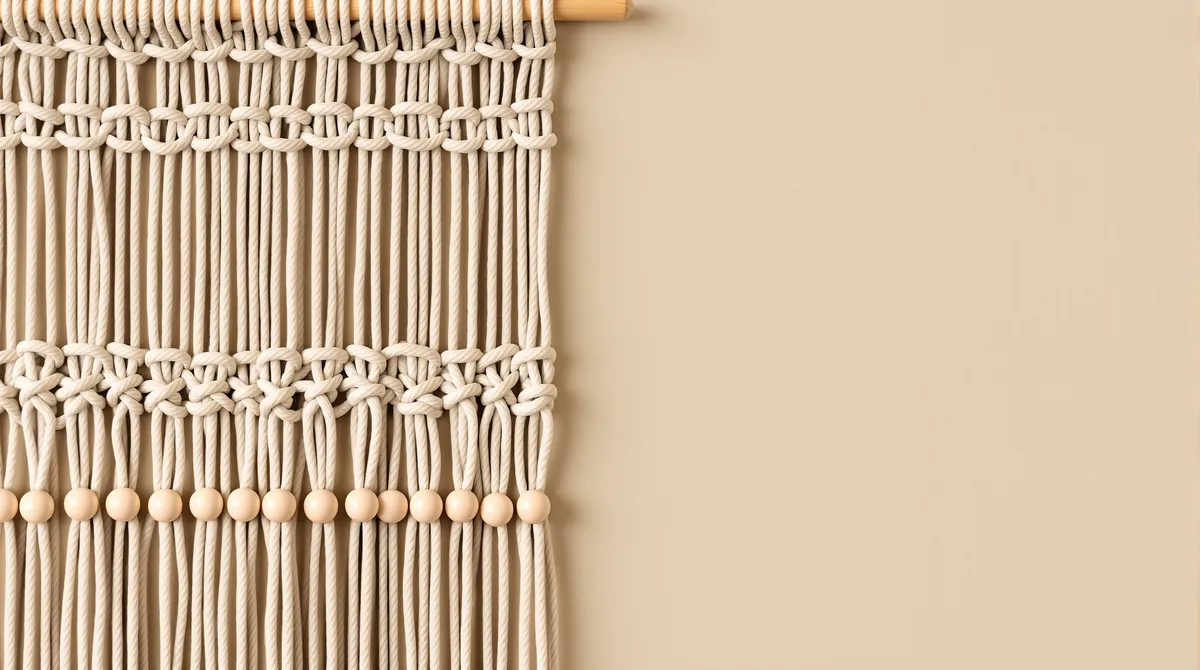
Technique · Knotting
Knotting is not slow stringing. Every knot is tied, tensioned and dressed, and the next one depends on the last being right — which is why knotted work carries a different lead time from beadwork and has to be drawn before it is started.
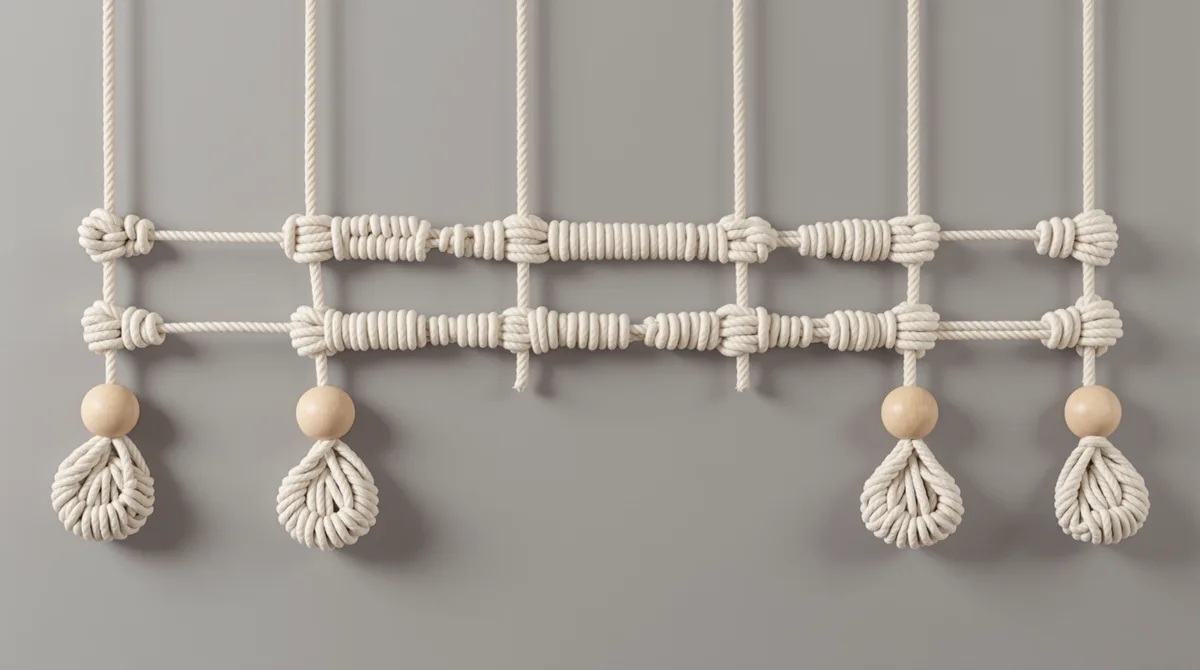
Hand-tied macramé in rows of square knots and half hitches worked in natural cotton cord, a round wooden bead threaded on the working cords between each pair of knot rows, hung…
Macramé is hand-knotted cotton cord, worked in square knots and half hitches downwards from a mounted wood dowel or metal hoop, with a combed or knotted fringe below the last row. It runs 60 to 90 days after sample approval rather than the 40 to 60 of beaded décor, because every knot is tied, tensioned and dressed in sequence.
Macramé is knotting. Cotton cord is mounted onto a dowel, a hoop or a shaped wire frame, and then knotted downwards row by row until the pattern is finished, leaving the cord ends below as a fringe. Two knot families do almost all of it: the square knot, which builds flat bands and diamonds, and the half hitch, which builds diagonal lines and curves.
It is not beadwork, and it is in our technique reference because it shares the studios, the wall-hanging formats and the buyers — and because beads are frequently knotted into it. The documented knotted formats run from trees at 12 to 18 cm to wall panels at 25 to 45 cm drop.
Knot count, and nothing else comes close. Knot count is not proportional to finished size: a dense 30 cm panel can carry more knots than an open 60 cm one, which is why knotted work cannot be quoted from dimensions the way strung work can be estimated from a drop and a strand count.
The second driver is pattern complexity, because a pattern that changes cord roles frequently costs more than one that repeats. The third is the fringe, which is slower to dress well than it looks.
Because knotting is sequential and stringing is not. A beadworker can load a strand steadily; a knotter has to tie, tension and dress each knot, and the next knot depends on the last one being right. Tension is cumulative, so an error two rows up cannot be corrected without untying the work below it.
That is the whole reason the published lead times differ: beaded décor runs 40 to 60 days after sample approval, and bohemian and knotted work runs 60 to 90. Where a single piece mixes knotting with beadwork, the knotting sets the date for the order.
A tech pack for knotted work carries the knot pattern drawn row by row, with the knot type at each position and the role of each cord. Cord specification and cut lengths — long, because a knot consumes cord and a piece cut short cannot be rescued. The mount: dowel, hoop or wire frame, with its dimensions. Bead positions plotted into the same drawing where the design carries beads. Fringe length and dressing method. Finished drop and width.
A genuinely new construction is drawn in full before the first knot is tied. On our knotted dog series, at roughly 18 to 35 inches, the full tech pack was drawn before anything was knotted, for exactly that reason.
Volume and silhouette without beads. A knotted panel reads as substantial from across a room at a fraction of the material cost of a strung one, and the fringe gives it a soft edge that no bead hem can imitate.
It also holds a shape against gravity in a way strands cannot. A knotted piece mounted on a shaped wire frame can be a butterfly or an animal in outline; strung work can only be a plane.
Cotton cord at three to five millimetres is the core material. The adjacent natural-fibre family — raffia, jute and cotton rope wrapped and coiled over a wire ring — appears in the same ranges and is built on the same bench.
Beads can be worked in, but the cord decides which. A bead threaded onto three-to-five-millimetre cord needs a drill hole comfortably larger than that, so knotted work uses turned wood beads, ceramic beads and moulded resin beads rather than the glass seed beads that carry pattern in strung construction. That is a hole-diameter constraint, not a stylistic one.
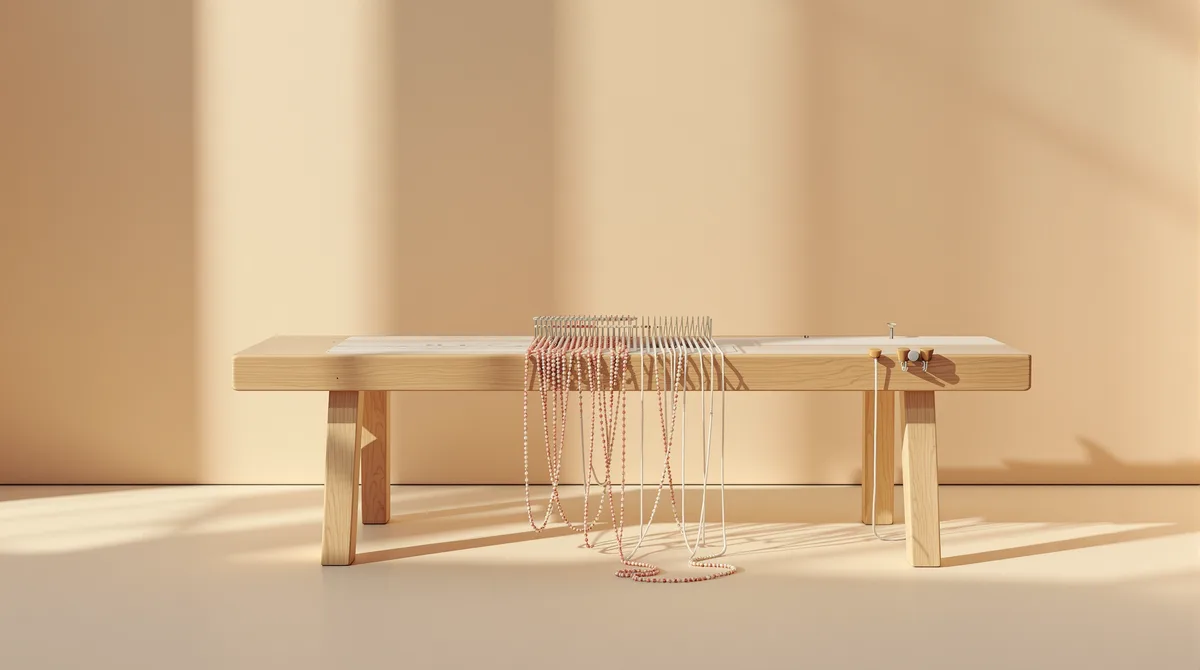
In our own studios, by hand. The equipment is deliberately simple: a working board or a hanging rail, a comb, and the mount itself, with the dowel coming out of our own wood turning. The components around the knotting are machine-made in plants we own — the dowel turned in our own Saharanpur wood factory, a wire frame formed and finished in our own Moradabad metal plants.
| Specification | Value |
|---|---|
| Core material | Cotton cord, 3–5 mm |
| Knot families | Square knot and half hitch |
| Mount | Turned wood dowel, metal hoop, or a shaped wire frame |
| Fringe | Combed or knotted, cut level after dressing |
| Craft family | Hand-knotted macramé and bohemian work |
| Knotted trees | 12–18 cm |
| Knotted wall panels | 25–45 cm drop |
| Sampled wall hanging | 36 in overall on a 22 × 14.5 in wire frame |
| Tech pack to finished sample | About 5 weeks, on a documented construction |
| Bead bore needed | Comfortably above the cord diameter |
| Production | 60–90 days after sample approval |
The documented range runs to wall panels at 25 to 45 cm drop and ornaments and trees from a few centimetres up. The largest piece we have taken to a finished sample is a knotted wall hanging at 36 inches overall on a 22 by 14.5 inch wire frame, delivered from tech pack to sample in about five weeks.
Anything substantially larger is a development. The constraint that bites first is tension control across a wide panel, not the knotting itself.
Row by row against the tech pack for knot count and knot type, then measured for drop, width and fringe length, then checked against the approved sample for tension. Beads are pushed to confirm they are locked rather than sliding. The mount attachment is loaded, because that is where the whole weight sits. Then first-article inspection, lot inspection, kitting and export packing through our own quality and packing house.
The mount — dowel, hoop or shaped frame — and its dimensions. The finished drop and width. The knot pattern, as artwork or a reference image. The cord specification and colour. Any bead positions, with a bead whose bore passes the cord. The fringe length and whether it is combed or knotted. Then packing, quantity per colourway, and the destination.
The omission that costs most is the cord. A softly twisted cord chosen for its hand will fluff at every knot, and by then the piece is made.
The knotted wall hangings, including the butterfly piece on its shaped wire frame; the knotted tree and ornament pieces in the catalogue; the knotted dog series in development at 18 to 35 inches; and the knotted fringe panels and hoops. Knotted tassels, ornaments and charms a few inches long are the same knotting scaled down, and are in development rather than in production.
By keeping the approved sample and measuring against it, not by eye. Two pieces with the same knot count can finish several centimetres apart if tension drifts, so tension is checked at the bench during the run rather than discovered at final inspection. That is the single practical difference between a knotted programme that holds and one that arrives inconsistent.
Good to know
A colour-count sheet is the bead-by-bead plan that makes a strung pattern repeat exactly across a run. Knotted work uses the equivalent document in a different form: a knot pattern drawn row by row, with knot type, cord roles and any bead positions plotted on it. The principle is identical — the drawing governs the bench, not the other way round.
Cotton cord at three to five millimetres is the core. Raffia, jute and cotton rope sit in the adjacent natural-fibre family, wrapped and coiled over a wire ring. Beads can be worked in where the bore passes the cord, which in practice means large turned wood, glazed ceramic and moulded resin rather than glass seed beads.
By knot count and measured tension rather than by eye. The approved sample is kept and the run is checked against it for row count, drop, width and fringe length. Tension is the hard one: two pieces with identical knot counts can finish several centimetres apart if the tension drifts, which is why tension is checked at the bench and not only at the end.
Wandering rows from inconsistent tension. Beads that slide, meaning the knots below them were tied loose. A fringe cut before it was dressed, which fans unevenly. Cord fluffing at the knots, which comes from a cord too softly twisted for the work. And a mount attachment that has pulled, which is where the full weight sits.
Within limits, and the limits are real ones. Our documented formats run to wall panels at 25 to 45 cm drop, and the largest sampled piece is a wall hanging at 36 inches overall on a shaped wire frame. Larger knotted panels are a development rather than a repeat of something documented, and the tension control is what gets harder rather than the knotting.
No. Square knots and half hitches are tied by hand, which is what the word hand-knotted means and why the hours behave the way they do. The dowel is turned in our own wood factory and a wire frame is formed in our own metal plants, so the components are machine-made and the knotting is not.
It depends entirely on knot count, and knot count is not proportional to size — a dense panel at 30 cm can carry more knots than an open one at 60. The useful figure we can publish is the programme one: about five weeks from tech pack to a finished sample on a documented construction, and 60 to 90 days of production after sample approval.
Keep exploring
Reference
Five craft families — strung, embroidered, wire-wrapped, knotted and wrapped fibre — and what each one is good for.
Open the referenceCraft topic
How a bead is trapped between knots rather than strung, why the cord gauge limits the bead, and why knotted work runs 60 to 90 days rather than 40 to 60.
Compare the optionsReference
40 to 60 days after sample approval for beadwork, 60 to 90 for bohemian and macramé, with sampling in front of both.
View the rangeProcess
The gather, the drawn cane, the cut, the tumble and the anneal — and why colour is decided in the melt before any bead exists.
Open the referenceProcess
What annealing relieves, why a colourant changes the glass it colours, and how a real breakage problem was solved by changing the furnace and the palette.
How it is madeCraft topic
Head, skirt and loop — how each part is built, and the neck that decides whether it survives.
Open the reference
Start a conversation
Send a reference, a colour chip or a sketch. Minimums are set per design and confirmed per quote; sampling is quoted separately and usually runs 16 to 20 days from an agreed brief.