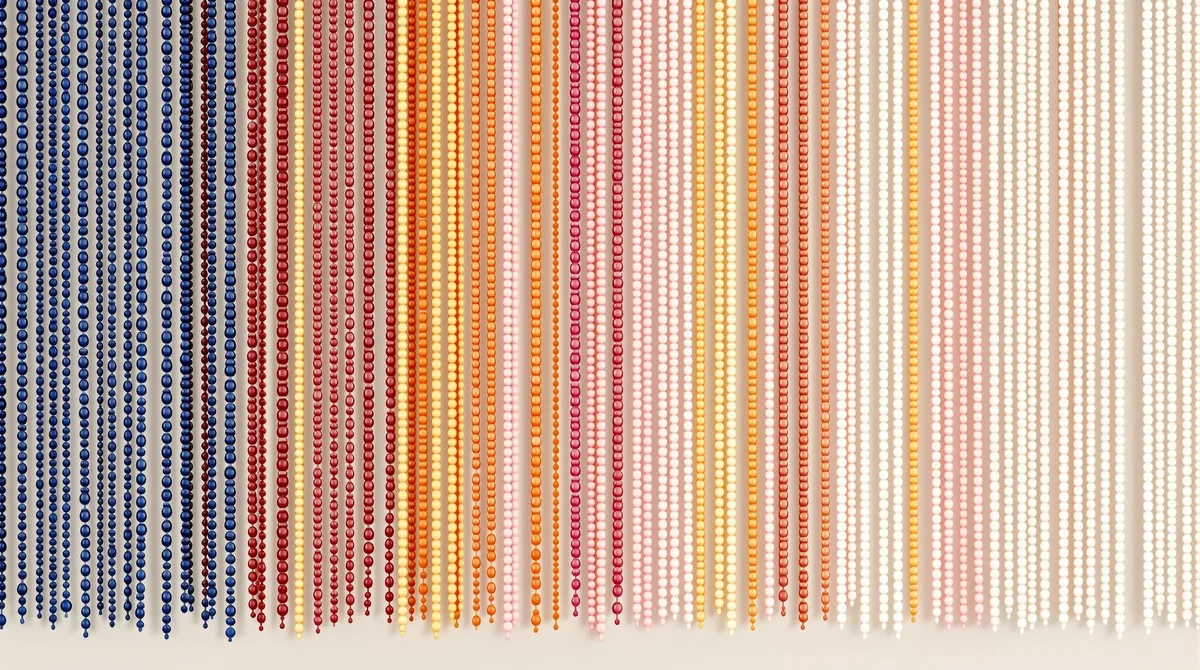
Colour story
The Sorbet Parade story
Scattered pastel accents across 60 strands at 120 × 180 cm, placed from a bead map rather than by chance.
Compare the options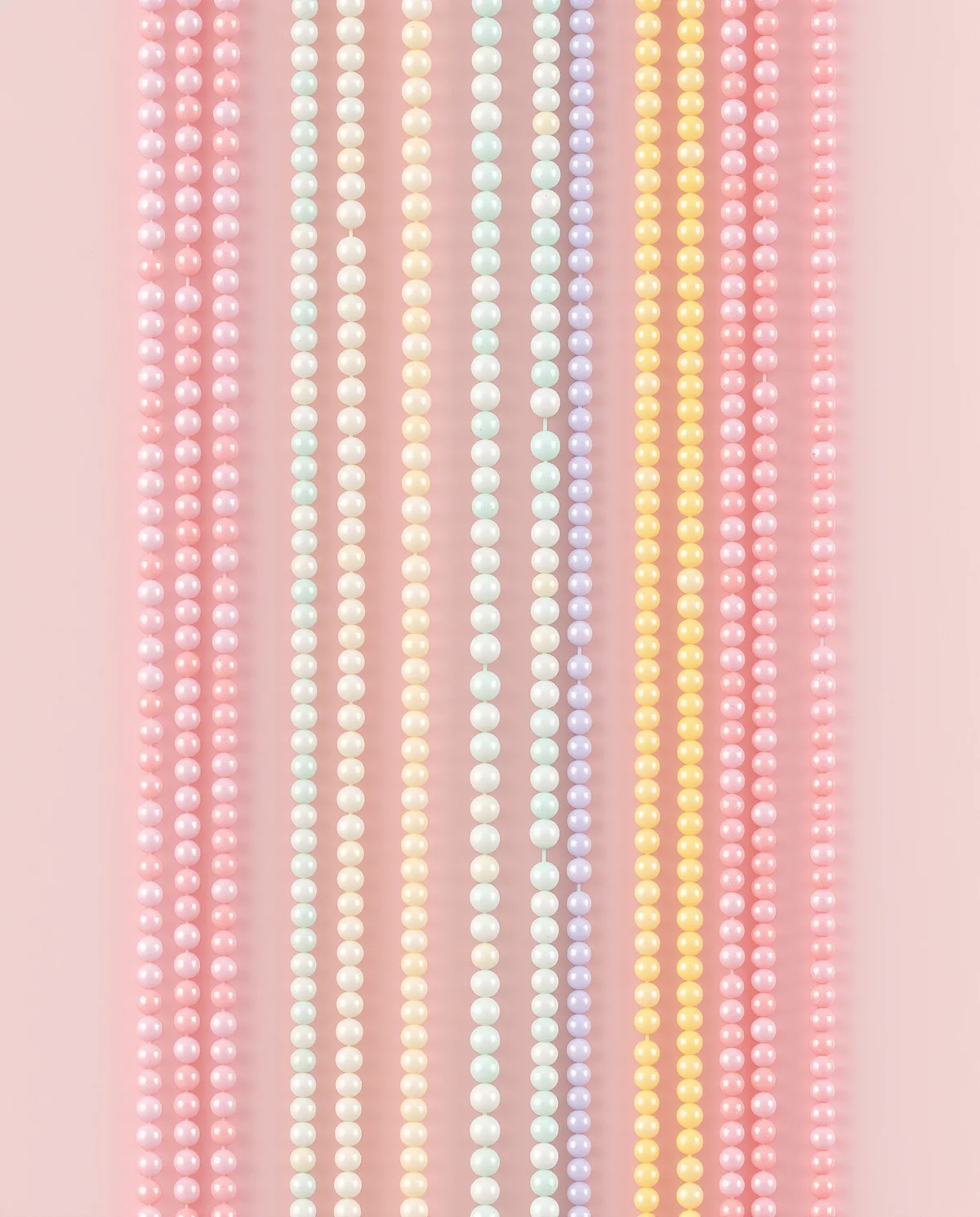
Design · Sorbet Parade Confetti Curtain
Sixty strands of pale ground with pastel accents thrown across it. The throwing is done on paper.
Six bead strands in the Sorbet Parade palette, candy pink, lemon, mint and lilac mixed so each strand reads as scattered confetti.
The Sorbet Parade confetti curtain is drawn at 120 × 180 cm on 60 strands with a straight hem. Its pastel accents are scattered on a pale ground, and the scatter is written as a rule — a set count per strand, offset so that no two adjacent strands align — because a confetti pattern only repeats across a production run if it is mapped rather than judged.
The Sorbet Parade confetti curtain is drawn at 120 × 180 cm on 60 strands with a straight hem: a pale glass seed-bead ground carrying larger pastel accents, scattered.
Available to develop at that size. What is not speculative is the method, because the same scattered-accent mechanism is in production on a sampled dotted portal and the rules it runs on are written down.
A set number of accents per strand, offset from strand to strand so that no horizontal row forms. On the sampled dotted portal that figure is three to four accents per strand with around 90 to 120 accents in a whole curtain, and it is a reasonable starting point here.
The word to avoid in a brief is random. A scatter described as random is unrepeatable: two pieces from the same run diverge, and the variance arrives as a quality complaint. A scatter described as a count plus an offset is a specification, and it repeats.
Two documents, drawn together. The colour-count sheet carries both the ground sequence and the accent positions, and the accent rule is a count per strand plus an offset. The bead count on a filled seed-bead ground is high relative to the format, so coverage per panel is the figure that moves a quote rather than the finished size.
| Specification | Value |
|---|---|
| Finished size | 120 × 180 cm |
| Strand count | 60 |
| Strand pitch | About 2 cm centre to centre |
| Hem shape | Straight |
| Ground | Pale glass seed beads, dyed to sit under the accents |
| Accent | Larger pastel pressed glass or moulded beads |
| Scatter rule | A set count per strand, offset so adjacent strands never align |
| Matched piece | An awning valance at the same 120 cm width |
| Status | A design available to develop at the drawn size |
This design has not been through development. The transferable lessons come from the sampled dotted portal that shares its mechanism, and there are two.
First, dye the ground to the accents rather than the other way round. The base seed beads on the sampled design are dyed to match the accent colours, and that is the change that makes an accent read as part of the strand instead of as something applied to it. Second, translucent and opaque versions of the same accent are different products — one glows and recedes, the other holds its edge — and both should be sampled before one is chosen.
At 120 cm wide the carton is the limiting dimension, so pieces per carton are agreed at quote stage.
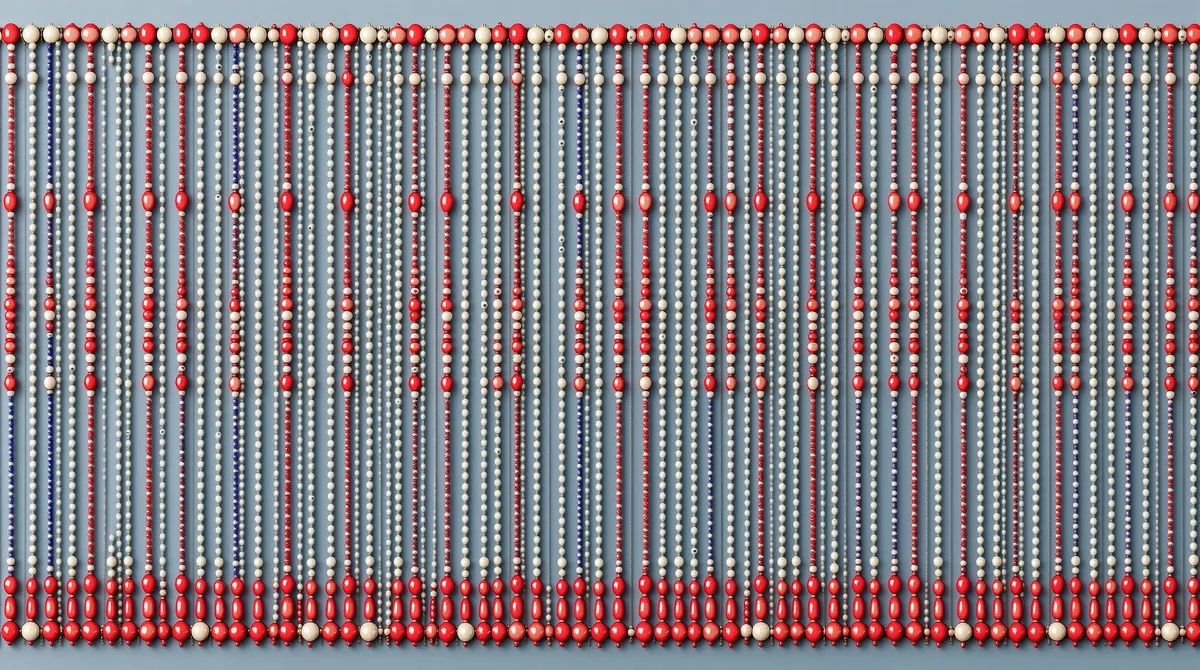
It shows the design as drawn: the format, the 60 strands, the straight hem and the pastel palette, built from named beads so that it converts directly into a colour-count sheet.
The accent distribution illustrates the rule. The map is written at specification stage.
The pastel confetti story, which holds this curtain and an awning valance at the same 120 cm width. The story is defined by its mechanism — a scattered accent on a matched ground — rather than by the particular pastels, which means it transfers to any palette while keeping its character.
Both halves, unequally. The accents are what a customer sees; the ground is what makes them work. A pale ground dyed to sit under the accents is the invisible half of the design and the half most often got wrong.
Pressed glass is the drawn route for the accents because a mould-made bead repeats its dimensions, which matters when a scatter is placed on a map. Acrylic moulded and dyed to the colour is the lighter alternative, and it is genuinely better at pastels because the colour runs through the material rather than sitting on its surface.
Straight, and deliberately so. A scattered accent is a pattern already; a shaped hem adds a second rhythm, and at 180 cm the two compete rather than combine.
The straight hem also makes the accent the only variable, which is what a palette-driven range needs. A recolour becomes the whole visual change.
A single turned wooden dowel at 120 cm, from our own Saharanpur wood factory, with its section checked against the finished weight rather than copied from a narrower build. A seed-bead ground is dense, so this is not a light design despite its pale palette — a filled strand carries many times the beads of a spaced one.
Both, with one dependency. Recolouring means changing the accents and then dyeing the ground to the new accents; changing the accents alone leaves the ground out of tune with all of them.
Resizing a width moves the strand count on the library's convention. Resizing a drop means revisiting the accent count per strand, because a scatter needs a minimum number of events before it reads as distribution rather than as a handful of beads.
Retailers and own-label brands, with a natural fit in kids, teen and dorm ranges, and in gift and lifestyle. A pastel confetti pattern is the most immediately cheerful thing in the doorway group.
It also suits event and display companies, where a pale wide panel photographs well as a backdrop and the palette reads under most lighting.
Good to know
Yes. Width moves the strand count on the library's convention — 40 strands at 90 cm, 60 at 120 cm. A shorter drop needs the accent count per strand revisited rather than scaled, because a scatter needs a minimum number of events before it reads as a scatter.
Pale glass seed beads as the ground and larger pastel beads as the accents. Pressed glass is the drawn route because a mould-made bead repeats its dimensions. Acrylic moulded and dyed to the colour is the lighter alternative and is unusually good at pastels.
Exclusivity is a commercial decision taken per programme rather than a property of the design. Name it in the brief and it is quoted alongside the piece.
It shows the design as drawn — format, strand count, hem and palette — built from named beads, so it can be turned into a colour-count sheet. The design is drawn to size and available to develop.
Strands are kept in order and protected against knocking in transit, then packed to your carton, label and packaging specification. At 120 cm wide the carton is the limiting dimension and pieces per carton are agreed at quote stage.
Yes. A sketch, photo or artwork with size, materials, colours and quantity becomes a colour-count sheet, with a rough cost sheet produced before any sample is made.
Keep exploring
Colour story
Scattered pastel accents across 60 strands at 120 × 180 cm, placed from a bead map rather than by chance.
Compare the optionsDesign
The full-length doorway designs, 90 × 200 to 120 × 210 cm, documented by strand count, hem shape and bead count.
See the detailDesign
Dotted oval glass beads at 13 × 22 mm, scattered three or four to a strand on a seed-bead base dyed to match each dot.
See the detailDesign
Large hand-made Venetian glass beads on a hand-strung doorway, with the palette edited for glass strength rather than for looks.
Read the guideDesign
Lime glass seed-bead strands with spaced deep forest rounds at 76 × 140 cm, cut to an arched drop.
Compare the optionsGlossary
Dyeing one bead to another bead's colour rather than to a swatch — why it is used, and what it does not promise.
Compare the options
Start a conversation
Send a reference, a colour chip or a sketch. Minimums are set per design and confirmed per quote; sampling is quoted separately and usually runs 16 to 20 days from an agreed brief.