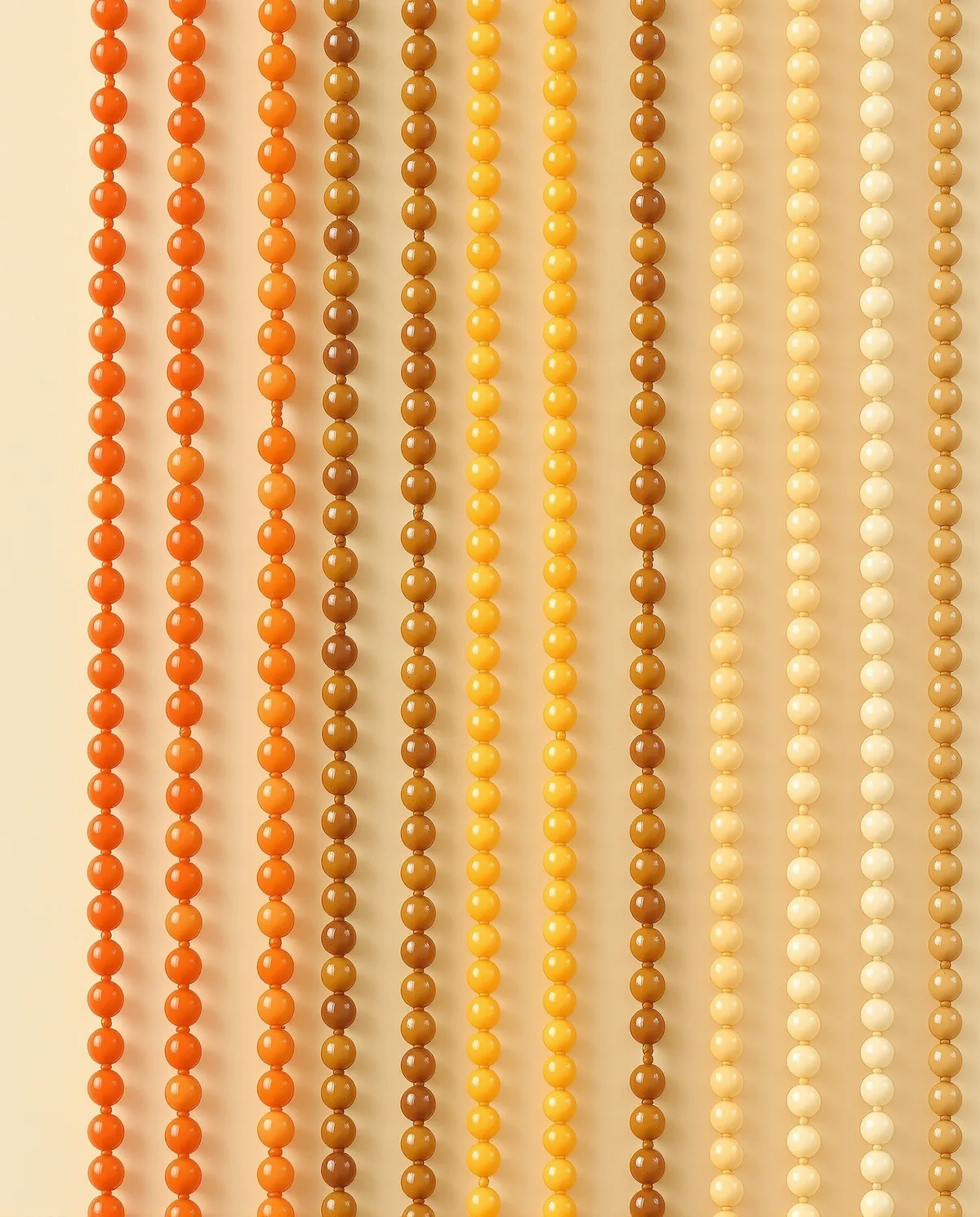
Colour story
Orange and cocoa glass
Glossy orange, canary glass, chocolate brown and cream soda, built as a door curtain, a sunburst valance and a wall hanging.
How it is made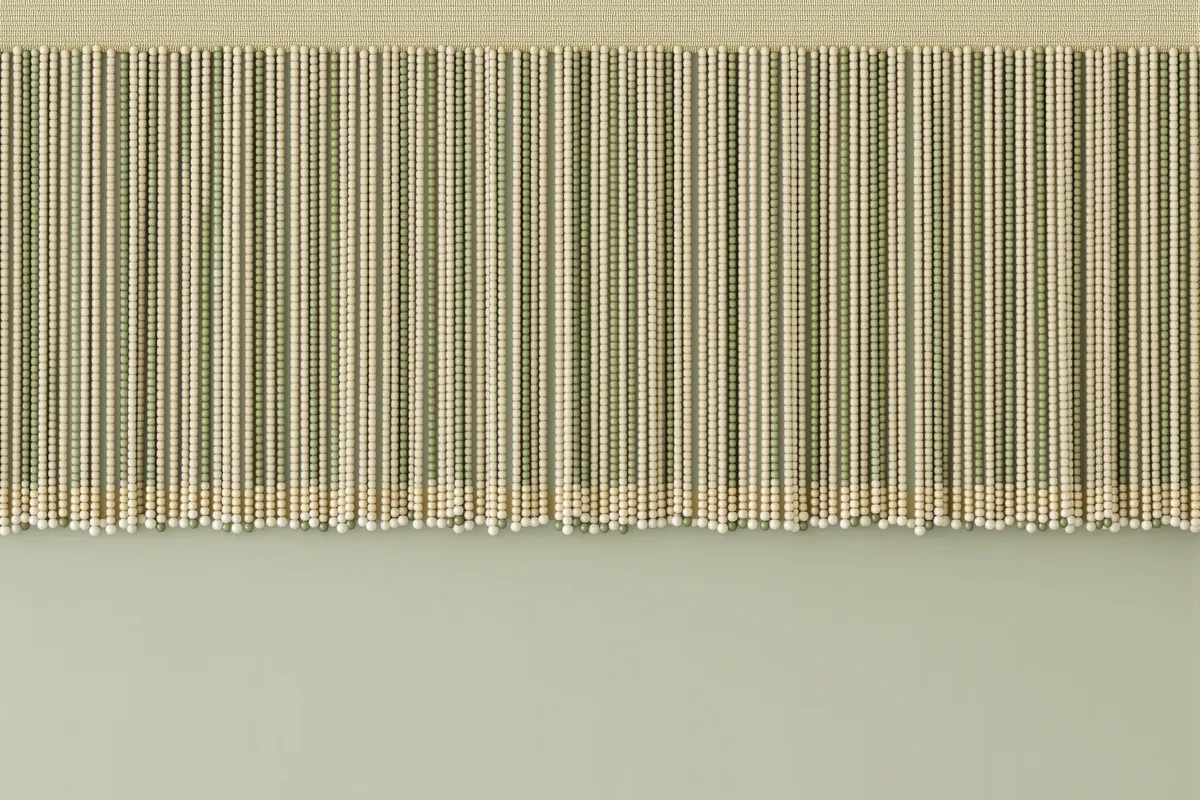
Design · Sunburst Valance
A sunburst is a curve expressed in 56 to 60 numbers, on a piece only 35 cm deep. There is very little room for the curve to be wrong in.
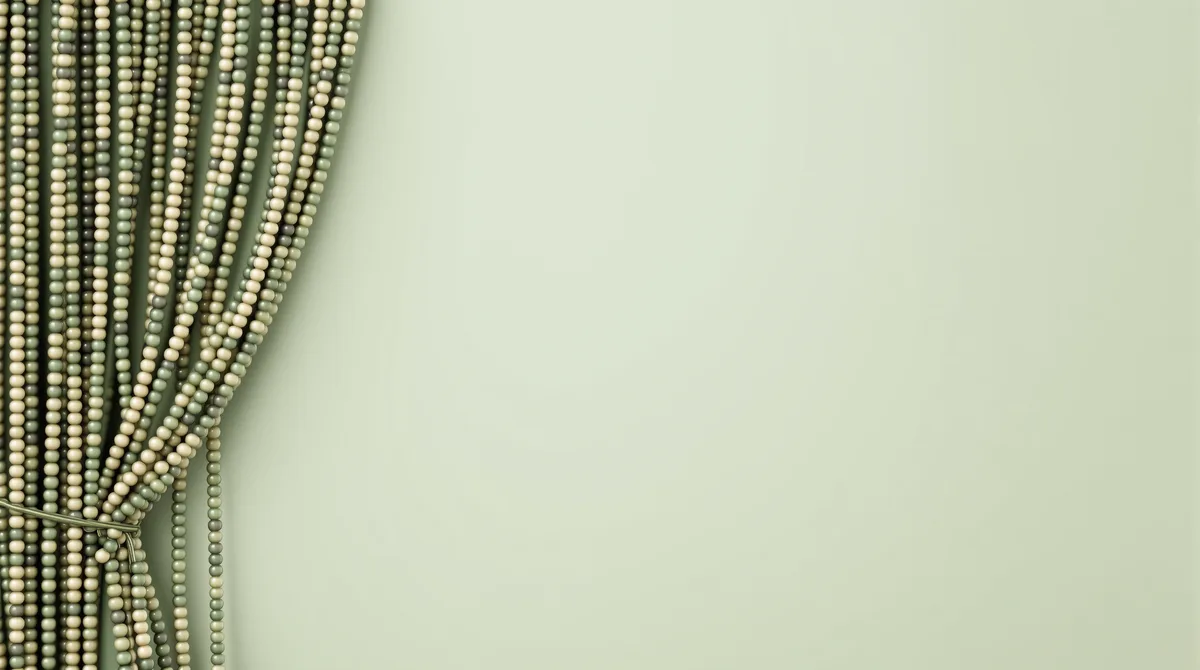
A short beaded valance only thirty centimetres deep, close strands of olive, moss and oatmeal beads below a plain header rail, the hem stepped into a repeating fan arch.
The Seventies Sunroom sunburst valance is a 120 × 35 cm piece whose radiating profile exists only in its strand lengths. There is no shaped frame and nothing is bent: 56 to 60 drops are written out in a sequence that rises and falls, and the sunburst is the result. On a 35 cm depth the tolerance for error in that sequence is very small.
The Seventies Sunroom sunburst valance is a 120 × 35 cm piece in the collection's palette of glossy orange, canary glass, chocolate brown and cream soda. Its hem radiates.
It belongs to a matched set in this story, alongside a door curtain at 120 × 200 cm and a wall hanging at 60 × 100 cm. The valance is the piece most likely to be briefed first, because it reaches the palette on roughly a quarter of the beads.
56 to 60 strands across 120 cm, on the library's own convention for that width, which is a pitch of about 2 cm. Each strand is a written sequence of the four colours in the palette.
The sunburst is layered on as a strand-length sequence: a list of 60 drops that rises and falls across the width. That is the entire mechanism. There is no shaped frame, nothing is bent, and no bead is doing anything other than sitting in a column of a particular length.
A radiating hem makes the drop list the specification. The longest and shortest drop are both stated and every value between them is written out, because a sunburst is a curve expressed in 60 numbers. The strand count sets the density, and the first article is checked against the profile rather than against a colour.
| Specification | Value |
|---|---|
| Finished size | 120 × 35 cm |
| Strand count | 56 to 60 at about 2 cm pitch |
| Hem shape | Radiating sunburst, built from strand lengths |
| Bead count range for the format | About 900 to 2,000 |
| Palette | Glossy orange, canary glass, chocolate brown, cream soda |
| Matched pieces | Door curtain at 120 × 200 cm; wall hanging at 60 × 100 cm |
| Header | Turned wooden dowel at 120 cm |
| Studio link | Confirmed collection slug — app.gemixx.com/?c=seventies-sunroom |
| Status | A design available to develop at the drawn size |
Recoloured freely, keeping the gloss specification. In the Design Studio the design opens as your own copy to recolour and resize directly, and the collection link for this story is confirmed: app.gemixx.com/?c=seventies-sunroom.
Resizing means redrawing the profile. A sunburst depends on the ratio of its depth to its width, so a profile that reads correctly at 120 × 35 cm looks like a sag at 90 × 35, and the drops have to be recalculated rather than scaled.
Retailers and own-label brands as the entry piece in a three-piece set. One palette, three formats, one approved colour set, with the valance as the entry piece — that is the strongest merchandising structure in the library.
It also suits café and small hospitality fronts, where a short beaded piece dresses a window without closing it.
The lesson comes from the sea-glass valance. There, a shaped arch was corrected during sampling into a properly curved profile, which shows exactly why a shaped hem drawn as an outline and a shaped hem written as 60 strand lengths are different documents — and why only the written one is buildable.
The sunburst is the most demanding version of that problem in the library. On a 35 cm depth, a one-bead error in a drop is a visible error in the curve, because there is so little depth for the error to hide in.
Profiled hems have one specific requirement: the strands are not interchangeable, so they are bundled in sequence and labelled. At 120 cm wide the carton is set by the width rather than by the drop, which makes a valance an awkward shape to freight despite its small bead count.
It shows the design as drawn to size. The strand count on this page follows the library's 120 cm convention rather than a measurement of this particular design, and that is stated where the figure appears.
The Seventies Sunroom colour story, which is collection 10 in the Design Studio and the only beaded collection among the three announced for 2027. Its notes describe it as a sun-faded record sleeve.
Glossy glass, specified as gloss. On a short format that matters more than on a door drop: a valance sits in the top of a window where the light is strongest, so the finish is doing most of the work the colour gets credit for.
At 35 cm deep there is one additional constraint: the palette has to resolve in a very short strand. Four colours on a 35 cm drop is close to the limit — five would read as a mixture rather than as a palette.
As a radiating sequence of drops. Written out, it repeats exactly across a production run. Judged at the bench, it does not repeat at all, and on a 35 cm piece the failure is immediately visible.
The longest and the shortest drop together are the specification. A single height does not describe this hem.
A turned wooden dowel at 120 cm, made in our own Saharanpur wood factory, with its section checked against the finished weight. A valance is a light piece by bead count, running roughly 900 to 2,000 beads against 3,100 and up for a doorway, so the fixing question here is about the 120 cm span rather than about load.
Good to know
Exclusivity is a commercial decision taken per programme rather than a property of the design. Name it in the brief and it is quoted alongside the piece.
It shows the format and the profile as drawn, built from named beads so the design converts into a colour-count sheet. The strand count follows the library's 120 cm convention, and is confirmed on the sample.
Strands are kept in order and protected against knocking in transit, then packed to your carton, label and packaging specification. On a profiled hem the strands are not interchangeable, so they are bundled in sequence and labelled.
Yes. For a profiled valance the most useful thing to send is the longest and the shortest drop, not a single height — a single height does not describe a shaped hem and is the commonest ambiguity in a valance brief.
Yes, and the palette structure travels well: two warm brights against two neutrals. Keep the gloss specification when recolouring, because gloss is decided at the works alongside colour and a matte version reads several steps duller.
Yes, with the profile redrawn rather than scaled. A sunburst depends on the ratio of its depth to its width, and a profile that reads correctly at 120 × 35 cm looks like a sag at 90 × 35.
Keep exploring
Colour story
Glossy orange, canary glass, chocolate brown and cream soda, built as a door curtain, a sunburst valance and a wall hanging.
How it is madeManufacturing
Short strung panels at 120 × 35 cm and other formats, 56 to 60 strands, with scalloped, fan-arch, V-point and straight hems — and why height is the cost lever.
Specs and sizesDesign
Valances at 120 × 30 to 40 cm and café curtains at 76 × 76 cm, documented by hem shape, strand count and bead count.
How it is madeDesign
The deep blue story at valance drop — 120 × 30 to 40 cm, where the same palette runs a fraction of the doorway bead count.
Open the referenceDesign
A scalloped awning profile over a pastel scatter at the 120 cm width, so the short drop reads as deliberate.
View the rangeDesign
Dyed glass seed beads embroidered onto a sheer ground at 30 inches square, with a three-inch rod pocket.
Specs and sizes
Start a conversation
Send a reference, a colour chip or a sketch. Minimums are set per design and confirmed per quote; sampling is quoted separately and usually runs 16 to 20 days from an agreed brief.