Guide
Making a bead curtain
Strand count and pitch, cord choice, the bead order on paper, stringing, knotting, fixing to a dowel — and the hour count.
How it is made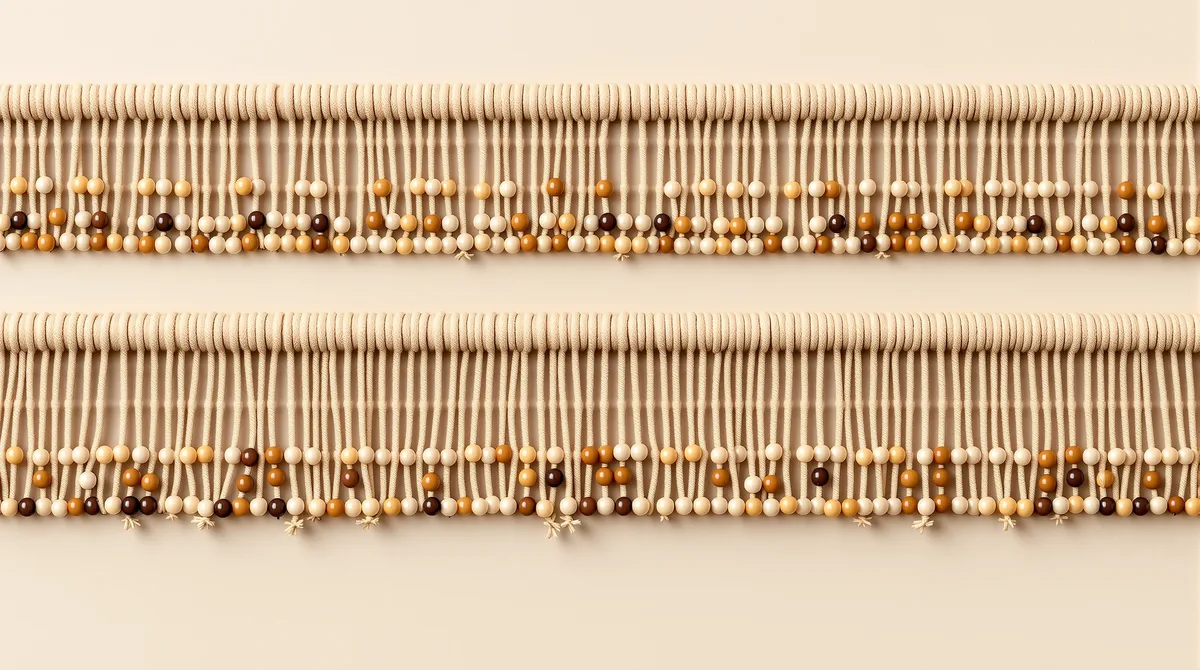
Guide · Comparison
The decision is not about skill. It is about how many beads the design contains, and nobody estimates that correctly before they start.
Two beaded panel headers laid one above the other, the upper with its cords knotted at an even pitch, the lower with knot spacing and bead heights that wander.
Make it yourself when the piece is small, spaced and plain — a valance, a short panel, or a doorway in single-colour beads at an open pitch. Have it made when the design carries a pattern, because a densely patterned 90 × 200 cm curtain holds about 11,800 beads on our design-render basis and every one has to land in the right place.
Make it yourself if the panel is plain, spaced and singular. Have it made if the panel carries a pattern, has to match a colour, or has to be one of several.
The deciding number is the bead count. A spaced 90 × 200 cm panel holds roughly 3,100 beads; a densely patterned one of the same dimensions holds about 11,800. The gap between them is the gap between a weekend and a month of evenings.
A home build is: buy beads, buy cord, cut forty lengths, thread them, finish each end, and attach them to a dowel at a consistent pitch. At a 90 cm width that is a strand count of forty at a pitch of about 2.25 cm. At 120 cm it is sixty at about 2 cm.
Made to order is: a brief with size, material, colours and quantity, a rough cost sheet showing where the cost sits before any sample is made, beads matched to a Pantone reference or a physical chip, a sample usually ready in 16 to 20 days from an agreed brief and photographed for approval before it ships, then production — 40 to 60 days after sample approval for beaded décor. Nothing is held in stock; every panel is made to order.
| Make it yourself | Made to order | |
|---|---|---|
| Realistic scope | Plain or simple-repeat, spaced pitch, one or two colours | Any pattern, any density, any size |
| Beads to thread, 90 × 200 cm spaced | About 3,100 | About 3,100 |
| Beads to thread, 90 × 200 cm densely patterned | About 11,800 | About 11,800 |
| Strands at 90 cm width | 40 at about 2.25 cm pitch | 40 at about 2.25 cm pitch |
| Pattern planning | Draw a strand grid on paper first | Bead map written before any bead is threaded |
| Colour matching | Whatever beads you can buy | Matched to a Pantone reference or a physical chip, confirmed on the sample |
| Repeatability across panels | Hard; strand lengths drift | Held to the approved sample |
| Timeline | Your evenings | Sampling usually 16–20 days; production 40–60 days after sample approval |
| Where it goes wrong | Uneven drops and a pattern that is not level | Nothing, if the bead map is approved first |
Nothing about the route changes the weight, but the route changes how much the weight matters.
A made panel arrives with one of the panel headers sized for its own load and, on some constructions, end suspension loops knotted at the top of each strand so it hangs level whether it is fixed to a door or to a wall. A home build arrives at the fixing stage with whatever dowel you bought, and the most common home mistake is a dowel that bows under a glass panel.
If you are building at home, build in acrylic or wood. The weight is forgiving, a tension rod inside the frame will hold it, and no drilling is needed.
That is a bead question, not a route question: body-coloured glass holds its colour permanently and surface-dyed beads do not.
What the route changes is whether you get the colour you wanted. A made panel's beads are matched to a reference and confirmed on a sample, and acrylic is moulded and dyed to the colour specified — which is also what dyed to match means on a tech pack. A home build uses the colours that were available, which is why home-made panels so often read as almost-right — the hue is close and the tonal steps between beads are not.

On a single plain panel, a home build is cheaper, and the saving is real. On anything patterned, the comparison collapses, because the cost in a made panel is the stringing hours and those hours do not disappear when you do them yourself — they just stop being priced.
The levers that move a made panel's price are, in order: bead size and material, construction — strand count and tightness — strand spacing, the dowel and packing, then height. The same levers govern a home build. If a design is unaffordable, open the pitch or drop the height before changing the bead.
Minimums on a made panel are set per design and confirmed per quote rather than fixed across the range, because a plain-strand panel and a fully patterned one use very different amounts of material and stringing time.
Loose beads, overwhelmingly. A box of beads is dense and nothing in it can be damaged by being jostled.
A finished panel has to travel with its strands in order, and in glass with cushioning so beads cannot knock together. That is the one place where the home route has an unambiguous economic advantage.
The home build, and almost always at the strand end. A knot that slips empties the strand onto the floor; a crimp or a stopper bead does not. The second most common home failure is strand lengths that are not identical, which produces a hem that wanders and cannot be fixed without re-doing the strands.
A made panel fails at the cord, eventually, after years — and one parted strand is re-strung in bead-map order and re-knotted at the header. Spare beads can be built into the production run for that purpose, specified with the order.
Make it yourself: one panel, one room, a plain or simple-repeat design, and an appetite for the work. Also every case where the real goal is the making rather than the object.
Have it made: anything with a motif or a gradient; anything where a colour has to match an existing scheme; anything where more than one panel has to look like the others; and anything a business will sell, because a run of panels has to hold to one approved sample rather than to the maker's mood on a given evening.
The best mixed route is not building half a panel. It is buying a made panel and altering it.
Shortening is straightforward: mark the finished length with tape across the strands, work one strand at a time, undo the end stopper, remove beads down to the mark keeping a few spares, and re-secure with a tight double knot, a crimp or the original stopper. On a patterned panel, take the same number of beads off every strand so the pattern stays level, and check first, because the bottom of a motif will be lost. On a shaped hem — an arch or a scallop — shorten every strand by the same amount so the hem shape survives.
Adding an end bead to steady a light strand is the other high-value alteration, and it is a ten-minute job. Realistic tolerances are the frame for the result: hand work varies, and so does a kitchen table.
The number that settles this argument is the bead count, and the record is unambiguous about scale. Beyond the 11,800-bead figure for a dense panel, individual constructions show how much placement work sits inside a design that looks simple: a dotted portal carries roughly ninety to a hundred and twenty large oval glass beads, scattered three or four to a strand and deliberately never aligned in a row; a mushroom-accent portal carries about a hundred and twenty mushroom beads on the same basis; a laser-cut blossom wall hanging runs 155 to 170 blossoms in its dowel version and about 130 in its rod-pocket version.
Each of those counts is a plan, not an improvisation, and that is the real difference between the two routes. On average sixteen artisans contribute to a finished Gemixx product, each applying one discipline. A home build asks one person to be all sixteen, and on a plain panel that is entirely reasonable.
Good to know
Whichever uses body-coloured glass, and that is a bead choice rather than a route choice. The difference between the routes is matching: a made-to-order panel has its beads matched to a Pantone reference or a physical chip and confirmed on a sample, where a home build uses whatever colour the beads you found happen to be.
A home build, almost always, and at the strand end. The end knot is the single most common failure: a knot that slips lets the whole strand empty itself onto the floor. Use a crimp or a stopper bead, not a knot alone, and the home build gets a great deal more durable.
Only indirectly, and the figure worth quoting is the bead count. A densely patterned 90 × 200 cm curtain holds about 11,800 beads on our render basis, and on average sixteen artisans contribute to a finished Gemixx product, each applying one craft discipline. The point is not that it is hard; it is that it is long.
Make it yourself for one plain panel in a room you live in. Have it made for a pattern, for an exact colour, for more than one matching panel, or for anything that has to be reproduced again next year. The dividing line is repeatability, not difficulty.
A home build is better value on a single plain panel and better fun. A made panel is better at everything that involves a second panel, a specified colour, or a pattern that has to be level. There is no version of this where a home build wins on a graphic design.
Usefully, yes. Buy a made panel and alter it: shorten the strands, re-space them on a wider dowel, add a weighted end bead. Those are all small jobs with a good success rate, and they are a much better use of an evening than threading eleven thousand beads.
Loose beads, in a box, by a very wide margin — which is the one unambiguous economic advantage of a home build. A finished panel has to travel with its strands in order and, in glass, cushioned against knocking, so the carton is large relative to the piece.
Keep exploring
Guide
Strand count and pitch, cord choice, the bead order on paper, stringing, knotting, fixing to a dowel — and the hour count.
How it is madeManufacturing
Brief, rough cost sheet, colour match, sample, production, packing — the route from a sketch to a packed carton, in plants we own.
View the rangeGuides
One guide per question that arrives often enough to be worth answering properly.
Compare the optionsGuide
Colour consistency, durability, paperwork and the two production routes faux capiz actually uses — cast resin, or dyed cut acrylic.
Specs and sizesGuide
What chain genuinely does better, what it does not, and which of the two suits a given opening and budget.
Specs and sizes
Start a conversation
Send a reference, a colour chip or a sketch. Minimums are set per design and confirmed per quote; sampling is quoted separately and usually runs 16 to 20 days from an agreed brief.