Material
The long glass tube
Cut long instead of short: how a tube gives beadwork direction, where it outperforms a round, and why the cut ends decide the thread.
See the detail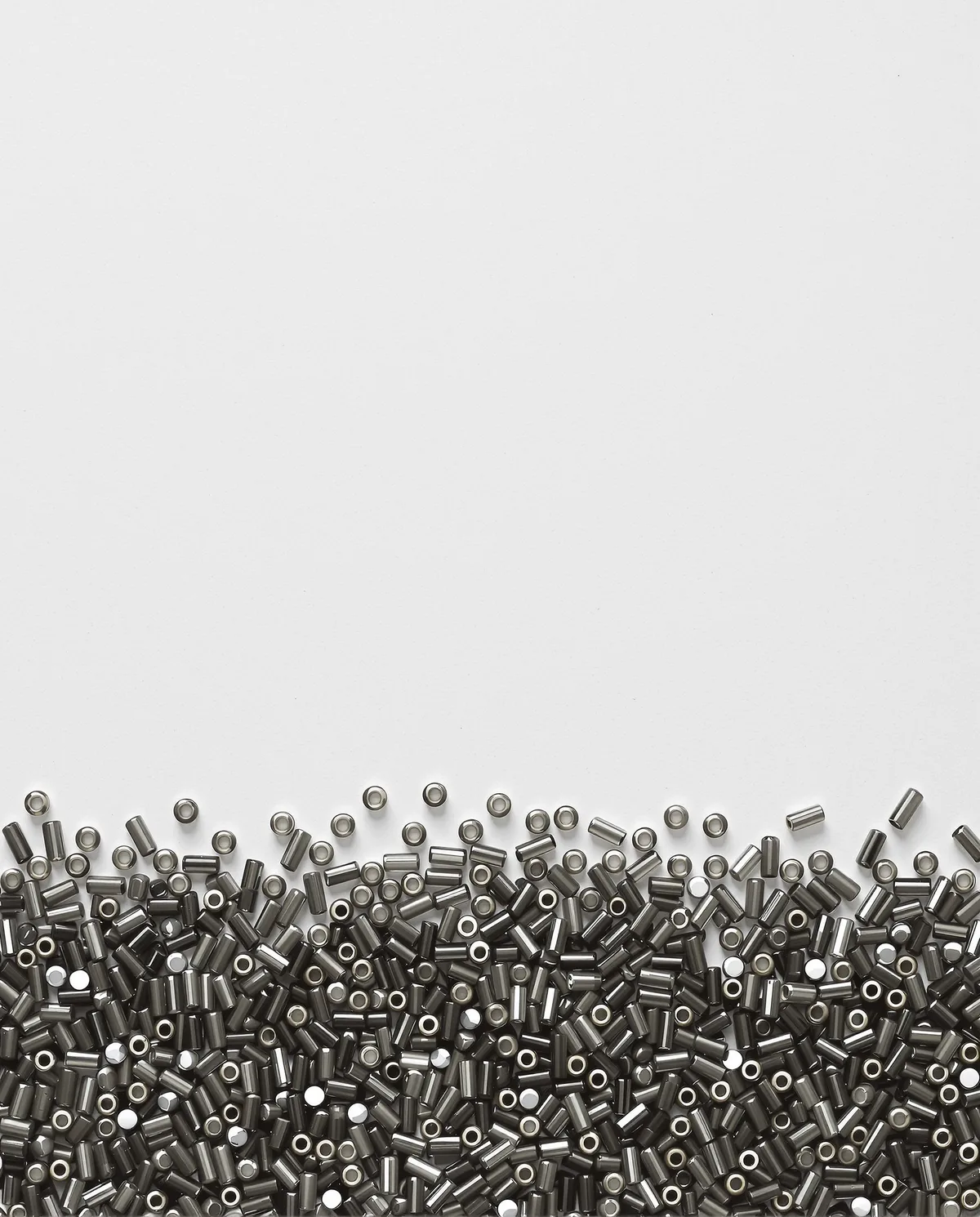
Guide · Comparison
Both are drawn glass, cut from the same cane. One is cut short and tumbled round; the other is left long. Everything else follows from the length of the cut.
Glass bugle beads in silver-lined pewter, bronze and smoke grey, cut tubes from six to twenty millimetres long shown loose beside a threaded sample strand.
A seed bead is a short round unit with no direction; a bugle is a glass tube that points. Seed beads build fields, gradients and curves because they tessellate in any direction. Bugles build lines, rays and directional texture, cover more area per bead, and wear thread faster at their cut ends. Most strong embroidery uses both.

Seed beads for anything the eye has to resolve. Bugles for anything that should have a direction.
They are the same material cut to different lengths, which is why the distinction is geometric rather than qualitative. A short cut tumbles into a round unit with no orientation; a long cut stays a tube and points.
Both start as drawn glass cane — glass pulled into a long tube and then cut — and both are drawn and cut in our own glass works at Firozabad.
A seed bead is cut short and tumbled, so it ends up a small round barrel, working at roughly one to three millimetres in décor. It has a hole through its short axis and no visible direction.
A bugle bead is the same cane cut long and left as a tube. It has a hole running its whole length, and its length is its defining property: it occupies a line rather than a point.
| Specification | Glass seed bead | Glass bugle bead |
|---|---|---|
| Form | Short round barrel | Glass tube |
| Working size in décor | About 1 to 3 mm | Several millimetres long |
| Direction | None | Strongly directional |
| Coverage per bead | Low | Higher along its length |
| Follows a curve | Yes, in any direction | No, it chords the curve |
| Image resolution | High: behaves like a pixel | Low: behaves like a stroke |
| Thread wear | Low | Higher — cut ends abrade thread |
| Typical role | Fields, gradients, motifs, grounds | Rays, lines, fringe, directional texture |
| Where used | Grounds and seed-bead strands | Zardozi-tradition bead embroidery |
Because a seed bead can be placed anywhere and a bugle has to be pointed somewhere.
Seed beads tessellate in any direction, which is why they can carry an image: enough of them side by side stop reading as beads and start reading as a surface. That is the behaviour that lets beadwork depict a motif, a letter or a figure at all.
A bugle cannot do that. What it can do is draw a stroke — a ray in a sunburst, a stem, a line of fringe, a brushed texture across a field. Where a design wants movement rather than resolution, bugles do in one bead what six seed beads would do awkwardly.
Per covered area they are close, because a bugle is longer but thinner. What changes is the behaviour of a hanging element: a bugle fringe swings as a set of rigid segments, and a seed-bead fringe swings as a flexible line.
On flat work neither weight matters. On a hanging trim, bugles give a crisper, more architectural movement and seed beads give a softer one.
Neither has an inherent advantage, because colour in glass is held either in the body or on the surface, and both cuts come in both kinds. What matters is which you specify.
Body-coloured glass survives light and cleaning indefinitely. Surface-dyed glass is a coating: it is the normal way a ground is tied to an accent, and it is also the thing that fades in a sunlit position and lifts to a solvent. On bugles there is a second consideration — a silver-lined bugle carries its colour inside the tube, which is protected from abrasion on the outside and visible through the glass.
Cost in bead embroidery sits in bead count and stitching hours, not in the bead. A bugle covers more area per bead, so a bugle-worked field needs fewer beads and fewer stitches than a seed-bead field of the same size — which makes bugles the cheaper way to fill area and seed beads the only way to carry detail.
That is the same lever we reach for in production when a design has to hit a target: de-densify the infill, keep the outline tight, or move a flat area to a larger bead. At normal viewing distance the saving is invisible and the detail where it matters is untouched.
The bugle, at the thread. A bugle's ends are cut glass, and cut glass abrades a couching thread every time the piece flexes. On a coaster that is handled daily, that is the component with a service life.
The remedy is standard and worth specifying explicitly: a small seed bead at each end of every bugle, so the thread turns against a rounded bead rather than against a cut edge. It costs two beads per bugle and removes the failure mode.
Neither, meaningfully. Both are drawn glass of similar density, and the finished piece rather than the bead decides the freight.
What does change the shipping picture is the format. Flat embroidered pieces pack densely and travel well; strung panels and hangings are bulky and sometimes non-collapsible, which is a packing conversation rather than a bead one.
Seed beads suit anybody whose brief contains an image: a monogram, a figure, a flower, a graphic. They are the whole basis of bead embroidery on the table — coasters, placemats, napkin rings — and of fine seed-bead strands in hanging work.
Bugles suit a brief with movement in it: art-deco rays, sunbursts, fringe, directional texture, anything that should look drawn rather than printed. They also suit a buyer looking at cost on a large flat area.
Yes, and the strongest constructions do. The pattern that works is the same one that works in strung beadwork: a fine ground doing the colour work and a larger or more directional bead doing the drawing.
In embroidery that means a seed-bead field with bugle rays over it, or a bugle outline filled with seed beads, with the ground frequently dyed to match the accent so the accent reads unmistakably as the subject.
For a motif: seed beads, with the field de-densified where it will not be seen closely. For a sunburst, a ray or a fringe: bugles, with a seed bead at each end. For anything combining the two: both, with the ground dyed to match.
The reason to settle it at the brief rather than at the bench is that the two cuts behave differently on a curve. A curve drawn in bugles is a polygon, and no amount of skill at the needle changes that — it is a property of a straight glass tube.
That the two live together in one documented discipline. Our technique and material reference catalogue covers bead and thread embroidery in the zardozi tradition — seed and bugle beads with metallic thread, couched onto a stiffened fabric or felt ground — across coasters of about 10 to 11 cm diameter, dimensional florals at 9 to 12 cm, appliqué patches and brooches.
Alongside it, wire-wrapped beadwork uses glass seed and bugle beads on a shaped brass-wire armature: a flat-back wrap for napkin rings at 6 to 9 cm, and a full three-dimensional wrap for figural pieces at 12 to 18 cm. In both families, the bugle is the stroke and the seed bead is the surface, and nothing in the record uses one to the exclusion of the other.
Good to know
A bugle build, and it fails at the thread rather than at the bead. A bugle's ends are cut glass, and cut glass works against a couching thread every time the piece flexes. The standard answer is a small seed bead at each end of the bugle so the thread never touches the cut edge.
Both families in the same discipline. Our technique reference catalogue documents bead and thread embroidery in the zardozi tradition using seed and bugle beads with metallic thread on a stiffened ground, across coasters around 10 to 11 cm in diameter, dimensional florals of 9 to 12 cm, appliqué patches and brooches. Bugles appear alongside seed beads rather than instead of them.
Seed beads if the design contains an image, a gradient or any curve the eye has to resolve. Bugles if it contains rays, lines, a sunburst, a fringe or a texture that should look brushed rather than dotted. If it contains both, specify both — that is the normal answer.
No, and the question usually hides a different one about cost. A bugle covers more area per bead, so a bugle field is quicker to work; a seed bead resolves detail nothing else can. They are a long cut and a short cut of the same glass, and neither is a compromised version of the other.
Routinely, and the best constructions do. A seed-bead ground with bugle rays, or a bugle outline filled with seed beads, uses each for what it is good at. The practical detail is to put a seed bead at each end of every bugle, which protects the thread and tidies the join.
Effectively identical — both are drawn glass and the weight per covered area is similar. Freight on beadwork is driven by the finished piece rather than by which cut of cane is inside it, and a flat embroidered piece packs far more efficiently than a strung panel either way.
Keep exploring
Material
Cut long instead of short: how a tube gives beadwork direction, where it outperforms a round, and why the cut ends decide the thread.
See the detailMaterial
How seed beads are drawn, why dye lots are quoted per run, what the drill hole limits, and where seed-bead work earns its cost.
View the rangeGuides
One guide per question that arrives often enough to be worth answering properly.
See the detailGuide
The real hours in a hand-strung panel, where a home build wins outright, and where the bead count makes it a bad idea.
Compare the optionsGuide
Beads on cord against beads couched on cloth: cost behaviour, failure mode and which products come from each.
Read the guideGuide
Knot finish, strand length consistency, bead alignment, drill quality, header fixing, dye evenness, spares and packing.
How it is made
Start a conversation
Send a reference, a colour chip or a sketch. Minimums are set per design and confirmed per quote; sampling is quoted separately and usually runs 16 to 20 days from an agreed brief.