Reference
How beadwork is built
Five craft families — strung, embroidered, wire-wrapped, knotted and wrapped fibre — and what each one is good for.
Specs and sizes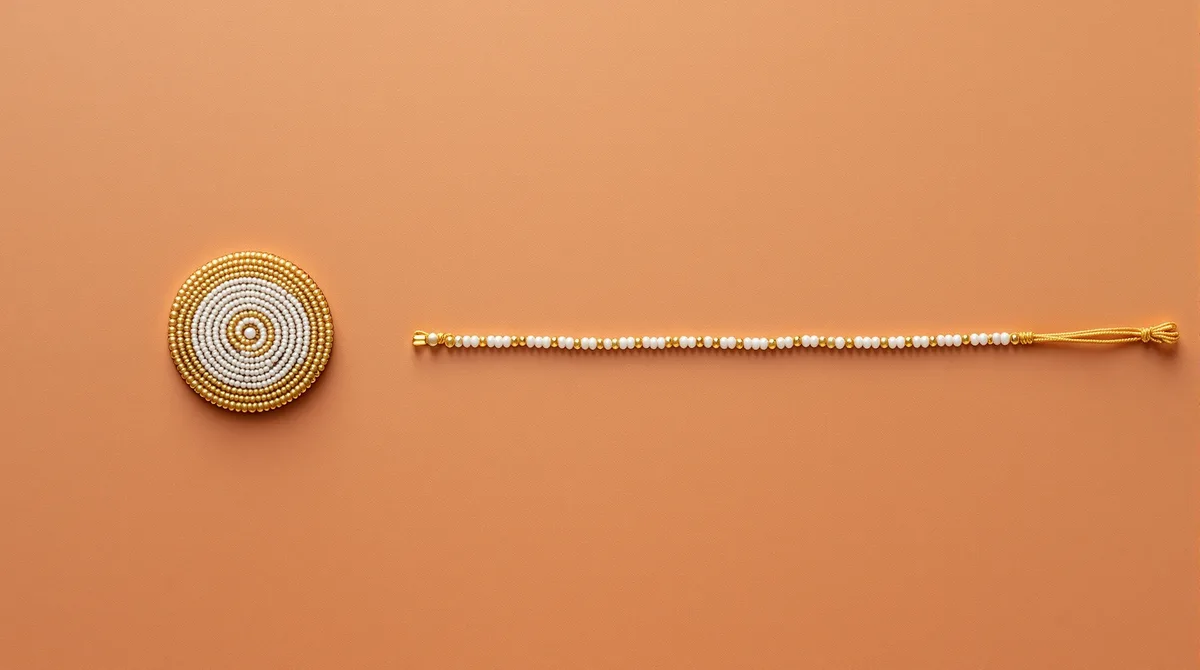
Guide · Comparison
One question settles it: does the piece hang, or does it lie flat? Gravity holds a strung bead in place. On flat work, thread has to do that job one bead at a time.
A disc of couched glass-bead embroidery in tight spiral rows of seed beads and metallic zari thread beside a hand-strung strand of the same seed beads, the two construction…
Strung beadwork threads beads onto cord so they hang in strands, and gravity holds every bead in position. Bead embroidery couches beads onto a stiffened cloth or felt ground with thread, so each bead is stitched individually. The first makes curtains, portals, valances and wall hangings; the second makes coasters, placemats, cushions and ornaments.
Strung beadwork threads beads onto cord so that they hang in strands. Bead embroidery couches beads onto a stiffened cloth or felt ground, one stitch at a time.
Strung work makes everything that hangs: doorway portals, door curtains, café curtains, valances, wall hangings, beaded lamp shades. Embroidered work makes everything that lies flat or wraps something: coasters, placemats, chargers, cushions, ornaments, purses and cases.

In strung work the cord is the structure. There is no backing and no frame. Beads are threaded in a specified order, the strand is knotted or looped at the header, and the whole panel is thirty-odd lengths of cord carrying several thousand beads. A densely patterned 90 × 200 cm curtain holds about 11,800 beads; a spaced version of the same size holds nearer 3,100.
In bead embroidery the ground is the structure. Glass seed and bugle beads are couched down with fine thread — often with metallic thread alongside, in the zardozi tradition — onto stiffened fabric or felt. Every bead is stitched. A coaster of ten or eleven centimetres across may carry several hundred of them.
| Strung on cord | Bead embroidery (zardozi tradition) | |
|---|---|---|
| What holds the bead | The cord, plus gravity | A couching stitch, bead by bead |
| Ground | None — the cord is the structure | Stiffened fabric or felt, sometimes with a canvas backing |
| Unit of planning | Strand, then bead position along it | Grid position on the ground |
| Products | Doorway portals, door curtains, café curtains, valances, wall hangings, lamp shades | Coasters, placemats, chargers, cushions, ornaments, purses and cases |
| Typical sizes we have made | 90 × 200 cm doorway; 76 × 140 cm portal; 50–76 cm wide wall hangings | Coasters 10–11 cm; cushions 10 × 10 in; ornaments 7–11 cm |
| Cost lever | Strand count, pitch, height, bead size | Coverage density, bead size, ground size |
| Failure mode | Cord slackens, abrades at the drill hole, parts | Couching thread slackens; the ground marks or swells |
| Cleaning | Dry dust downwards; damp cloth on the beads only | Spot clean only; never immerse |
Per piece, strung work, by a wide margin — a full-length glass panel is a serious load and needs a fixing chosen for it. Per square centimetre of covered surface, embroidered work is heavier, because the beads sit shoulder to shoulder with no air between strands.
That is why a fully covered embroidered cushion face needs a de-densified infill to hit a weight and a cost, and why a strung panel can be lightened simply by opening the pitch. On a 90 cm panel at 40 strands the pitch is about 2.25 cm; on a 120 cm panel at 60 strands it is about 2 cm. Both figures come from the design renders.
The bead answer is the same, because the same beads go into both. Body-coloured glass is permanent; surface-dyed seed beads are a batch property and dye lots shift slightly between runs.
The difference is everything that is not a bead. Embroidered work has thread and a ground, and both are more light-sensitive than glass: a felt ground and a metallic couching thread will both go before the beadwork does. Strung work has only cord, which is hidden inside the drill holes and fades invisibly.
They are priced on different units, which is why quoting them against each other is meaningless until the piece is specified.
Strung work is priced on strand count, strand pitch, height and bead size, roughly in that order, with the dowel and the packing behind them. Embroidered work is priced on coverage: how much of the ground carries beads, and at what bead size.
The single strongest lever in embroidery is de-densifying — a tight bead outline with an open fill — which we have used to bring a fully beaded cushion face to a target without changing the design the customer approved. The equivalent lever in stringing is opening the pitch or dropping the height: on one valance, cutting the height from 30 in to 26 in took out enough beads to move the whole costing.
Embroidered work, per piece. The pieces are small and flat and they stack.
Strung work is large-format and fights the carton. A wall hanging built on a rigid bar rather than a collapsible header has to ship in oversize packaging; one of our seed-bead wall-art developments was re-planned around exactly that problem. A café curtain at 24 × 30 in with a cotton header and a three-inch rod pocket folds, which is one of the quiet reasons café formats cost less to land than full-length ones.
Strung work fails at the cord. The cord passes through the drill hole of every bead on the strand and abrades there; wet cord slackens, discolours and holds dust. A parted strand is a repair — it is re-strung in bead-map order and re-knotted at the header — which is why spare beads belong on the packing specification.
Embroidered work fails at the couching thread or at the ground. Immersion is far worse here than on a strung panel, because water slackens every stitch simultaneously, swells a stiffened ground and leaves a permanent water line on felt. Flat beadwork is spot-clean only, with no exceptions worth making.
Retailers and brands building a tabletop or gifting range want embroidered work: tightly engineered cost, dense packing that keeps carton cube down, high perceived handwork, and no measuring for the end customer.
Interior and hospitality designers want strung work, because what they are specifying is an architectural element — a portal, a divider effect, a window dressing — and only a hanging construction does that.
Event and display companies buy both, and they care about something neither family advertises: how fast a piece can be unpacked, hung and re-packed without damage.
Constantly, and the join is one of the more interesting details in the category.
A solid beaded top band worked in close horizontal rows is embroidery; the strands that fall from below it are strung. A café curtain with a cotton header band and a three-inch rod pocket swaps the embroidered band for a textile one and hangs the strung drops from that. A moulded daisy connector sitting between the header trim and the strands below is a third variant: a single moulded bead doing the structural job of a join.
On a wall hanging the inverse happens — laser-cut faux capiz blossoms are locked onto a strung cord by a small spacer bead dyed to match, so the blossoms cannot slide. That is strung construction borrowing a trick from flat work.
Strung, if the brief contains the words doorway, window, portal, valance, divider effect or shade. Embroidered, if it contains coaster, placemat, charger, cushion, ornament, purse or charm. Wire-wrapped, if it contains napkin ring or a small figural object, because a short open collar of seed beads wrapped over a shaped brass armature holds a three-dimensional form that neither of the other two will.
Where a brief genuinely sits on the line — a beaded panel that will sometimes hang and sometimes lie on a table — specify strung, and add a weighted end bead. A strung piece tolerates being laid flat. An embroidered piece does not tolerate being hung.
Five craft families run in our own plants: crochet, wire-wrapped beadwork, macramé, bead and thread embroidery, and natural fibre, each with its own artisans, its own benches and its own reference sheets. Within those, coasters run 10 to 11 cm across, dimensional florals 9 to 12 cm, napkin rings 6 to 9 cm and figural wire-wrapped birds and animals 12 to 18 cm.
The strung side is the large-format programme: thirty hand-strung strands on a single wooden dowel is the standard build, and that programme has been in continuous production. Both families draw on the same bead library — deep enough to give a brand a bead nobody else is using — and the same colour-matching discipline against a Pantone reference or a physical chip.
Good to know
Five craft families run in our own plants: crochet, wire-wrapped beadwork, macramé, bead and thread embroidery, and natural fibre, each with its own artisans and its own bench. Strung work sits outside those families altogether, because it is the curtain and portal programme, which runs separately and in volume.
Let the product decide. A hanging piece is strung; there is no sensible way to embroider a doorway. A flat or wrapped piece is embroidered or wire-wrapped; there is no way to string a coaster that will survive a wet glass. The only real decision is where the two meet — a beaded top band above strung strands, for instance.
They are different trades with different artisans. Embroidery can depict anything, because every bead is placed independently on a grid. Stringing cannot depict anything freely, because a bead's position is fixed by the order it goes on the cord. That is a constraint, not a weakness: it is what makes a strung pattern repeat exactly across a run.
Yes, and some of our strongest constructions do. A solid beaded top band worked in close horizontal rows above the point where strands begin is embroidery; everything below it is strung. A beaded café curtain built on a cotton header band with a three-inch rod pocket is the same idea with a textile header instead.
Embroidered work, per piece, because the pieces are small and flat and pack densely. Strung panels are large-format and awkward: a wall hanging with a rigid bar rather than a collapsible header ships in oversize packaging, which we have had to design around more than once.
The same beads are used in both, so the bead answer is identical. The difference is the thread and the ground. Metallic couching thread and a felt or stiffened-fabric ground are both more light-sensitive than glass, so on an embroidered piece the ground fades before the beadwork does.
Strung work fails at the cord, which abrades against the drill hole of every bead it passes through and slackens if it gets wet. Embroidered work fails at the couching thread, which is why soaking a coaster is worse than soaking a curtain: water slackens every stitch at once and leaves a water line on felt.
Keep exploring
Reference
Five craft families — strung, embroidered, wire-wrapped, knotted and wrapped fibre — and what each one is good for.
Specs and sizesTechnique
Seed and bugle bead couched onto a stiffened ground in the zardozi tradition: the stitch, the interval, the failure modes and why images live here.
How it is madeGuides
One guide per question that arrives often enough to be worth answering properly.
How it is madeGuide
What fabric does that beads cannot, the three briefs where fabric is simply correct, and where a bead panel wins outright.
See the detailGuide
A portal frames the opening and leaves it clear; a full curtain covers it. Wear, bead count and how the room reads all follow.
Read the guide
Start a conversation
Send a reference, a colour chip or a sketch. Minimums are set per design and confirmed per quote; sampling is quoted separately and usually runs 16 to 20 days from an agreed brief.