Guide
Shortening, by stringing medium
Mark one strand, work to that mark on every strand, and re-secure each end — the method depends on cord, wire or monofilament.
Read the guide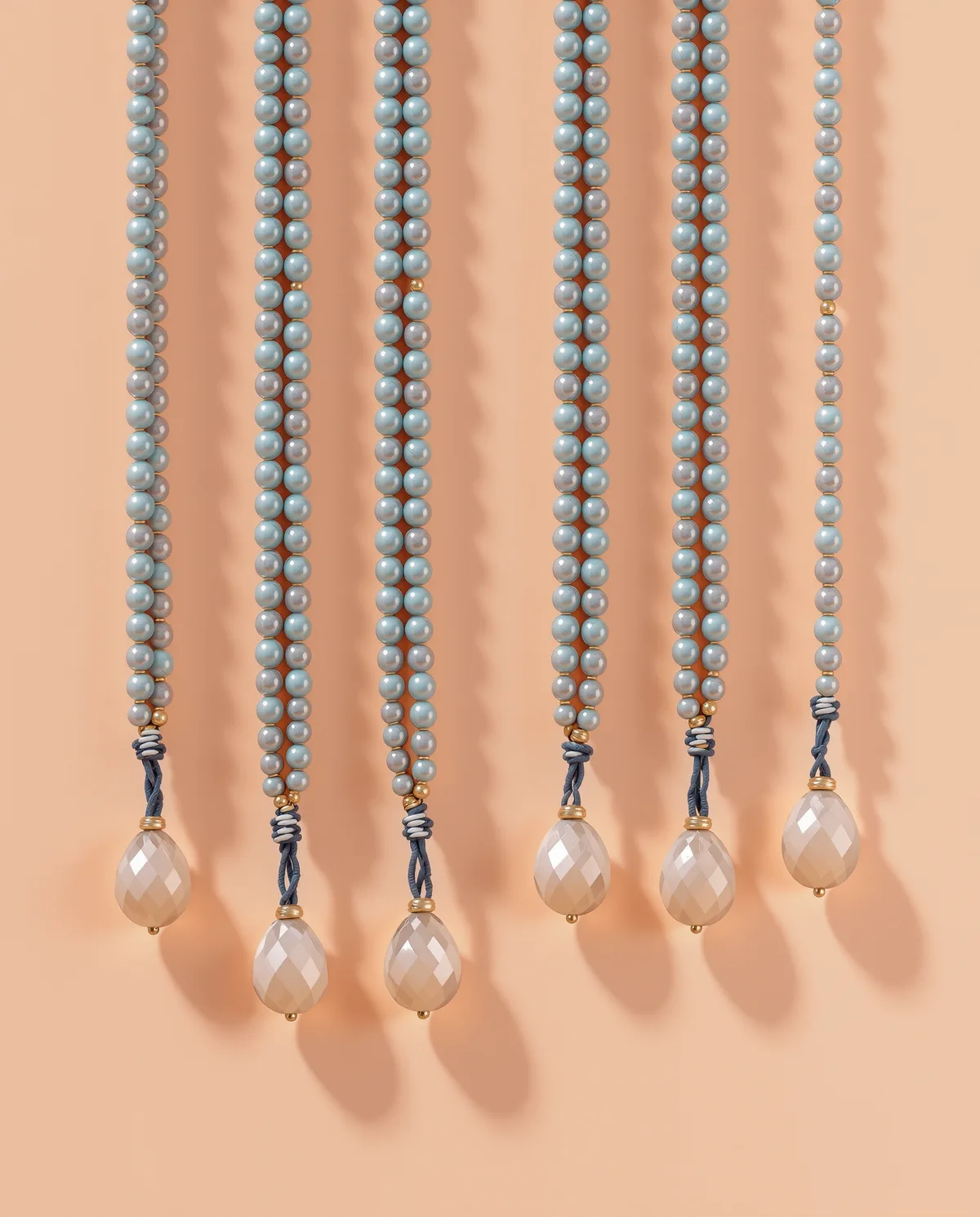
Guide · Altering
Shortening a bead panel is subtraction. Lengthening one is manufacturing, in your hallway, with beads you probably cannot match — which is why the best answer is usually to move the header.
The lower ends of six bead strands, each finishing in a single larger faceted drop knotted below the last seed bead.
Three options, in order of how well they work: raise the header so the whole panel hangs lower, replace whole strands with longer ones built to the original bead sequence, or splice an extension onto each existing strand. The first needs no beads at all. The third is visible at every join and is the last resort rather than the method.
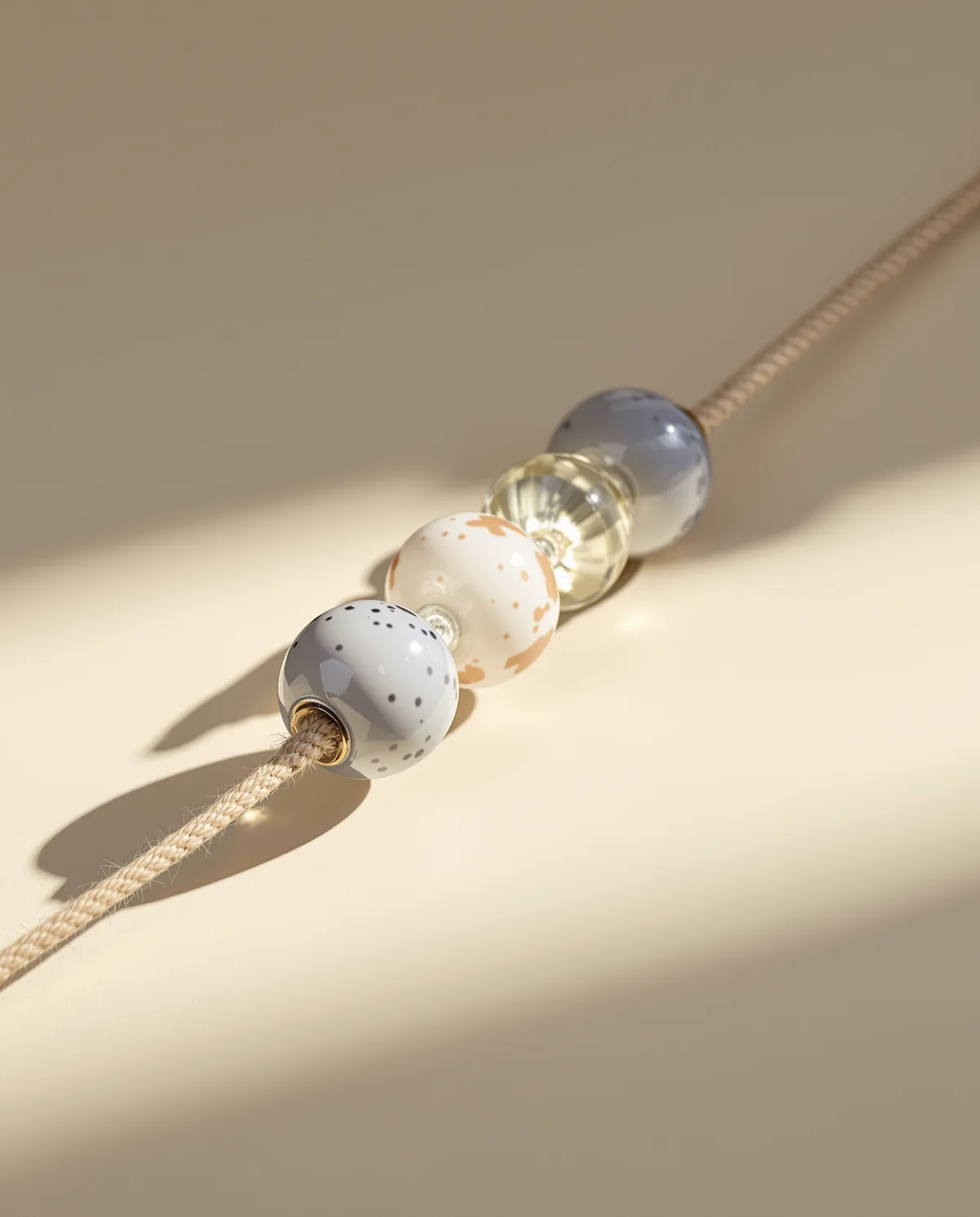
Either moving the top, or adding beads to the bottom of every strand. There is no third place length can come from.
That asymmetry is the whole point of this page. Removing length means taking beads off and re-securing an end, which is a tidy job with a known method. Adding length means finding a bead that matches a run you were not party to, extending a loaded cord, and hiding a join that sits at exactly the same height on thirty strands at once.
The shortfall, measured. Often it is less than people think, and under about two centimetres a heavier end bead per strand will close the gap without any of this.
A straight-on photograph of the hem. The original spare beads, if they came with the panel. And a clear look at the wall above the opening, because if there are four centimetres of clear wall there, this page has already answered itself.
Measure the shortfall at three points across the panel. A panel that is short by different amounts is crooked, not short.
Check the wall above the header. If the shortfall fits there, move the fixing up and stop.
If it does not, decide between replacing strands and splicing. Replace if you can match the bead; splice only if you cannot.
To replace: release one strand at the header, lay it out, record its bead order, build the new strand to that order plus the extra length, knot it in.
To splice: release the end stopper, knot a short length of matching cord to the working cord with a tight double knot, add the extra beads, re-secure the end.
Do one strand, hang it, and look at it from across the room before committing to the other twenty-nine.
Because it needs no beads, leaves no join, is reversible in ten minutes, and costs nothing. It also usually improves the opening: a header mounted on the wall above the frame rather than inside the reveal makes a doorway read taller, which is a reason people choose it deliberately.
The limits are real but narrow. You lose the neat tight-to-the-reveal look. On a very low opening there may be no wall to use. And if the panel was built to sit inside the reveal, moving it out means the strands now swing against the frame's outer edge rather than inside it.
At the match. A surface-dyed bead carries its colour as a coating and the dye lot shifts between runs, so a bead of the same catalogue colour from a different batch will be close and not identical. In a plain strand, close is visible.
The second failure is the join line. People splice carefully, strand by strand, and because each strand was measured from its own hem the joins end up at thirty slightly different heights — which looks worse, not better, than thirty joins in a row. Measure every join from the header, not from the hem.
Yes, and it is the first thing to establish. Waxed cotton cord takes a knot well and a knot is the only way to extend it. Nylon-coated steel wire does not knot usefully; it is joined with a crimp, which is stronger and more visible. Monofilament sits between the two and is the least forgiving of a knot under load.
Look at the end of one strand before you plan anything. The finish at the bottom — a knot, a crimp, or a stopper bead — tells you what you are working with.
Acrylic is the easy case: moulded and dyed to a colour reference, so a match is a specification rather than a hunt. Wood varies by nature, and natural grain variation means a replacement bead will sit inside a tone range rather than on a single colour — which is also why a wood panel hides a splice better than any other.
Glass is the hardest. Body colour is set in the glass, specialty beads come from particular runs, and large hand-made beads are strength-graded by colour because some colours knock badly against others in a hanging panel. Faux capiz discs are cast or cut to shape and dyed, so they match well — the catch is disc diameter, which has to be the same or the hem reads as a mistake.
That a short panel is nearly always a mounting question, and to check the wall above the frame first. That lengthening is possible and will show. And that a drop is specifiable at order, which is the cheap version of this conversation.
If they have already bought, the single most useful thing you can send is the spare beads for that design, if the design is one you stock.
Every bead that ever came off that panel, sorted by colour and kept dry. The offcut cord, because matching stringing medium is harder than matching a bead. And the original end stoppers, which are often a specific bead rather than a knot and are the fiddliest thing to replace.
Label the bag with the panel, not the colour. In a house with two bead panels, unlabelled spares are no spares at all.
Hang it, leave it a day, then sight along the hem from one end. Settling will take up a millimetre or two per strand and will do it unevenly at first, so a hem that looks slightly ragged on the evening you finish is usually fine by the weekend.
Then look for the join line from four or five paces back, which is the distance a panel is actually seen from. A join that is invisible at arm's length and obvious across the room means the heights disagree, not that the beads mismatch.
Nothing, directly — no panel we have built has been lengthened after the fact, because the drop is a specified dimension and the panel is made to it. What the record does say is why: height is one of the main cost levers on a beaded panel, because it is beads per strand multiplied by every strand.
On a 30-strand build, five centimetres of extra drop is five centimetres of beads thirty times over. That is the same arithmetic that makes lengthening expensive in a hallway, and it is also the reason we would rather re-make a panel to the right drop than splice one. Published production timing for beaded décor is 40 to 60 days after sample approval, with sampling usually 16 to 20 days from an agreed brief.
There is no warranty position to void. The permanent change is structural rather than cosmetic: a spliced strand has a knot carrying everything below it, and that knot is now the strand's weakest point for the rest of its life.
The reversible version is strand replacement. Keep the original strands intact in a labelled bag and the panel can go back to exactly what it was, which is worth more than it sounds on a design you cannot buy again.
Extractable data
| Route | Beads needed | Visible join | Reversible | Practical limit |
|---|---|---|---|---|
| Raise the header | None | No | Yes | The height above the opening |
| Replace whole strands | A full strand each | No | Yes, strands kept | Matching the bead and the dye lot |
| Splice an extension | The extension only | Yes, at every join | Partly | Looks wrong on a plain strand |
| Add a longer end bead | One per strand | No | Yes | A centimetre or two, no more |
| Re-make the panel to size | All of them | No | n/a | 40 to 60 days after sample approval |
Good to know
For raising the header, whatever drives your fixing plus a level. For strand work, fine scissors or flush cutters, a crimping plier if the panel is built on coated wire, a beading needle if the cord is soft, and a strong light. The light is not optional: matching a bead by colour under a kitchen bulb does not work.
A knot is a weak point by definition, and on a hanging strand it is a weak point carrying the whole load below it. A well-tied double knot in waxed cord is strong enough in practice, but it sits at the join and will eventually be the place the strand parts. That is an argument for replacing strands rather than extending them.
It gets harder. Glass colour is often in the body of the bead and set at the press or the furnace, so you are matching a glass rather than a dye — and specialty beads such as dotted ovals or Venetian-style feature beads come from a specific run. Acrylic is easier, because it is moulded and dyed to a colour reference.
Not sensibly. Lengthening needs matching beads, which a shop does not hold, and it leaves a visible join on display stock. If a customer needs a non-standard drop, the right answer is a panel specified to that drop — every beaded door curtain is made to order anyway.
Deal with that first and separately. A parted strand is re-strung in its original bead order and re-knotted at the header, which is a repair with a known method. Trying to lengthen and repair in one pass means you lose the reference strand you were going to copy.
Raising the header: half an hour. Replacing strands: an evening for a 30-strand panel, assuming the beads are to hand. Splicing: longer than you expect, because every join has to finish at the same height or the panel reads as damaged rather than altered.
Keep exploring
Guide
Mark one strand, work to that mark on every strand, and re-secure each end — the method depends on cord, wire or monofilament.
Read the guideGuides
One guide per question that arrives often enough to be worth answering properly.
Specs and sizesGuide
Narrowing a panel removes whole strands rather than cutting across them, and which strands go decides whether the pattern still reads.
Specs and sizesGuide
Why acrylic forgives cutting, which tool to use, and how to finish an end so it holds for years.
See the detailGuide
The per-strand arithmetic for a V-point or a scallop, and why marking the whole shape before cutting anything is the job.
Specs and sizesGuide
Replacing one bead mid-strand without dismantling it, and the options when no matching bead is left.
Specs and sizes
Start a conversation
Send a reference, a colour chip or a sketch. Minimums are set per design and confirmed per quote; sampling is quoted separately and usually runs 16 to 20 days from an agreed brief.