Guide
Steam and beadwork
Which materials tolerate steam, which mark permanently, and why the cord rather than the bead sets the lifespan.
Open the reference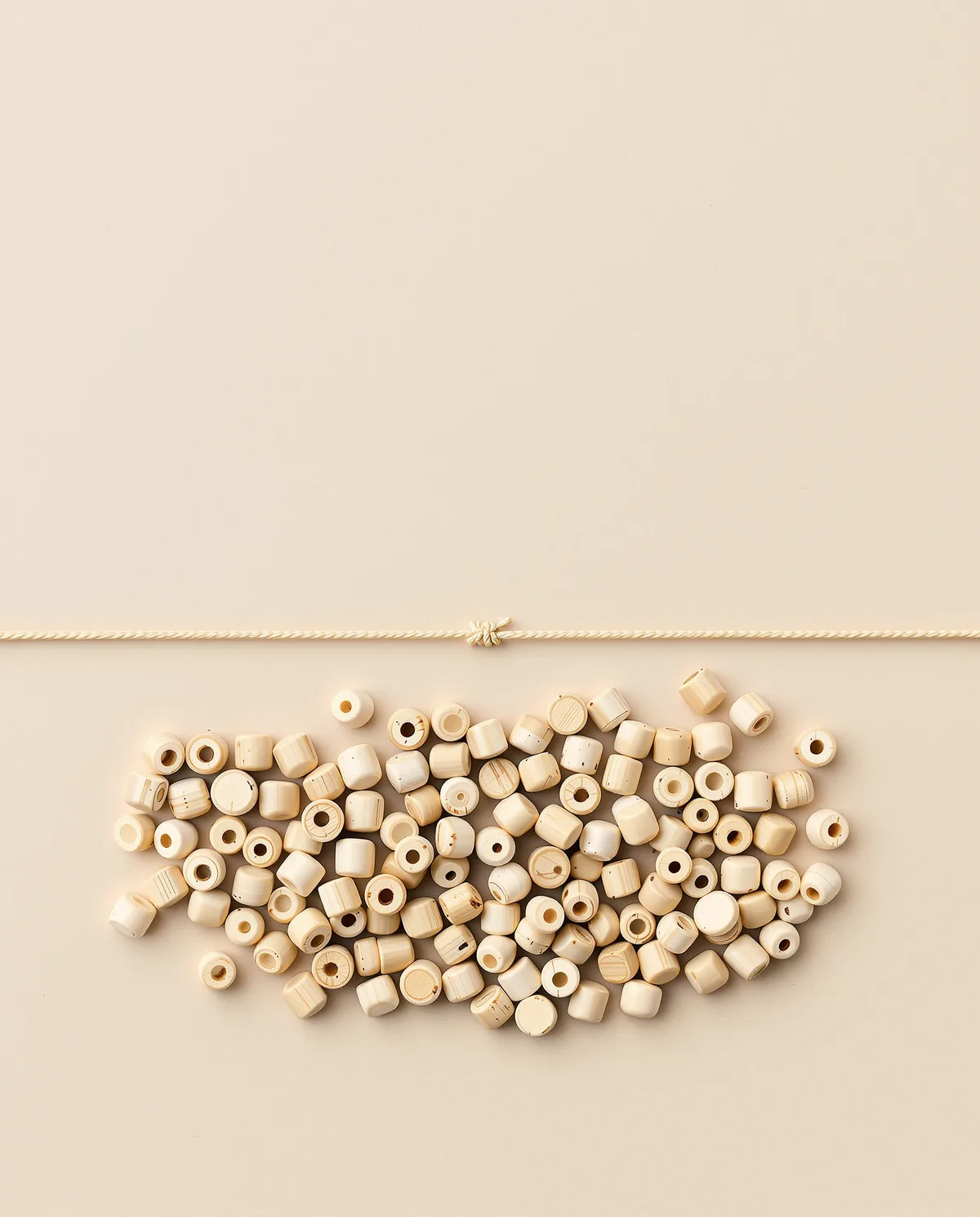
Guide · Outdoor
Humidity does not attack beads. It attacks the two organic components — the cord and the wood — and it does it slowly enough that nobody connects cause to effect.
Cut bamboo tube beads, short lengths of natural culm with the hard outer skin intact and the pale fibrous wall showing at each cut end.
In a persistently humid room, specify glass, acrylic or faux capiz beads on a synthetic stringing medium, and avoid wood and bamboo. Humidity reaches the cord first — cotton cord slackens, discolours and loses strength — and wood second, where it swells and can lift a lacquer. The beads themselves are unaffected either way.
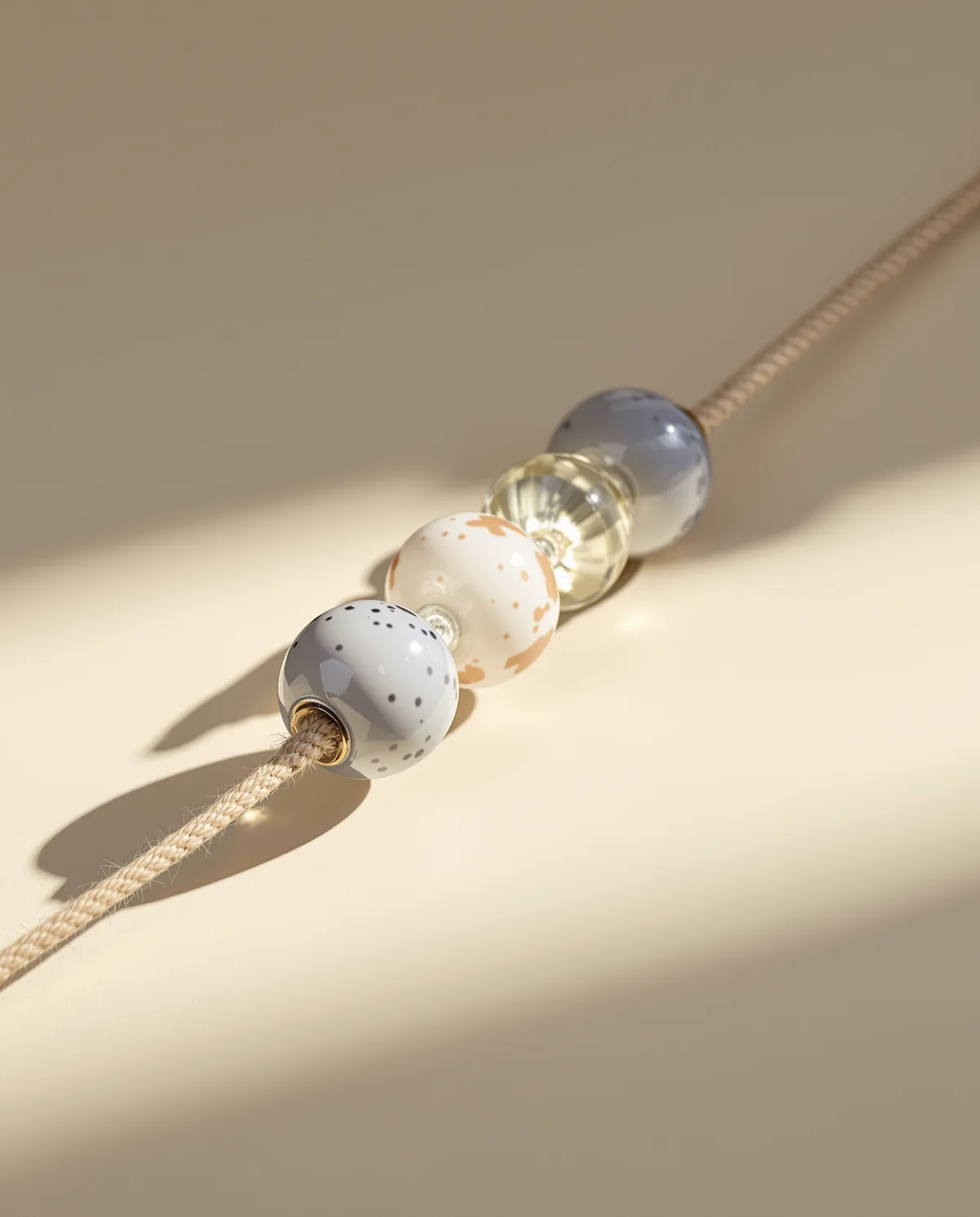
Glass, acrylic or faux capiz beads, on a synthetic stringing medium, and no wood or bamboo anywhere in the build including the header.
That specification has nothing organic in it, which means nothing in it responds to moisture. Everything else on this page is the explanation of why those two decisions — bead family and stringing medium — are the only ones that matter.
A bead panel is a set of inert objects threaded onto one structural component. The beads carry no load; the cord carries all of it, at every drill hole it passes through.
So the question "will this survive a damp room" is really "will the cord survive a damp room", and for cotton cord the answer is that it degrades: it slackens, it discolours, it holds dust, and it loses tensile strength at exactly the points where a bead's drill hole is already abrading it. The failure, when it comes, is a parted strand, and it is indistinguishable from ordinary wear except that it happens several times in a year.
Wood is the second organic component. Wood beads swell and shrink with ambient humidity, and a lacquered or waxed finish will eventually lift. A turned dowel does the same, and the dowel is also where every strand is knotted.
Bead side: glass is drawn and hand-strung in our own Firozabad glass works and is completely stable; acrylic is moulded and dyed to colour and equally stable; faux capiz is cast resin or dyed cut acrylic, so it is an engineered material rather than shell, which in a damp room is an advantage rather than a compromise.
Construction side: a coated steel-wire medium removes the cord problem but changes the finishing, because wire is crimped rather than knotted. A header that is a stitched cotton band rather than a bare dowel adds a textile component, which is the wrong direction in a bathroom. End suspension loops in cord are a small organic component in an otherwise inorganic build, and they are the first thing to check on an old damp-room panel.
A loaded drill hole on a weakened cord. Everything converges there.
The design levers are to reduce the load per hole and to remove the organic medium. Smaller beads spread the same total weight over more drill holes. A synthetic medium is unaffected by moisture. A shorter drop reduces the total weight each top knot carries. None of those is exotic; all of them are specification decisions taken before a sample is made.
Heavier beads concentrate load. On a long strand of large glass beads, the cord at the top drill hole is carrying everything below it, and that is the hole that wears. Many small beads spread the same weight across many contacts.
This is why a dense seed-bead panel is a more conservative damp-room build than a sparse large-bead one of the same weight, which is the opposite of the intuition that fewer beads means less stress.
Three moves, in order. Put the panel outside the wettest zone — a bathroom doorway rather than inside the shower room; the top of a cellar stair rather than the cellar. Specify glass or acrylic on a synthetic medium. And accept the panel as a serviceable item: budget for re-stringing rather than for permanence.
The fourth move, if the room is genuinely wet: do not use beadwork. A persistently condensing room will defeat a cotton cord and will mark wood, and there is no construction we would claim otherwise for.
In a hotel, the issue is who maintains it and what they are told. A panel in a spa corridor or by a pool is in a humidity regime that nobody will monitor, so the specification has to assume no maintenance: inorganic beads, synthetic medium, and an inspection on the housekeeping schedule rather than a care card in a drawer.
In a nursery the humidity question is usually secondary to the fixing and the reach question, which belongs on its own page. What is relevant here is that a cord weakened by damp is also a cord that parts more easily when pulled, so a damp room and a small child are a combination that argues for a synthetic medium on both counts.
Through testing on the specified build. Where a retail programme requires it, testing is arranged to the buyer's own protocol at an accredited laboratory and quoted with the programme — flammability, material compliance and incremental market testing all run that way, and the report names the construction it was run on.
That route works here because we manufacture the components. The specimen can be the exact assembly a buyer signs off: the bead we drew, the medium we strung it on, the header we made, tested together rather than as separate parts.
The bead material, the stringing medium, the header type, and "for interior use". Four facts, no reassurance.
A listing that says "glass beads on coated wire, wooden dowel, interior use" lets a buyer work out for themselves that the dowel is the organic part — which is both true and more useful than any reassurance. Name the components and the decision becomes the buyer's to make.
By choosing the components, because that is the whole of it. The bead families we draw, mould and cast are all inorganic. Wood is turned in our own wood factory at Saharanpur and is specified where it is right, which is a dry interior. Bamboo is confirmed per design, and a damp room is the wrong place for it.
Beads are matched to a Pantone reference or a physical chip and confirmed on the sample, so a damp-room palette can be built in acrylic as readily as in glass. The one thing we do not do is substitute a synthetic medium silently: if a build changes from cord to coated wire, the finishing changes with it and that is approved on the sample.
How each component behaves in persistent damp, which is what decides the specification: the cord is the part humidity ages, not the bead, so the stringing medium is the lever. Where a programme needs a tested figure, the build is tested and the testing is quoted with it.
The construction is documented end to end — which component is organic, where the load sits at each drill hole, and what each bead family is made of — because we draw, mould, cast and turn those components ourselves. Ask a supplier which test and which build any damp-room rating was run on; that question is the one a real answer survives.
Extractable data
| Component | Persistent humidity | Direct wetting | Failure mode | Recoverable |
|---|---|---|---|---|
| Glass beads | No effect | No effect | None | n/a |
| Acrylic beads | No effect | No effect | None at room temperature | n/a |
| Faux capiz, cast resin | No effect | No effect | None | n/a |
| Faux capiz, dyed cut acrylic | No effect | No effect | None | n/a |
| Wood beads | Swells and shrinks | Marks, grain raises | Lacquer lifts, bead splits | No |
| Bamboo beads | Marks | Marks badly | Surface staining | No |
| Cotton cord | Slackens, holds dust | Discolours, weakens | Parts under load at a drill hole | No |
| Coated steel wire | No effect | No effect | None | n/a |
Good to know
Completely. Glass, acrylic and faux capiz are indifferent to humidity; wood and bamboo are not. But the decisive component on any panel is the stringing medium, because that is the only part doing structural work — a glass panel on cotton cord still has a humidity problem, and a glass panel on coated wire does not.
State the bead material, the stringing medium, the header type and interior use. A listing that names the cord lets a buyer make this decision for themselves, which is the useful thing a listing can do. Where a programme needs a tested figure, the build is tested and the testing is quoted with it.
Specify the construction rather than look for a rating: the cord is the component humidity ages, not the bead, so a synthetic stringing medium is the lever that matters. Where a programme needs a tested figure, the build is tested and the testing is quoted with it.
Glass, acrylic or faux capiz on a coated steel-wire medium, with nothing organic in the build — no wood bead, no wooden dowel, no cotton header band. The cord is the component humidity ages, not the bead, so the stringing medium is the whole decision. For a genuinely wet room, specify something other than beadwork; where a programme needs a tested figure, the build is tested and the testing is quoted with it.
For a bathroom or a cellar, your own building fabric is the first question — a room with condensation on the walls is a ventilation problem before it is a décor problem. For a contract specification, ask us for a construction that removes the organic components, and ask your testing house what evidence they will accept.
Indirectly, and in a way worth knowing. Larger beads mean fewer beads per strand but more weight per bead, so the load at each drill hole is higher — and a weakened cord parts at a loaded drill hole. On a damp-room panel, smaller beads on a synthetic medium is the more conservative build.
Keep exploring
Guide
Which materials tolerate steam, which mark permanently, and why the cord rather than the bead sets the lifespan.
Open the referenceGuides
One guide per question that arrives often enough to be worth answering properly.
Read moreGuide
Under cover it lasts; in weather it does not, whatever the beads are made of. The failure order outdoors is cord, finish, wood.
Specs and sizesGuide
Colour through the glass body survives; surface dye and coated finishes go first; acrylic sits between the two.
Specs and sizesGuide
What a hot dish does to each component, why no temperature rating is published, and the service-piece distinction that resolves it.
How it is madeGuide
Loosely tied bundles in strand order, flat or hanging, never folded, somewhere dry — and label which opening it came off.
Read the guide
Start a conversation
Send a reference, a colour chip or a sketch. Minimums are set per design and confirmed per quote; sampling is quoted separately and usually runs 16 to 20 days from an agreed brief.