Process
Bead dyeing, dye lots and what fades
Colour through the body, colour in a dye bath, colour on a surface — what each one promises, what a dye lot is, and what direct sun does to all three.
Specs and sizes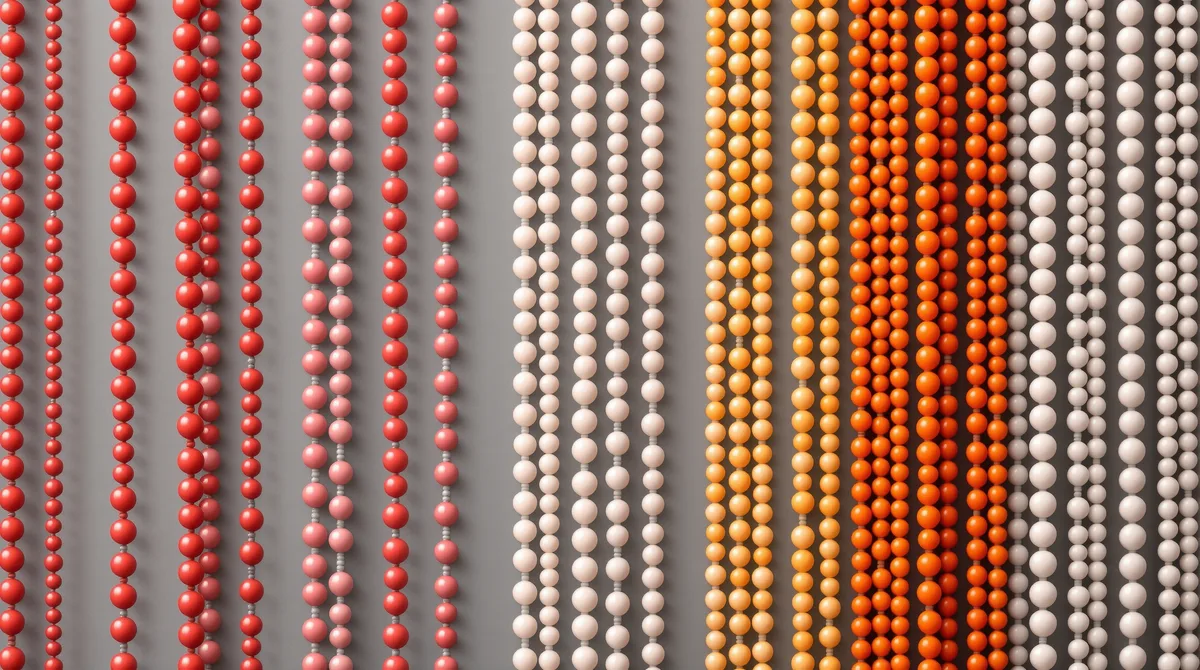
Guide · Outdoor
The question is not what the bead is made of. It is how the colour is held in the bead, and that single distinction predicts everything.
Six short strands of the same poppy-red and tangerine glass laid parallel and graded from full saturation through to pale chalky bleach, reading as a fade ladder.
Body-coloured glass does not fade; surface-dyed beads and coated finishes do, and go first. Acrylic sits between the two: its colour is through the material but the polymer itself can yellow. Wood stain and lacquer fade, and cotton cord discolours before any of them. Specify by how the colour is held, not by the bead family.
Beads whose colour is in the body of the material do not fade. Beads whose colour sits on the surface do, and they are the first thing in the panel to change.
That distinction cuts across the materials, which is why "do glass beads fade?" has no useful answer. A body-coloured glass bead and a surface-dyed glass bead are the same glass with completely different lifespans in a sunlit doorway.
Ultraviolet light breaks down colourants. A colourant in the body of a glass bead is behind a thickness of glass and is chemically part of it; a colourant on the surface is exposed, thin, and the first thing the light reaches.
Surface dye is also the normal way a ground is tied to an accent. Where a design uses a fine base strand dyed to match a large accent bead, the base strand is the surface-dyed component — so the part of the panel most likely to fade is often the part doing the colour work.
The second mechanism is the polymer one. Acrylic holds its colour through the material, but the material itself can yellow in strong light, which shifts every colour towards warm rather than lightening it.
The third is the cord. Cotton cord discolours in sunlight before the beads visibly change, and it loses strength while it does so — which means a sunlit panel's structural clock is running faster than its cosmetic one.
| Colour method | In strong sun | First visible change | Alternative to specify |
|---|---|---|---|
| Glass, body colour | Stable | None | — |
| Glass, surface dye | Fades | Lightens unevenly | Body-coloured glass |
| Glass, silver-lined | Fairly stable | Lining can dull | Body-coloured glass |
| Frosted or sea-glass finish | Stable in colour | Surface soiling only | — |
| Acrylic, moulded colour | Slow change | Yellowing of the polymer | Glass for a sunlit opening |
| Acrylic, surface finish | Fades | Gloss and colour together | Moulded colour |
| Wood, stained or lacquered | Fades | Lightens; lacquer chalks | Natural wood, which ages gracefully |
| Faux capiz, dyed | Slow change | Face dulls | — |
| Cotton cord | Discolours | Yellows, then weakens | A synthetic medium |
Because sun does not arrive evenly across an opening. One side gets morning light, the centre gets most of the day, a few strands sit permanently in the shadow of the architrave.
The practical consequence is that a faded panel is a gradient rather than a uniform change, which is why partial repairs look worse than no repair: new colour next to half-faded colour reads as a step. It is also a free diagnostic — the strands behind the frame are the closest thing you have to the panel as made.
A dyed gradient in a sunlit opening. That is the specific combination that fails worst.
A gradient carried by dye depends on the relationship between several dyed tones, and sunlight changes each of them at a different rate, so the gradient stops being a gradient. A gradient carried by bead size — smallest beads at the top, largest at the hem, which is how the honey ombre approach works — depends on geometry, and geometry does not fade.
It does not change the chemistry and it changes the consequence. Large beads show a colour change over a larger area, so the same percentage loss is more visible. Small beads in a dense field average out: a seed-bead ground loses tone gradually rather than patchily.
And as above, where bead size is doing the design work rather than dye, fading degrades the piece far more gracefully.
Four moves. Specify body-coloured glass in any opening that gets direct sun. Carry a gradient by bead size rather than by dye. Use a synthetic stringing medium if the cord will be in sun, because cord discolouration comes with strength loss. And accept surface dye as a consumable choice where the colour cannot be achieved any other way.
The fifth, non-material: hang it somewhere else. A panel between two interior rooms will outlive the room; the same panel across a south-facing window will not.
In a hotel, as a replacement cycle rather than a care regime. A panel in a sunlit atrium should be specified as re-orderable: nothing is held in stock, every panel is made to order, and production runs 40 to 60 days after sample approval, so the planning is the solution.
In a nursery the relevant point is different. A bright, surface-dyed acrylic palette is exactly what a children's room brief tends to ask for, and it is also the least lightfast combination available. Saying so at the brief is more useful than discovering it in year three.
Nothing we are in a position to characterise, and colour is matched to your reference and approved on the sample.
Where a retail programme requires testing, it is arranged to the buyer's own protocol and quoted separately. Our published compliance set covers social and environmental auditing, responsible timber certification and supply-chain security, plus material compliance on relevant product lines — none of which is a lightfastness result for beadwork.
How the colour is held, in one phrase: body-coloured glass, surface-dyed glass, silver-lined, moulded acrylic. Then one plain line: surface-dyed beads will fade in strong direct sunlight.
A listing that does this is more useful than one that promises fade resistance, and it is also the only version that is true. Colour is matched to a Pantone reference or a physical chip and confirmed on an approved sample — which guarantees what the panel looks like on arrival, and says nothing about year five.
How the colour is physically held in each bead type, which is what predicts fading: body colour through the glass, surface dye, a silver lining, a moulded acrylic colour, a wood stain.
Also usable: that dye lots shift between runs — which is why production is held to the approved sample rather than to a reference chip — and that colour variance is one of the defects first-article and lot inspection looks for before export packing. Colour is matched to your reference and approved on the sample, and where a programme needs a light-fastness class the build is tested and the testing is quoted with the project.
Good to know
Colour held in the body of the glass does not fade; colour held on the surface of a bead does, and in a south-facing opening it will do so within a few years.
Less than the colour method does. A surface-dyed glass bead fades and a body-coloured glass bead does not, and they are the same material. The one genuine material effect is that acrylic can yellow as a polymer, independently of its colour.
How the colour is held — body colour, surface dye, silver-lined, moulded — and that surface-dyed beads will fade in strong direct sunlight. It should not claim ultraviolet stability or fade resistance, because a light-fastness class belongs to a tested build rather than to a bead family.
Not by us, and no lightfastness or weathering result is published for a Gemixx panel. What this page rests on is how colour is physically held in each bead type, which is construction knowledge rather than a test result, and the difference is worth stating.
A lightfastness class, a fade-resistance rating, a years-to-visible-change figure, or that any panel is ultraviolet-stable. Where a specification needs a number it has to be tested against the actual build, and that testing is quoted separately.
If you are a buyer with a lightfastness requirement, ask your own testing house which protocol they will accept and we will build and submit to it. If you are furnishing a sunlit room, the useful question to any seller is simply: is this colour in the glass or on it?
Not the chemistry, but it changes what fading does to a design. On a gradient carried by bead size rather than by dye — smallest beads at the top, largest at the hem — fading shifts the tonal relationship between sizes rather than erasing a colour, so the grade degrades more gracefully than a dyed one.
Keep exploring
Process
Colour through the body, colour in a dye bath, colour on a surface — what each one promises, what a dye lot is, and what direct sun does to all three.
Specs and sizesGuide
Which beads can be swapped, why re-dyeing a strung panel does not work, and the replace-or-live-with-it call.
Compare the optionsGuides
One guide per question that arrives often enough to be worth answering properly.
See the detailGuide
Cord and wood fail first in humidity, long before glass notices. Which materials and cords survive a persistently damp room.
How it is madeGuide
Under cover it lasts; in weather it does not, whatever the beads are made of. The failure order outdoors is cord, finish, wood.
Read the guideGuide
Knot finish, strand length consistency, bead alignment, drill quality, header fixing, dye evenness, spares and packing.
Open the reference
Start a conversation
Send a reference, a colour chip or a sketch. Minimums are set per design and confirmed per quote; sampling is quoted separately and usually runs 16 to 20 days from an agreed brief.