Manufacturing
Beaded café curtains
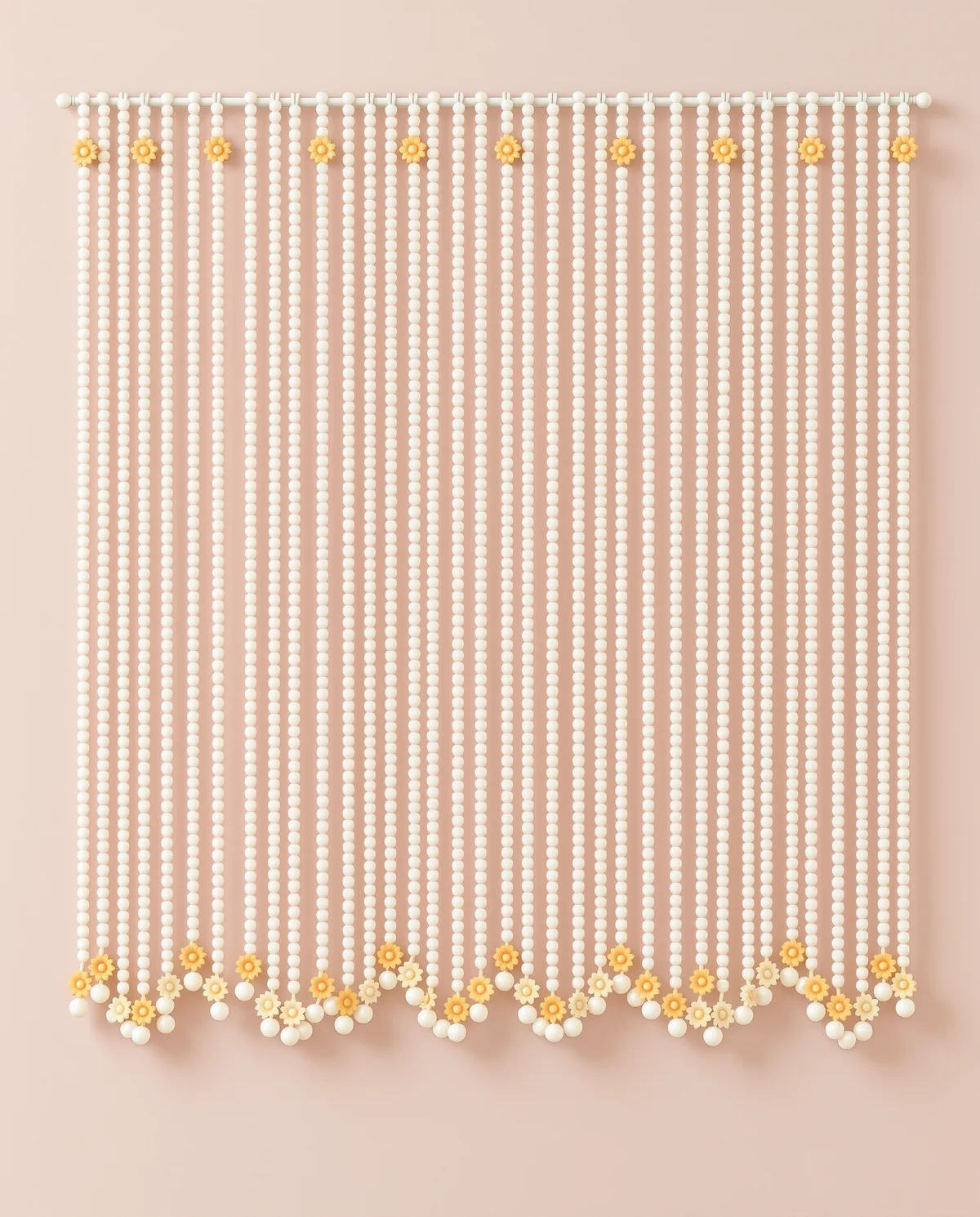
Built on a cotton or organza header with a three-inch rod pocket: the band, the strands, the hem and the sizes we have shipped.
See the detail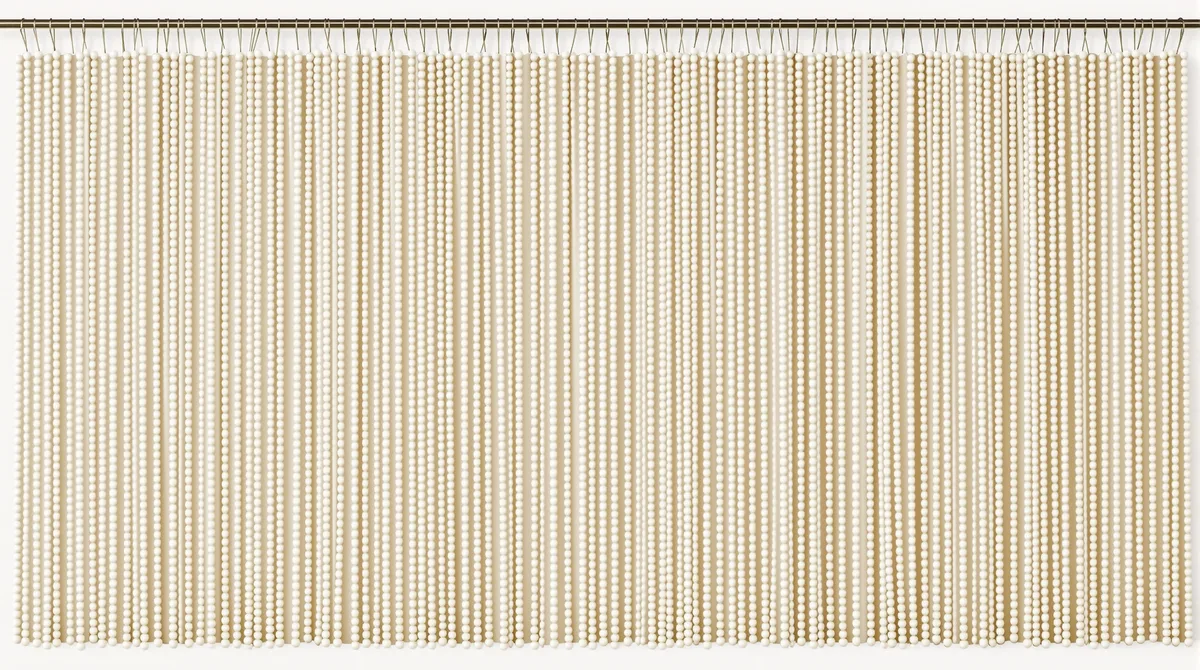
Application · Application
A window panel hangs still, so durability stops being the question. What takes its place is daylight — hours of it, every day, on whichever surface the colour lives on.
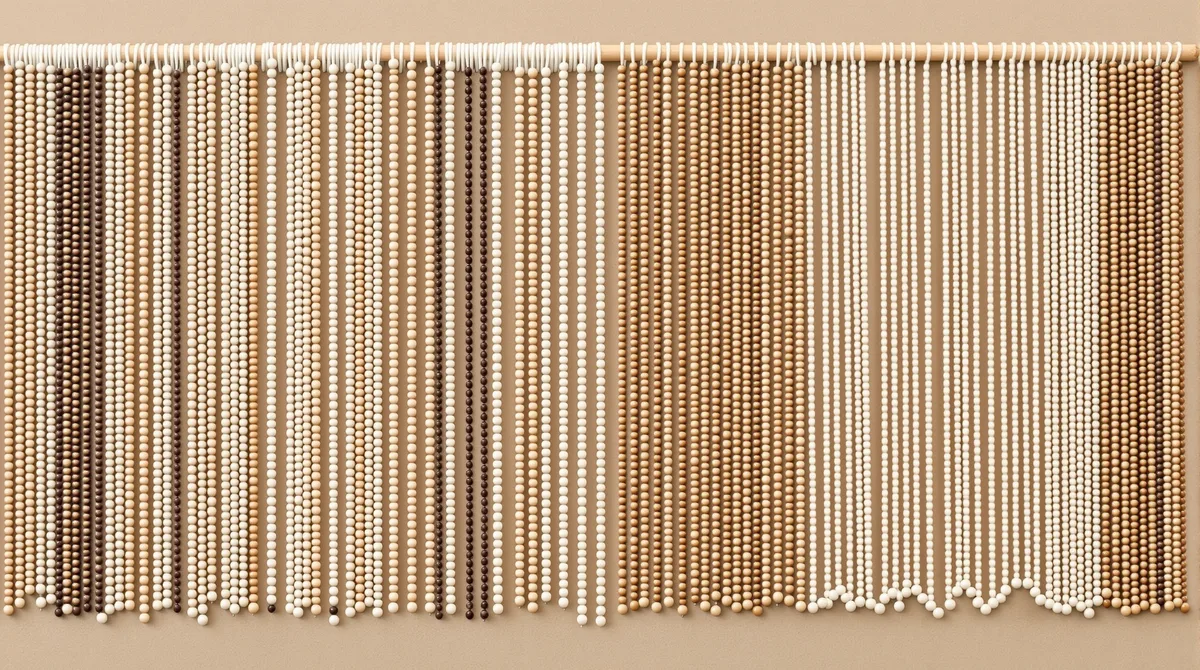
A half-height beaded cafe curtain hung from a slim rail, the waist-deep strands in chalk white, pearl and oat glass.
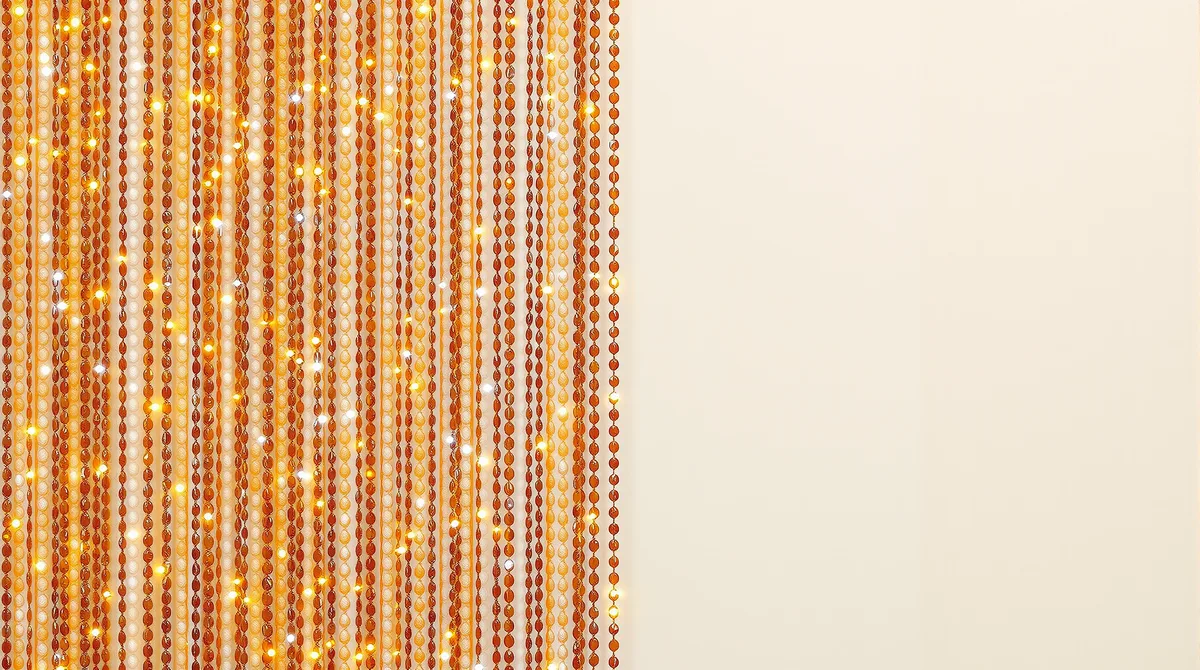
At a window, daylight governs the specification instead of wear. Body-coloured glass holds its colour in strong light where surface-dyed beads are the risk, and length is set from the sill rather than the floor — café height, valance depth or a full drop to the sill line. Privacy is not what a bead panel delivers; light modulation is.
Almost always light, dressed up as privacy. A client asks for a bead panel at a window because they want the glare broken, the view softened and the glass made interesting from the street. They rarely want the room screened, and a bead panel would not screen it anyway.
So establish early what the panel is for. If the answer is genuinely privacy, beadwork is the wrong product and we will say so. If the answer is light, texture and a shopfront that reads from the pavement, it is one of the best products in the category.
Colour stability, first. A window panel sits in direct or near-direct daylight for the whole of its life, and that is a different kind of load from a doorway's. Dye sitting on the outside of a bead is exposed; colour fired into the glass body is not.
Second, a top fixing that suits a window rather than a door. Third, a length set from the sill. Fourth, a hem that reads well against a bright background, because a window panel is always seen in silhouette and a shaped hem does far more work there than a pattern does.
Three formats are shipped. A café curtain at 24 × 30 inches plus a three-inch rod pocket, built on a cotton header band with a beaded top trim and strands below. A seed-bead café curtain at 30 × 30 inches on organza, also with a three-inch rod pocket. And a valance at 30 × 24 inches with a scalloped arch hem, fullest at the sides, longest strand 24 inches and shortest 10.
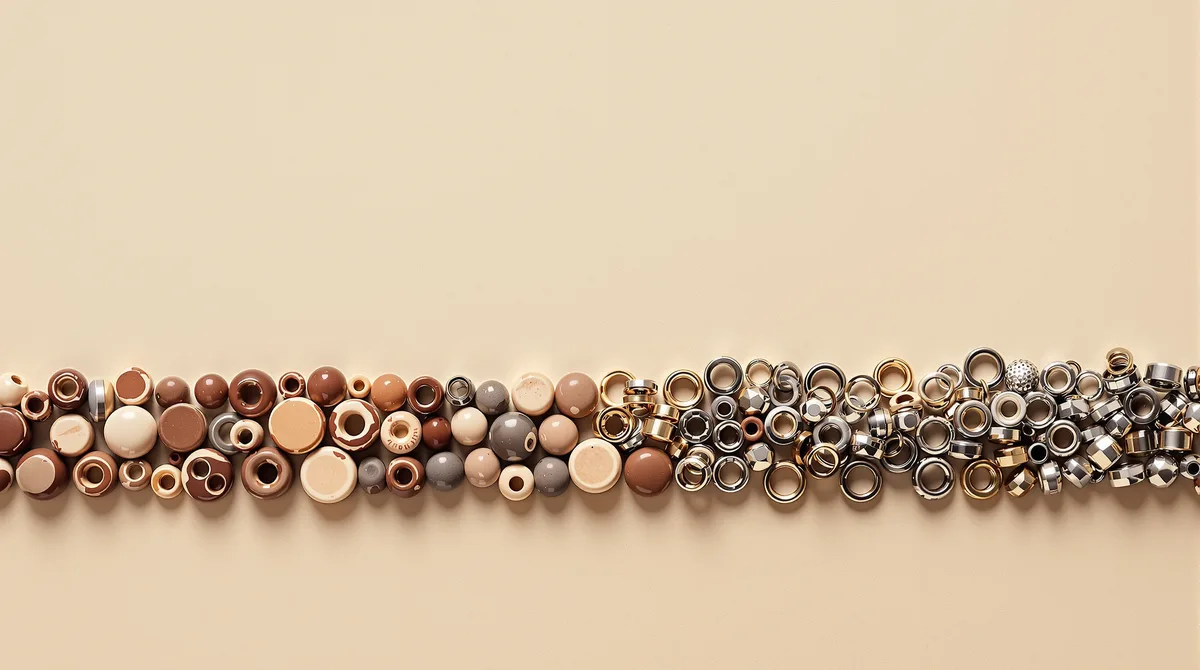
Material: body-coloured pressed glass for anything in strong light. Irregular frosted sea-glass beads at around 4 to 5 mm are a good window bead because the frosting diffuses rather than flashes. Keep surface-dyed beads out of direct sun.
Sampling 16 to 20 days from an agreed brief, photographs approved before the sample ships, production 40 to 60 days after sample approval. A café front normally means a repeat of one panel, so the critical path is the first sample, not the quantity.
One scheduling trap is specific to windows: if the client wants the colour checked in situ, the sample has to arrive before the approval meeting and be hung at the real window, in the real light, at the real time of day. That is worth two weeks of programme.
Give the sill-to-rail dimension, not the floor-to-rail one. Then panel width, the rod diameter if there is a rod pocket, the header type and depth, strand count or pitch, bead material and size, colour references, the hem shape with longest and shortest drop, and whether the window opens inwards.
State whether the panel hangs inside the reveal or on the face. On a café front, also state the module: four identical panels at 750 mm read quite differently from three at a metre, and that decision belongs on the drawing rather than in the installer's judgement.
Height is the cheapest lever at a window, which is why café height and valance depth are so common. A valance uses a fraction of the beads of a full drop and the saving is close to proportional.
Beyond that, the ranking is the same everywhere: bead size and material first, then strand count and tightness, then pitch, then the header and packing, then height. Minimums and pricing are set per design and confirmed with your quote. A rough cost sheet is produced before any sample is made so the look can be traded against price while it is still cheap to change.
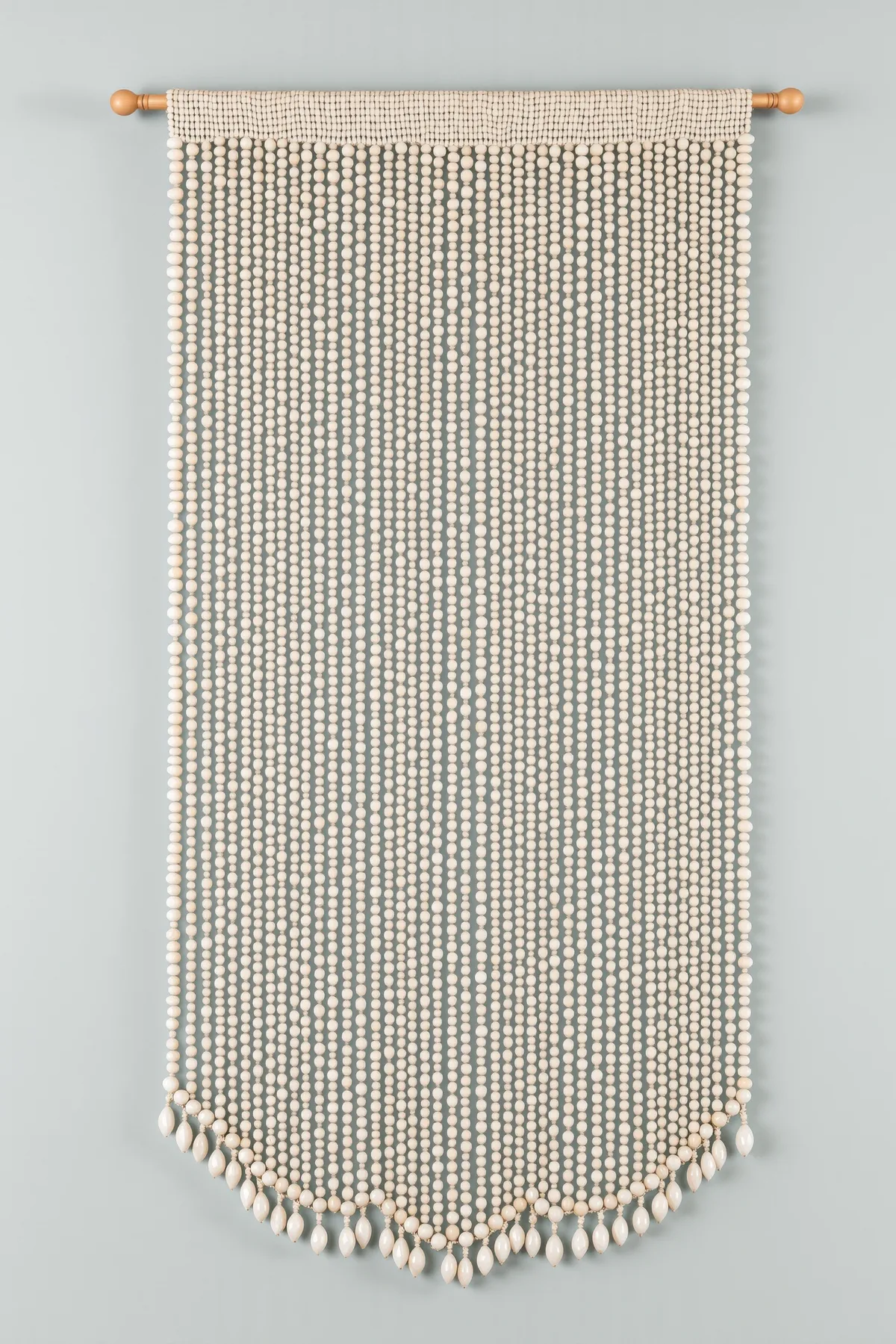
Café curtains in both constructions have been made and shipped, as has a valance with a scalloped arch hem. One useful piece of history: a seed-bead window panel was originally briefed as a full curtain and converted to café size because the bead-mounting frame the work is built on caps at a certain size. That is a real manufacturing limit, and it is better known at brief stage than at sampling.
These are retail pieces. No specified café-front installation sits behind this page, and we are not going to imply one.
Surface-dyed beads in a south-facing window. A fabric header in a position that gets wet. Full-height panels at a shopfront where the cleaner needs to reach the glass behind them. And any suggestion to a client that a bead panel will give them privacy — it breaks up a sightline and nothing more.
We would also advise against specifying beadwork at a window without seeing the sample in that window's light. Glass colour behaves differently against bright sky than it does against a studio wall, and no photograph settles it.
The designer, and then whoever cleans the glass. A café front is cleaned from outside and inside, often daily, and a panel that has to be unhooked every morning will not survive its first month in service. Ask that question at design stage; it usually pushes the drop up and the pitch wider.
Sample approval is ours to run: photographs first, then the physical sample, then production held to it.
A café curtain needs a rod through its three-inch pocket, carried on brackets. A strung panel needs a dowel or header rail on hooks or brackets. We make the dowel, the header rail and the sewn header band; rods, brackets, tracks and tension rods are not supplied.
Window loads are modest compared with a doorway because the drops are short, but the fixing still has to go into something solid. A tension rod inside a reveal is viable for a light acrylic or wood panel and not for a glass one.
Domestically, none. Commercially, expect a flammability question — NFPA 701 in the US, local equivalents elsewhere — and fire performance is tested on the specified build and quoted with the project.
Light-fastness is the question a window project should ask and rarely does. Colour is matched to a reference or a physical chip and approved on the sample, which is a match rather than a durability claim; where a shopfront needs a durability figure, it is established on the specified build and quoted with the project. Where a landlord or a brand standard governs shopfront dressing, read it before the sample: shopping-centre handbooks frequently restrict what may hang behind glazing.
Monthly dry dusting, header to hem, with the top third done first because that is where sun-baked dust settles. Spot-clean beads with a barely damp cloth and dry in the same pass. Keep the cord and any fabric header dry.
Access is the detail to design in. Decide at drawing stage whether the panel lifts off its rod in one piece, and if it does, specify where it is stored while the glass is cleaned. A panel that is bundled on the floor of a café every morning will tangle, and tangling is a repair job, not a dusting job.
Extractable data
| Item | What suits a window | Note |
|---|---|---|
| Café curtain | 24 × 30 in plus a 3 in rod pocket | Shipped format on a cotton header band |
| Seed-bead café curtain | 30 × 30 in on organza, 3 in rod pocket | Shipped 2025; Shantoon poly-cotton base ≈60–65 GSM |
| Valance | 30 × 24 in, scalloped arch hem | Longest strand 24 in, shortest 10 in |
| Valance, wide | 120 × 35 cm | A format from the current design library |
| Full window panel | Drop set from the sill, not the floor | Ask for the sill-to-rail dimension |
| Top fixing | Sewn fabric header with a 3 in rod pocket, or a dowel | Rod through the pocket is supplied by the project |
| Bead material, strong light | Body-coloured pressed glass; frosted sea-glass beads ≈4–5 mm | Colour is in the glass, not on it |
| Bead material to avoid | Surface-dyed beads in direct sun | Dye is a surface property |
| Header fabric | 100% cotton band, or organza / chiffon for a sheer | Fabric is the fade-sensitive part |
| Size limit | Set by the bead-mounting frame | A full curtain has been converted to café size for this reason |
| Sampling | 16–20 days from an agreed brief | Photographs approved before the sample ships |
| Production | 40–60 days after sample approval | Published lead time for beaded décor |
| Light-fastness | Matched to your reference | Approved on the sample before production runs |
Good to know
Two routes. A café curtain hangs on a sewn fabric header with a three-inch rod pocket, so it needs a rod of the right diameter and a pair of brackets — both supplied by the project. A strung panel hangs from a wooden dowel or header rail, which we make, on hooks or brackets above the reveal. Either way the fixing has to clear the opening window itself if the window opens inwards.
Domestically, none. In a commercial café front, a hanging decorative panel is usually treated as drapery and asked to meet NFPA 701 or the local equivalent, and fire performance is tested on the specified build and quoted with the project. Colour is matched to your reference and approved on the sample. A bead panel is not glazing and is never specified as a safety barrier at one.
Dry dusting down each strand, header to hem. A window position collects less airborne grease than a kitchen doorway but more sun-baked dust on the upper beads, so the top third needs attention first. Where there is a fabric header, keep it dry: a cotton band shrinks unevenly and marks, and organza and chiffon mark worse.
Sampling is 16 to 20 days from an agreed brief, with photographs approved before the sample ships, and production is 40 to 60 days after sample approval. A café front is usually several identical panels, which does not change the lead time but does make the approved sample more important, because every panel is held to it.
Colour, if the wrong bead was chosen. Surface-dyed beads lose tone in direct sun and the loss is uneven across a panel, which reads as patchiness rather than fading. The second failure is the fabric header, not the beadwork — cotton and organza bands both age faster in strong daylight than glass does. Body-coloured glass is the most stable element in the whole assembly.
Café curtains are a shipped format: a beaded café curtain on a cotton header with a three-inch rod pocket and a scalloped chevron hem, and a 30 × 30 in seed-bead café curtain on organza, both made and dispatched. Those were retail pieces rather than specified café fit-outs, so treat the record as evidence of the construction and the sizes, not of a commercial installation.
Keep exploring
Manufacturing
Built on a cotton or organza header with a three-inch rod pocket: the band, the strands, the hem and the sizes we have shipped.
See the detailSpecification
How transmission, refraction and cast bead-shadows behave through the day — and where glare control fails.
See the detailPillar
Twenty settings, from a closet front to a hotel lobby, each with the format that suits it, the fixing it needs and the standard that applies.
Compare the optionsSpecification
Ceiling fixing, double-sided reading, strand drift in airflow, and a plain account of what a bead division will not do.
How it is madeSpecification
Grease, steam and daily traffic: which bead materials survive a kitchen opening, which finishes do not, and how often it needs cleaning.
How it is made
Start a conversation
Send a reference, a colour chip or a sketch. Minimums are set per design and confirmed per quote; sampling is quoted separately and usually runs 16 to 20 days from an agreed brief.