Material
Wood, in detail
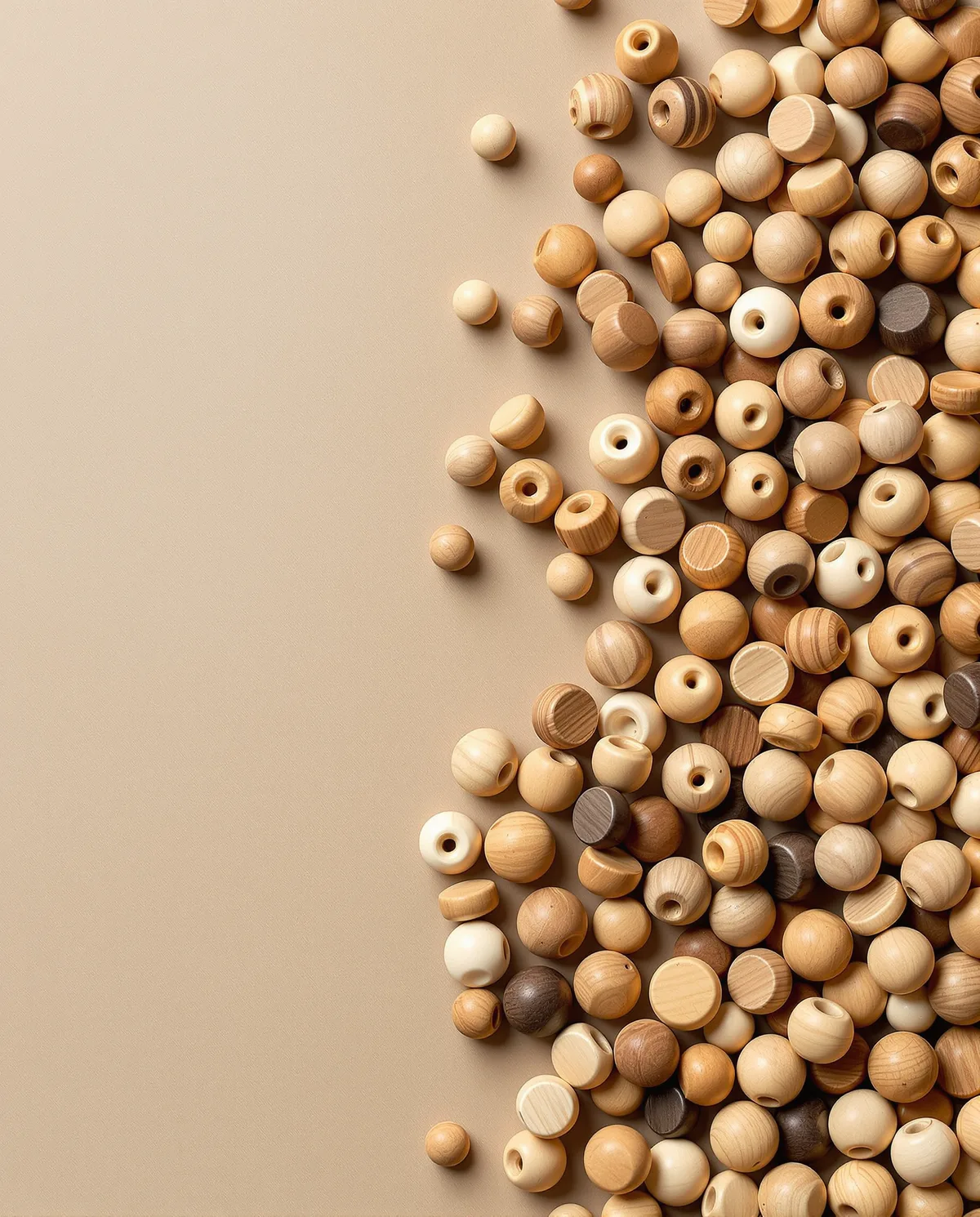
Turned and drilled in our own wood factory: grain variation you approve rather than eliminate, the finishes that hold colour, and the dowel from the same plant.
Read the guide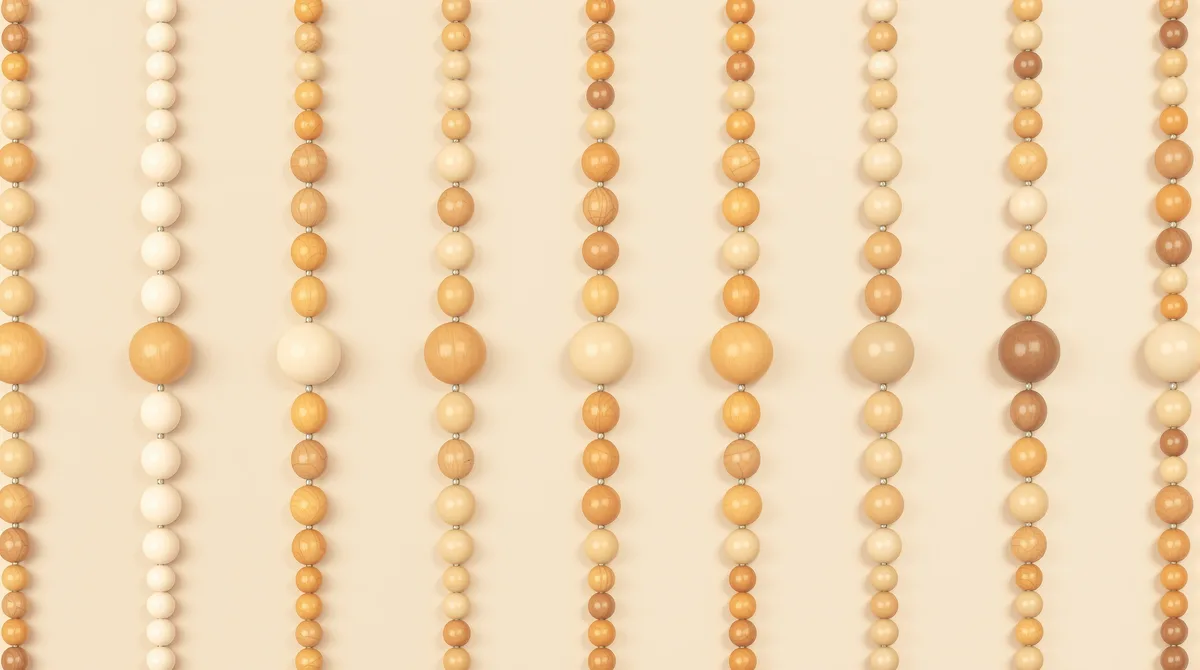
Guide · Material
Wood is the quiet one. It knocks instead of chiming, it is warm instead of bright, its colour varies from bead to bead on purpose — and it has exactly one thing it cannot tolerate.
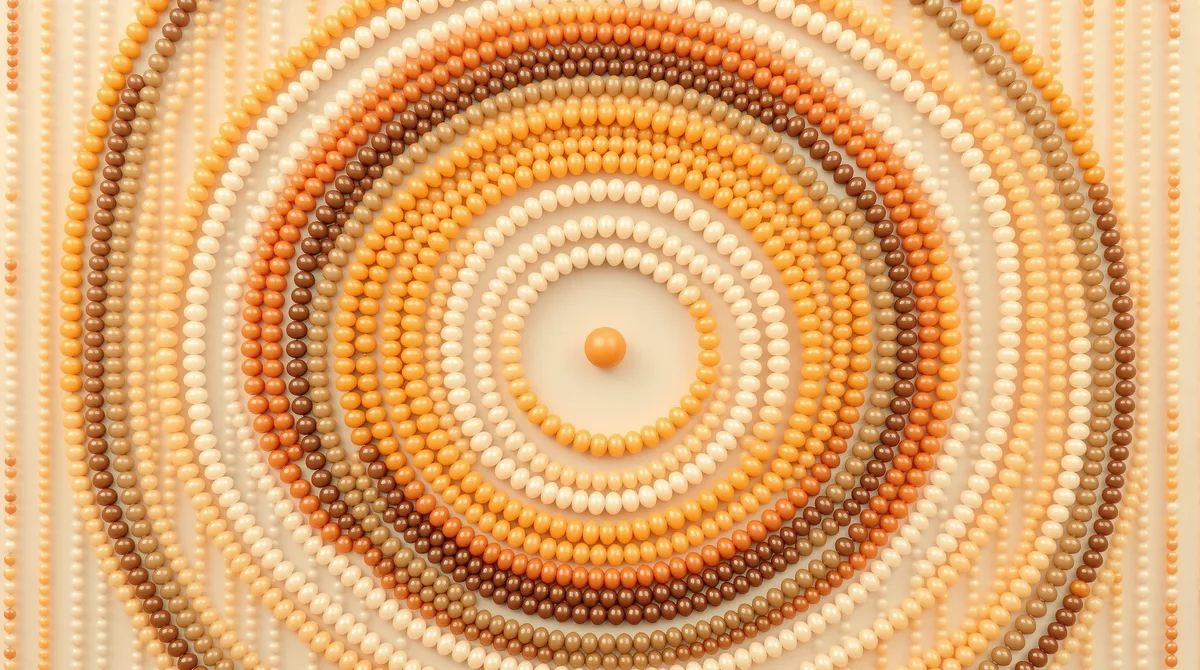
Hand-strung cords of round turned wooden beads in three diameters repeating down every strand, in cream, tan and caramel wood tones.
A wooden beaded curtain hangs turned wood beads on cord. It is light, matte and warm, gives a soft knock rather than a chime, and its grain varies from bead to bead so no two panels match exactly. The one thing that ruins it is damp: water raises the grain and can lift a lacquer. Our curtain dowels are turned in our own Saharanpur wood factory.
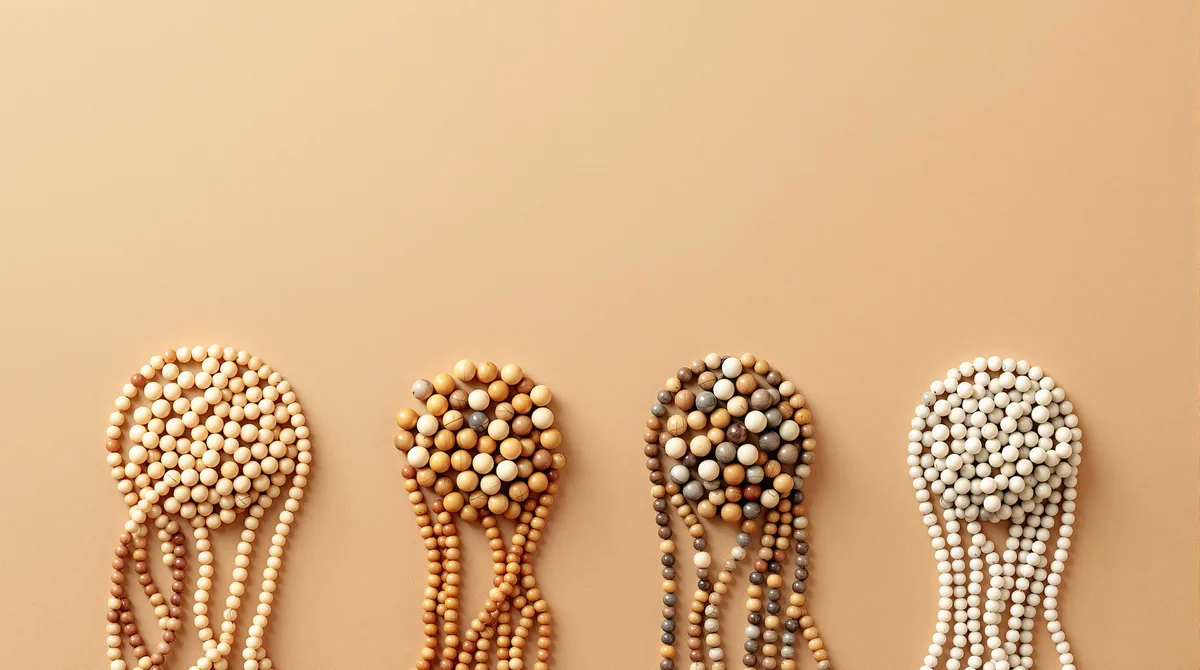
A hand-strung panel in which the beads are turned wood — rounds, rondelles, flats and tubes, in natural or stained finishes. Strands are threaded on cord and gathered on a single turned wooden dowel, exactly as in any other strung panel.
The construction is unremarkable. What makes a wood panel a different object from a glass one is that every property you notice from a metre away is inverted: it is light where glass is heavy, matte where glass is bright, quiet where glass chimes, and variable where glass is consistent.
It recedes, in a useful way. Wood is the only bead material that reads as part of the architecture rather than as an applied decoration — in the same way a rush mat or a cane blind does.
It also moves more than glass. Most woods sit below 1 g/cm³ against glass near 2.5, so a wood strand swings further for a given push and settles more slowly. In a doorway in constant use that reads as liveliness; in a draughty hallway it can read as restlessness.
And it is the quiet option. A wood bead gives a soft knock: warm, low and damped, because the fibrous material absorbs its own vibration almost immediately. Outside a bedroom door it is the right material in the category.
Three comparisons matter.
Against glass: wood gives up weight, straightness, light transmission and the chime, and gains warmth, quiet and a third of the weight on the fixing.
Against bamboo: wood is denser, quieter, and takes stain and lacquer. Bamboo is a hollow cut tube with no finish at all, lighter again, and rattles rather than knocks — and bamboo is the one material we confirm per design rather than hold as an owned capability.
Against acrylic: comparable in weight and completely different in character. Acrylic's advantage is colour; wood's is that it has none to lose.
The most common real answer is wood plus something — glass or acrylic accents for colour and weight, placed towards the hem.
The standard sequence: a bead map that fixes every bead position before stringing begins, colour direction agreed, cord sized to the smallest drill hole in the build, beads threaded in map order, strands gathered on the dowel, hem cut to shape by strand length.
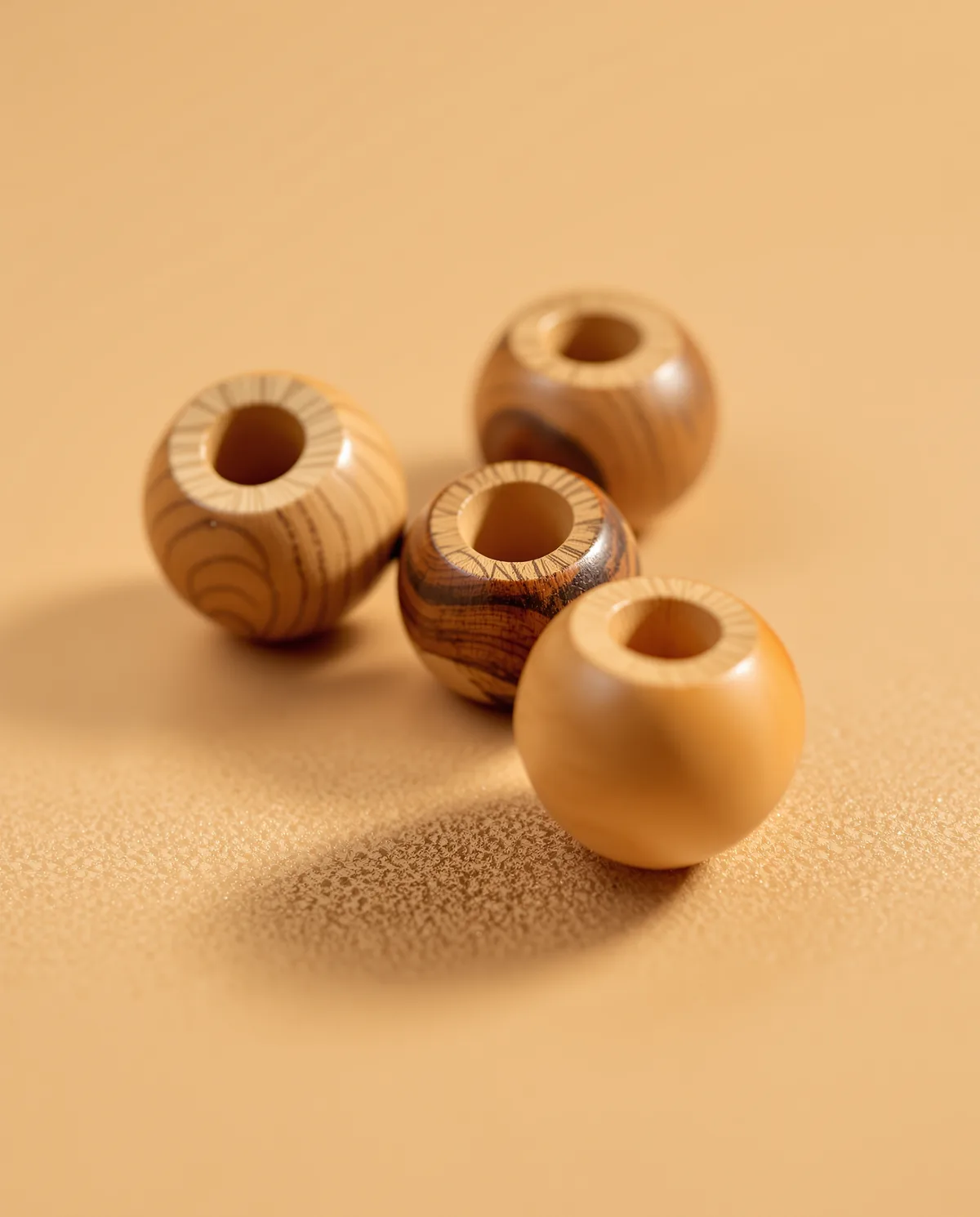
Two things are handled differently for wood. The tone range is approved rather than matched: natural grain varies, so a sample establishes the acceptable spread of colour and production is held to it. And weight is designed in: a larger bead, longer beads, or a deliberately heavier end bead gives a light strand the pull it needs to hang straight.
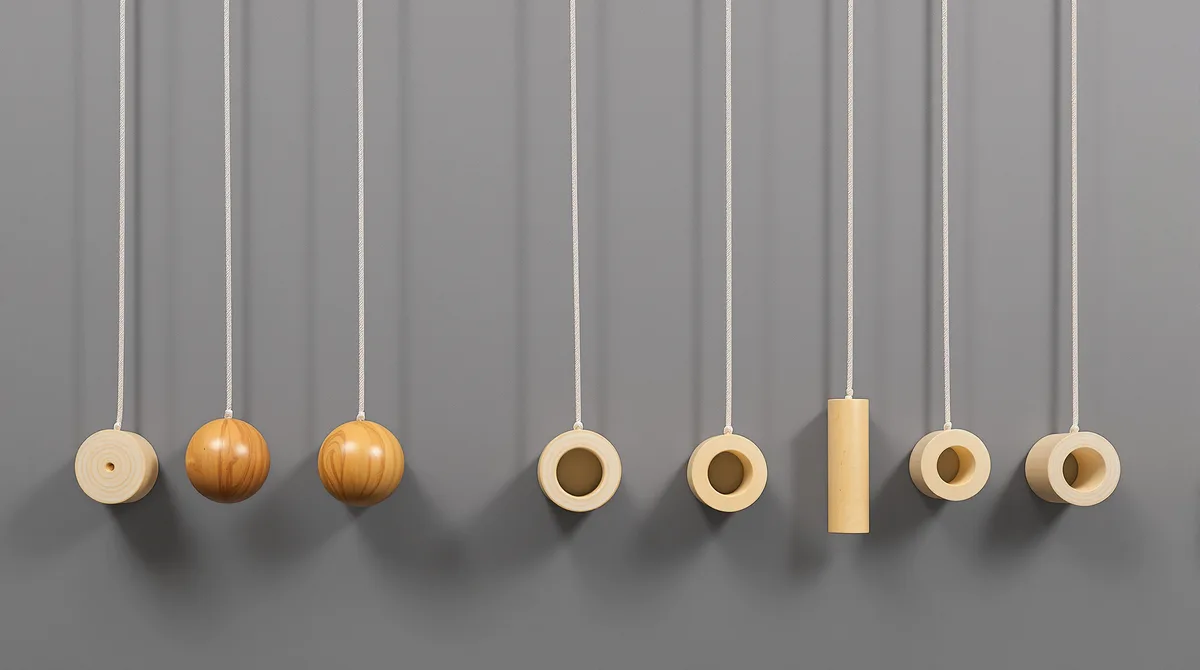
Our curtain dowels are turned in our own Saharanpur wood factory — the same plant that does the turning, carving, joinery, inlay and finishing for the woodware lines.
Not exactly, and the position is that this is the material rather than a defect.
Natural grain varies bead to bead and board to board. What we do is approve the tone range on the sample and hold production to it, which keeps a programme consistent in character without pretending to exact repeatability.
If exact repeatability across a large retail programme matters more than natural variation, the alternative is acrylic, moulded and dyed to a named colour. Saying that is more useful than promising a match that wood cannot deliver.
Damp, and only damp. Water raises the grain and can lift a lacquer, and because the change is in the material rather than on it, the mark stays.
So wood is a dry-room material. A bathroom doorway is the wrong place for it — glass, acrylic and faux capiz tolerate the steam and wood does not. A kitchen that steams heavily is marginal. A hallway, a bedroom, a closet, a living-room opening: all fine indefinitely.
The care instruction follows directly: dust it, or wipe with a dry cloth. A barely damp cloth is the most it should see, dried in the same pass, and the cord stays dry regardless.
None through the bead. Wood is fully opaque, and matte as well, so it does not even reflect much — which makes it the best screening material in the category.
What you get is a slatted effect: solid where the beads are, clear where the gaps between strands are. Pitch is therefore the only lever on light with wood, and a close pitch gives a dim, warm, filtered doorway that no translucent bead can imitate.
More than glass, and still not much. An opaque matte bead at a tight pitch breaks up a sightline properly, so from several metres a wood panel screens movement and body shape.
At a metre it conceals nothing, as with every panel in this category, and at night with a light on behind it the room becomes the brighter side. The practical statement is that wood screens who rather than what — and for a doorway between two rooms in a private home, that is usually enough.
About 90 × 200 cm, roughly 35 × 79 in, for a single interior door. North American interior doors are commonly 28 to 36 in wide, so a 90 cm panel covers most of them; from 36 in upwards, move to 120 cm.
Width, drop and strand count are set per order in any case. There is no stock programme behind beaded décor — every panel is made to order against an approved sample — so a non-standard size is routine rather than exceptional. Wood also makes a long drop easier than glass does, because the cumulative strand weight that limits a tall glass panel barely applies.
Bamboo door beads is the comparison most people are making without saying so, and the two are less alike than they look. Glass bead curtains is the other end of the density range, and mixing bead materials is how a wood panel gets colour. Screening a doorway is worth reading because wood is the best screening material in the category. Steam and beadwork explains the one room wood should not go in. For the sound, what a beaded curtain sounds like sets the soft knock against a chime and a rattle.
Good to know
The wooden dowels are turned in our own Saharanpur wood factory, which also does the turning, carving, joinery, inlay and finishing for our woodware lines. The wood beads themselves are specified per design and confirmed when we quote, because bead shape and size vary far more than a dowel does.
Yes, when the bead size and strand length are chosen for it. Most woods sit below 1 g/cm³ against glass near 2.5, so a wood strand is light. Larger or longer beads, or a heavier end bead, give a light strand the weight it needs to fall straight.
No, and that is the material rather than a fault. Natural grain varies, so we approve the tone range on the sample and hold production to that sample. If exact repeatability across a large programme matters more than natural variation, acrylic dyed to a named colour is the alternative.
Yes. Mixed strands are common and are often the best way to add colour while keeping the cost down. Wood carries the drop warmly and cheaply; glass or acrylic accents bring the colour and the light. Put the heavier beads towards the hem so they help the strand hang straight.
Yes. Width, drop and strand count are set per order — there is no stock programme behind beaded décor, so every panel is made to an approved sample at the size you give. The standard door size is about 90 by 200 cm, roughly 35 by 79 in.
Dust it, or wipe with a dry cloth. Do not soak it and keep it away from constant steam. A barely damp cloth is the most it should ever see, dried in the same pass, and the cord should stay dry regardless — the cord is the component that actually fails on any strung panel.
More than glass and less than bamboo. Wood is light enough to drift in a draught, which is what causes strands to cross. A heavier end bead and a slightly wider strand pitch fix nearly all of it, and both are decisions made on the sample rather than afterwards.
Keep exploring
Material
Turned and drilled in our own wood factory: grain variation you approve rather than eliminate, the finishes that hold colour, and the dowel from the same plant.
Read the guidePillar
Door curtains, portals, café lengths and valances: the standard sizes, the strand counts and the one question each format answers.
Specs and sizesGuide
Cut or faceted glass, described plainly: the heaviest panel in the category and the only one that genuinely dazzles.
How it is madeGuide
Flat translucent discs in linked columns: a different construction, a different sound, and an engineered imitation of shell rather than shell.
How it is madeGuide
Answered from the production floor rather than from opinion: which formats are selling now, and which version of the look genuinely reads as dated.
See the detailGuide
Weight, sound, behaviour when cut and damp tolerance — and why the wood route is turned, drilled and finished in our own factory.
Specs and sizes
Start a conversation
Send a reference, a colour chip or a sketch. Minimums are set per design and confirmed per quote; sampling is quoted separately and usually runs 16 to 20 days from an agreed brief.