Specification
What a panel conceals
How pitch, diameter and opacity combine into a sightline — and the distance at which concealment stops working.
Specs and sizes
Guide · Performance
A bead panel screens movement, not detail, and it stops screening anything at all from about a metre away. That is the performance envelope, and it is narrower than most listings imply.
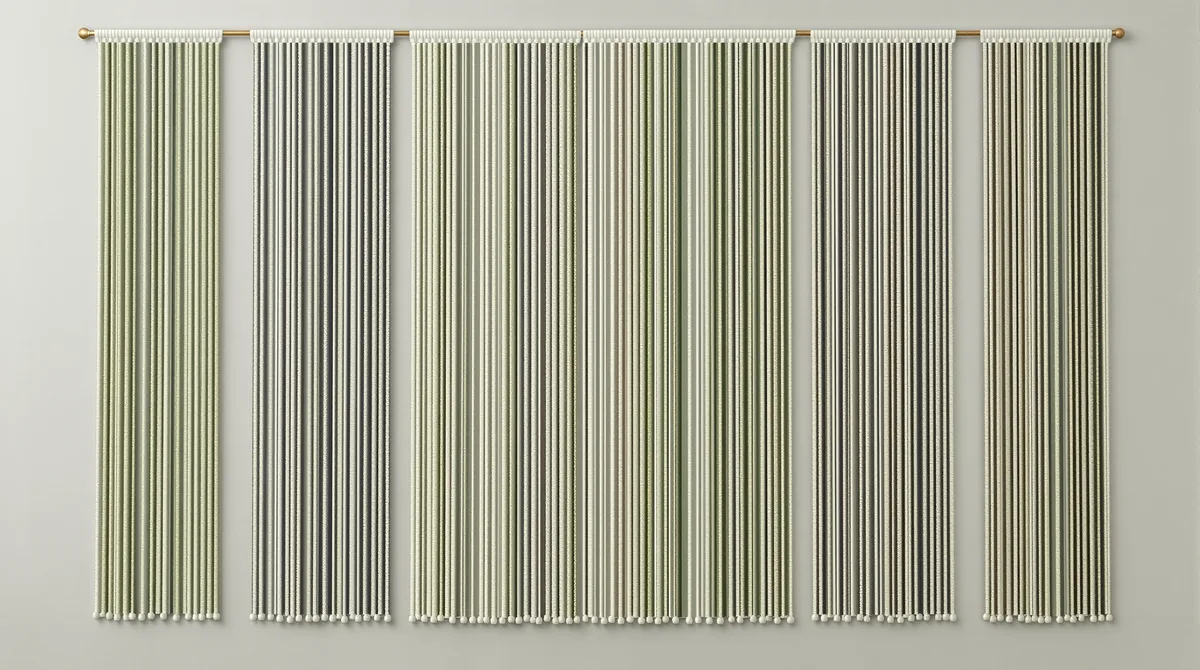
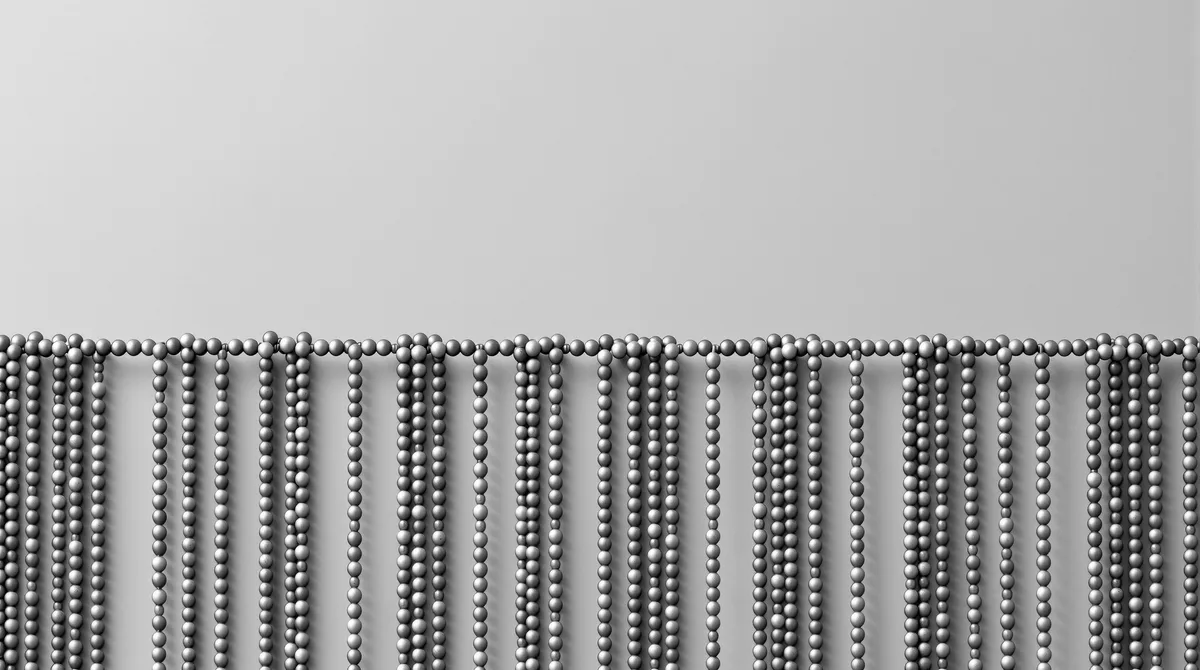
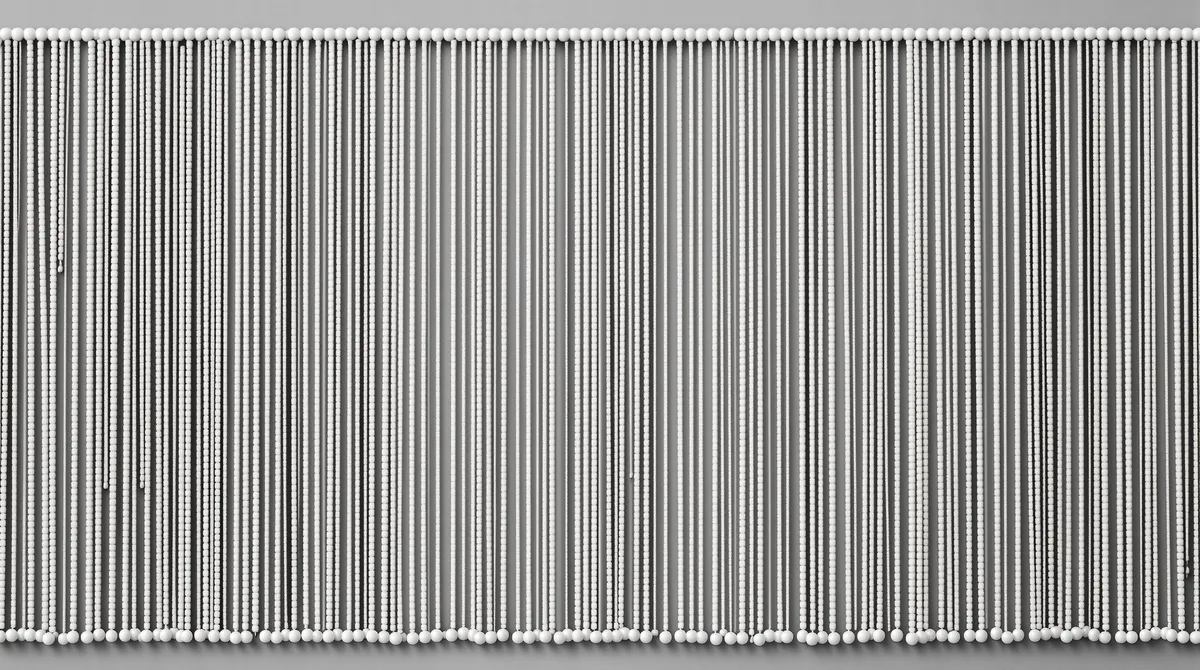
A two-layer beaded curtain, the rear cords offset by half a strand pitch into the gaps of the front cords, in opaque smoke-grey and pewter glass so no clear ground shows through.
A beaded curtain gives partial concealment at distance and none at close range. Opaque beads at a tight strand pitch will screen movement and body shape from several metres away; nothing in the category hides detail, and at about a metre a bead panel conceals effectively nothing. Specify opaque beads and a tight pitch, or specify something else.
Movement and mass, at distance. Not detail, at any distance.
That is the whole answer, and the reason it needs stating plainly is that "privacy curtain" is a phrase the category has borrowed from products that do the job properly. A bead panel is a set of parallel strands with clear gaps between them. The gaps are visible. What they reveal depends on how far away the observer is and how opaque the beads are, and it never approaches what a blind or a door gives you.
Because the gaps between strands subtend a smaller angle the further away you stand. At five metres, the clear gaps in a bead panel are narrow slices of a scene that is mostly covered, and your eye integrates the whole thing as a surface. At one metre the same gaps are wide windows you look straight through.
Nothing in the specification changes that geometry. A tight pitch moves the useful distance closer; it never eliminates the effect. Anyone standing at the panel sees through it.

Opaque ones, and the ranking is straightforward:
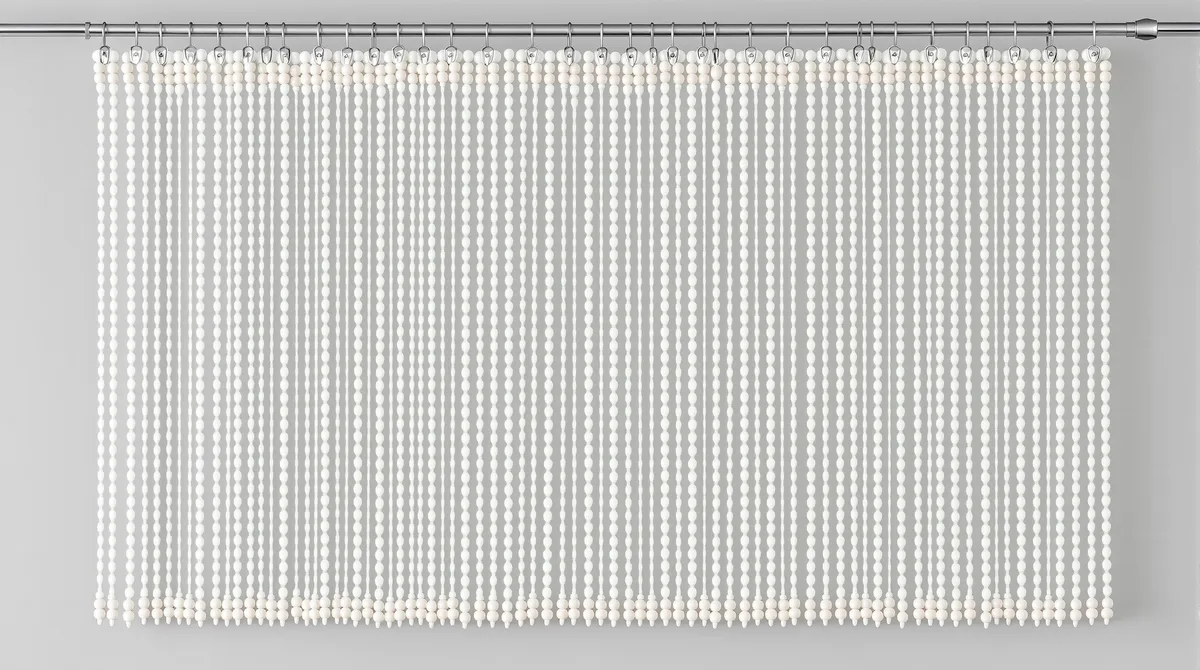
Our Polka Dot portal was made in both translucent and opaque versions, and the difference in how much you can see through them is not a nuance.

It sets the proportion of the opening that is covered. The arithmetic is strand count into width: 30 strands across 90 cm is a 3 cm pitch, which is the shipped construction, and the design library draws denser at 40 strands across 90 cm, roughly 2.25 cm, and 60 across 120 cm, roughly 2 cm. Tightening the pitch reduces the clear gap and increases the strand count — which increases the bead count, the weight and the cost together.
The limit is practical rather than theoretical. Below about a centimetre of pitch the strands interfere with each other constantly, the panel tangles, and you are spending a very large number of beads to buy a small improvement in something a blind does for a fraction of the money.
Because a bead panel has no light-blocking function. In daylight, the brighter side is usually outside the room, so the panel reads as a dark screen from inside and a reflective one from outside.
Switch a light on at night and the relationship inverts: the room behind the panel is now the bright side, and anyone in the dark hallway or outside the window sees through it better than they would at noon. People discover this on the first evening, and it is the single most common disappointment with the category.
Not enough to justify it. Two panels hung with a small offset do interrupt more sightlines, because the gaps no longer line up at every height. But the strands move independently and continuously, so gaps align constantly anyway.
If you are already contemplating the cost of two panels, one panel plus a roller blind behind it is better in every respect: the blind does the privacy and the beads do what beads are for.
The closest is linked faux-capiz disc construction: flat discs linked one below the next into columns hung side by side, rather than beads threaded on a cord. The discs are broad and overlapping, so the construction behaves much more like a dense screen than a strung panel. Library pieces in that construction run from 70 × 130 cm up to 90 × 200 cm, with twelve to sixteen columns and in the region of 239 to 497 discs — figures that come from the 2027 design renders.
Even so, it is not a solid surface, and concealment is judged on the sample, in the real light and at the real distance. Nobody has tested one.
Say the distance. "Screen the doorway from the far end of a 4 m hallway" is a specifiable brief; "give us privacy" is not, because the answer to the second is no.
Then specify opaque beads, a pitch tighter than the 2.25 cm standard, and a full drop with the hem close to the floor — a short panel screens nothing, however dense it is. Width, drop and strand count are set per order against an approved sample, so a privacy-weighted build costs nothing extra to specify. It just costs more to make, because it contains more beads.
When concealment is a requirement rather than a preference. A shared bathroom. A bedroom off a communal hallway. A ground-floor window onto a street. A consulting room, a changing area, anywhere with a duty of care.
For all of those, specify a door or a blind and hang beadwork somewhere it is doing the job it is good at. That is a better outcome than a panel that technically satisfies a brief nobody should have written.
Light and beadwork is the companion page and the one that explains the night inversion in more detail. A wood bead curtain is the material we would specify if screening is the priority, because it is the most completely opaque bead in regular use. A capiz curtain is the construction that comes closest to a dense screen. The limits page sets out why this performance envelope is as narrow as it is, and bead curtain formats covers which format suits which opening. For the arithmetic behind strand pitch, stringing specifications has the figures.
Two more pages are relevant. Bead curtain formats covers which formats cover a whole opening and which only dress the top of one, and that distinction decides whether concealment is even on the table. Choosing a bead size matters because an opaque bead at a larger diameter covers more area per unit than a small one does.
Good to know
Enough to screen movement from across a room, and not enough to hide anything in detail. From several metres an observer sees that a doorway is occupied and roughly where someone is standing. From a metre, they see what is happening. That gap between the two distances is the whole performance envelope.
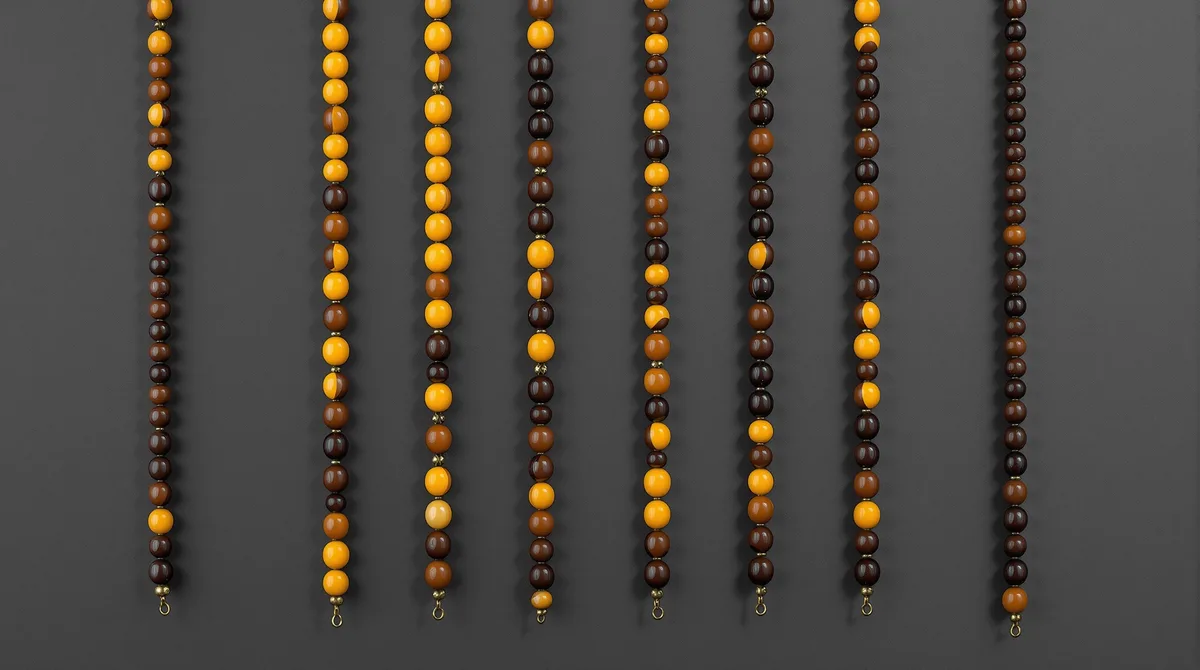
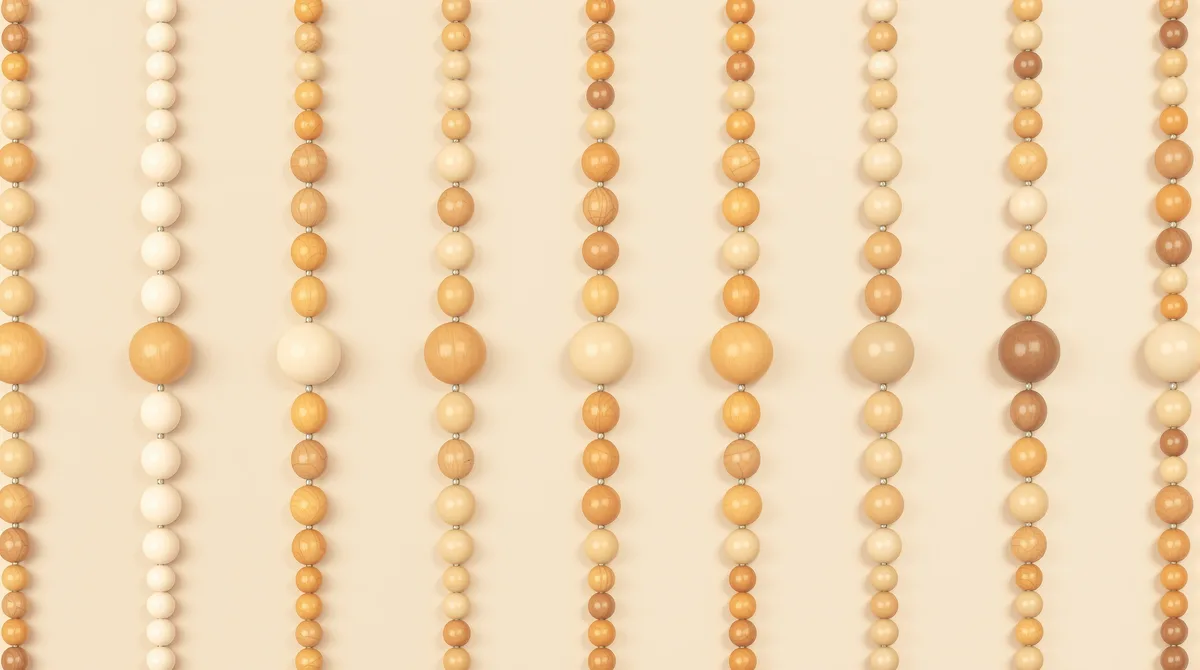
Opaque ones. Turned wood, glazed ceramic and opaque acrylic block what passes behind them; translucent glass and translucent acrylic do not, and iridescent or faceted beads actively draw attention. Our Polka Dot design was produced in both translucent and opaque versions and they behave completely differently in this respect.
It is the only other lever, and it does help — but it buys coverage rather than opacity. A 90 cm panel at 40 strands is a pitch of roughly 2.25 cm; tightening that leaves less clear gap between strands. Even at the tightest practical pitch the strands still move independently, which is why detail always gets through.
Only where privacy is a preference rather than a requirement — an en-suite inside a private room, a dressing area within a bedroom, a studio where one person lives. For a shared bathroom or a bedroom off a communal hall, a bead panel will not do the job and nothing about the specification will change that.
It gets worse, sharply. A lit room behind a bead panel is far more visible than a dark one, because the panel has no light-blocking function at all. Anyone outside a lit doorway at night sees through it better than they would in daylight, which is the opposite of what people expect.
Marginally, and not as much as the cost suggests. Two panels hung with a small offset do interrupt more sightlines than one, but the strands still move and the gaps still line up constantly. If you are considering two panels for privacy, one panel plus a blind is the better answer.
A linked faux-capiz disc construction comes closest, because the discs are flat, broad and overlap rather than sitting as separate beads on a cord. It is a dense screen rather than a strung panel. Even so it is not a solid surface, and concealment is judged on the sample, in the real light and at the real distance.
Keep exploring
Specification
How pitch, diameter and opacity combine into a sightline — and the distance at which concealment stops working.
Specs and sizesPillar
Door curtains, portals, café lengths and valances: the standard sizes, the strand counts and the one question each format answers.
Read the guideGuide
Air moves through, insects are discouraged rather than excluded, and strand pitch is the only lever that changes either.
See the detailGuide
Three predictable failures — soaked cord, lime scale, no containment — and the two things people usually want instead.
Compare the optionsGuide
Why there is no single weight figure, the density ratios that matter, and which fixing each weight class needs.
Read the guideGuide
Breaking light rather than blocking it: what a bead panel does to daylight through the day, and which beads come closest to shade.
Read the guideGuide
No soundproofing, no blackout, no insulation, no insect exclusion, no close-range privacy — and why none of them is fixable.
Read the guideGuide
A soft knock instead of a chime, grain that never matches twice, low weight, and the one thing wood cannot tolerate.
Specs and sizes
Start a conversation
Send a reference, a colour chip or a sketch. Minimums are set per design and confirmed per quote; sampling is quoted separately and usually runs 16 to 20 days from an agreed brief.