Guide
A retail care card
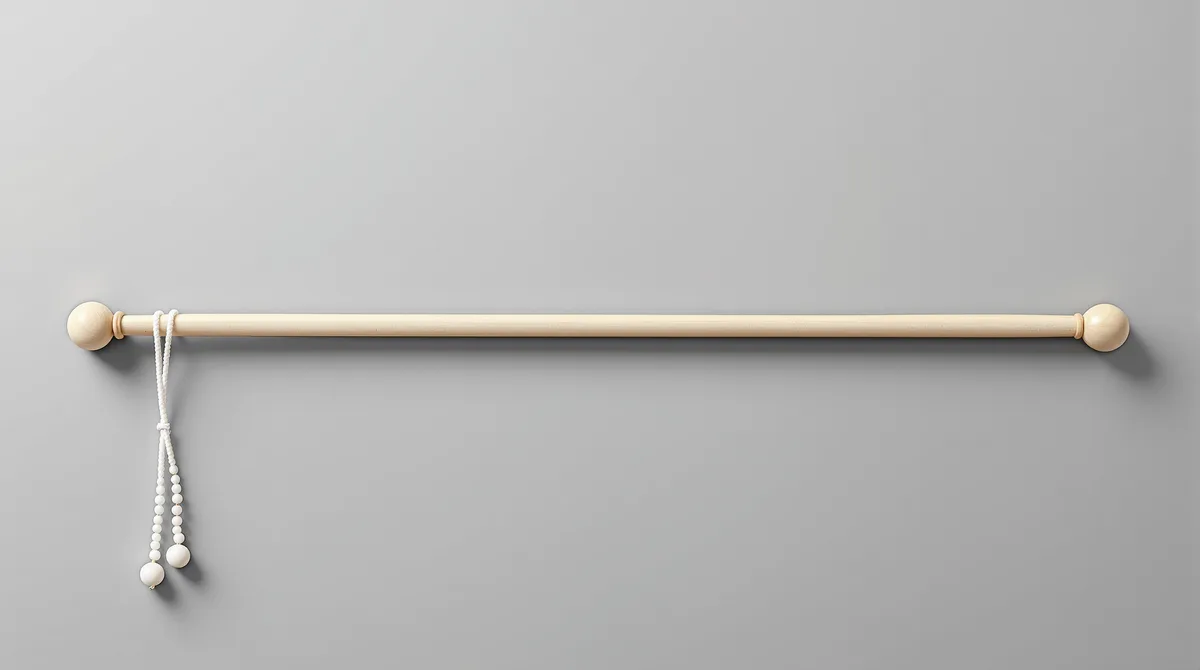
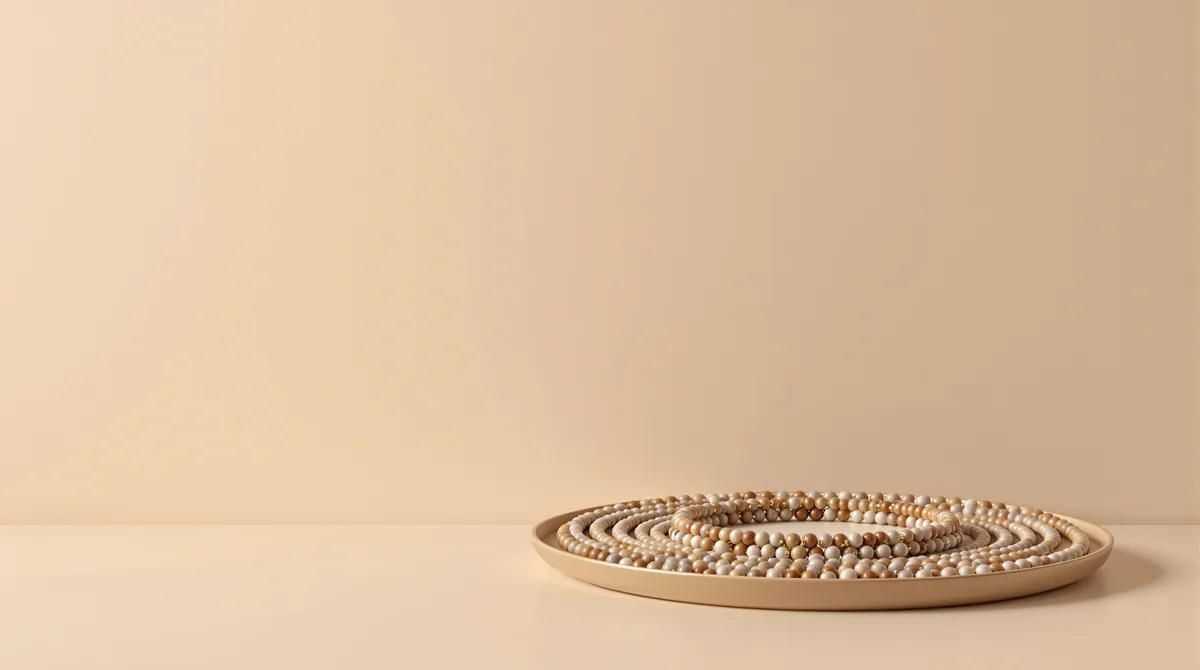
The four dos, the four nevers, the material note and the one line about the cord that prevents most returns.
See the detail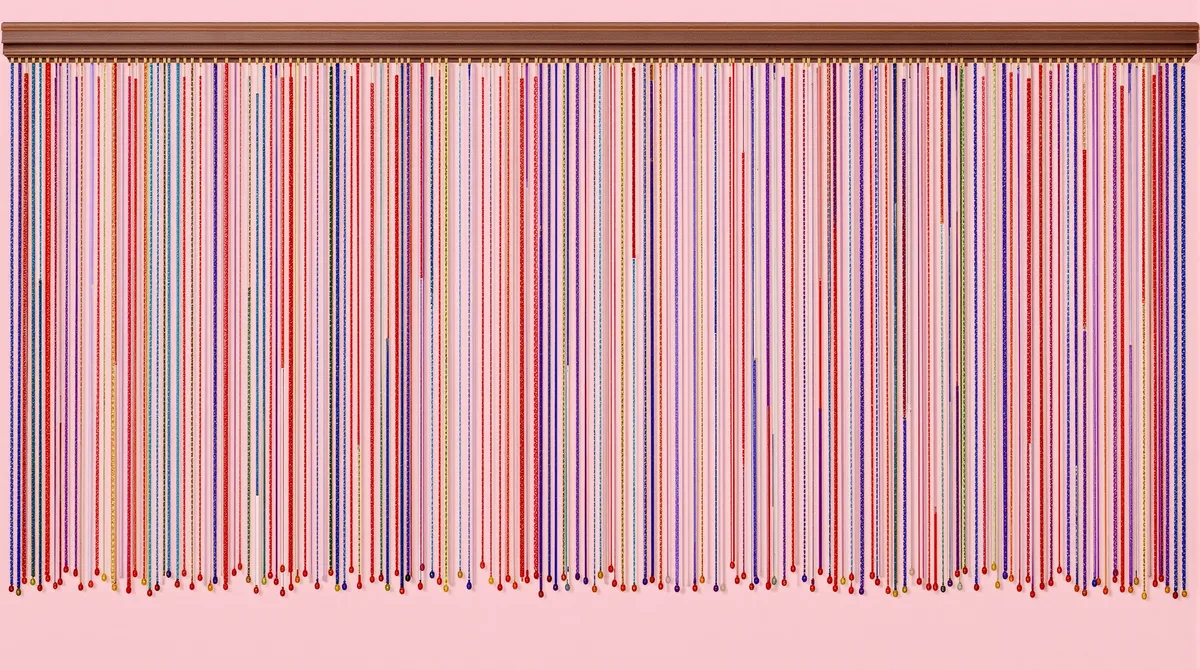
Guide · Buying
Specify for the cleaner, not for the photograph. A let's beadwork is handled by people with no stake in it and thirty seconds to spare.
A thirty-strand doorway portal of moulded translucent acrylic beads in red, cobalt, apple green, amber and violet on a clear base strand, hung from a rectangular stained wooden…
Specify acrylic or body-coloured glass beads at an open pitch, a turned timber or metal header rather than a cotton rod pocket, a hem finishing just above the floor, and a fixing into solid structure. Then buy a spare panel with the first order, because a matched replacement two years later depends on the bead lot rather than on goodwill.
A decorative element that will be handled by people who did not choose it, cleaned by people with thirty seconds, and photographed for a listing that has to look the same in three years as it did on day one.
That is a harder brief than a home, and almost all of it is answered at specification stage rather than in use.
Two jobs, and both are commercial.
It divides space without closing it, which is useful in the open-plan conversions most lets are — though privacy through beadwork is a claim worth not making. A doorway between a kitchen and a living area, or between a bedroom and an en-suite corridor, reads as finished with a panel in it and unfinished without.
And it photographs. A hand-strung glass panel with light coming through it is one of the few decorative elements that looks expensive in a wide shot and still looks good close up, which is exactly what a listing photograph needs.
Acrylic is the default for a let. It does not shatter, the colour is moulded into the body of the bead so it cannot be wiped off, and it is light enough that the fixing is never marginal. It is moulded and dyed to the colour specified, to our own dies where a design needs a shape that does not exist.
Body-coloured glass is the upgrade, and it is worth it where the panel is the room's feature. The colour is in the glass and permanent. Glass does chip where beads knock together — and glass strength is colour-dependent, so palette matters — but a chipped bead is replaced from spares rather than being a failure.
What to avoid in a let: surface-dyed beads of any kind, because a dyed surface lifts under a fast wipe; and bamboo, which marks in damp and is the wrong material for a coastal or bathroom position.
The five levers, in order of effect: bead size and material, construction — strand count and tightness — strand spacing, the dowel and packing, then height.
For a let, two of those are worth spending on and three are worth saving on. Spend on the bead material and on the header, because they are what survives. Save on density: a spaced 90 × 200 cm panel holds about 3,100 beads on our 2027 design-render basis against roughly 11,800 for a densely patterned one, and in a let the open panel is both cheaper and faster to clean.
Minimums are set per design and confirmed per quote rather than fixed across the range, because a plain-strand panel and a fully patterned one use very different amounts of material and stringing time. Before any sample is made we show a rough cost sheet, so the trade-off between look and price can be made early.
Owners and managers of short-let apartments and holiday houses, and the interior designers who fit them out. In our own buyer base the closest analogue is the hospitality designer specifying a look for hotels, restaurants, salons and spas — the same requirements arrive with the same priorities.
Rooms, in order of how well it works: an internal doorway, a landing or stairwell window, a kitchen-to-living threshold, a bathroom doorway in acrylic or glass but never in wood. Rooms where it does not work: anywhere over a bed, anywhere within reach of a cot, and any corridor narrow enough that a suitcase will drag through it.
Four things, in order of frequency.
A strand parts, because a guest pulled the panel sideways or because a cleaner lifted it by the strands rather than by the dowel. That is a repair, and it only becomes a problem if the spares are gone.
The panel gets wet. Someone with a damp cloth cleans it properly rather than quickly, the cord slackens and discolours, and six months later strands start dropping. A housekeeping note on a maintenance schedule prevents this and nothing else does.
A cotton header marks. A rod pocket or header band in a let is handled, wiped and eventually stained, and it cannot be cleaned quickly.
A fixing fails, because a previous owner hung a glass panel on a plasterboard anchor.
The same way as any other panel, which is the reassuring part: beads threaded onto cord in a specified order, knotted over a turned wooden dowel, with the strand drops cut to shape the hem. Thirty hand-strung strands on a single wooden dowel is our standard build, and a densely patterned panel can hold a bead count of about 11,800, every one placed by hand.
Two construction details earn their place in a let specifically. End suspension loops knotted at the top of each strand let a panel hang level from hooks without a rail, which makes taking it down and re-hanging it a two-minute job rather than a careful one. And an end bead on a light strand keeps the finished drop falling straight, which is what prevents the sway that leads to tangling.
Six things, and the sixth is the one people miss.
Body colour rather than surface dye. An open strand pitch. A timber dowel or a metal rail, not a cotton rod pocket. Crimped or stopper-bead strand ends. A hem finishing just above the floor.
And a spare panel, ordered with the first one. Surface-dyed components shift between dye lots, bead specifications evolve, and a design in a library this year may be recoloured next year. A spare panel bought at the same time is identical; a replacement ordered two years later is a colour-matching exercise.
For a doorway or a threshold, it is a strong choice: it needs no operation, nothing to break, and it survives being walked through thousands of times.
For a window where a guest will want the room dark, it is the wrong choice and a blind is right. For a bedroom, fabric. For anything where a fire specification applies — and in a serviced apartment building it may — note that a fire classification is tested on the actual build, quoted separately.
Acrylic: light, and a tension rod sprung inside the door frame will carry it with no drilling at all, which suits a leasehold flat.
Glass: roughly twice the mass of the same design in acrylic, and it belongs on a rod carried by brackets screwed into solid timber or into structure behind the plaster, rated above the panel weight. Fixing into plasterboard is the failure case.
In a let, use the heavier assumption whichever material you choose, and fix into something solid. A fixing that fails at home is an inconvenience; a fixing that fails in a let does so in front of a paying guest and ends up in a review.
Most of it, which is usually the appeal and occasionally the problem.
At forty strands on a 90 cm width — a pitch of about 2.25 cm on our render basis — roughly as much of the panel is gap as is bead. Light passes between the strands and through the glass, which is what makes the panel photograph well and what makes it useless as a blackout.
The practical consequence for a listing: photograph the panel with light behind it and describe it as a divider rather than as a curtain.
Extractable data
| Decision | Specify | Why |
|---|---|---|
| Bead material | Acrylic, or body-coloured glass | Does not shatter, or holds colour permanently |
| Colour method | Body colour, not surface dye | A dyed surface lifts under a fast wipe |
| Strand pitch | Open — about 2.25 cm at 90 cm width | A brush passes between strands; cleans in seconds |
| Header | Turned timber dowel, or a metal rail | A cotton rod pocket marks and cannot be cleaned quickly |
| Strand end | Crimp or stopper bead | A knot alone slips and empties the strand |
| Hem | Just above the floor | A pooling hem is vacuumed, trodden on and caught |
| Fixing | Brackets or hooks into solid structure | Plasterboard anchors fail in front of guests |
| Spares | A spare panel plus the bead bag, bought with the first order | Dye lots shift between production runs |
| Lead time to plan for | 40–60 days after sample approval | Sampling is usually 16–20 days before that |
Good to know
The beads outlast the building. The cord is the service item, and in a let it ages faster than at home because it is handled more and dusted harder. Expect to re-string a strand occasionally rather than to replace a panel, and keep the spare beads where the housekeeper can find them.
An open-pitch panel can be dusted in under a minute with a dry microfibre cloth drawn down each strand from header to hem. A dense seed-bead panel cannot, and a cotton header cannot be cleaned quickly at all. Specify for the thirty seconds the cleaner actually has.
Yes — a doorway is the best position for it, because nothing has to be drawn aside and nothing is within reach of a bed or a sofa. What is not suitable for a let is a panel over furniture or within a child's reach, and a pooling hem in a corridor.
An acrylic full-length panel is light enough for a tension rod inside the frame. A glass panel of the same design is roughly twice the mass, because glass is roughly 2.5 g/cm³ against about 1.2 for acrylic, and needs brackets into solid structure. In a let, use the heavier assumption and fix properly.
Yes. Width, drop and strand count are set per order, and beads are matched to a Pantone reference or a physical chip and confirmed on a sample. Allow for the timetable: sampling is usually 16 to 20 days from an agreed brief, then 40 to 60 days of production after sample approval for beaded décor.
Less than people expect, and the two causes are both specification choices. Light strands with no weighted end bead sway and cross; strands of uneven length cross as they settle. A made panel holds every strand to the approved sample, and a weighted end bead keeps a light strand falling straight.
Four lines. Dust dry, downwards, from header to hem. Do not wet the cord, the dowel or any fabric header. Lift the panel by the dowel if it has to come down. Report a broken strand rather than removing it — it is a repair, and the spare beads are in the cupboard.
Keep exploring
Guide
The four dos, the four nevers, the material note and the one line about the cord that prevents most returns.
See the detailGuides
One guide per question that arrives often enough to be worth answering properly.
Read the guideGuide
Width at three heights, the floor gap, the header depth — and the two decisions that come before any of them.
See the detailGuide
Which four numbers decide the product, which words mean less than they appear to, and what a missing strand count tells you.
Specs and sizesGuide
Cord first, then knots, then the dowel, then the finish — and why none of it is about the beads themselves.
Specs and sizes
Start a conversation
Send a reference, a colour chip or a sketch. Minimums are set per design and confirmed per quote; sampling is quoted separately and usually runs 16 to 20 days from an agreed brief.