Guide
How to clean beaded curtains
Dry dusting first, spot cleaning the beads, keeping the cord dry, what never to use, and how to handle a broken strand.
View the range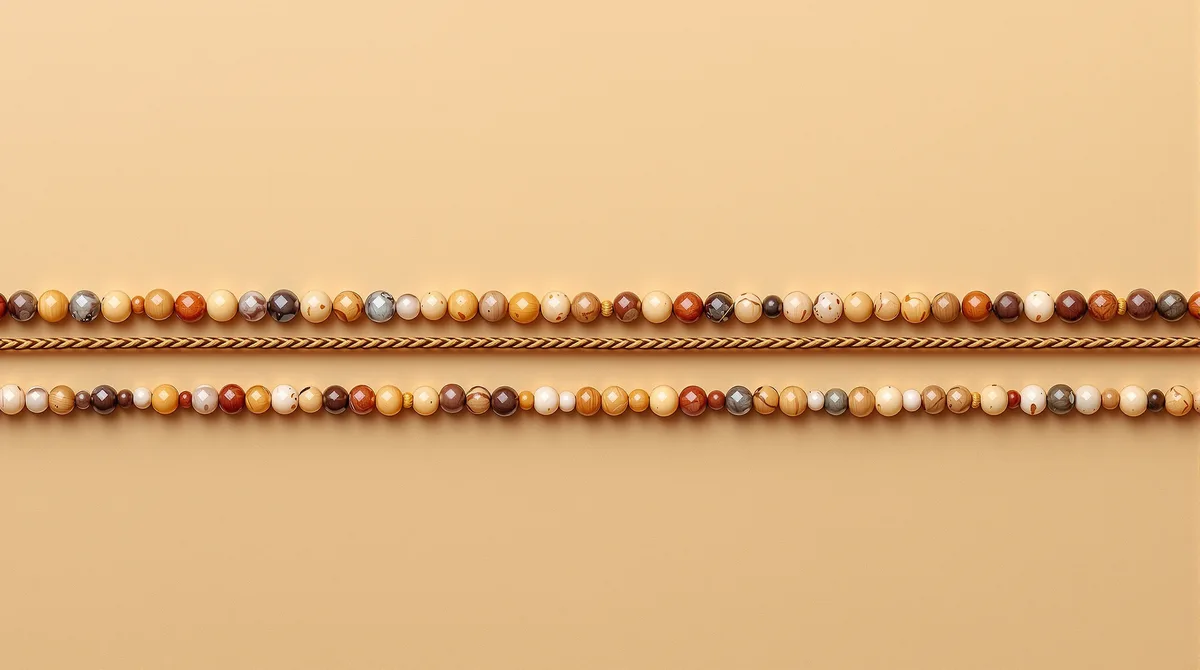
Guide · Care
One material tolerates washing and only off its dowel. Everything else is wiped, and the reason is always the same component.
Two strands of round beads laid parallel above and below a bare length of braided stringing cord — the cord is the part of a bead panel that water reaches first.
Acrylic bead strands can be washed in lukewarm water with mild soap, taken off the dowel, and dried fully while hanging. Glass, wood, bamboo and faux capiz are wiped rather than washed. A complete panel should never be immersed with its dowel or header attached: soaking the cord is what slackens it, and the cord is the structure.
Dust dry. Then wipe damp, bead only, drying in the same pass. Then, only if the panel is acrylic and only if the strands come off the dowel, wash.
Those three steps are in order of increasing risk, and most panels never need to reach the third. A panel that is dusted monthly does not need washing at all.

Because the cord is the entire structure. A strung panel has no backing, no frame and no textile plane: it is thirty lengths of cotton cord carrying several thousand beads, and each cord passes through the drill hole of every bead on its strand.
Wet cotton cord does four things, all bad. It slackens, so strand lengths drift and the hem wanders. It discolours, visibly, at the drill holes where it shows. It holds dust, so a washed panel attracts more dirt than it did before. And it abrades against the hole edges as it dries and stiffens.
None of that is reversible. A bead can be replaced; a soaked cord has to be re-strung.
| Component | Washable? | Method | What goes wrong if you ignore it |
|---|---|---|---|
| Acrylic beads | Yes, off the dowel | Lukewarm water, mild soap, dry hanging | Solvents and hot water cloud and craze the surface |
| Glass beads | No | Damp cloth, dried in the same pass | Water reaches the cord through every drill hole |
| Frosted or sea-glass beads | No | Light damp cloth only | Rubbing polishes the matte surface into gloss |
| Surface-dyed beads | No | Light damp cloth only | Dye lifts; the strand goes patchy |
| Wood beads | No | Dry cloth; barely damp at most | Grain raises; lacquer lifts |
| Bamboo beads | No | Dry cloth; keep out of damp | Marks in rain or constant damp |
| Faux capiz discs | No | Soft damp cloth, dried at once | Abrasives dull the surface permanently |
| Cotton cord | No | Keep dry | Slackens, discolours, abrades, parts |
| Cotton header or rod pocket | No | Keep dry | Shrinks unevenly; wicks water into the strand knots |
| Wooden dowel | No | Dry cloth | Grain raises; the finish lifts |
The method does not change. The frequency and the economics do.
In a bar, a restaurant or a salon, airborne grease turns loose dust into a film within weeks, and film is what tempts housekeeping towards water. The correct commercial answer is more frequent dry dusting — fortnightly rather than monthly — plus a written care card in the housekeeping file, because a cleaning team without instructions will reach for a sink.
The second commercial difference is that a panel is a repairable asset rather than a disposable one. Re-stringing a strand on site is cheaper and faster than replacing a panel, and it is what we would recommend on a contract installation. That calculation only holds if the cord has not been soaked across the whole piece.
Four things, and they are worth knowing before anyone fills a bowl.
A slackened cord cannot be tightened. A discoloured cord cannot be bleached — bleach is one of the things that must never touch beadwork. A frosted or sea-glass bead that has been rubbed hard is polished into gloss and is now a different bead. A surface-dyed bead that has met solvent or hot detergent is patchy for good.
Against those, the recoverable faults are small: a chipped bead is replaced from spares, and a parted strand is re-strung.
Dust more. That is genuinely the whole answer, and it is cheaper than every alternative.
Beyond frequency, two specification choices reduce dust. A smaller bead holds less dust, because there is less flat surface facing upwards — panels built on glass seed beads stay cleaner than large-bead panels in the same room. And an open pitch lets a brush pass between strands rather than dragging dust sideways: on a 90 cm panel we normally run forty strands at a pitch of about 2.25 cm, which is open enough to work between, on our 2027 design-render basis.
Position matters as much. A panel in a doorway away from a hob or an extract path accumulates a fraction of what the same panel collects beside a kitchen.
Nothing wet. A panel is inspected dry against its approved sample before it ships, which is also the state it should be cleaned in.
That is the most useful signal available on this question: the factory that strung the panel does not put water on it either.
Dry dusting monthly at home, fortnightly in a commercial interior.
Damp wiping twice a year at home, quarterly in a bar or kitchen doorway.
Washing: ideally never, and realistically once in a panel's life, when a long-neglected acrylic panel has acquired a grease film. Treat it as an intervention rather than a routine.
Anything hot, anything caustic, anything abrasive and anything with a motor in it. The cord is the weak element in all four cases, and it fails after the bead looks fine.
Hot water is the one people underestimate, because it feels like cleaning harder. It drives water into the cord faster, and it softens acrylic — acrylic deforms well below any temperature glass would notice. Lukewarm means lukewarm.
Lightly, and along the strand rather than at one bead.
Frosted and sea-glass beads are matte because the surface is textured: pressure polishes it. Surface-dyed beads carry colour as a coating: solvent and hot detergent remove it. On a mixed panel you often cannot tell by eye which beads are body-coloured and which are dyed, so the safe default is to treat every bead as dyed.
Body-coloured pressed glass is the one surface that genuinely tolerates a firm wipe. If you know you have it, use it.
They are the reason "wash the panel" is the wrong instruction even on an acrylic piece.
A dowel is finished timber: water raises the grain and can lift a lacquer. A cotton header band or a three-inch rod pocket is a textile that marks, shrinks unevenly and wicks water straight up into the strand knots. Neither can be dried out of trouble afterwards.
So the acrylic washing method always begins with separation: take the strands off the dowel, or support the dowel clear of the water. Then wash, rinse in clean lukewarm water, and dry the strands fully while hanging before they go back.
Re-string it. Spare beads are worth specifying with the order precisely for this.
Work from the bead map order, which is documented for every design we make, so the replacement strand matches its neighbours bead for bead. Finish the end with a crimp or the original stopper bead; a knot alone can slip and empty the strand. If the spares are gone, send a photograph of the strand and the header and we can usually match the beads, because the construction is on record.
Good to know
No. A dowel is turned timber, usually stained or lacquered, and water raises the grain and can lift the finish. If acrylic strands are being washed, take them off the dowel first or support the dowel clear of the water. Dowels for our curtains are turned in our own Saharanpur wood factory and they behave like any other finished timber component.
Spot-clean only. A coaster, placemat or cushion face has beads couched individually onto a stiffened ground, so immersion slackens every stitch at once, swells the ground and leaves a water line on felt. Lift debris with a soft dry brush, wipe the beads with a barely damp cloth, dry immediately.
No. It is re-strung on new cord in bead-map order and re-knotted at the header, finished with a crimp or the original stopper bead rather than a knot alone. Spare beads specified with the order are what the repair runs on. A strand that parted after a wash is the most common version of this repair, which is the argument of this page in one sentence.
Dry, and never damp. Take it down by the dowel, gather the strands into loose bundles tied at two or three points with soft ribbon, then lay it flat or roll it around a cardboard tube. A panel stored with damp cord will come out of storage discoloured and slack, and neither is reversible.
Never. A drum tangles thirty independent strands into one mass and abrades the cord against the drill hole of every bead on the way. Even on a delicate cycle in a mesh bag, the cord takes the full soaking and the tangle is usually unrecoverable.
Dry, downwards, strand by strand, from the header towards the hem so dust leaves the panel at the bottom. Dust often enough and the washing question never comes up, which is the real answer to it — damp work is a remedy for a panel that was not dusted.
Keep exploring
Guide
Dry dusting first, spot cleaning the beads, keeping the cord dry, what never to use, and how to handle a broken strand.
View the rangeMaterial
Moulded to our dies and dyed to the reference: the widest colour latitude in the library, half the weight of glass, and no shatter risk.
Open the referenceGuides
One guide per question that arrives often enough to be worth answering properly.
Open the referenceGuide
Why abrasives dull the surface permanently, how to handle a laser-cut edge, and the method that keeps the pearlised look.
Specs and sizesGuide
Why soaking slackens every couching stitch at once, and the brush-then-damp-then-dry routine that works instead.
Specs and sizes
Start a conversation
Send a reference, a colour chip or a sketch. Minimums are set per design and confirmed per quote; sampling is quoted separately and usually runs 16 to 20 days from an agreed brief.