Material
Faux capiz: the shell look, engineered
Cast resin or dyed cut acrylic, finished to imitate capiz shell: what it gives that real shell cannot, and why thin discs tangle.
Open the reference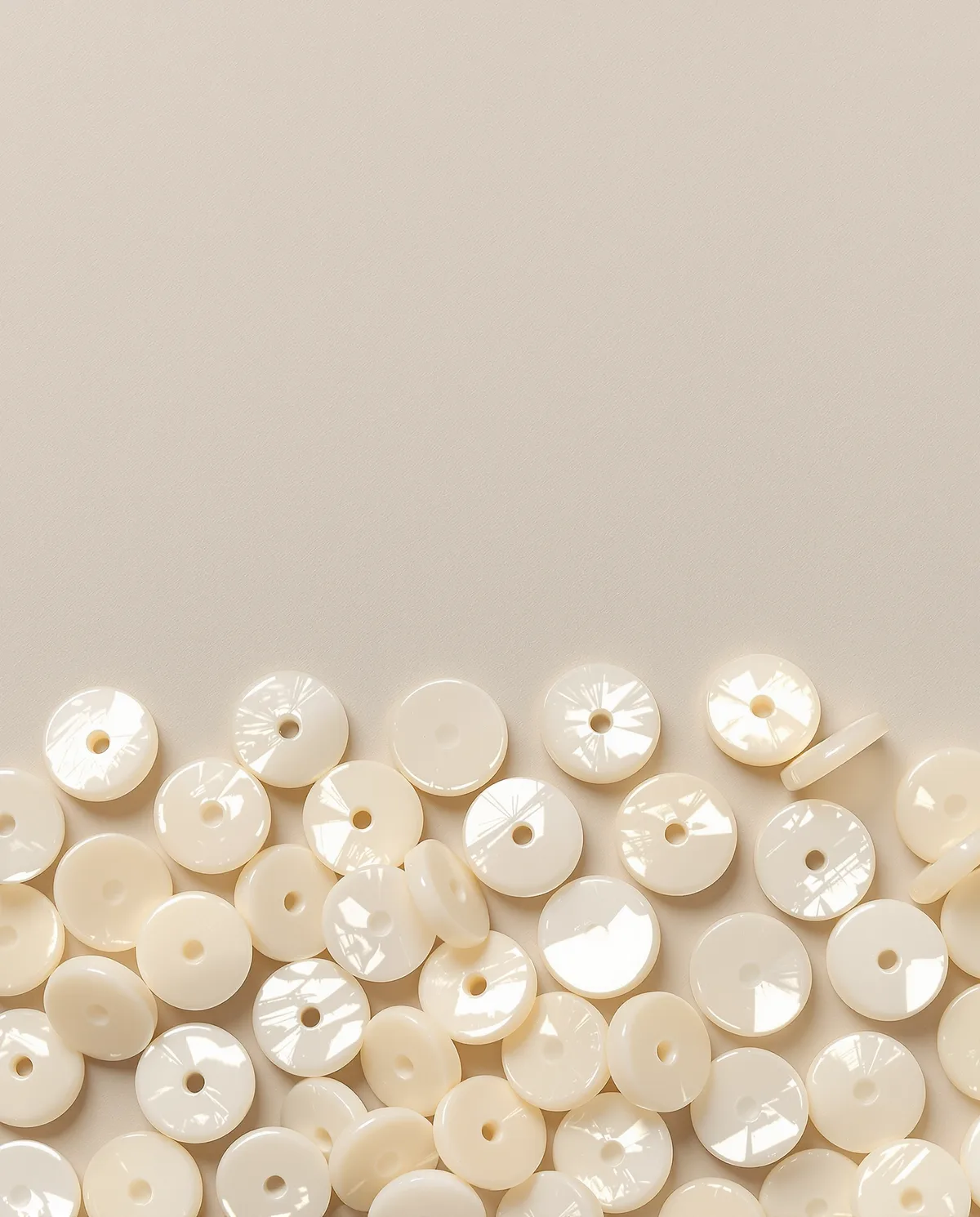
Guide · Care
Faux capiz is cast resin or dyed cut acrylic finished to imitate shell. The imitation is in the surface, and the surface is what you can lose.
Faux capiz discs at twenty-five and fifty millimetres, cast and dyed to imitate capiz shell, each of even thickness and even colour with a hole near the edge.
Wipe faux capiz discs with a soft, barely damp cloth and dry them in the same pass. Never use an abrasive cream, a scouring pad or a solvent: faux capiz is cast resin or dyed cut acrylic finished to imitate capiz shell, and the pearlised effect lives in that finish. Once it is scratched or dulled it cannot be restored.
Dry first, with a soft brush. Then a soft cloth wrung until it is barely damp, drawn along the disc rather than scrubbed at it. Then dry, in the same pass, with a second cloth.
Never immerse, never scour, never polish. On faux capiz those three instructions matter more than they do anywhere else in the category, because the thing being cleaned is a finish rather than a material.

On a disc hanging the cord does two jobs rather than one. It carries the load, as it does on any strung panel, and it also holds each disc at a fixed position along the column.
That second job is done by a spacer bead. On a five-petal blossom build, a small spacer dyed to match sits at the centre of each blossom and locks it on the cord so it cannot slide downwards. If a spacer is lost, the disc above it travels, and the piece reads as damaged when nothing has actually broken.
So the cord-related failure on faux capiz is usually not a parted cord. It is a lost spacer, and it is worth checking before anything else.
| Component | Dry clean | Damp cloth | Immersion | Notes |
|---|---|---|---|---|
| Cast resin discs | Yes | Lightly | No | Cast to shape rather than cut from sheet; dyeable |
| Dyed cut acrylic discs | Yes | Lightly | No | Cut and finished to imitate shell |
| Pearlised or iridescent finish | Yes | Lightly | No | A surface; abrasives dull it permanently |
| Laser-cut edge | Yes | Carefully | No | Catches a cloth and chips; wipe along the edge, not across it |
| Spacer or locking beads | Yes | Yes | No | Dyed to match; holds the disc in position on the cord |
| Cotton cord | Yes | Avoid | No | Runs through the disc centre on a blossom build |
| Wooden dowel | Yes | Barely damp | No | Keep dry; turned timber |
| Cotton header or rod pocket | Yes | Avoid | No | Used on the rod-pocket version of a disc hanging |
| Disc sizes we have sampled | — | — | — | 10–30 mm in sampling; 25 mm and 50 mm in the 2027 linked-disc designs |
Checks the surface and the cut edge, dry, disc by disc on a sample.
Faux capiz in our builds is cast resin or dyed cut acrylic, cut and finished to imitate capiz shell — real capiz shell is the reference material, not the component. On blossom constructions the shapes are laser-cut; on others the resin is cast to shape rather than cut from square sheet stock, which takes wastage out and gives a cleaner edge. Discs are dyeable, and the spacer beads are dyed to match the disc colour.
The counts give a sense of how much surface is being inspected: one wall hanging runs 155 to 170 blossoms in its dowel version and about 130 in its rod-pocket version, because a gathered textile header and a rigid dowel hang differently and need different piece counts to read the same. Every one of those is checked against the sample at our quality-control and packaging house in Greater Noida, and network product issue rates run at a fraction of a percent. The tech pack records the piece count for each header.
More often than a bead panel. Monthly dry dusting at minimum, and fortnightly in a room that gets much traffic.
The reason is geometry. A round bead presents a curved surface to settling dust and sheds most of it. A disc hangs flat in its own plane with a horizontal upper edge, so it collects. It also shows dust sooner, because a pearlised surface works by reflecting light cleanly and a film interrupts that at a much lower threshold than it would on a matte bead.
Damp work should be rare: twice a year, and only where dry dusting has stopped being enough.
Anything that works by abrasion, and anything that works by dissolving.
Abrasive cream, scouring pads, melamine sponges and most "polishing" products remove a microscopic layer of surface. On faux capiz that layer is the product. Solvents, acetone and alcohol-based cleaners attack resin and acrylic directly, clouding or crazing them.
Hot water belongs on the list too. Both cast resin and acrylic soften with heat well below the point at which glass would notice anything, and a disc that has deformed does not come back.
Along the surface, never across the edge.
The pearlised or iridescent effect on a faux-capiz disc is directional: it is finished to catch light at a particular angle, which is why the material reads like shell at all. Rubbing it in small circles creates a patch that catches light differently from its surroundings, and that patch will read as a mark forever even though nothing is on it.
So wipe in one direction, along the length of the disc, and do the whole disc in one pass. If a mark will not come away in two passes, leave it: a visible mark is better than a visible polished patch.
Disc hangings run on one of two headers, and neither likes water.
A turned wooden dowel raises its grain when wet and can lift a lacquer. A rod pocket header wicks water up into the knots at the top of every column, marks, and shrinks unevenly — the panel headers reference covers both. Keep both dry and confine damp work strictly to the discs.
The header also determines the piece count, as the blossom example shows, so a damaged header is not a like-for-like replacement job: the construction was costed and planned around that header.
A disc column is re-strung the way a bead strand is: new cord, discs and spacers back in their documented order, re-knotted at the header, finished with a crimp or the original stopper.
The one detail that is easy to get wrong is spacer placement. The spacer is not decorative; it sets the position of the disc and stops it sliding. Re-string with the spacers in their original positions and the column hangs as it did. Re-string without them and the discs drift within a week.
Flat, dry and without pressure on the discs.
Both cast resin and acrylic take a set under long compression. A disc held bent in a tight bundle for six months may not flatten out completely, and a slightly dished disc breaks the clean reflection that the whole material depends on. Lay the piece flat, or roll it loosely around a cardboard tube with the header along the axis, tied at two or three points with soft ribbon.
Keep it out of direct sun and out of heat. A loft in summer is the worst available storage for a resin or acrylic piece.
Four lines. Dust dry with a soft brush. Wipe with a soft, barely damp cloth and dry immediately. Never use an abrasive cleaner, a scouring pad or a solvent. Keep away from heat.
One optional fifth line earns its place on this product: these discs are cast resin or dyed cut acrylic finished to imitate capiz shell, not shell. Customers ask, and the answer is a selling point — consistent colour, no shell-import paperwork, and better durability than the material it imitates.
The method does not. The inspection interval does.
In a hotel lobby or a café front, a disc hanging is in a dustier airstream and is also within reach of more hands, and both belong on a maintenance schedule. The two consequences are a fortnightly dry dust and a quarterly check for missing spacer beads, which is the fault that develops silently and shows up all at once as a column of discs sitting at the wrong heights.
Keep the spare beads from the original order. Replacing a spacer dyed to match is straightforward if the spares exist and a colour-matching exercise if they do not.
Good to know
Flat, dry and uncompressed, with the discs lying in their natural plane rather than stacked under pressure. Resin and acrylic both take a set under long compression, and a disc that has been held bent for a season may not flatten out completely. Lay the piece flat or roll it loosely around a cardboard tube.
No. Beyond soaking the cord, a drum tumbles flat discs against each other and against the drum wall, and the edges chip. A chipped laser-cut edge on a pearlised disc is immediately visible, because the cut face shows the raw material under the finish.
Dry, downwards, with a soft brush, and more often than on a bead panel. Discs sit flat and face upwards along the column, so they present a horizontal surface to settling dust in a way a round bead does not. They also show a dust film sooner, because the pearlised effect depends on a clean surface.
On faux capiz specifically: abrasive cream, scouring pads, melamine sponges, solvent, alcohol-based cleaners and anything described as a polish. All of them work by removing a microscopic layer, and the finish is a microscopic layer. A soft damp cloth is the only correct tool.
No. Disc hangings run on either a turned wooden dowel or a cotton rod pocket, and neither tolerates water. Keep both dry and confine damp work to the discs themselves, drying each one as you go.
Spot-clean only — and on a piece combining faux capiz with embroidery, the capiz sets the limit rather than the thread. A barely damp cloth on the discs, a soft dry brush on the beadwork, and no immersion from either side.
No. A disc column is re-strung the same way a bead strand is, in the documented order, with the spacer beads replaced in their original positions. The spacer is the part to get right: on a five-petal blossom build it sits at the centre and is what stops the blossom sliding down the cord.
Keep exploring
Material
Cast resin or dyed cut acrylic, finished to imitate capiz shell: what it gives that real shell cannot, and why thin discs tangle.
Open the referenceGuide
Dry dusting first, spot cleaning the beads, keeping the cord dry, what never to use, and how to handle a broken strand.
Read moreGuides
One guide per question that arrives often enough to be worth answering properly.
View the rangeGuide
A soft brush drawn downwards, strand by strand, so dust leaves at the hem instead of compacting in the header.
Specs and sizesGuide
The one material that tolerates water, the method that works, and why immersing a complete panel ends it.
Specs and sizes
Start a conversation
Send a reference, a colour chip or a sketch. Minimums are set per design and confirmed per quote; sampling is quoted separately and usually runs 16 to 20 days from an agreed brief.