Trend read
Seventies revival interiors 2027
Measured demand, warm and dotted in production, and the point where the look tips into pastiche.
See the detail
Guide · Style
This is a fair question with an unfair reputation. The answer has two halves: one specific version of the beaded curtain is dated, and the format itself is being reordered faster than we can render new designs for it.
Beads laid in concentric rings radiating out from a single centre bead, in glossy orange, canary, chocolate brown and cream soda.
No, but one version of them is. The cheap, uniform, full-rainbow plastic panel reads as dated. The format itself is in active demand: beaded portals, curtains, café curtains, valances and wall hangings are in continuous production here, and the lead portal is reordered season after season.
Almost nobody asking this question means "is beadwork a legitimate decorative material". They mean "will this look like a cheap plastic rainbow from 1998 hanging in a student kitchen". That is a precise objection and it deserves a precise answer rather than reassurance.
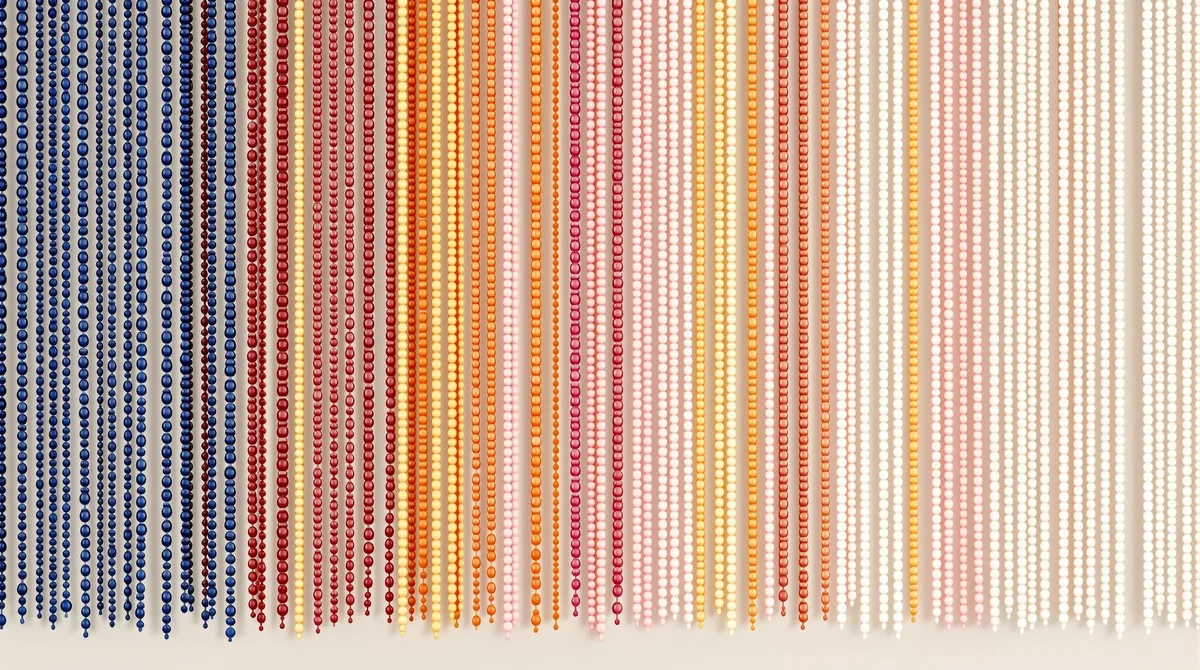
The answer is that the objection is aimed at a specific build, not at the category. One bead, one size, evenly spaced, full-spectrum colour in regular stripes — that is the panel people are picturing, and they are right that it has dated badly.
Four properties, and they always travel together.
One bead size. Nothing in the panel changes scale, so there is no hierarchy to look at. One material. Usually the cheapest moulded plastic, which also means one surface quality. Full-spectrum colour in even bands. A rainbow in order is the most machine-looking colour decision available. Perfect regularity. Identical spacing, identical strand lengths, a dead straight hem.
Remove any one of the four and the panel stops reading as dated. Remove two and it reads as designed.
It introduces deliberate irregularity. Accent beads are scattered — three or four to a strand, placed from a bead map so that no two land level on neighbouring strands. On our Polka Dot portal the dotted oval beads are explicitly never aligned in a row; on the Mushroom portal the glass mushrooms go up to four per strand, randomly placed, and the buyer asked for them to alternate orange and brown.
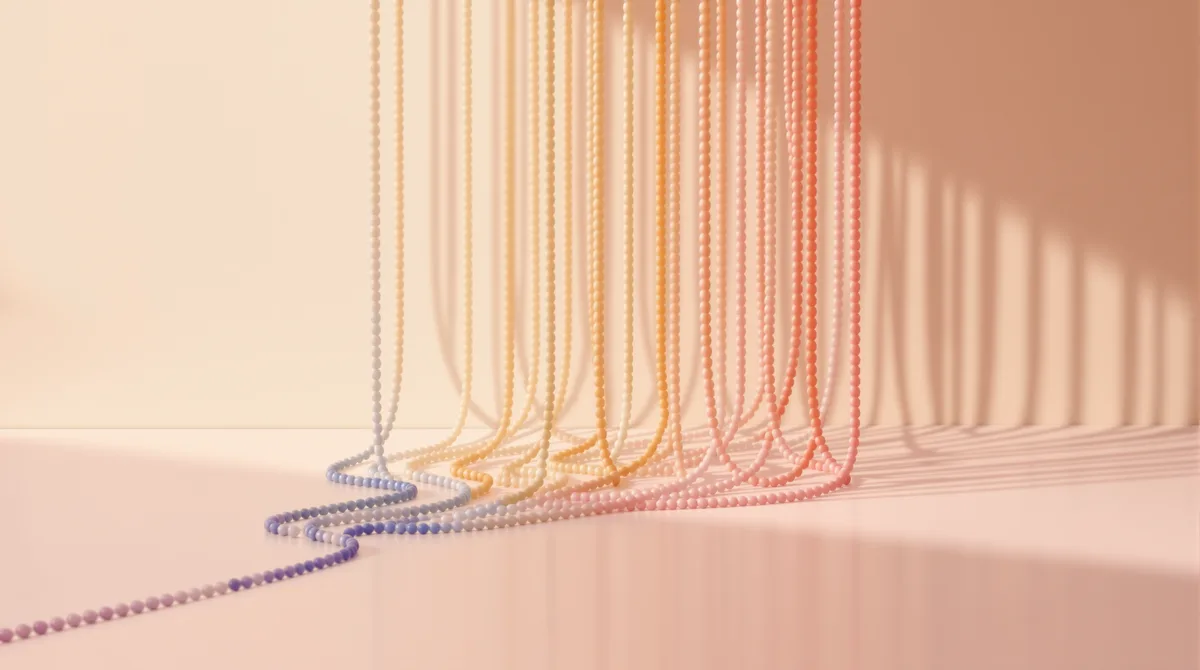
It grades scale. The Naia honey ombre colourway changes colour on a change of bead size rather than on a change of dye: the palest cornsilk tone on the smallest beads, honey through the middle, deep autumn amber on the largest at the hem.
And it shapes the hem — a scalloped arch, a chevron, an arched opening — instead of cutting straight across.
There is, and it sits on our own production floor rather than in trend commentary. The lead beaded portal is reordered season after season, and the full spread of formats — portals, curtains, café curtains, valances and wall hangings — is in continuous production.
The repeat is what matters. A first buy is a buyer's trend bet; a repeat buy is sell-through, and the lead portal has been bought again and again. A category in decline does not behave like that.
Portals and full-length door curtains carry the volume. A portal's open centre is the reason: it reads as architecture — an opening framed — rather than as a thing you push through, which is the gesture most associated with the dated version.
Café curtains and strung wall hangings follow. Valances are the hardest format to place, because a short piece has to reach its look on roughly a quarter of the bead count of a full drop — a format constraint rather than a verdict on the look.
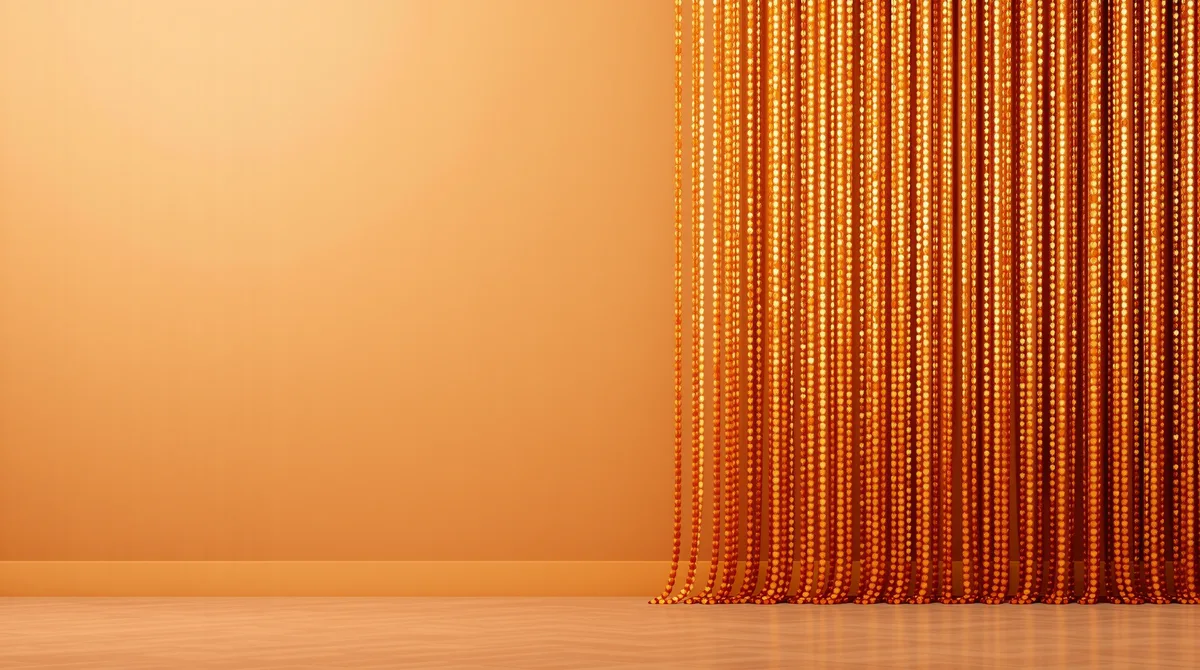
Yes, and it is worth separating from the plastic-rainbow memory. Our 2027 Seventies Sunroom collection is built on glossy orange and canary glass with chocolate brown and cream soda, in a 120 × 200 cm door curtain, a 120 × 35 cm sunburst valance and a 60 × 100 cm wall hanging.
The brief behind it, in the studio's own words, was warm, dotted and amber looks — buyers asking for statement pieces. That is a palette decision made in 2026, not a reproduction of a 1974 product.
Glass reads as material. It is heavy, it refracts, and it cannot be mistaken for anything cheaper. Specialty glass — dotted ovals, Venetian-style beads with inclusions, frosted sea-glass — reads as craft because the irregularity is visibly hand-made.
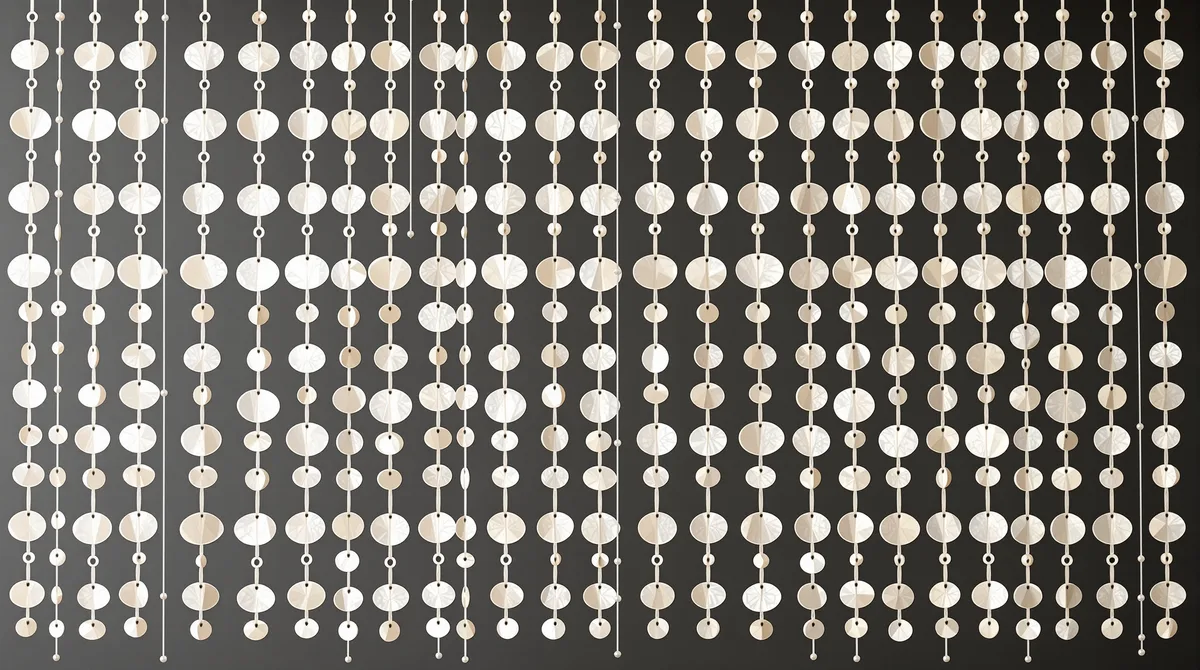
Wood reads as natural and quiet, and its grain variation is irregularity you get for free. Faux capiz discs read as neither bead nor shell, which is why they look contemporary: there is no older product they recall.
Uniform, glossy, mid-sized plastic is the only material in the category with a dating problem, and even that is solved by changing the bead size rather than the material.
The material will not. The palette will, in the same way and on the same timescale as paint.
If you want a panel you will not rethink, narrow the colour range to one tonal family in one material and let bead size and hem shape carry the interest. If you want a panel that is emphatically of this moment, take the saturated colour and accept that it is a five-year decision. Both are legitimate; only one of them is reversible by rehanging a different panel.
Students and young adults, for doorways, closets and as a substitute for a whole wall of decoration. Design-led households, for openings between rooms where a door would be wrong. And hospitality — beaded décor walls, lobbies and partitions, the category in which our installation at a US casino resort remains the reference project.
It is the same craft in all three. A dorm panel and a casino wall are the same strands on the same kind of dowel, strung from the same kind of bead map.
If the objection is really about the material rather than the era, read bead materials and decide between glass, wood and acrylic on their own terms. The style library sets out what is being designed now rather than what was sold in 1998, and the design library holds the colour stories those designs are built from. If the panel still feels like a risk, the pros and cons page is the ledger, and bead curtain pricing explains why a well-made panel costs what it does. A capiz bead curtain is the format least burdened by any of this, because there is no older product it reminds anyone of.
Good to know
Uniformity. One bead size, one bead shape, a full spectrum of colour in even stripes and perfectly regular spacing — that combination is what reads as a 1990s import rather than as beadwork. Break any one of the four and the panel stops looking dated, which is why scattered accents and graded bead sizes have become the default on current designs.
Yes. Beaded portals, curtains, café curtains, valances and wall hangings are in continuous production here, and the lead portal design is reordered season after season rather than bought once. The repeat is the signal that matters: a first buy is a buyer's bet on a trend, a repeat buy is sell-through.
Portals and full-length door curtains carry the volume. Café curtains and wall hangings follow. Valances are the hardest format to place, because a short piece carries about a quarter of the bead count of a full drop and still has to read as a finished object — which is a constraint to design for rather than a reason to avoid the format.
It is a real design brief with a real palette. Our 2027 Seventies Sunroom collection is built on glossy orange and canary glass with chocolate brown and cream soda, and it exists because buyers asked for statement pieces in warm, dotted and amber looks. That is not nostalgia for the plastic rainbow panel; it is a colour story.
The material will not. Glass, wood and bone look the way they look. What dates is the palette, exactly as it does with paint. If you want a panel that will not need rethinking, specify a narrow tonal range in one material and let the bead sizes carry the interest instead of the colours.
They are a student, young-adult and design-led product in roughly equal measure, which is a wider audience than the category had twenty years ago. The same construction serves a hospitality install and a dorm room — the beaded décor walls at a US casino resort are the same craft as a 90 by 200 cm door panel.
Keep exploring
Trend read
Measured demand, warm and dotted in production, and the point where the look tips into pastiche.
See the detailIndex
Twenty-four named looks, each described by the material, palette, pitch and hem that actually produce it.
See the detailPillar
Door curtains, portals, café lengths and valances: the standard sizes, the strand counts and the one question each format answers.
How it is madeGuide
Cut or faceted glass, described plainly: the heaviest panel in the category and the only one that genuinely dazzles.
See the detailGuide
Flat translucent discs in linked columns: a different construction, a different sound, and an engineered imitation of shell rather than shell.
See the detailGuide
Across the strands or down each one: the distribution decision that matters more than the palette, plus grading by bead size.
See the detailDesign
Colour stories documented by how they are built, not by how they look in a mood board.
See the detail
Start a conversation
Send a reference, a colour chip or a sketch. Minimums are set per design and confirmed per quote; sampling is quoted separately and usually runs 16 to 20 days from an agreed brief.