Specification
Wardrobe fronts
Shallow header depth and narrow width push a closet panel towards lighter beads, a tighter pitch and a tension-rod fixing.
Specs and sizes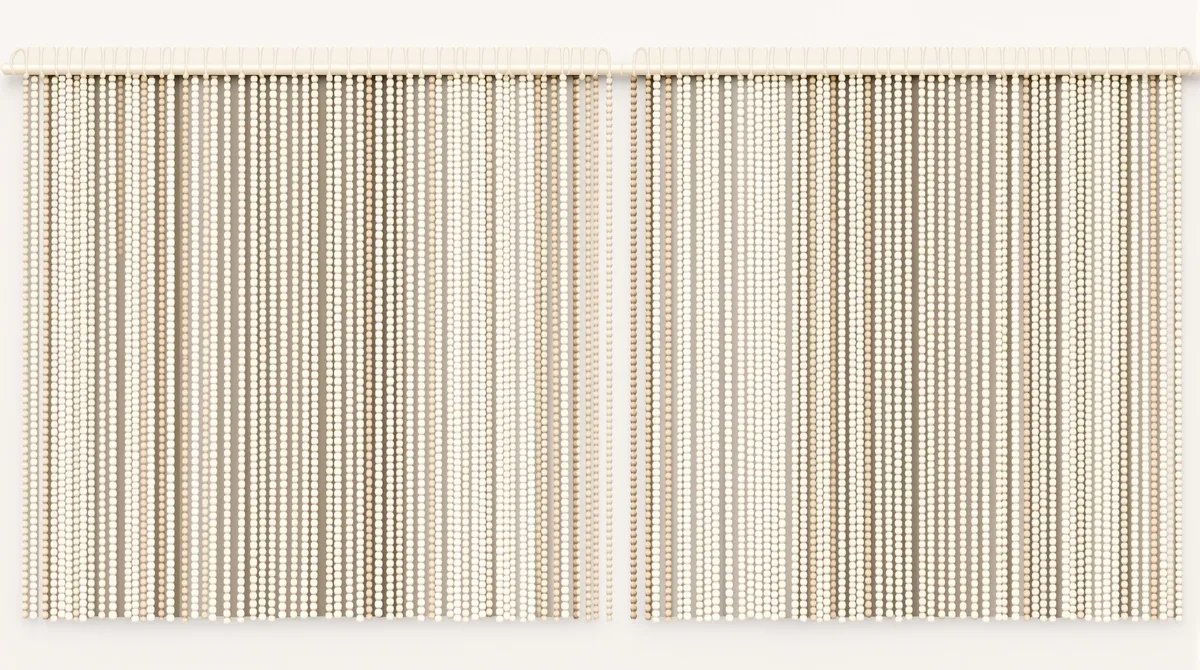
Guide · Format
A closet is the one opening where the beads touch something all day. That single fact — constant contact with hanging clothes — changes the bead, the pitch and the hem.
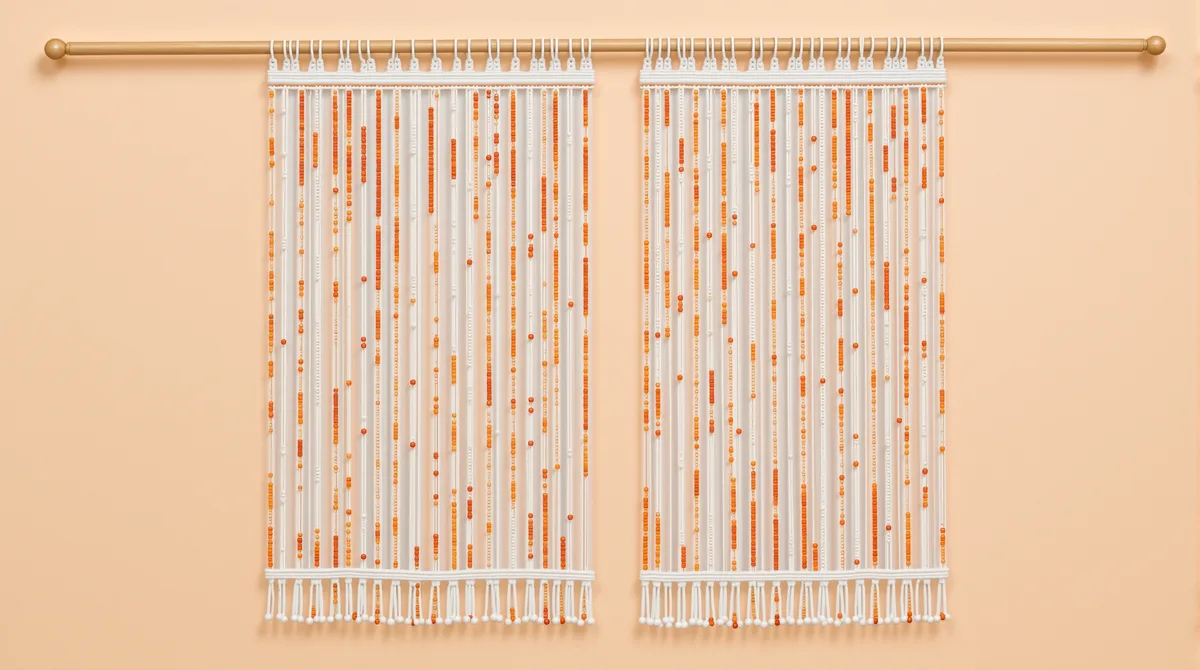
A beaded curtain split into two halves on slim rails at one height, drawn slightly apart at the centre, in greige, oat and chalk white with a level hem.
A bead panel works on a closet opening if it is built light and smooth. The three constraints are a shallow header reveal, an opening often narrower than a door, and constant contact with hanging clothes. Specify rounded beads, a wide strand pitch and a hem clear of the floor, and the panel will outlast a folding door.

Three things, and none of them is about the look. The reveal is shallow, often a few centimetres or nothing at all, so there may be nowhere inside the opening to put a bracket. The opening is frequently narrower than a door — a 60 or 70 cm single closet is common — so the standard 90 cm panel is too wide. And there is something immediately behind the beads, all day, touching them.
That last one is the real design constraint, and it is the one nobody thinks about until a bead catches a sleeve.
It covers rather than closes, which is all a closet needs. There is nothing behind it that requires sound, temperature or smell separation, so the only functions a door was performing were concealment and dust.
It also gives back the swing space. A folding or sliding door needs clearance; a bead panel needs none. In a small bedroom that is the practical reason people do it, before any decorative one.
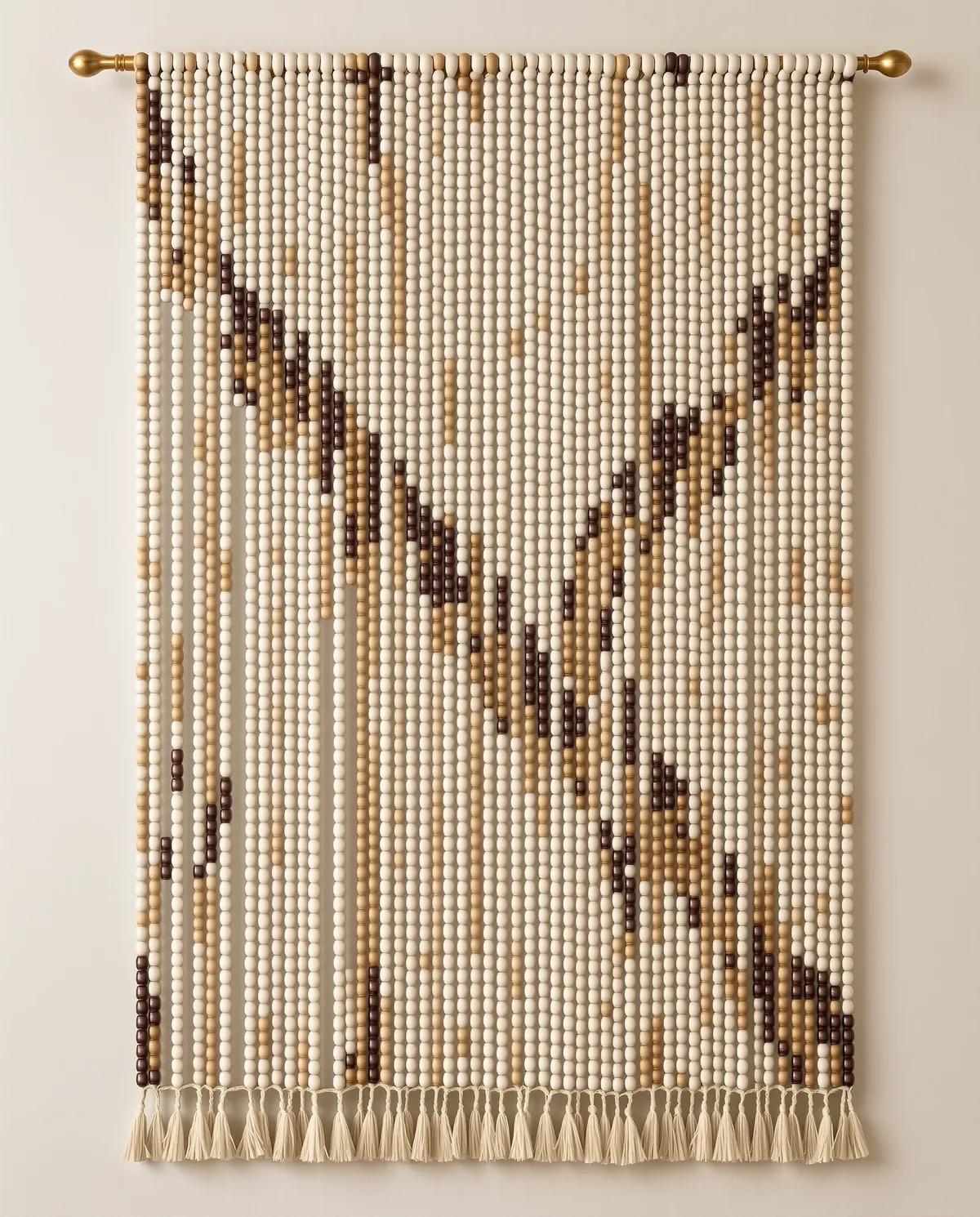
Smooth geometry only. Rounds, ovals, rondelles and discs are safe against fabric. The beads to avoid in a closet are the ones that look best everywhere else: faceted beads, whose cut edges catch a loop; dotted beads with raised surface decoration; and anything carrying a visible mould parting line.
Wood rounds, pressed glass rounds, smooth moulded acrylic and faux-capiz discs all work. A frosted sea-glass bead is irregular but not sharp, and is usually fine. A machine-cut crystal teardrop is exactly what not to specify here.
Measure the opening, not the door. Closet openings are often 60 to 80 cm for a single and 120 to 180 cm for a run, and none of those matches the 90 cm door standard.
Width and strand count are set per order in any case. The shipped construction runs a 3 cm pitch — 30 strands on a 90 cm panel — and the design library draws a 2.25 cm pitch, so a 70 cm panel lands somewhere between 23 and 31 strands and a 120 cm panel between 40 and 53. Every panel is made to an approved sample at the size you give.
A pair, for anything over about a metre. The reason is wear rather than looks: a single wide panel has to be swept across its whole width every time you reach a shelf, and that repeated bulk movement is the main cause of tangling and of strands parting at the header.
A pair parts at the centre, each half travels half the distance, and the centre line reads as deliberate. On a run of wardrobe doors, one panel per leaf is better still.
Wider than you would use on a doorway. A closet panel is handled many times a day, and strands need room to swing past each other and settle.
A tighter pitch gives better concealment, and on a closet you can afford to give some of that up — nobody is standing at distance assessing the view into your wardrobe. Open the pitch, accept slightly more visible shelving, and the panel will last considerably longer.
Light. Glass is the wrong default here for two reasons: the fixing is often a face-mounted rod on a cupboard surround rather than a door frame, and a heavy panel pushed aside twenty times a day loads the header more than a doorway panel ever does.
Acrylic and wood are the natural choices — acrylic for colour, wood for a quiet, matte, warm closet front. Both are light enough for a tension rod inside the reveal if there is one, which also keeps the installation reversible in a rental.
Above the floor, by a clear margin. A closet floor is where dropped hangers, shoes and belts end up, and a hem resting among them is a hem that gets trodden on and pulled.
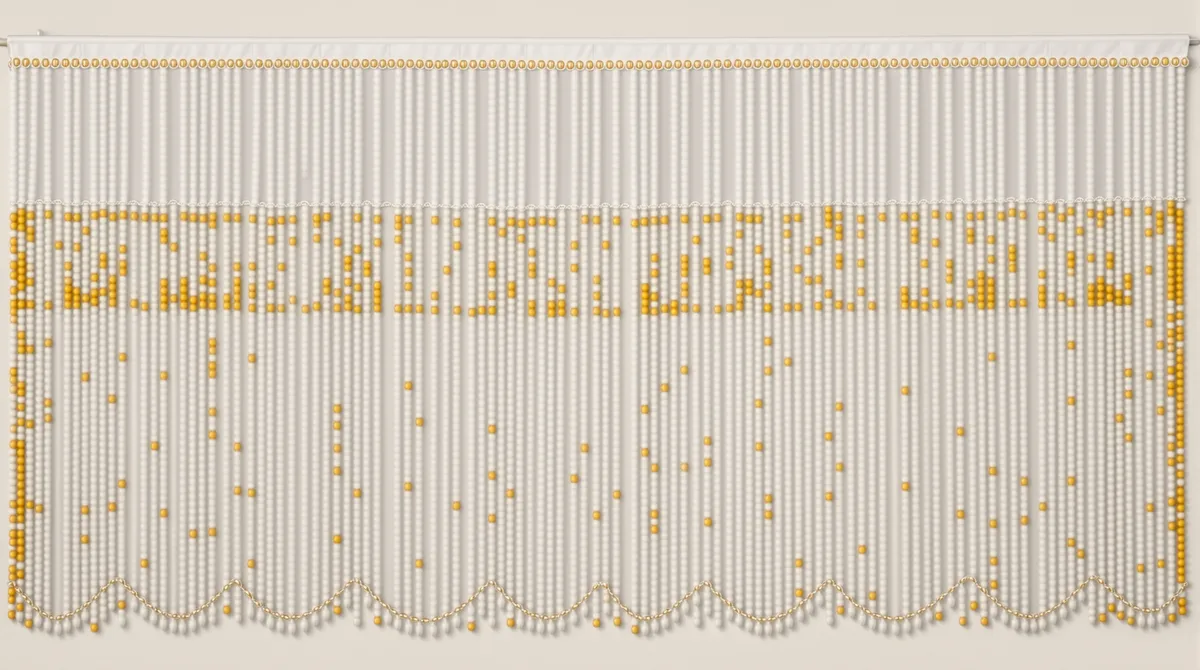
There is also a short option worth considering. Over a run of open shelving rather than a hanging rail, a café-length panel covering the top two thirds does the whole visual job while leaving the lowest shelf accessible without moving anything.
Less, usually, and for a clear reason: a closet panel is often narrower and the pitch is wider, so the strand count and therefore the bead count both drop. Bead count is the cost of a bead panel, so fewer strands is directly cheaper.
Choosing smooth rounds over faceted or decorated beads also tends to reduce cost, because feature beads are the expensive component. On a closet, the specification that protects your knitwear is also the one that protects your budget.
Three failures. The fixing is mounted inside a reveal too shallow to hold it and pulls out. A faceted bead was specified and has been quietly destroying one jumper a season. Or a single wide panel was chosen for a 160 cm opening and has been swept aside so many times that half the strands now hang unevenly.
All three are specification errors rather than product failures, and all three are decided before the sample is made.
Wardrobe work is mostly a bead-shape decision, so read choosing a bead size and then the crystal bead curtain question, which is the one material to keep away from knitwear. Tangled strands matters more on a closet than anywhere else, because the panel is swept aside several times a day. Panel runs covers the case for two narrower panels rather than one wide one, and panel headers deals with the shallow reveal most fitted closets have. If the opening is a run of doors rather than a single one, a wide doorway sets out how the set-out works.
Good to know
Yes, and it is one of the better uses for a bead panel: a closet needs covering rather than closing, nothing inside needs sound or temperature separation, and removing a folding door gives back the swing space. What you lose is dust protection, which matters if the closet holds clothes you wear rarely.
Deep enough for whatever carries the rod. A bracketed rod needs roughly the bracket's projection plus the panel's thickness; a tension rod needs only the rod. Many fitted closets have a reveal of a few centimetres or none at all, in which case the fixing goes on the face above the opening rather than inside it.
Smooth rounds, ovals and discs are safe. Faceted beads, dotted beads with raised decoration, and anything with a mould line or a cut edge will catch a loop of knitwear eventually. On a closet, specify a smooth bead even if a faceted one would look better.
One for a narrow opening, two for anything wide. A single panel on a wide closet has to be swept aside in its entirety every time, which is what causes tangling; a pair parts at the centre and each half moves half as far. The join reads as a deliberate centre line rather than a seam.
It is pushed aside far more often, which is the main cause of tangling. The fixes are design ones: a wider strand pitch so neighbouring strands have room, enough weight at the hem that strands fall back rather than drift, and the habit of moving the panel by the strands rather than by grabbing a handful.
No. A bead panel is open by construction, so it screens the view and not much else. For a closet holding everyday clothes that is fine. For stored or seasonal clothing, keep the garment bags.
It should clear the floor by enough that nothing drags — a closet floor collects dropped hangers, shoes and belts, and a hem sitting in that is a hem that gets pulled. A panel finishing just above the floor, or a café-length panel over a run of shelving, both work.
Keep exploring
Specification
Shallow header depth and narrow width push a closet panel towards lighter beads, a tighter pitch and a tension-rod fixing.
Specs and sizesPillar
Door curtains, portals, café lengths and valances: the standard sizes, the strand counts and the one question each format answers.
Read the guideGuide
Backlit all day: why body-coloured glass belongs at a window, how length is measured from the sill, and what fades.
Specs and sizesGuide
Three ways to hang beadwork in an arch: a straight rod inside the opening, a hem cut to the curve, or a shaped top rail.
Specs and sizesGuide
One panel or a pair, where the join falls, and why the walk-through gap should be designed rather than left to chance.
Specs and sizesGuide
Valance, café length and half drop: three short formats, what each one does, and how bead count falls with height.
Specs and sizesGuide
Strand weight, pitch, handling and packing: the four variables that decide whether a panel knots, and the three set at the brief.
Specs and sizes
Start a conversation
Send a reference, a colour chip or a sketch. Minimums are set per design and confirmed per quote; sampling is quoted separately and usually runs 16 to 20 days from an agreed brief.