Pillar
Where beadwork is specified
Twenty settings, from a closet front to a hotel lobby, each with the format that suits it, the fixing it needs and the standard that applies.
See the detailBuyer · Visual merchandising
A display panel is bought for one scheme and judged on whether it can be used in the next one. Short runs, fast colour changes, and rigging that survives a strike at midnight.
Visual-merchandising teams use beadwork as a reusable display asset: short runs of identical panels, hung on suspension loops so one person rigs them in a window overnight, in colourways that can be reordered against a locked reference. The durability priority is survival through repeated strike and rebuild, not years of static service.
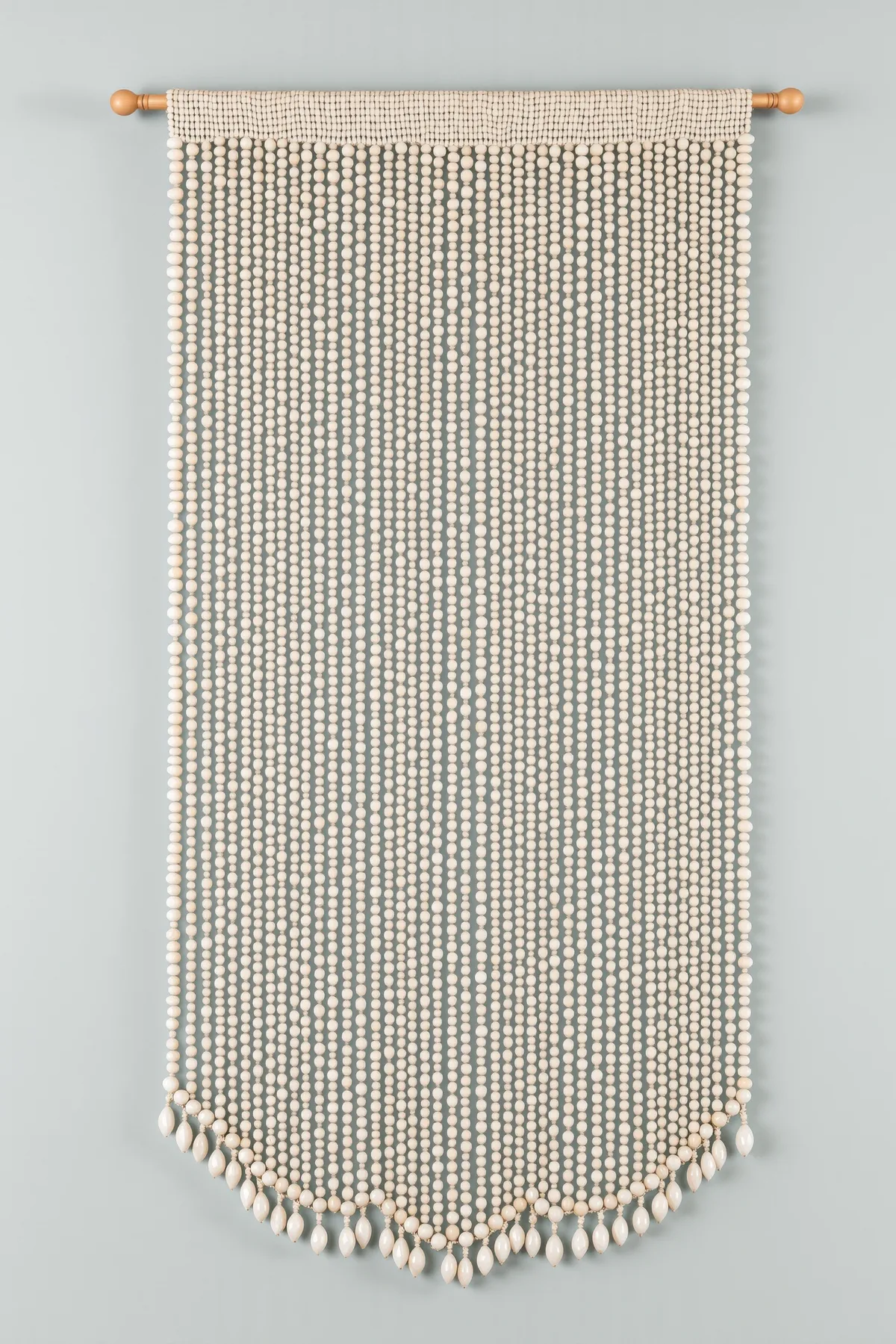
Display panels built as identical short-run modules. Each is a hand-strung bead panel on a header rail with end suspension loops at the top of each strand, so one person can rig it on a window grid or a ceiling track without adjustment.
Formats are the shipped ones — door curtains at about 90 × 200 cm, portals at 76 × 140 cm, wall pieces 50 to 76 cm wide on a dowel, a 90 × 67 cm dual wall-hanging and portal format developed in 2026, and café curtains at 24 × 30 or 30 × 30 inches plus a three-inch rod pocket.
Changeable: size, module count, strand count and pitch, bead material and size, colour, pattern, hem shape and the rigging interface.
Fixed: every piece is made to order against an approved sample; and flat bead embroidery is worked on a frame, so the frame sets the practical maximum for a panel on a fabric ground. Above that size the format is a strung one.
Module width, count and drop. Strand count or pitch. Bead material, shape and size with hole diameter — and bead size chosen against viewing distance, because a window is read from the pavement. Colour references as Pantone codes or physical chips. Hem shape. Rigging interface: window grid, track, rail or rod. Spares quantity. Carton and packing specification, including the reuse packing. Destination distribution centre.
To your carton, label and packaging specification, in loose tied bundles with strand order preserved, shipped to the port, warehouse or distribution centre you name.
For display work, specify the reuse packing as well as the delivery packing. The panel will be struck and put away, and the case it goes back into determines whether the next scheme starts with a clean hang or an hour of untangling. That is a cheap line on a specification and an expensive omission.
Glass beads are drawn and hand-strung in our own Firozabad glass works. Header rails and dowels are turned in our own Saharanpur wood factory. Acrylic and resin beads are moulded and dyed to our colour, to our own dies where a design needs a bead that does not exist. Ceramic comes from our own Khurja plant and plated metal from our own Moradabad plants where a design uses them. Inspection, assembly, kitting and export packing run through our own Greater Noida quality house.
Owning the plants is what makes a reorder repeatable. The bead map is held on file against the style, and a later panel is strung to the same map and held to the same approved sample.
The inspection point that matters most for display work is consistency across modules — strand length, hem line and colour sequence — because a window built from four panels shows a small discrepancy from across the street. Hem line is checked module to module, not panel by panel.
Cost per scheme, if the panels are reused; cost per unit, if they are not. Deciding which model is in play changes the right specification.
The levers in order: bead size and material first, then strand count and tightness, then pitch, then header and packing, then height. Two display-specific notes. A repeating module is substantially cheaper than bespoke panels, because one bead map is strung many times. And a shorter format — a valance at around 120 × 35 cm, or a window-height panel rather than a full drop — saves close to proportionally on bead count. Minimums and pricing are set per design and confirmed with your quote, and a rough cost sheet is produced before any sample.
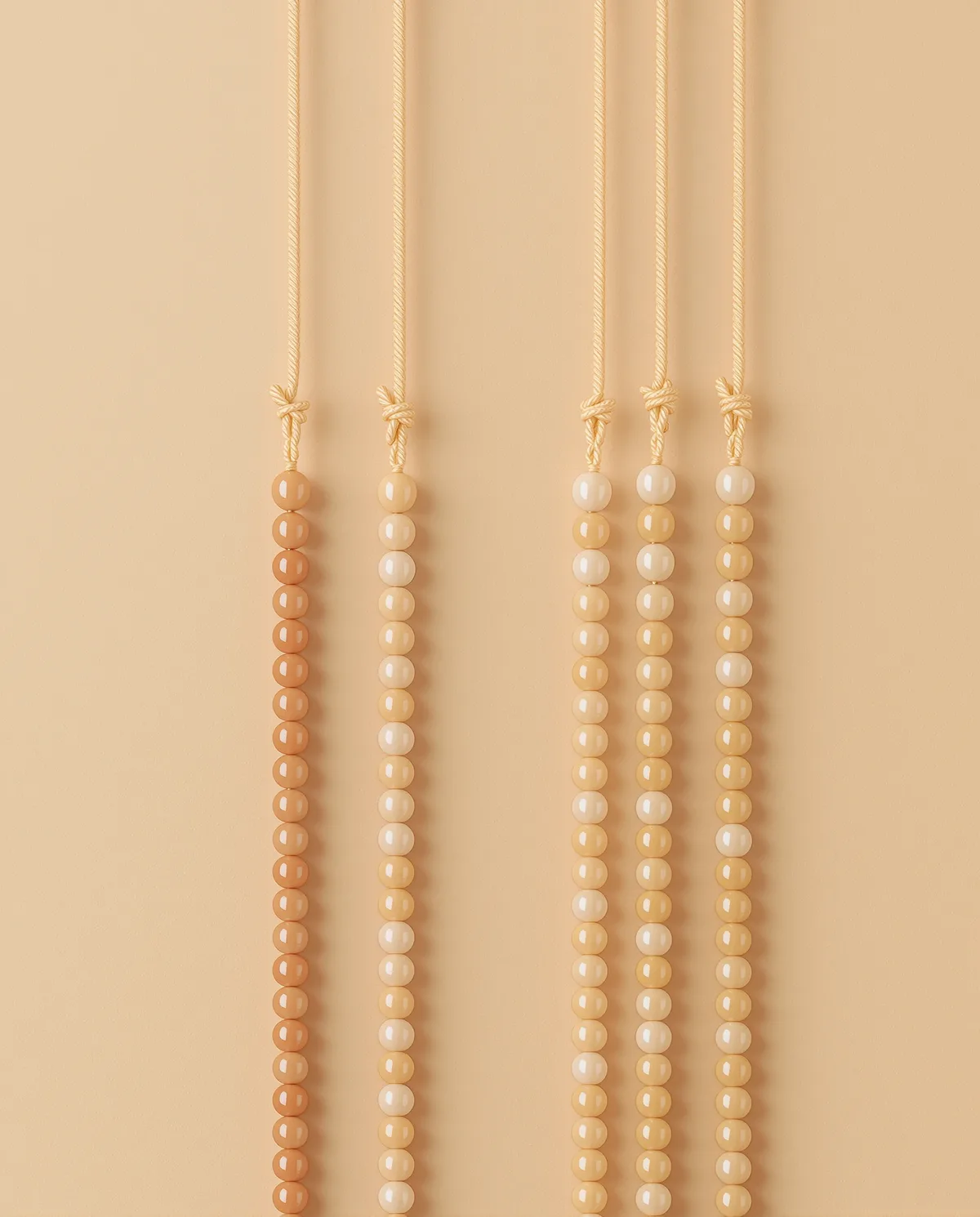
Visual-merchandising and store-design teams at retail chains, window-dressing agencies, and department-store display departments. They do not sell the panel; they use it, which makes this the one buyer type on this site measured purely on reuse.
It is also the use case closest to what we run every day. Beaded portals, door curtains, café curtains, valances and wall hangings are in continuous production, with the lead portal reordering season after season and every strand hand-strung in plants we own. That is retail product manufacturing, at volume. Panels that hold their colour and their hem line across a store estate come out of that discipline rather than out of a one-off window build.
Moulded acrylic, dyed to colour, is the default for display: light to freight, wide colour range, and it does not shatter when a panel comes down at speed. Body-coloured pressed glass where the window wants weight and light play — and body-coloured matters in a window, because a south-facing display will fade a surface-dyed bead unevenly within a season.
Faux capiz discs in cast resin or dyed cut acrylic give a flat, reflective, shell-look field. Frosted sea-glass beads at around 4 to 5 mm diffuse rather than flash. Turned wood for a natural scheme.
Shipped: door curtain at about 90 × 200 cm with thirty hand-strung strands on a dowel; portal at 76 × 140 cm; wall pieces 50 to 76 cm wide; the 90 × 67 cm dual format; café curtains at 24 × 30 in and 30 × 30 in plus a three-inch rod pocket. Drawn in the 2027 design library: valances at 120 × 35 cm and drops to 210 cm.
One compliance point belongs here rather than at the bottom of the page. A shop window is a commercial interior, the landlord's fit-out guide usually governs what may hang in it, and a flammability certificate is commonly requested. Fire performance is tested on the specified build and quoted with the project. For a reusable display asset it is worth testing once on the core design rather than per window.
Against a Pantone reference or a physical chip, bead by bead, confirmed on the sample before production. For a window, judge the match with light behind it as well as flat, because a display panel is seen in silhouette for half of every day.
Lock the reference once per seasonal palette and hold later orders to it. That is the difference between a store estate that looks coordinated and one where the newest windows do not match the oldest.
A reference image is usually enough to start, because display work is briefed visually more often than dimensionally — and the first thing the cost sheet does is turn that image into a strand count.
Production runs against the approved sample, strand by strand to the bead map, with first-article and lot inspection. Formal quotes follow within 48 hours of a specification, and a multi-SKU scheme starts with a discovery call rather than an email chain. Landed duty paid delivery to a named US location is available as a single delivered price, which is usually the simplest route for a store-estate roll-out.
The bead materials, the panel weight a window fixing has to carry and the cost levers that set a quotation are each covered on their own pages.
Extractable data
| Specification | Value |
|---|---|
| Display module | Identical panels, ≈90 cm wide |
| Shipped formats | Door curtain ≈90 × 200 cm; portal 76 × 140 cm |
| Wall-mounted format | 50–76 cm wide on a dowel |
| Dual format | 90 × 67 cm wall-hanging and portal, developed 2026 |
| Window format | Café curtain 24 × 30 in or 30 × 30 in, plus a 3 in rod pocket |
| Valance | 120 × 35 cm, drawn in the 2027 design library |
| Preferred bead material | Moulded acrylic, dyed to colour |
| Alternative | Body-coloured pressed glass; faux capiz discs in cast resin or dyed cut acrylic |
| Rigging | End suspension loops at each strand |
| Top fixing | Header rail; window rigging supplied by the buyer |
| Spares | Beads and cord strung with the production run |
| Reorder control | Bead map held on file; production held to the approved sample |
| Inspection | First-article and lot AQL, own quality house, Greater Noida |
| Sampling | 16–20 days from an agreed brief; photographs approved first |
| Production | 40–60 days after sample approval |
| Minimums | Set per design, confirmed per quote |
| Flammability | Tested on the specified build and quoted with the project |
Good to know
No. Minimums are set per design and confirmed per quote rather than fixed across the range. For display work the question is usually whether a short run across a small store estate is viable, and the answer is that it depends on the design: a plain-strand panel and a fully patterned one consume very different amounts of material and stringing time, so the figure comes with the quote.
No. Everything is made to order against an approved sample, with no retail stock programme. For a display team that means the scheme calendar, not the order, is the thing to plan around: a window going live in March is a conversation that starts in November, and the panels are then owned stock that can be reused in a later scheme.
Yes, and this is where display work most often goes wrong elsewhere. Acrylic beads are moulded and dyed to the colour you specify; glass beads are matched to a Pantone reference or a physical chip; and the match is confirmed on the sample. Lock the reference once for a seasonal palette, and later panels will match the ones already in the store estate.
Yes, with strand count and bead map recalculated for the new width and drop so the pattern still reads. One craft point governs the beadwork built on a fabric ground: flat bead embroidery is worked on a frame, and the frame sets the practical maximum, which is why one development moved from a full curtain to a café curtain. Above that size the format is a strung one. Ask the size question before the design is drawn.
Forty to sixty days, the published beaded-décor lead time, with sampling at 16 to 20 days from an agreed brief in front of it. That is the single most important planning fact on this page: beadwork does not fit a four-week scheme turnaround, and a display team that wants it has to buy it a season early.
To your carton, label and packaging specification, in loose tied bundles with strand order preserved, and shipped to the port, warehouse or distribution centre you name. For display work also specify the reuse packing — the case or carton the panel goes back into after a strike — because a panel stored compressed arrives at the next scheme tangled.
Glass beads are drawn and hand-strung in our own Firozabad glass works. Header rails and dowels are turned in our own Saharanpur wood factory. Acrylic and resin beads are moulded and dyed to our colour, to our own dies where a design needs a custom bead. Inspection, kitting, export packing and labelling run through our own quality-control and packaging house in Greater Noida. We own the plants, which is why a reorder can be held to the same approved sample.
Keep exploring
Pillar
Twenty settings, from a closet front to a hotel lobby, each with the format that suits it, the fixing it needs and the standard that applies.
See the detailIndex
Retailers, own-label brands, interior and hospitality designers, event companies, display teams and children's retail — and the one thing each cares about most.
Compare the optionsManufacturing
The CPSIA scope question, small-parts and cord risk, age grading, and the builds we will and will not make for children's retail.
Read the guideManufacturing
Repeatable backdrop panels, rigging that survives a van, fast reorder of one colourway, and real set-up times.
Read the guide
Start a conversation
Send a reference, a colour chip or a sketch. Minimums are set per design and confirmed per quote; sampling is quoted separately and usually runs 16 to 20 days from an agreed brief.