Guide
Beaded curtain limitations
No soundproofing, no blackout, no insulation, no insect exclusion, no close-range privacy — and why none of them is fixable.
Open the reference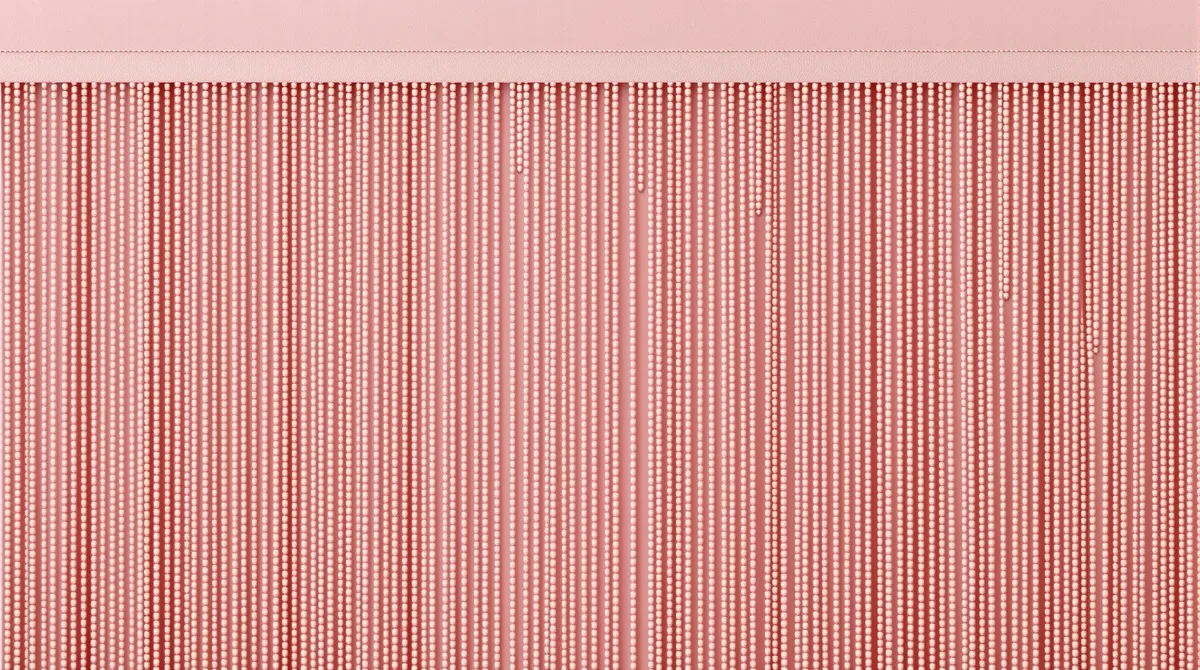
Guide · Comparison
These are not competitors. One closes an opening and one marks it. Most disappointment with beadwork comes from buying it to do the fabric job.
A beaded cafe curtain head-on: a plain rose cotton header band running right across the top above close hand-strung strands of tonal pink glass beads.
Choose fabric when the opening has to be closed — for darkness, warmth, sound or privacy. Choose a bead panel when the opening should stay open while still being marked: beads divide a space visually, let air and light through, and need never be drawn back. A bead panel gives no darkness, no insulation and no real privacy.
Fabric if the opening needs to be closed. A bead panel if it needs to be marked while staying open.
That distinction covers almost every real brief. Darkness, warmth, sound and privacy are fabric — and privacy through beadwork is the claim most often made and least often true. Division, airflow, character and a doorway that nobody has to pull anything aside to walk through are beads.
A fabric curtain is a continuous textile plane that moves on a track or a rod, with a heading at the top and a finished hem. It can be lined, interlined, blackout-backed and flame-retardant-treated. When it is drawn it is a wall.
A bead panel is a set of independent strands hung side by side from a dowel, a rail or a textile header. On a 90 cm panel we normally run a strand count of forty at a pitch of about 2.25 cm; on a 120 cm panel, sixty at about 2 cm. Both of those pitch figures come from our 2027 design renders. The panel is never drawn; it is walked through, and it closes itself behind you.
| Performance | Bead panel | Fabric curtain |
|---|---|---|
| Light blocking | Partial at best; light passes between and through beads | From filtering to full blackout, by fabric choice |
| Privacy | Breaks up a sightline; does not give privacy | Full, with a lined or blackout fabric |
| Airflow | Essentially unimpeded | Substantially blocked when drawn |
| Acoustic effect | None measured; expect none | Measurable absorption with weight and lining |
| Thermal effect | None | Real, with lining and interlining |
| Operation | Walk through; nothing to draw | Draw open and closed |
| Fire rating | Tested on the specified build and quoted with the project | Rated fabrics are widely available |
| Cleaning | Dry dust downwards; damp cloth on the beads | Usually launderable or dry cleanable |
| Weight on the fixing | High in glass; moderate in acrylic or wood | Moderate to high, spread along a track |
A full-length glass panel is the heaviest thing in this comparison, and the weight sits on a short run of dowel rather than spread along a track. That concentrates the load: a tension rod that will carry an acrylic panel comfortably can slip under glass, and a heavy panel wants a rod on brackets fixed into the frame or into structure behind the plaster.
A fabric curtain is often heavier in total, especially lined and interlined, but the load is distributed across a track with multiple fixings, which is much easier to satisfy.
Acrylic and wood panels sit between the two and are the answer for a renter.
Beads, where the bead is body-coloured glass, because the colour is in the glass and nothing can lift it. We match beads to a Pantone reference or a physical chip and confirm the colour on the sample, and that colour is then permanent. Bead colour under artificial light is a separate question and worth asking at the same time.
Dyed textile fades in direct sun, and a lining usually fades faster than the face fabric, which is how a curtain ends up two colours. The one bead that behaves like a textile is a surface-dyed seed bead, where the dye is a coating rather than a body colour — worth knowing before specifying one for a south-facing window.
They are not comparable per square metre, and pretending otherwise produces bad decisions.
A fabric curtain's cost is fabric area, lining and making-up. A bead panel's cost is beads and stringing hours, and the beads are counted individually: a densely patterned 90 × 200 cm curtain holds about 11,800 beads on our design-render basis, every one placed by hand. That is why a bead panel often costs more than it looks like it should — the answer to "why so much" is the bead count and the hours, not the material.
The levers that move a bead panel's price, in order: bead size and material, strand count and tightness, strand spacing, the dowel and packing, then height.
Fabric, by a lot. It folds, it compresses, and a carton of it is mostly textile.
A bead panel resists compression. The header is rigid, the strands must stay in order so they do not tangle, and glass needs cushioning so beads cannot knock. The practical consequence is that café-length formats land far cheaper than full-length ones, which is a real reason we have converted full-size developments down to café size more than once.
Fabric fails gradually: the hem drops, the heading tape pulls, the colour goes. All of it is visible for months before it matters.
A bead panel fails suddenly and locally. One cord parts, one strand drops, and the rest of the panel is untouched. That is a repair — the strand is re-strung in bead-map order and re-knotted at the header — which is why spare beads are worth specifying with the order. In a doorway used every day, the beads will usually outlast the textile; the cord is the service item in between.
Fabric: bedrooms, hotels where guests expect blackout, anywhere with an acoustic or thermal requirement, anywhere a fire rating is mandated. On a rated-fabric requirement the answer is fabric, and it is not close.
Beads: kitchen and bathroom doorways where ventilation matters, retail and hospitality thresholds, children's and teen rooms, spa and treatment-room entrances, any doorway in constant use where a drawn curtain would be a nuisance within a week.
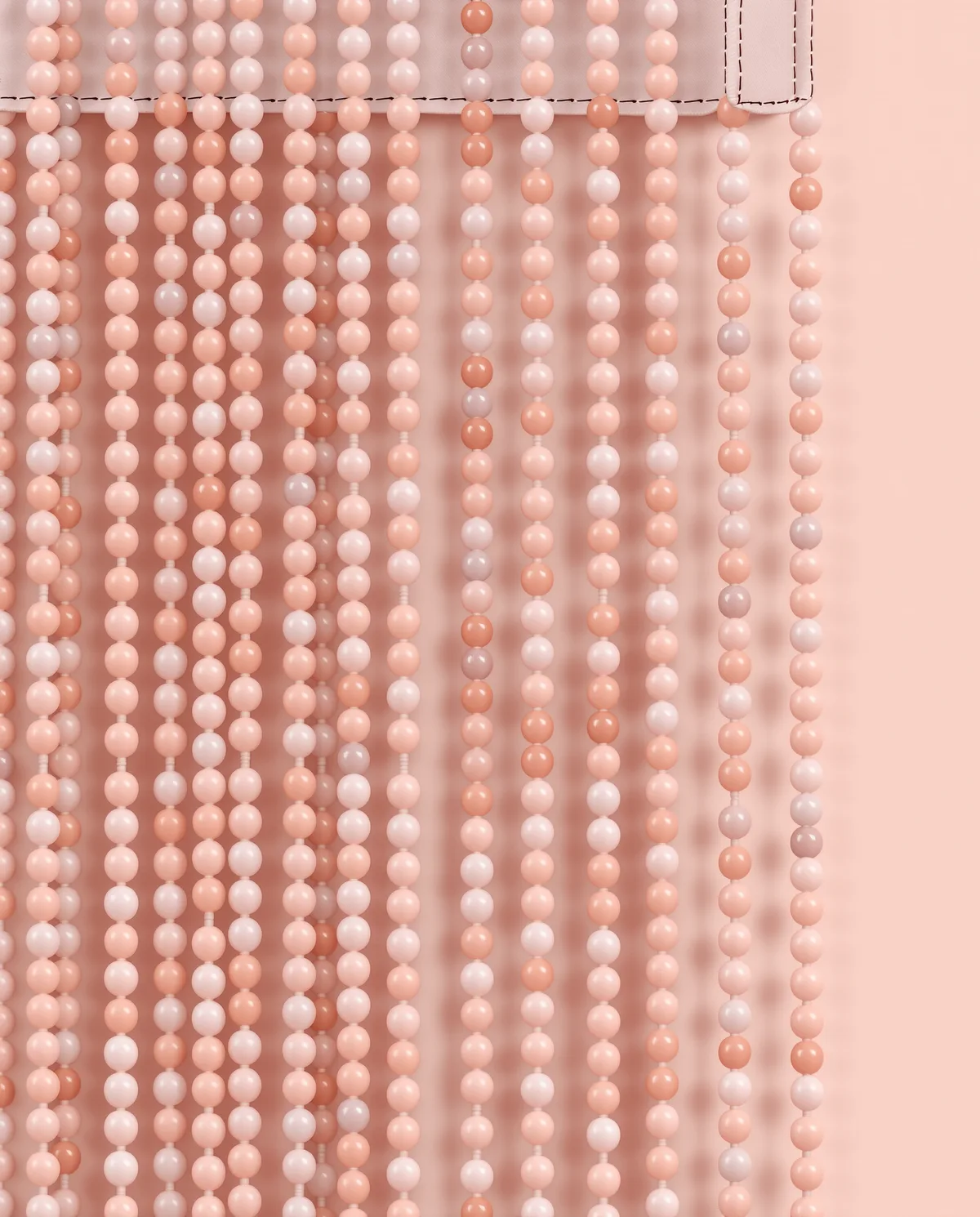
Yes, and the hybrid is a made construction rather than an idea. A beaded café curtain runs on a 100% cotton header band with a three-inch rod pocket, with the beaded drops hanging from that band and finishing in a scalloped chevron hem. Earlier doorway developments used a ten-ounce canvas mounting pattern with the same three-inch pocket.
The header choice is not cosmetic. One of our wall hangings exists in two versions — a dowel version carrying roughly 155 to 170 laser-cut blossoms, and a rod pocket header version carrying about 130 — because a textile header gathers and a dowel does not, so the two need different piece counts to read the same.
For a doorway between a kitchen and a living space: a bead panel, acrylic, opaque, with a weighted end bead. It marks the threshold, it does not stop the extract fan working, and nobody has to touch it.
For a bedroom: fabric, lined. There is no bead specification that makes a bedroom dark.
For a hotel corridor or a restaurant threshold: a bead panel, glass, with the feature beads annealed — but check the fire specification first, because a contract classification is tested against the actual build and quoted with the project rather than taken from a category.
The textile-header constructions are the clearest evidence that these two families are complements rather than rivals. Café formats at 24 × 30 in with a three-inch rod pocket are a live part of the beaded programme; a seed-bead café curtain at 30 × 30 in was built on a Shantoon poly-cotton base of roughly 60 to 65 GSM, with an alternative white-on-white version on chiffon.
That last development is also a useful craft lesson. It began as a full-length curtain and moved to café size because flat bead embroidery is worked on a frame, and the frame sets the practical maximum; above that size the format is a strung one. That is a property of flat beadwork, not of stringing, and a good illustration of why the two families are specified for different jobs rather than swapped for each other.
Good to know
Textile headers are a standard part of our beaded programme, not a novelty. Café curtains run on a 100% cotton header band with a three-inch rod pocket above beaded drops; earlier portal developments used a ten-ounce canvas mounting pattern with the same three-inch pocket; and one wall hanging exists in both a dowel version and a rod-pocket version, with different blossom counts because the two headers hang differently.
Fabric if the brief contains the words dark, warm, quiet or private. Beads if it contains divide, frame, airflow, character or walk-through. If it contains both, you are specifying two products for one opening, and the usual answer is a bead panel on the doorway and fabric on the window.
No, and treating them as rivals is the error. A bead panel asked to black out a bedroom will fail at it completely, and a fabric curtain asked to mark a kitchen doorway without stopping ventilation will fail at that. Each is excellent at its own job and bad at the other one.
Yes. A bead panel inside the reveal with a fabric curtain across the face is a common layered arrangement: the beads do the character and the airflow, the fabric does the blackout when it is drawn. Specify the bead panel to the reveal width and keep the fabric track clear of it.
Fabric, comfortably, because it folds and compresses. A bead panel is rigid in one dimension — the header — and the strands must be kept in order and cushioned, so the carton is large relative to the finished piece. Glass makes it heavier again.
Beads, decisively, where the bead is body-coloured glass. Colour in glass is as permanent as the glass. Dyed textile fades in direct sun and a lining fades faster than the face fabric. The exception is a surface-dyed bead, which behaves more like a textile than like glass.
Fabric fails at the hem, the heading tape and the colour, and it fails gradually and visibly. A bead panel fails at the cord, suddenly and in one strand, and that single strand is a repair rather than a replacement. In a busy doorway, the beads will usually outlast the textile.
Keep exploring
Guide
No soundproofing, no blackout, no insulation, no insect exclusion, no close-range privacy — and why none of them is fixable.
Open the referenceGuides
One guide per question that arrives often enough to be worth answering properly.
Read the guideGuide
What chain genuinely does better, what it does not, and which of the two suits a given opening and budget.
See the detailGuide
A portal frames the opening and leaves it clear; a full curtain covers it. Wear, bead count and how the room reads all follow.
Specs and sizesGuide
A valance dresses the top of an opening; a short curtain covers part of it. The line sits near a third of the height.
Specs and sizes
Start a conversation
Send a reference, a colour chip or a sketch. Minimums are set per design and confirmed per quote; sampling is quoted separately and usually runs 16 to 20 days from an agreed brief.