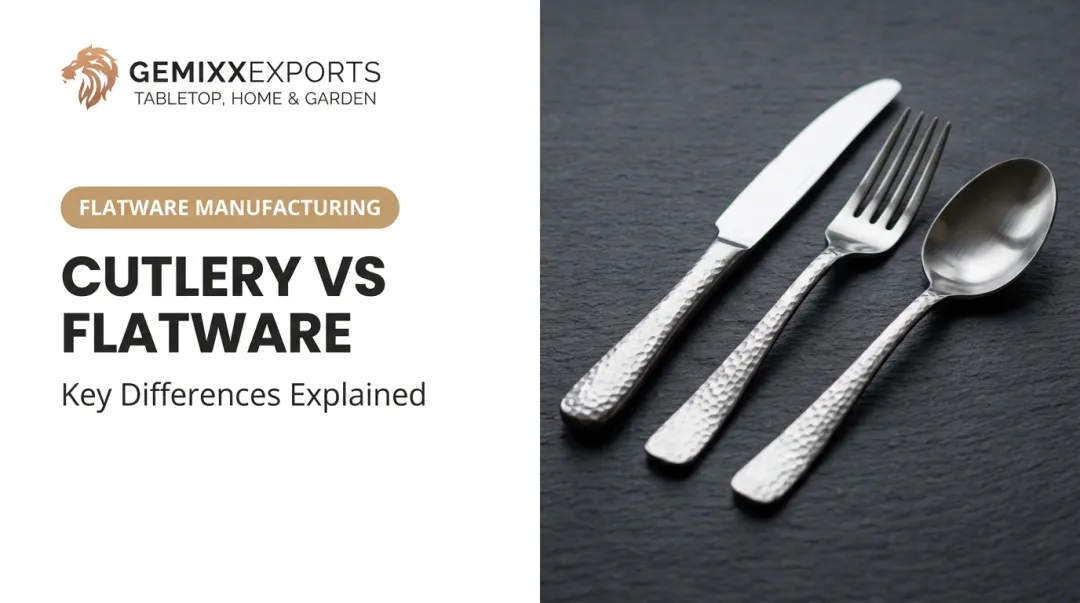

The choice affects more than looks. It shapes your visual identity, how premium the set feels, how often staff polish, how marks show up between washes, and where a collection sits in a retail assortment.
Here's the short version: satin diffuses light for a softer, understated look, while mirror reflects light for a brighter, more formal presentation. Neither wins everywhere. This guide helps restaurants and retailers match the finish to the operation.
Key Takeaways
- Satin has a brushed, low-sheen look that suits casual, modern, and minimalist settings.
- Mirror is highly reflective and suits formal, classic, and presentation-led concepts.
- Judge finish separately from steel grade, weight, construction, and ergonomics.
- Restaurants should test cleaning workflow and traffic; retailers should test assortment fit and photography.
- Approve a physical sample before ordering.
Satin vs Mirror Finish Flatware: Quick Comparison
| Factor | Satin | Mirror |
|---|---|---|
| Look | Soft, low-glare, brushed | Bright, reflective, formal |
| Composition | Not set by the finish | Not set by the finish |
| Cost | Depends on the full specification | Depends on the full specification |
| Marks | Depends on alloy, care, and use | Depends on alloy, care, and use |
| Typical fit | Modern, casual, farm-to-table | Fine dining, hotels, formal events |
Cost
Finish alone does not set a standard price premium. Quotes move with alloy, gauge, construction, pattern complexity, order volume, and customization. Mirror polishing uses progressively finer abrasives and buffing, but that describes the process, not the price. Ask for itemized quotes and compare like with like.
Composition
Finish does not identify the alloy. Labels such as 18/0, 18/8, and 18/10 describe chemistry claims, and the British Stainless Steel Association notes 18/10 can be used as an alternative label to 18/8 without higher actual nickel. A shiny surface proves nothing about grade. Record the exact material specification in writing.
Durability and marks
Many buyers assume satin hides scratches and fingerprints, and visually that is plausible. Mark visibility and service life still come down to alloy, thickness, construction, and care, not finish alone. Don't treat mirror as inherently weaker, either.
Maintenance
Manufacturer care guidance from makers like WMF and Steelite focuses on dishwasher handling, prompt removal, and drying, not on the finish. Both finishes need proper washing, drying, and storage. Mirror pieces may demand more attention if a spotless shine is part of your brand promise.
Best-fit setting
- Satin: modern, industrial, minimalist, casual, and design-led concepts; approachable retail assortments
- Mirror: fine dining, hotels, banquets, classic table settings; traditional or elevated retail collections

What Is Satin Finish Flatware?
Satin flatware has a low-reflection surface, usually made by brushing or controlled abrasion. It diffuses light instead of bouncing it back. In stainless-steel standards, World Stainless describes the No. 6 satin-matt finish as less reflective than brushed No. 4.
The result is less glare and a setting that feels contemporary or understated. Handling marks may be less conspicuous, though that remains a visual judgment rather than a tested claim. Satin does not eliminate cleaning or wear.
Terminology also varies between finishers. The British Stainless Steel Association (BSSA) warns that "satin," "brushed," and "polished" are used loosely, so specify the finish and approve a sample.
Evaluate satin alongside:
- Steel composition and gauge
- Balance and handle comfort
- Knife construction
- Dishwasher guidance
- Consistency of the brushing across the whole collection
Use cases for satin
- Restaurants: Modern casual dining, cafés, bistros, minimalist rooms, and contemporary fine dining, especially with stoneware, wood, concrete, or natural textiles
- Retail: Modern everyday assortments for shoppers who find highly polished cutlery too formal
Mixed treatments exist too. 1880 Hospitality's Satinique pairs a brushed satin center panel with polished edges and reflective tines and bowls, showing the choice is not always all-or-nothing.
What Is Mirror Finish Flatware?
Mirror-finish flatware is polished to a smooth, high-reflection surface. The No. 8 finish is the most reflective type commonly produced, made with successively finer abrasives followed by buffing.
The Australian Stainless Steel Development Association describes it as bright with image clarity, unlike other bright surfaces that reflect light without a sharp image.
Design impact
Mirror adds formality. It emphasizes clean lines, picks up candlelight and overhead lighting, and makes the flatware a visible part of the tablescape.
Perception versus evidence
Be careful with claims about luxury or cleanliness. A peer-reviewed study in Flavour found diners enjoyed food more with heavier stainless cutlery. That study is about weight, not polish, so it is not proof that a mirror finish improves dining. No finish should be sold as hygienically superior.
Operational trade-offs
On a reflective surface, fingerprints, mineral spots, and fine scratches can be easier to see. Plan for:
- Prompt removal from the dishwasher and thorough drying
- Light polishing before service where needed
- Careful stacking and storage to avoid scratching

Mirror says nothing about steel quality or lifespan. Verify corrosion resistance, thickness, construction, and commercial-use guidance.
Use cases for mirror
Hospitality: fine dining, hotels, banquets, tasting menus, and classic restaurants where formal presentation defines the brand.
Retail: classic, bridal, holiday, entertaining, and gift collections, especially shown with porcelain, crystal, or formal linens.
For e-commerce, Adobe cautions that reflectors can make reflective products look too bright, so test photography early.
Satin vs Mirror Finish Flatware: What Is Better?
Neither. The better finish is the one that fits your operation. Weigh these criteria:
- Restaurant concept and table identity
- Service volume and cleaning workflow
- Dining room lighting and tableware pairing
- Customer expectations and retail price tier
- Replacement availability and total cost of ownership
Choose satin when
You want a softer contemporary look, design versatility, or a relaxed, approachable table. It suits operations where staff time for polishing is tight.
Choose mirror when
You want brightness, classic elegance, and a strong visual statement, and your staff can support careful drying and handling.
What to compare in supplier quotes
Normalize every quote on these fields:
- Steel grade and material specification
- Finish designation and finish zones (handle, bowl, tines, edges)
- Gauge and piece weight
- Knife construction and handle ergonomics
- Dishwasher instructions
- Lead time and minimum order quantity
- Packaging, replacement pieces, and samples
Checkpoints by buyer type
Retailers:
- Complements your current assortment
- Photographs consistently across listings
- Supports your price tier
- Reorders without mismatched pieces
Restaurants: Run representative pieces through real service before a large order:
- Stacking and storage
- Commercial dishwashing and drying
- Table lighting next to your existing ware
Real-World Examples and Supplier Options
Public, measured case studies comparing satin and mirror outcomes in restaurants or retail are scarce, so treat what follows as supplier examples rather than proof of performance.
- Corby Hall's Distinction collection lists an 18/10 stainless option in mirror finish with hollow-handle knives.
- 1880 Hospitality's Satinique shows a mixed satin and polished design.
- Gemixx offers brushed and polished stainless finishes across modern, contemporary, and classic patterns.
Gemixx, a family-run manufacturer with handcrafted expertise since 1982, works with US restaurants, retailers, wholesalers, and houseware brands on bespoke flatware. Services include finish development, prototyping, manufacturing, importing, and warehousing, with FDA-compliant stainless-steel bowls and handle options in wood, bone, marble, resin, and enamel.
Quotes typically arrive within 48 hours, with sampling quoted separately. Production runs 40 to 60 days after sample approval, and minimums vary by silhouette, finish, and packaging.
Whatever supplier you choose, request samples of both finishes. Compare them under your own lighting, handling, washing, and merchandising conditions before committing to production.
Conclusion
Satin is the more understated, forgiving visual choice. Mirror is the brighter, more formal one. Which is right depends on your concept, your workflow, and what your customers expect.
Before ordering, compare finish alongside:
- Steel composition
- Construction
- Care requirements
- Replacement availability
- Supplier capabilities
A great finish on weak flatware is still weak flatware.
Frequently Asked Questions
What's the best material for flatware?
Stainless steel is the standard for commercial flatware. Compare alloy composition, corrosion resistance, gauge, construction, balance, and food-safety compliance rather than choosing by material name alone.
What does satin finish on flatware mean?
Satin is a brushed, low-sheen surface that diffuses light. It looks softer than polished steel, and some buyers find it makes minor marks less noticeable.
What is mirror finish flatware?
Mirror finish flatware is polished to a smooth, highly reflective surface. It is associated with brightness, formality, and visual refinement.
Is satin or mirror finish better for flatware?
Neither is universally better. Satin often suits contemporary, high-traffic settings, while mirror often suits formal or presentation-led environments.
Which flatware finish is easier to maintain in a restaurant?
Satin may show fingerprints and minor scuffs less, but no study confirms a finish-specific advantage. Both need proper washing, drying, storage, and maker-approved care.
What should retailers consider when choosing satin or mirror flatware?
Consider merchandising, target customer, price tier, product photography, assortment consistency, and replenishment. Order samples to test how each finish presents on shelf and on screen.