
Restaurants need plates that survive thousands of service cycles. Retailers and wholesalers need product that looks good on a shelf, ships without damage, and can be reordered in the same color next season. Both groups face the same fuzzy vocabulary: stoneware, porcelain, and listings that say only "ceramic."
This guide breaks down how the three compare, how to match material to your operation, and what to check with suppliers before you commit.
Key Takeaways
- "Ceramic" is the umbrella; porcelain and stoneware are specific types, so "ceramic" alone isn't a spec.
- Porcelain tends toward lighter, refined pieces; stoneware toward heavier, tactile, heat-holding ones.
- Construction, glaze, and quality control often matter more than the material name.
- Test samples, get food-contact documentation, and pilot before a full rollout.
Understanding Stoneware, Porcelain, and Ceramic Dinnerware
What "ceramic dinnerware" means
Ceramic is a broad family of clay-based bodies fired in a kiln. Porcelain, stoneware, and earthenware all sit inside it. Retail terms aren't uniform technical grades, which is why ASTM C242 exists as a terminology reference.
A listing that says only "ceramic" may leave out critical details. Ask for a full technical specification that covers:
- Firing temperature and water absorption
- Thickness and glaze
- Intended commercial or retail use
Porcelain dinnerware
Porcelain is a high-fired, dense ceramic with a smooth, light-toned finish. It suits formal and contemporary presentation. The ISO porcelain tableware standard sets body water absorption below 0.5%, and it defines translucency as the body's ability to transmit visible light.
Lighter pieces are easier on servers and dish crews. But thin or poorly made porcelain can still chip, crack, or fail under thermal shock.
Stoneware dinnerware
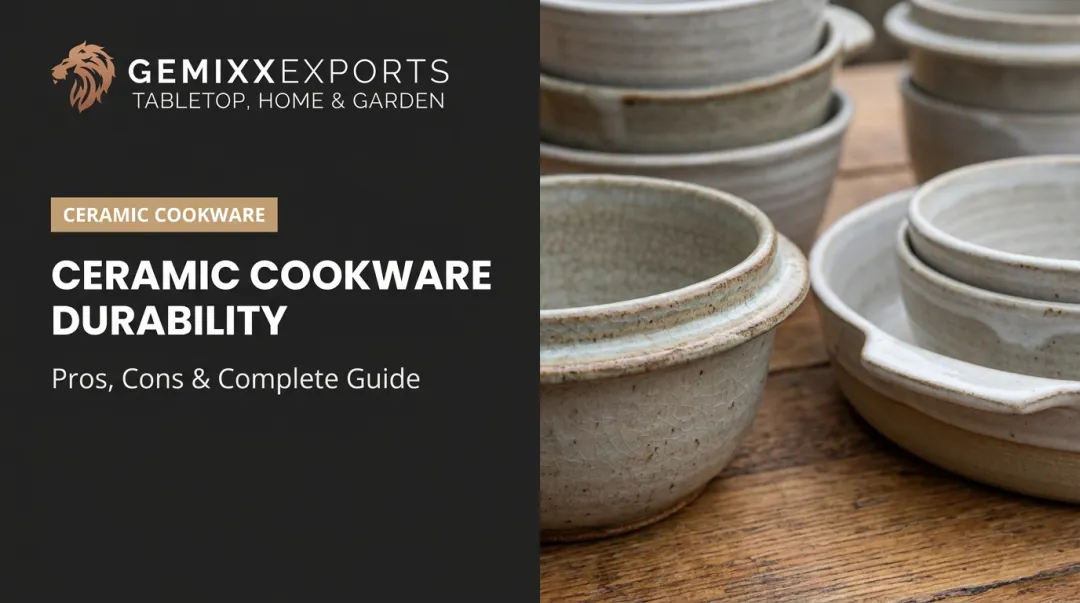
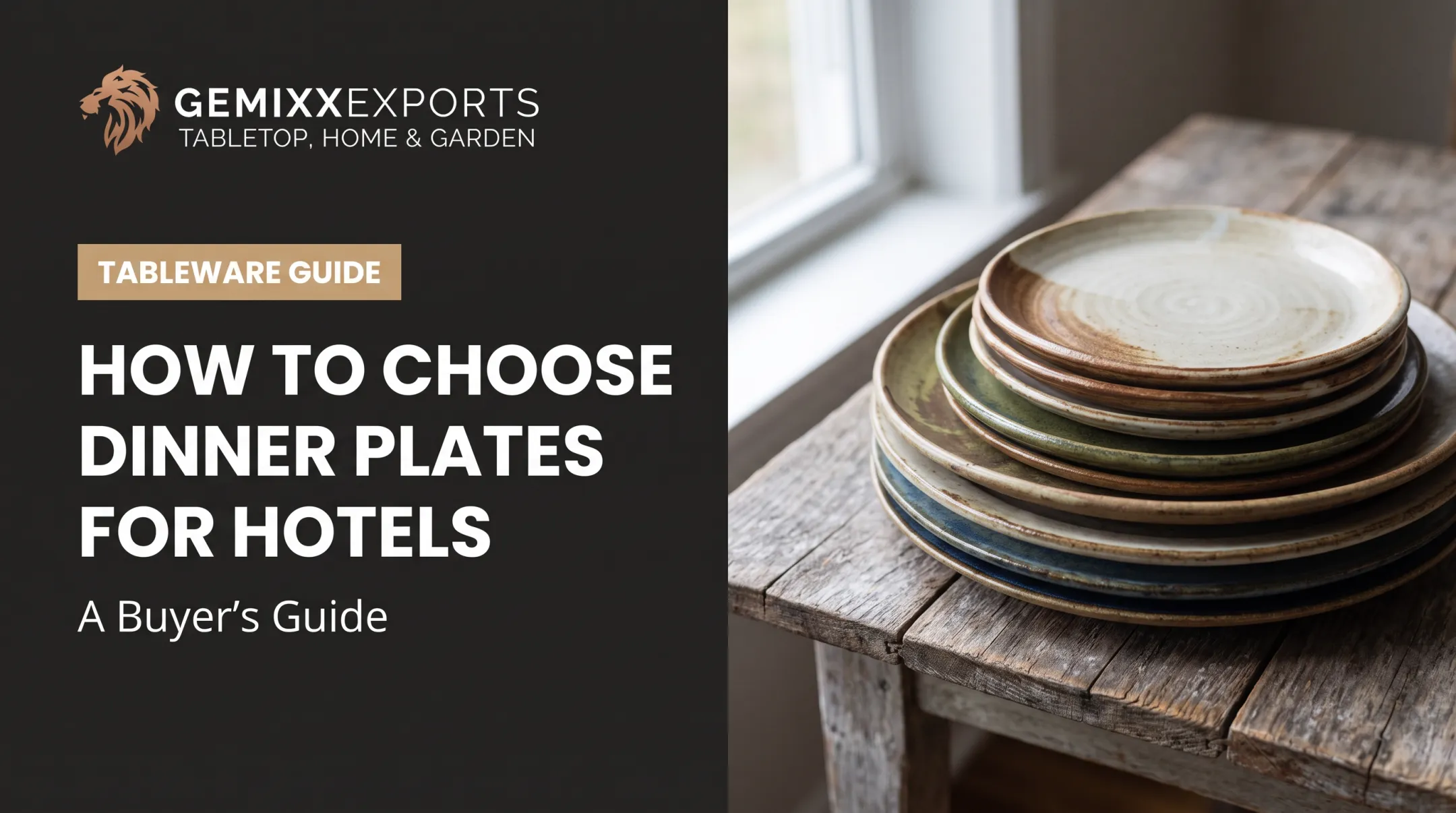
Stoneware is typically a thicker, denser body with a substantial feel, good heat retention, and an organic, handcrafted look. It fits rustic, artisanal, and chef-led concepts.
The trade-off is weight. That affects staff handling, shelf capacity, and freight.
"Ceramic" as an unspecified label
A well-specified ceramic product names its body: stoneware, porcelain, or earthenware. A bare "ceramic" tag doesn't. Beyond the body name, glaze quality, thickness, foot ring, shape, and firing consistency often matter as much as the material label itself.
What firing, vitrification, and glaze mean in practice
Firing and vitrification drive density, moisture absorption, stain resistance, and durability. Don't treat any one number as universal.
The ISO porcelain standard cites a conventional second firing of 1,360-1,400 °C, but that isn't a recipe for every body. Canadian tariff guidance puts semi-vitreous ware at 0.5%-3% absorption; that is a classification, not a rule for all stoneware.

Glaze matters too. Mayco notes that dinnerware glaze should be chemically durable and free of surface texture, and that finished-ware producers are responsible for food-contact testing.
Stoneware vs Porcelain vs Ceramic: Commercial Performance Comparison
Durability, chipping, cracking, and breakage
No ceramic dinnerware is unbreakable. Thickness, rim design, glaze, and firing quality change outcomes more than the category does. "Commercial grade" and "chip resistant" are claims, not results.
Useful benchmarks exist. ASTM C368 measures impact resistance at the centers and rims of tableware. Manufacturers such as HF Coors and Steelite describe vitrified, high-alumina lines with chip and thermal-shock claims, and Steelite backs one range with an edge-chip warranty.
Those are product-line claims, not category guarantees. Ask for test data and handle real samples.
Weight, handling, stacking, and storage
Porcelain is typically lighter; stoneware heavier. That shows up in server fatigue, dish-pit speed, shelf loading, and carton weight.
Consider two venues:
- High-volume café or banquet hall: Thousands of covers a week, constant bussing and stacking. Lighter, stackable pieces with narrow rims save table space and labor.
- Presentation-led tasting room: Fewer covers, slower pace. Heavier stoneware adds perceived value and the weight is a minor issue.
Heat retention and thermal shock
Stoneware often holds heat well. Porcelain gives you a lighter serving piece. Heat retention is not the same as resistance to sudden temperature change. A plate can stay warm for ten minutes and still crack going from freezer to oven.
Follow the manufacturer's instructions for every transition: refrigerator, freezer, oven, hot pass, table. HF Coors, for instance, states its line goes from a 500°F oven to a commercial dishwasher, but that applies to that product only.
Appearance, plating, and brand presentation
Stoneware can offer matte, reactive, and irregular finishes. Porcelain delivers smooth, bright, refined surfaces. General ceramic varies widely.
FE&S notes that narrow rims are common in fast-casual and banquet service, wide or rolled rims suit fine-dining decoration, and mid-rims are versatile. Rim shape, color contrast, and glaze reflection all affect how food reads on the plate and on a retail shelf. Neither style is universally better.

Care, commercial dishwashing, and utensil marking
Never assume dishwasher, microwave, oven, and freezer limits are shared across a material. Check them per product. ASTM C556 tests overglaze resistance to household detergents, so it is not a commercial-dishwasher qualification.
When evaluating pieces, check:
- Utensil marking and glaze wear
- Metallic decoration (Mikasa and Fitz and Floyd both warn against microwaving gold or platinum accents)
- Rough foot rings that scratch tables or racks
- Nesting stability
- Fit with your racks and wash cycle
Choosing Dinnerware for Restaurants and Hospitality Operations
Match the material to the restaurant concept
Start with service style, menu, plating approach, turnover, table setting, and the guest experience you want. FE&S lists menu price, demographics, volume, and catering as key drivers.
Typical fits:
- Porcelain: refined, lightweight, high-presentation service
- Stoneware: casual, rustic, chef-led, heat-holding dishes
- Ceramic: design-led or value-conscious programs (specify the body)
Operational durability and replacement planning
Judge breakage exposure across the whole chain: front-of-house handling, bussing, dishwashing, stacking, transport, storage. A drop test alone misses most of it.
For replacement planning, use your own breakage logs, service volume, and reorder needs. Published figures are thin. One Foodservice Director case showed a University of Montana catering operation replacing 2%-3% of its china annually, but that's one site, not a benchmark.

Menu presentation and guest experience
Color, texture, rim width, and depth control how portions and sauces look. A neutral porcelain canvas supports detailed plating and negative space. Textured or earthy stoneware reinforces a rustic or artisanal menu, such as braises, grain bowls, or shared plates.
Cleaning, stacking, and staff workflow
Before rollout, test whether pieces fit:
- Existing dish racks and the dish machine
- Shelving and bus tubs
- Storage areas, accounting for weight and nesting
Then document staff rules on thermal shock, abrasive cleaners, glaze protection, and metallic detailing.
Total cost of ownership
Price per piece is one line. Factor in:
- Freight and packaging
- Storage space
- Breakage and replacement pieces
- Lead times and minimum order quantities
- Cost of changing an established table setting
FE&S advises against letting cost be the only factor. GFS recommends testing pieces with real menu items.
Run a pilot order first. Record performance, staff feedback, guest response, and replenishment experience in writing.

Choosing Dinnerware for Retailers, Wholesalers, and Houseware Brands
Build an assortment around customer and channel needs
Position each material for a distinct need: lightweight everyday use, formal entertaining, rustic design, starter sets, or premium tabletop. The 2026 IHA MarketOutlook found replacing an existing product was the top dinnerware purchase motivation at 37%, so replacement pieces and open-stock availability deserve space in your plan.
Balance core neutral SKUs with a few differentiated colors, shapes, and finishes. A range too broad to replenish efficiently hurts more than it helps.
Evaluate product consistency and retail readiness
Request samples from the intended production run, not a showroom piece. Review:
- Glaze uniformity and color variation
- Dimensions, weight, and flatness
- Rim quality and nesting
- Barcode and packaging readiness
- Replacement-piece availability
Packaging counts. Crate & Barrel's 2026 vendor guide, for example, requires over-boxed transit-test samples and references an ISTA 3A test for individual parcel packages. That is one retailer's rule, but it shows how seriously buyers treat breakage in transit.
Also insist on clear care instructions, accurate material labeling, and photography that shows true color and finish.
Plan inventory, replenishment, and private-label development
Agree on MOQ, production capacity, lead time, reorder cadence, color continuity, and discontinued-SKU policy before launch. For private label, ask about:
- Custom shapes, finishes, and branded packaging
- Sample approval steps
- Quality-control checkpoints
- Approved-spec lock across future batches
Supplier and Sourcing Checklist for Commercial Dinnerware
Verify safety, testing, and product documentation
Request food-contact documentation for the exact product:
- Lead and cadmium leach results
- Glaze details
- Decoration details
- Written care instructions
FDA action levels for ceramicware vary by category, measured in the leaching solution:
| Lead (CPG 545.450) | Action level |
|---|---|
| Flatware (average of 6) | 3.0 µg/mL |
| Small hollowware | 2.0 µg/mL |
| Large hollowware | 1.0 µg/mL |
| Cups and mugs | 0.5 µg/mL |

Cadmium has its own levels under CPG 545.400. These are enforcement criteria, not limits on body composition, and the FDA applies them across all ceramicware types. Neither porcelain nor stoneware is inherently safer.
California adds its own layer: its tableware law prohibits lead or cadmium release above FDA standards and requires a permanent manufacturer or importer mark.
Proposition 65 safe-harbor levels are exposure doses, not leach limits. Compliance can differ item to item, so don't assume one supplier's items share the same status.
Test samples under realistic conditions
Run samples through the conditions they'll actually face:
- Flatness and wobble checks
- Rim strength and stacking
- Stain and utensil-mark tests
- Repeated dishwasher cycles
- Heat transitions per manufacturer instructions
Compare each sample to the approved specification. For handmade finishes, write down what variation is acceptable before you place a production order.
Consider a vertically integrated housewares partner
Gemixx is one option for buyers building coordinated housewares. The family-run manufacturer has 40+ years of handmade production and offers prototyping, manufacturing, importing, and warehousing.
Its Khurja ceramics factory hand-throws and hand-decorates dinnerware in stoneware and thrown-clay ceramic bodies, with reactive, matte, gloss, and wax-resist glazes. Lead time runs 60-90 days after sample approval, and the ceramics program is a SEDEX member and SMETA audited.
Porcelain isn't listed in its specifications. Confirm food-contact and care details per program in the quote, and ask for documentation tied to your specific product. Gemixx also covers flatware, barware, cookware, and décor, which suits buyers coordinating a full tabletop line.
Frequently Asked Questions
Which is better, porcelain or stoneware?
Porcelain suits buyers who want lighter handling and refined presentation. Stoneware suits those who want a heavier, tactile feel and strong heat retention. Construction and use case decide the winner.
Which is better, ceramic or porcelain?
Porcelain is a type of ceramic, so the comparison is incomplete. "Ceramic" alone is a broad label. Compare the exact body, glaze, firing, care instructions, and compliance documents.
What is the healthiest material for dinnerware?
The FDA does not designate porcelain, stoneware, or earthenware as inherently safest. Safety depends on tested glaze, decoration, and manufacturing. Check current FDA lead and cadmium guidance and applicable Prop 65 information.
How can you tell if a bowl is ceramic or porcelain?
Look and feel aren't definitive, and translucency alone isn't proof. Check the manufacturer's specification. If it matters, request technical documentation or lab testing of absorption.
Is porcelain considered high end?
It's often positioned as premium for its refined look, but price and quality vary widely. Judge construction, finish, design, compliance, durability, and supplier support rather than the label.