Style
Y2K beaded curtains
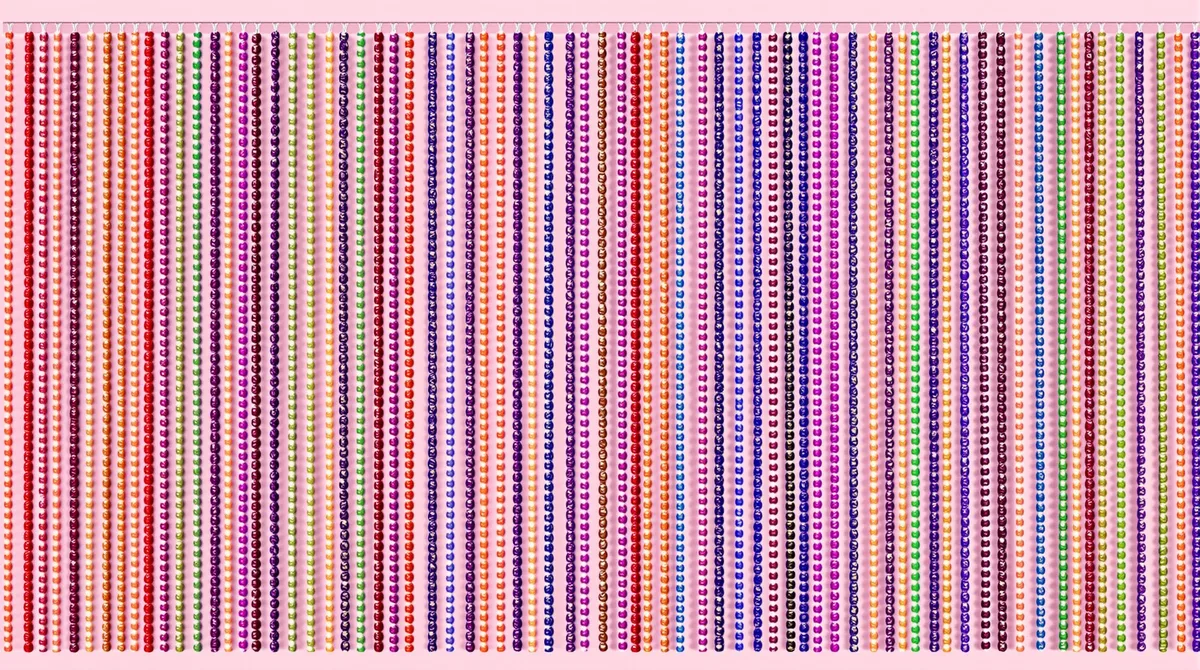
Smileys, mushrooms, daisies and cherries on translucent and iridescent grounds, scattered to a rule.
See the detail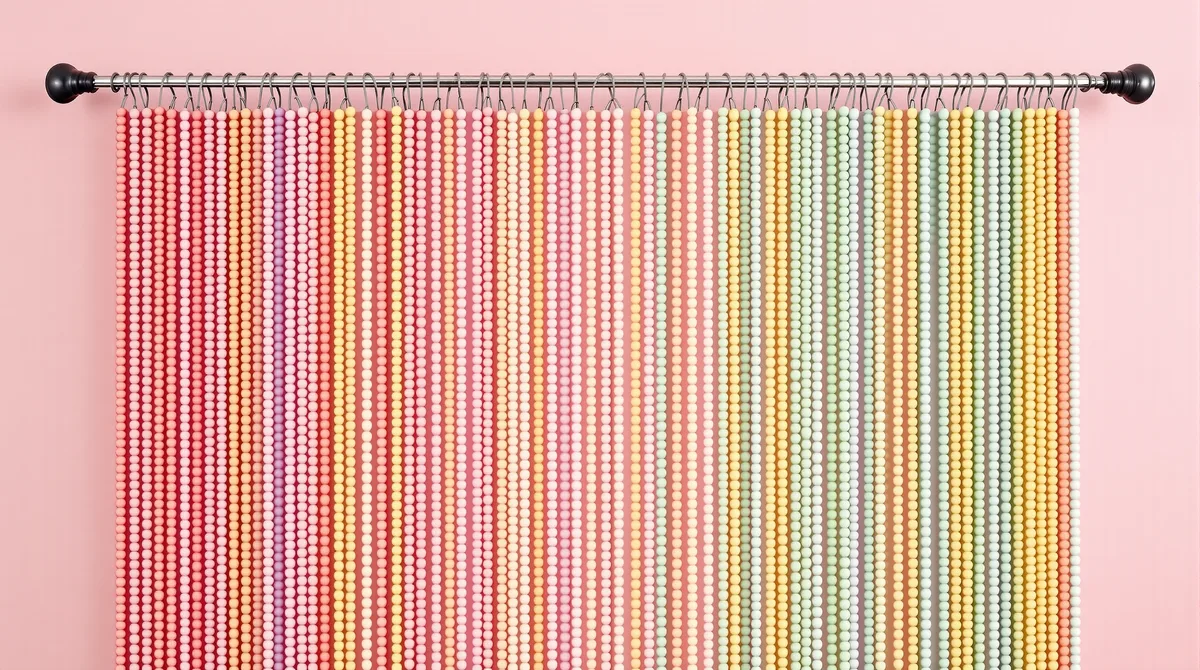
Guide · Ideas
A dorm panel has a brief no other beadwork has: it must go up without tools, come down in ten minutes, survive a car boot, and go up again somewhere else next September.
A beaded curtain hung from a chrome spring tension rod with black rubber end caps, the cords strung with lightweight moulded acrylic beads in candy pink, lemon, mint and lilac.
A dorm beaded curtain should be acrylic, hung on a tension rod inside the door or window frame, and short enough to pack flat. Acrylic is the only material that is light enough for a no-drill fixing, cannot shatter in transit and takes the saturated colour the room is actually for. Bundle it loosely for storage, never fold it.

Four requirements that no other application has all at once. It has to go up without tools, because drilling is forbidden. It has to come down fast, because moving day is always compressed. It has to survive transport, usually in a car with everything else. And it has to do a disproportionate amount of visual work, because the alternative is a wall of posters.
Everything on this page follows from those four, and they point consistently at one material and one fixing.
Acrylic. Not as a compromise — as the correct answer.
It is the lightest full-size panel available, which is what makes a no-drill fixing viable. It cannot shatter, which matters enormously in something that gets packed twice a year. And because acrylic beads are moulded and dyed to a named colour, it takes the saturated palette that a student room is actually for, in a way no natural material does.
Wood is a sensible second choice if the room wants calm rather than colour. Glass is the wrong answer here on both weight and fragility, however much better it looks.
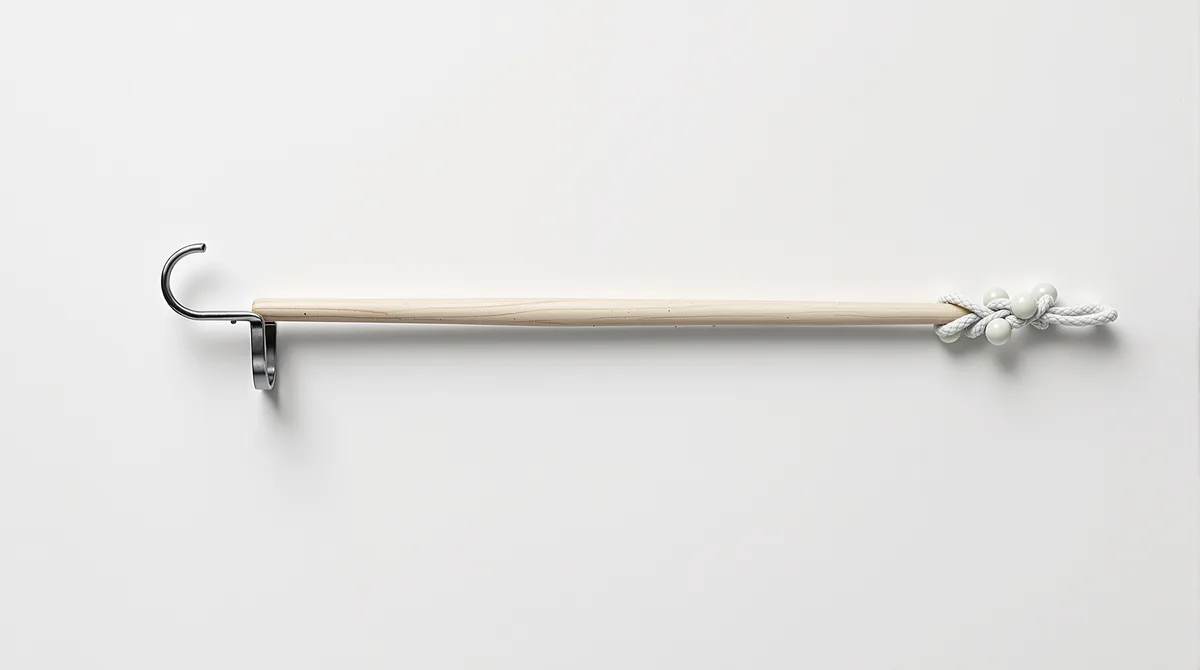
A tension rod inside the frame. That is the entire strategy, and it works because acrylic, bamboo and wood panels are light enough for a friction fitting to carry.
Measure the inside of the opening, buy a rod that spans it with some adjustment left, and hang the panel's dowel or its suspension loops on it. Nothing is screwed, nothing is glued, and there is no mark to explain at the end of the year.
Adhesive hooks are the tempting alternative and the worse one: they fail under a sudden pull, and they take paint with them when they come off.
Three places work better than a doorway.
Over the bed, as a headboard. A panel hung on a tension rod across a recess, or on a rod above the bed, does what a feature wall does and occupies no wall.
Across a wardrobe or shelf recess, which is the most useful version: it conceals the mess, needs no clearance, and is a short drop so it packs small.
At the window, where it is the only treatment that lets you keep the light while changing what the window looks like.
The doorway itself is often shared and often fire-regulated, so check before you plan around it.
Shorter than instinct suggests. A full 200 cm door drop is a lot of beads to transport and a lot of beads to pay for.
A café length or a half-drop over a bed, a window or a recess reads just as strongly from across a small room, and because bead count falls directly with the height, it costs correspondingly less. The published cost levers put height last in order of effect only because the others multiply; on a short format it is still the fastest way to halve a bead count.
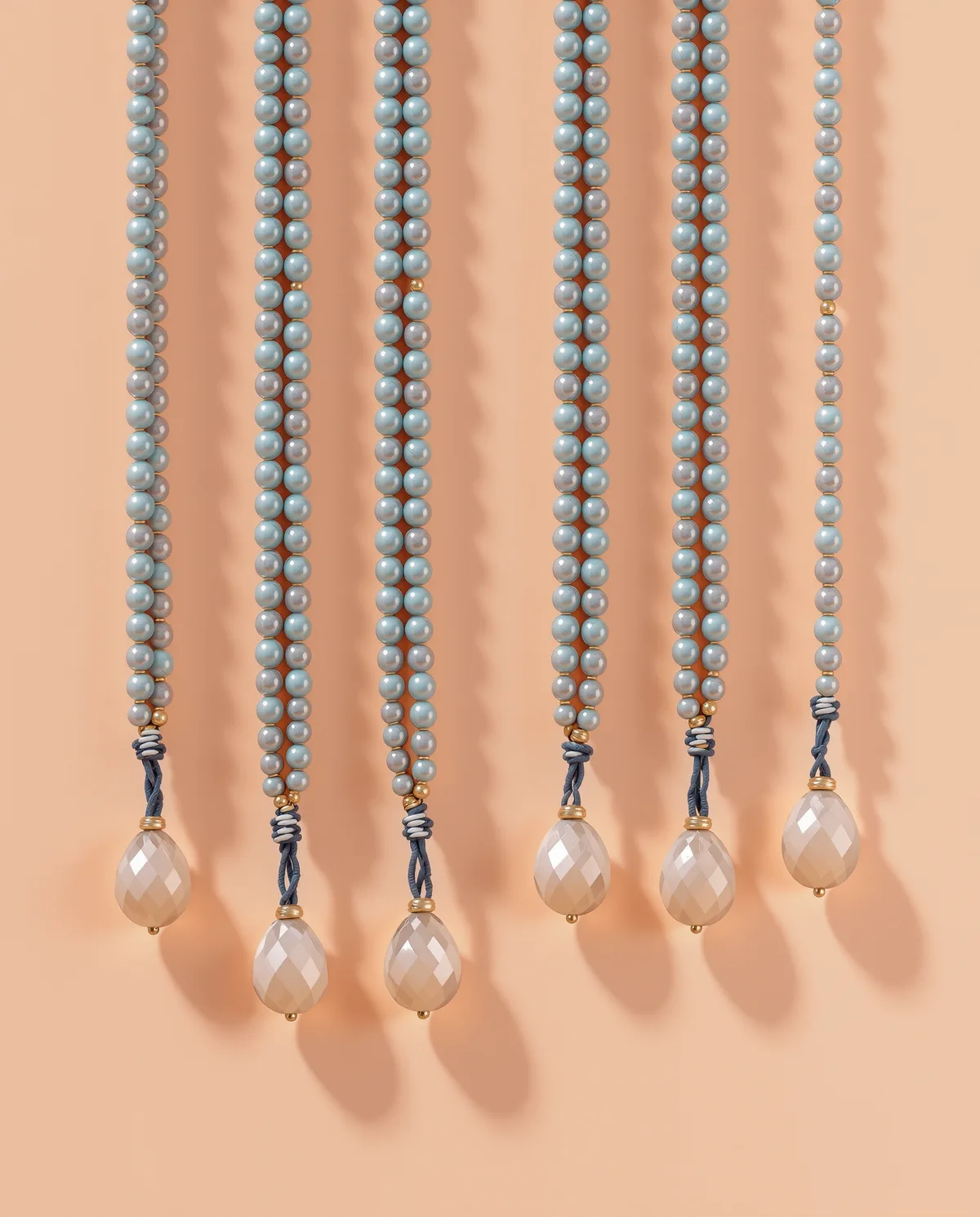
Bundle it before it moves, and never fold it. A dorm panel is taken down twice a year by somebody in a hurry, which is the single likeliest moment for it to tangle, so the method belongs on the care card rather than in a student's memory.
Do not fold it. A fold puts a sharp crease on every cord at the same height, and that line is where strands will part later. Do not stuff it into a bag unbundled either — that is how thirty strands become one knot.
Done properly, a packed bead panel is one of the more robust things in the car.
Possibly, and it is worth deciding in advance rather than discovering. Every passage through the panel makes a sound, and in a shared room at unsociable hours that is a real cost.
Acrylic is the quietest of the hard beads: a light click rather than glass's bright chime. A wider strand pitch helps too, because fewer beads are struck in a single pass. Hanging the panel over a bed or a recess rather than across the route to the door removes the problem entirely.
Only with something structural overhead, and in most halls of residence there is not and you are not allowed to add one.
One note on scope. Beaded room dividers are a real craft category and a reasonable thing to want, and they are a craft category here rather than a Gemixx range. Anything on this page about dividing a room is about hanging a curtain panel in an opening; a division built from panels hung side by side is the format we build.
It is not a one-year object. The beads are effectively permanent in indoor use — acrylic does not craze or chip — and the cord is the only service item on the whole panel. A panel you buy in a first year is still a working panel in a first flat and a first house.
That makes it a different kind of purchase from the things it competes with on a student budget. The posters do not move with you.
No-drill bead curtains covers the fixing in detail and is the page that matters most in a hall of residence. Small-space beadwork deals with pitch and palette at close quarters, which is the other half of a room this size. Acrylic door beads is the material page behind the recommendation here, and tangled strands explains how to pack a panel so it survives the car. For the sound, which is the thing a roommate will notice, what a beaded curtain sounds like sets the materials against each other. The style library is where the designs themselves live.
Two more pages help. Bead curtain formats sets out which format suits which opening, and bead curtain pricing explains why a short drop in a larger bead is the cheapest way to buy the same effect. Routine care covers the dusting, which in a room this size is a five-minute job rather than a chore.
Good to know
Yes — a tension rod inside the door or window frame is the standard answer and it is genuinely adequate for a light acrylic, bamboo or wood panel. It leaves no mark, comes down in seconds and goes up again anywhere there are two facing surfaces at the right spacing.
Lift it off the rod by the dowel, let the strands hang together, and tie them into loose bundles down the length of the panel. Never fold it: a fold puts a hard crease on every cord at the same height and that is where strands part. Loosely tied bundles survive a car boot indefinitely.
Acrylic. It cannot shatter, which rules glass out of a panel that gets packed and unpacked repeatedly, and it is light, which is what makes the no-drill fixing work. Wood is a reasonable second, provided the car it travels in does not get damp.
Shorter than a door. Over a bed, a window or a wardrobe recess, a café length or a half-drop reads just as strongly and packs into a much smaller volume. Bead count falls with the height, so a short panel is also the cheaper way to buy the same effect.
It will make a sound every time anyone passes through it, which in a shared room is a real consideration. Acrylic is the quietest of the hard beads — a light click rather than a chime — and a wider strand pitch reduces how many beads are struck at once.
Only if there is something structural to hang it from, and a ceiling hook in a hall of residence usually is not allowed. There is also a note on scope: beaded room dividers are a craft category here rather than a Gemixx range, and a division built from panels hung side by side is the format we build.
It outlasts almost anything else in the room. The beads are effectively permanent and the cord is the only service item, so a panel you buy in a first year is still a panel in a first flat. That is a different proposition from a wall of posters.
Keep exploring
Style
Smileys, mushrooms, daisies and cherries on translucent and iridescent grounds, scattered to a rule.
See the detailGuide
Tension rods inside the frame, the real limits of adhesive fixings, and how to match the panel's weight to what the fixing will take.
Specs and sizesPillar
Door curtains, portals, café lengths and valances: the standard sizes, the strand counts and the one question each format answers.
View the rangeGuide
The only divider that costs no floor area — and how pitch, colour and sound all change when you are standing a foot from it.
See the detailGuide
Cut or faceted glass, described plainly: the heaviest panel in the category and the only one that genuinely dazzles.
Specs and sizesGuide
The lightest panel you can hang, the widest colour range, a light click rather than a chime, and no shatter risk.
Specs and sizesGuide
Strand weight, pitch, handling and packing: the four variables that decide whether a panel knots, and the three set at the brief.
Compare the options
Start a conversation
Send a reference, a colour chip or a sketch. Minimums are set per design and confirmed per quote; sampling is quoted separately and usually runs 16 to 20 days from an agreed brief.