Glossary
Dyed to match (DTM)
Dyeing one bead to another bead's colour rather than to a swatch — why it is used, and what it does not promise.
View the range
Manufacturing · Colour
Yes, and with four caveats that matter more than the match itself. A bead is a three-dimensional object made of a translucent material, and that changes what a flat colour reference can promise.
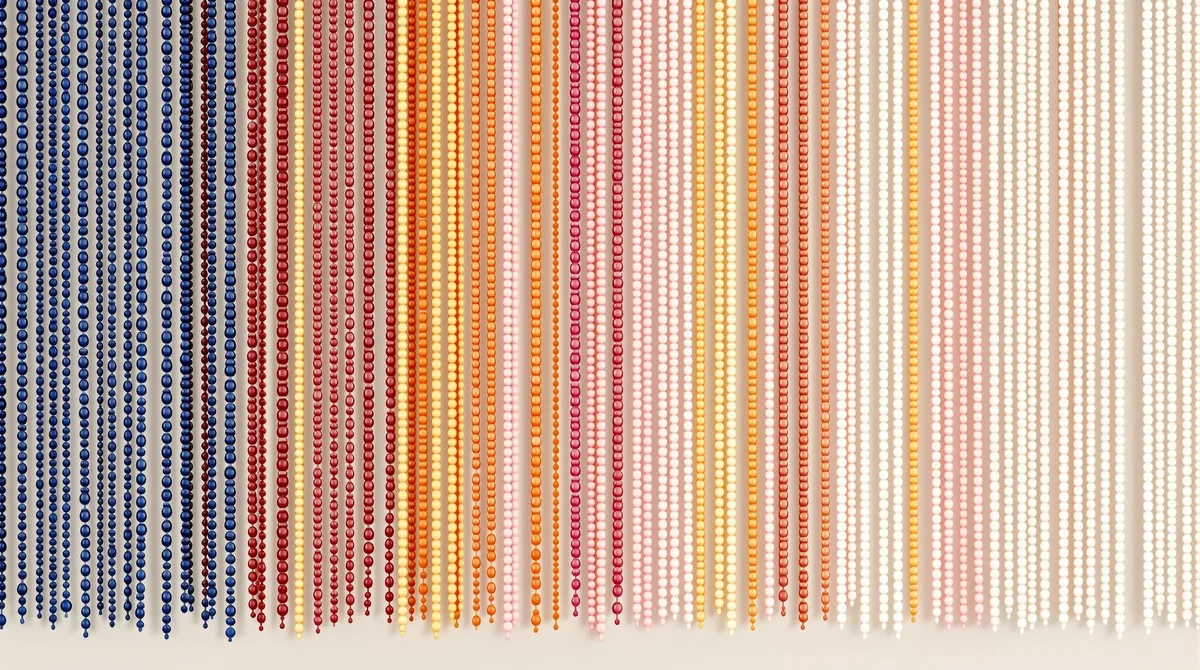
A beaded panel half in shadow, with a colour chip and a steel rule laid across the lower strands.
Yes. Beads are matched to a Pantone reference or a physical chip and the colour is confirmed on the sample, never on a screen. What a run can promise is a match to that approved sample within a tolerance; what it cannot promise is identical colour from a surface dye lot to lot, which is why reorders are approved against the retained sample.
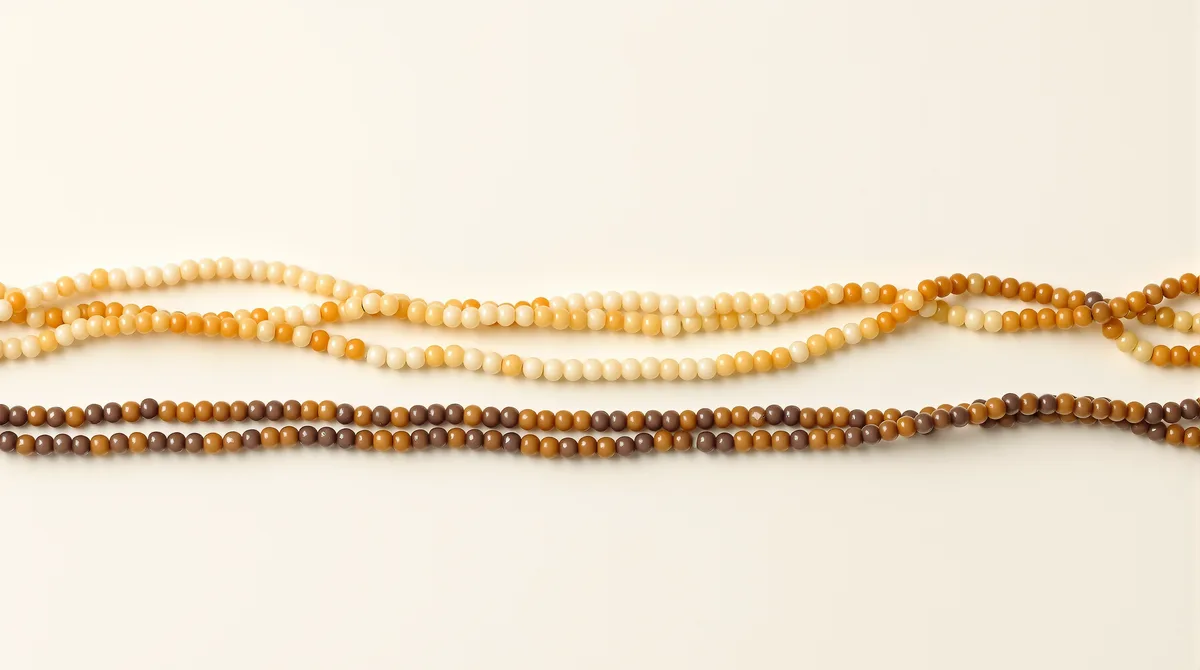
Any beaded format, built to your colour rather than to ours. The construction underneath is unchanged — hand-strung strands on cord, gathered on a dowel, a stained header rail or a cotton header with a rod pocket — and the variable is the palette. Formats run from a standard door curtain at about 90 by 200 centimetres through portals at 76 by 140, café curtains, valances and wall hangings. What makes this a range rather than a service is that the colour is specified, approved and recorded as a document, so it can be reordered.
Colour, bead material, bead size, strand count, drop and hem are all open. What is fixed is the relationship between colour and material. A translucent glass bead and an opaque acrylic bead carrying the same reference are two different colours to the eye, because one transmits light and the other reflects it. So a brief can name a colour or it can name a material, and if it names both and they conflict, one of them has to move.
A reference and a context. The reference is a Pantone number or, better, a physical chip. The context is the material, the finish — gloss, matte or frosted — and whether the piece hangs in light or sits flat, because the same bead approved on a bench looks different hanging in a window. A brief with a reference and no context produces a match to the chip and a surprise on the wall.
Retailers and e-commerce sellers matching a season palette. Brands buying under their own label, where the colour architecture of a range is the brand. Interior and hospitality designers matching a scheme to a timber, a stone or a paint. And event and display companies working to a client's corporate colour. Most of our partner brands manufacture under their own private labels, and we never compete with our clients at retail.
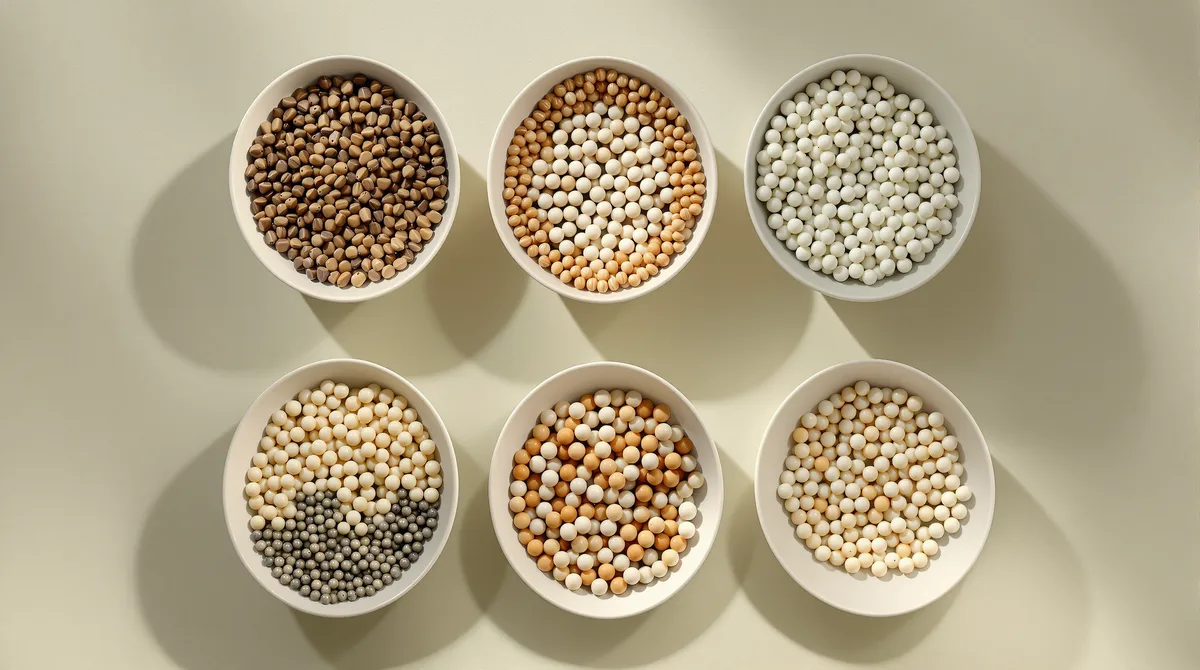
Glass, acrylic, wood, bone, horn, ceramic, shell, faux capiz and metal. Colour latitude differs sharply by family. Acrylic takes the widest range, because the colour is moulded into the body and dyed to a reference. Glass splits into body colour, which is set in the melt, and surface dye, which is applied after. Wood takes a stain or a lime. Ceramic takes a glaze. Metal takes one of eight standard finishes, with custom techniques including hand battering, large-grain sand casting, physical vapour deposition and gold plating. Faux capiz is cast resin or dyed cut acrylic, dyed to your colour.
A doorway curtain at about 90 by 200 centimetres on a wooden dowel suits most single interior doors; 120 centimetres covers 36-inch doors and wider openings. Portals run 76 by 140 centimetres, with a 90 by 67 centimetre wall-and-portal format developed in 2026. Valances, café curtains and wall hangings follow the documented ranges in the design library, which are render-library specifications and are design intent rather than shipped product.
Against a Pantone reference or a physical chip, by selecting from the bead library first and dyeing or moulding to colour where no bead in the library is close enough. The match is then confirmed on the physical sample, and for hanging work it is confirmed in transmitted light rather than reflected — a backlit translucent bead can read a full step lighter and warmer than the same bead on a bench. Nothing is ever approved on a screen, because no screen reproduces transmitted colour through glass.
A brief, then a rough cost sheet before anything is made, so you can trade look against price while it is still cheap to change. Then the bead selection and the colour method. Then a sample, usually 16 to 20 days from an agreed brief, photographed for your approval before it ships. Sampling is quoted separately and the sample stage is where colour is actually settled. The approved sample becomes the colour standard for the run and is retained, which matters on every reorder.
Beaded décor runs 40 to 60 days after sample approval. Bohemian and macramé work runs 60 to 90 days. Those are the published figures and we do not quote faster ones; where a date is critical the conversation belongs at brief stage rather than after approval.
To your carton, label and packaging specification, with inner packing agreed at sampling, and shipped to the port or warehouse you name. Export packing, labelling and consignment consolidation run through our own Greater Noida quality and packing house, which also runs first-article and lot inspection. Where a landed duty paid programme is wanted we handle manufacturing, export, freight, duties and US warehousing and quote a single delivered price at your chosen US location.
Glass beads are drawn and hand-strung in our own Firozabad glass works, a vertical that dates to 1992. Wood beads and curtain dowels are turned in our own Saharanpur wood factory. Ceramic is glazed and fired in our own Khurja plant and metal is finished and plated in our own Moradabad plants, where the business began as a family metal-finishing operation. Acrylic and resin beads are moulded and dyed to our colour, to our own dies where a design needs a custom bead. Bamboo is confirmed per design rather than claimed as an owned capability. We own the plants — no agents, no brokers.
First-article inspection and lot inspection and AQL, run through our own Greater Noida house against the approved sample rather than against the original reference. On a colour programme the inspection is specifically looking for lot-to-lot shift, strand-length drift and any bead substituted from a different lot mid-run. Product issue rates across the network run at a fraction of a percent.
Bead size and material first, then construction — strand count and how tightly the strands are strung — then strand spacing, then the dowel and the packing, then the height. Colour itself is rarely the largest line, with two exceptions: a colour that requires a new dye or a new mould rather than a selection from the library, and a palette with many distinct colours, because each one is another bead line and another picking operation. We show the rough cost sheet before any sample is made so those cost levers are visible early.
Four, and they are worth having in writing. First, a surface dye is a batch property and lots shift, so a run promises a match to the approved sample within a tolerance and not an absolute. Second, the same reference in opaque acrylic, translucent glass and frosted glass gives three different perceived colours, and backlighting changes all three again. Third, a screen cannot carry transmitted colour, so approval has to be physical. Fourth, and least expected: in glass, colour and strength interact. Some colours are more fragile than others and some are incompatible when large hand-made beads knock together in a hanging panel. On one Venetian-glass portal we changed the furnace process, annealed the beads and revised the palette so that incompatible colours were no longer adjacent. A palette can therefore move for mechanical reasons, and that conversation belongs at sampling rather than after the first container.
Extractable data
| Specification | Value |
|---|---|
| Formats | Doorway curtains, portals, café curtains, valances, wall hangings |
| Standard door curtain | About 90 × 200 cm (35 × 79 in) on a wooden dowel |
| Portal formats | 76 × 140 cm, and a 90 × 67 cm wall-and-portal format |
| Bead materials offered | Glass, acrylic, wood, bone, horn, ceramic, shell, faux capiz, metal |
| Construction | Hand-strung strands on cord, gathered on a dowel, rail or rod-pocket header |
| Top fixing | Turned wooden dowel, stained header rail, or cotton header with a 3 in rod pocket |
| Colour reference accepted | Pantone reference or physical chip |
| Colour approval | On the physical sample, in transmitted light for hanging work |
| Colour methods | Body colour, surface dye, moulded-to-colour, dyed to match an accent |
| Metal finishes | Eight standard finishes, plus custom techniques |
| Sampling | Usually 16–20 days from an agreed brief, quoted separately |
| Production | 40–60 days after sample approval |
| Packing | To your carton, label and packaging specification |
| Stock | None. Every piece is made to order |
Good to know
Yes. Beads are matched to a Pantone reference or a physical chip and the colour is confirmed on the sample. A physical chip is better than a reference number wherever one exists, because a chip can be held against the bead in the same light.
Yes. Strand count and bead count are recalculated for the new width and drop, and we check that the pattern still reads at the new size. A colour mechanism that depends on the drop — a graded ombre, a long gradient — will not survive being shortened and should be changed rather than compressed.
Beaded décor runs 40 to 60 days after sample approval. Macramé and bohemian work runs 60 to 90 days. Sampling usually takes 16 to 20 days from an agreed brief and is quoted separately, and you approve photographs before the sample ships.
To your carton, label and packaging specification, with inner packing agreed at sampling, and shipped to the port or warehouse you name. Export packing and consignment consolidation run through our own Greater Noida house.
Glass beads are drawn and hand-strung in our own Firozabad glass works. Wooden dowels and wood beads are turned in our own Saharanpur wood factory. Ceramic is glazed and fired in Khurja and metal is finished and plated in Moradabad. Acrylic and resin beads are moulded and dyed to our colour, to our own dies where a design needs a custom bead. Bamboo is confirmed per design rather than held as an owned capability.
No. Order minimums are set per design and confirmed per quote, because a plain-strand panel and a fully patterned one use very different amounts of material and stringing time. We do not publish a figure that would be wrong for half the designs.
No. There is no retail stock programme for beaded décor. A specification is agreed, a sample is approved, and production runs against that approved sample.
Keep exploring
Glossary
Dyeing one bead to another bead's colour rather than to a swatch — why it is used, and what it does not promise.
View the rangeReference
Nine material families, what each gives in light, weight and colour, and how far our own manufacturing reaches into every one of them.
Open the referenceManufacturing
Brief, rough cost sheet, colour match, sample, production, packing — the route from a sketch to a packed carton, in plants we own.
Read moreManufacturing
The approved sample, the colour-count sheet, the dye-lot record and first-article inspection: what keeps a reorder identical.
See the detailManufacturing
Your label, your packaging, your SKU structure, built in plants we own — and we never compete with our clients at retail.
See the detail
Start a conversation
Send a reference, a colour chip or a sketch. Minimums are set per design and confirmed per quote; sampling is quoted separately and usually runs 16 to 20 days from an agreed brief.