Design
Colour stories, by construction
Colour stories documented by how they are built, not by how they look in a mood board.
See the detail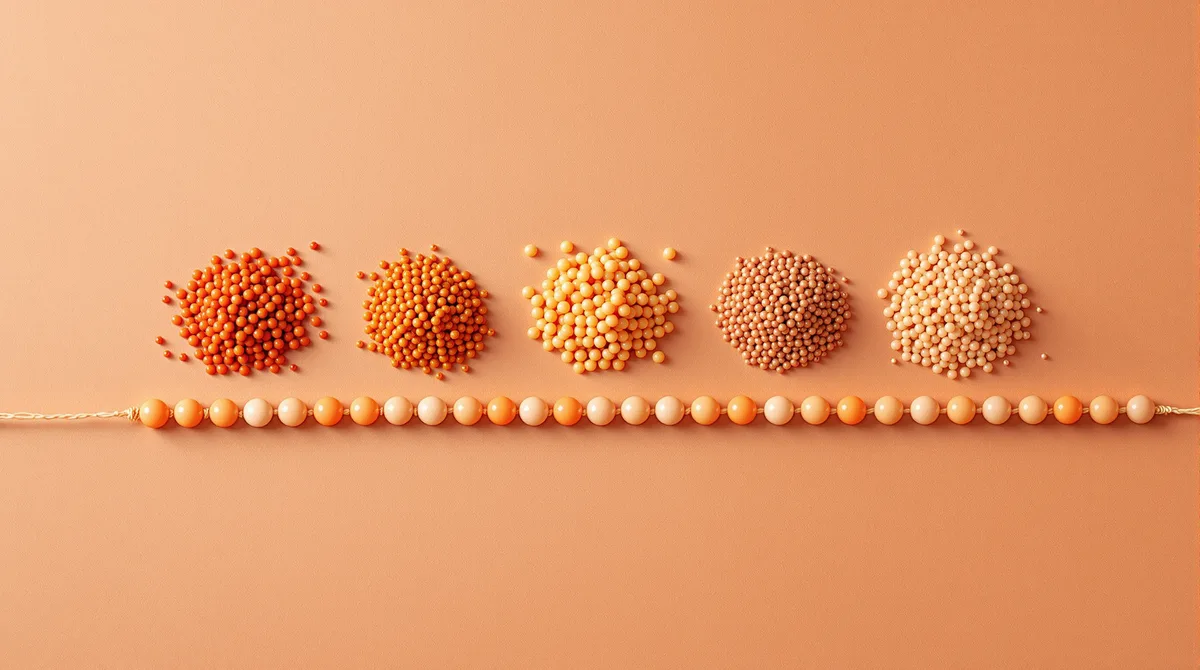
Manufacturing · Exclusivity
Exclusivity on beadwork is a commercial agreement rather than a product feature, and it is discussed at quote. What is worth understanding first is which design route you are actually on.
One colourway set out as five small piles of glass beads in related terracotta, rose-clay and butter-yellow shades, with a single master strand threaded in that sequence lying in…
Exclusivity on a bead design or a colour story is agreed at quote rather than offered as a standard term. What makes it possible is that every design is a documented bead map and colour-count sheet, so a specific build can be identified and held. We will not reproduce another brand's protected design, and we never compete with our clients at retail.
There are three routes, and almost every exclusivity conversation is really a question about which one you are on.
Route 1 — a recolour. An existing library design in your colours. Fastest, cheapest, and the lowest-risk way to get something that is visibly yours.
Route 2 — an adaptation. A library design changed in size, bead material, density or hem profile. Still built on a proven construction, but materially different from the original.
Route 3 — a development. A new design from your sketch, photograph, artwork or mood board, drawn to a bead map before the first bead goes on a cord.
The exclusivity you can realistically hold increases down that list, and so does the development work behind it.
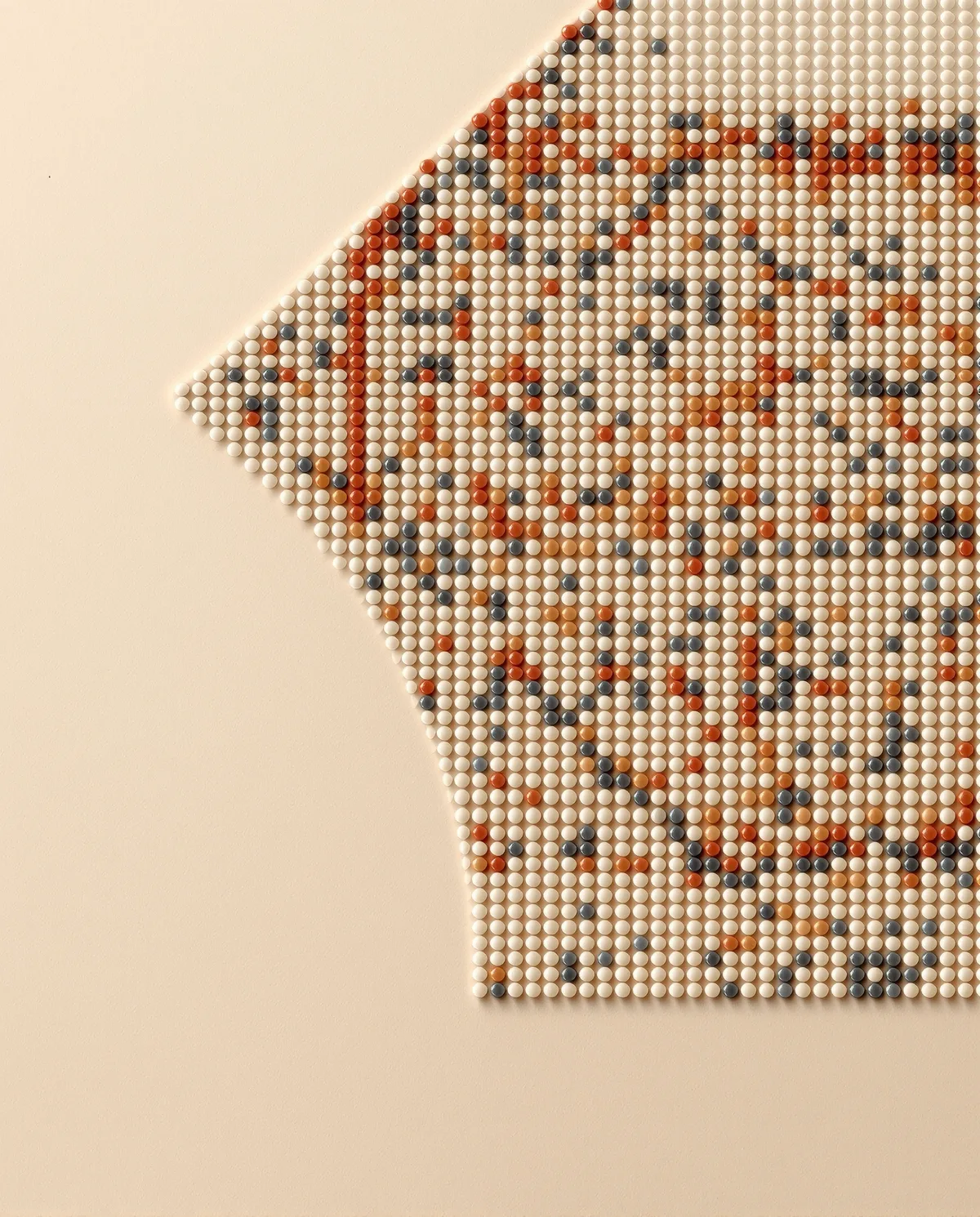
That every design exists as a document. A bead map fixes every bead position; a colour-count sheet records the bead-by-bead plan for every strand.
That is not a filing nicety. It means a specific build is identifiable: this pattern, in these beads, at these sizes, in this colour sequence, at this pitch. A design that exists only as an approved sample in a box is hard to define in an agreement. A design that exists as a bead map can be named precisely.
Changeable: the design, the colour story, the distribution of colour across or down the strands, bead size and material, pitch, hem, size and format. Also the degree of change from any library starting point, which is really the dial you are turning.
Fixed: our position on two things. We will not reproduce another brand's protected design, and we never compete with our clients at retail. Both are stated plainly because both protect you.
For an exclusivity conversation, three things beyond the normal brief.
What is being held — the design, the colour story, or both. The scope — which categories, formats and sizes it covers. The territory, because an exclusive in one market and an open design in another are entirely different agreements.
Those are the questions we would ask at quote, and raising them in the brief rather than afterwards is what keeps the development from having to be redone.
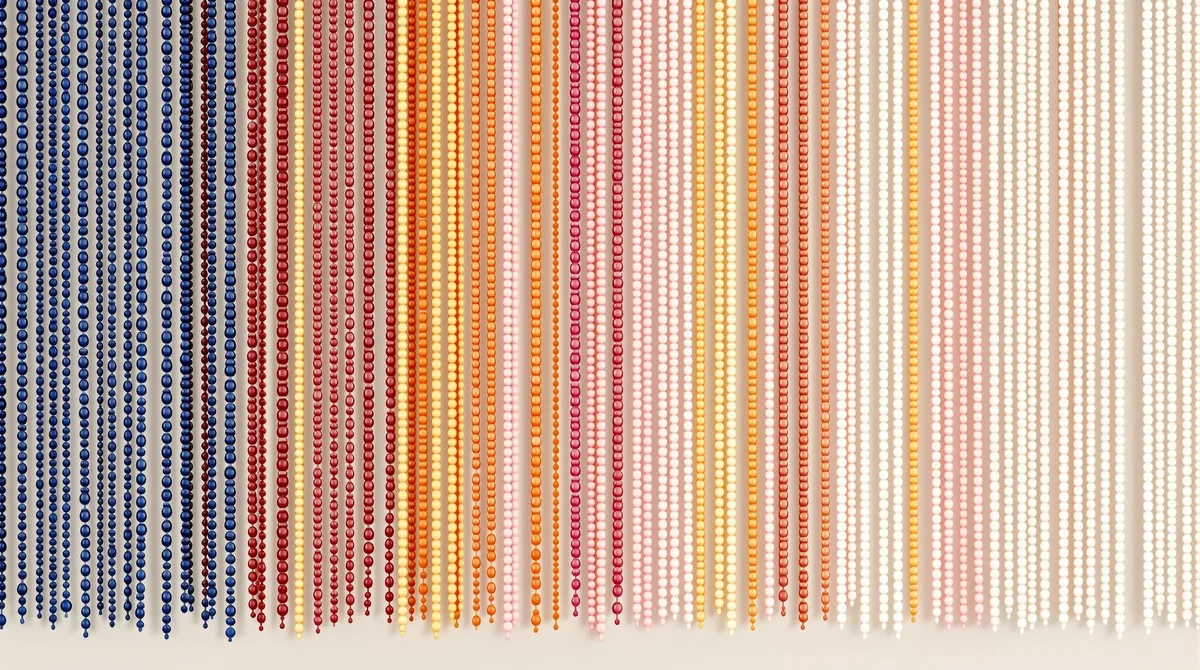
A colourway is a palette plus a distribution, and both are specifiable. The first question on any colour brief is whether the colours change across the strands, giving vertical bands, or down each strand, giving horizontal ones. They produce opposite results from the same five beads.
Two mechanisms carry most designs. Dyed to match, where the base bead is dyed to the accent so the accent reads as the subject. And grading by bead size, where the colour change lands on a change of scale rather than a change of dye — which reads as depth rather than as a stripe, and which no single-size panel can imitate.
Because both are recorded on the colour-count sheet, a colourway is as holdable a thing as a pattern.
The design library works in fourteen: Lapis Hour, Moonwater, Ember & Honey, Seventies Sunroom, Sorbet Parade, Wavy Check, Sterling Swan, After Hours, Honey Hour, Op Pennant, Cherry Blossom, Olive Press, Café Society and Rose Clay Garden.
Every one is recolourable, and a recolour is the fastest route to something that is recognisably yours. The naming system itself is a useful piece of shared vocabulary: it carries a distribution as well as a palette, so a story already knows whether its colour runs across or down.
We will match a look. We will not reproduce a protected design.
The practical form of that answer: send us a vintage piece, a photograph, a reference from a market stall, and we will propose beads, construction and colours that get to the same place in new materials as a vintage-inspired design. Send us another brand's current product and the answer is no.
This protects you more than it protects us. A programme built on somebody else's protected artwork is a liability sitting on your SKU, and discovering it after a season of sell-through is the expensive version.
A brief — board, sketch, artwork or a library reference, with size, material, colours and quantity. A rough cost sheet before any sample is made, showing where the cost sits and which lever moves the price.
That sheet matters most on a ground-up development, because the first idea is rarely the one that hits the target. A 2025 portal development ran through six or seven iterations before it reached its cost, and the change that got it there was using two bead sizes in one strand rather than one.
Then colour matching against a reference or chip, then the sample — usually 16 to 20 days from an agreed brief, photographed for approval before it ships, quoted separately. Production runs 40 to 60 days after sample approval.
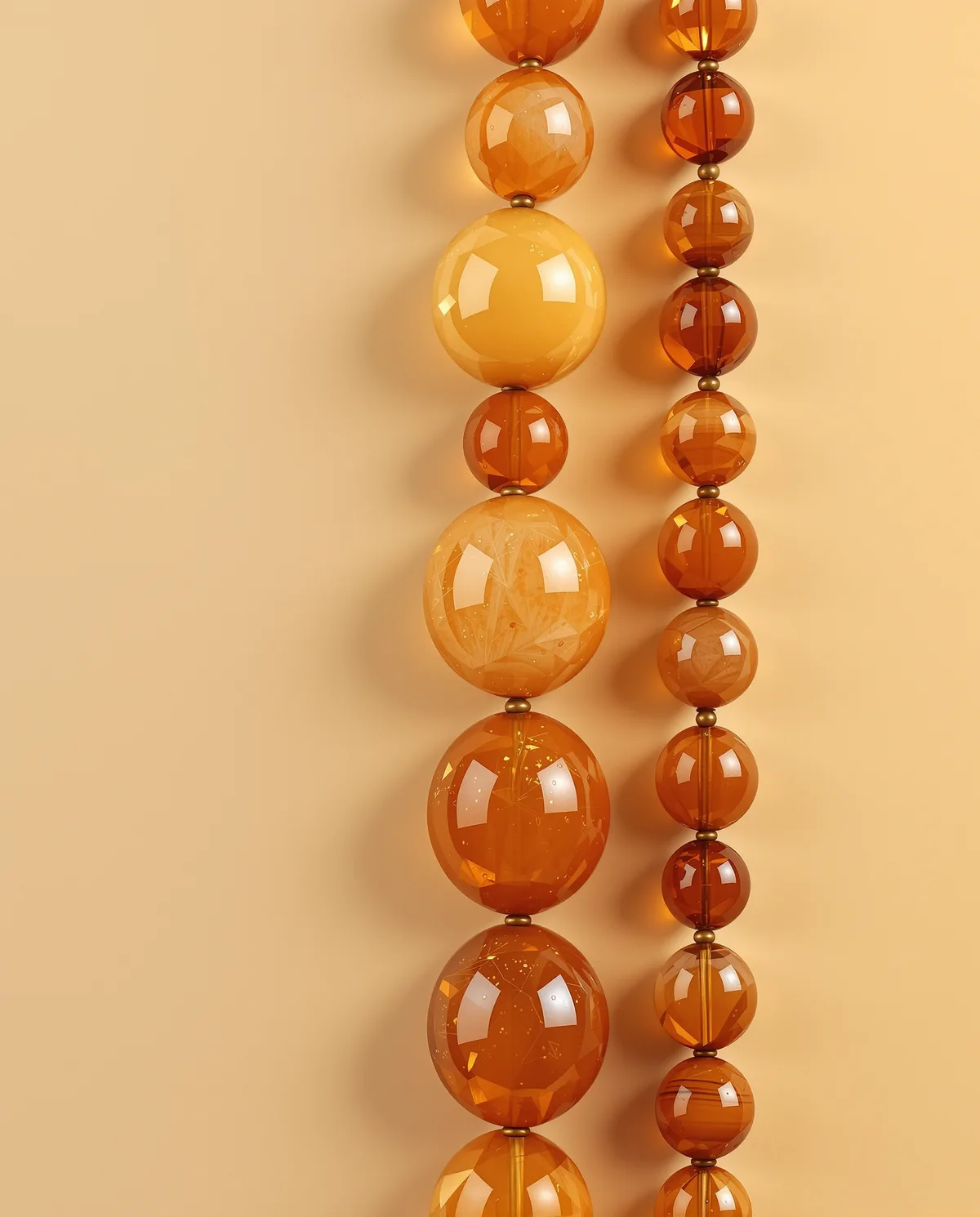
Frequently, and it is where a development becomes genuinely exclusive. Acrylic and resin beads are moulded to our own dies, and we cut a die where the design requires a bead nobody makes — the custom three-inch almond beads that form the daisies on a café curtain came that way, on dies we funded, as did a custom flower bead for a portal development.
A bespoke bead is the strongest form of design distinctiveness available in this category, because the shape itself is not available elsewhere. It is also a development with its own lead time, so it has to be raised early.
An exclusive colourway is only exclusive if someone owns the recipe, and we do. The colour is mixed at our own Firozabad glass works or dyed onto acrylic to our own formulation; a custom shape comes off a die we cut and keep. Turned wood is Saharanpur, fired ceramic is Khurja, plated metal is Moradabad, and bone, horn, shell and capiz are cut and finished in our own beadwork studios.
On an exclusive, the first article is checked against the retained colour standard rather than only against the drawing — because the thing being protected is the colour, and a drawing cannot hold one. Factories we own, not vendors we book.
The design library holds the colour stories a recolour starts from. Bead colour matching covers how a palette becomes an approved bead, graphic bead patterns covers the bead map behind a pattern, and private label beadwork covers whose name goes on the box.
Extractable data
| Specification | Value |
|---|---|
| Route 1 — recolour | An existing library design in your colours; fastest and cheapest |
| Route 2 — adaptation | A library design changed in size, bead, density or hem |
| Route 3 — development | A new design from your sketch, photograph, artwork or mood board |
| Named colour stories | Fourteen in the design library, every one recolourable |
| Design record | A bead map and colour-count sheet, held per design |
| Exclusivity | Agreed with the quote, per programme |
| IP position | We will not reproduce another brand's protected design |
| Retail position | We never compete with our clients at retail |
| Custom beads | Moulded to our own dies where a design needs a bead that does not exist |
| Sampling | 16–20 days from an agreed brief, quoted separately |
| Production | 40–60 days after sample approval |
| Minimums | Set per design, confirmed per quote |
Good to know
Not by default. Tell us if you need exclusivity on a design or on a colour story and we will discuss it when we quote. It is a commercial agreement rather than a product attribute, which is why the term, the period and the territory are the things being agreed.
That is the most common version of the request, and it is the easiest to define. A colour story is a palette plus a distribution, and both are recorded on the colour-count sheet, so a specific colourway of a shared design is an identifiable thing to hold. Raise it at quote.
We can match its look, colours and bead sizes in new materials, as a vintage-inspired design. We do not reproduce another brand's protected design. That distinction is deliberate and it protects you as much as anyone else — a programme built on somebody else's protected artwork is a liability on your SKU, not ours.
Yes, and it is a normal route. Send the board and the colours, and we propose beads, construction and a rough cost before any sampling. The rough cost sheet matters more on a ground-up development than anywhere else, because the first idea is rarely the one that hits the target.
Yes, with a check. Strand and bead counts are recalculated for the new width and drop, and we confirm the pattern still reads at the new scale. A motif that works at 90 cm can lose its reading at 120 cm, and a scattered accent that works on a 200 cm drop can look sparse on a café length.
To your carton, label and packaging specification, shipped to the port or warehouse you name. On an exclusive programme the packaging is often where the exclusivity is most visible to a shopper, so it is worth specifying as carefully as the beadwork.
Glass beads are drawn and hand-strung in our own Firozabad glass works; wood, including curtain dowels, is turned in our own Saharanpur factory; ceramic is glazed and fired in Khurja; metal is finished and plated in Moradabad. Acrylic and resin beads are moulded and dyed to our colour, to our own dies where a design needs a custom bead.
Keep exploring
Design
Colour stories documented by how they are built, not by how they look in a mood board.
See the detailManufacturing
Brief, rough cost sheet, colour match, sample, production, packing — the route from a sketch to a packed carton, in plants we own.
Specs and sizesManufacturing
Matched to a Pantone reference or a physical chip, approved on the sample, never on screen — and what a dye lot can promise.
Specs and sizesManufacturing
Artwork to bead map, the resolution limit set by bead size, and why a scattered accent costs a fraction of a graphic.
Specs and sizesManufacturing
Draw the bead, cut the die, mould and dye it: what a custom bead shape costs, what it needs from a buyer, and when it pays.
Specs and sizesManufacturing
Your label, your packaging, your SKU structure, built in plants we own — and we never compete with our clients at retail.
Specs and sizes
Start a conversation
Send a reference, a colour chip or a sketch. Minimums are set per design and confirmed per quote; sampling is quoted separately and usually runs 16 to 20 days from an agreed brief.