Pillar
Beaded décor compliance
Lead, CPSIA, Prop 65, REACH, fire standards, electrical listing and audit — what applies, who carries it, and what we hold.
See the detailMarket · United States
The US is the market with the deepest record behind it and the most useful commercial arrangement: a client-facing office in Princeton, New Jersey, and the option of a single delivered price at a warehouse you name.
For a US programme two things change. Commercially, there is a client-facing office in Princeton, New Jersey, and Gemixx manufactures, imports and warehouses product in the US, so a programme can be quoted landed duty paid as a single delivered price at a chosen US location. Regulatorily, California Proposition 65 and the CPSIA children's-product rules are the two that bite.
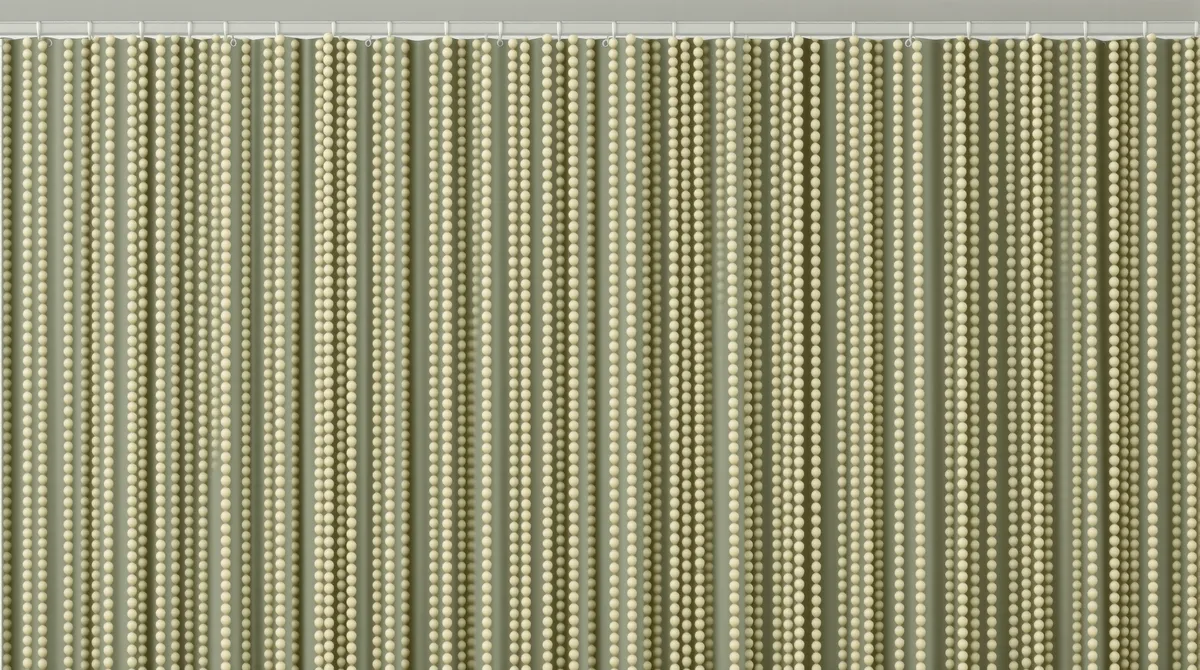
Doorway portals, full-length door curtains, café curtains, valances and wall hangings — and in this market every one of those formats is moving at once. The design library behind them is where the detail sits: a 90 by 200 cm translucent-acrylic portal on a stained wooden header rail, thirty hand-strung strands to a panel, in continuous production; a two-tone green seed-bead curtain at 76 by 140 cm; a Venetian-glass portal; a dotted-oval portal; a mushroom-bead portal hung on end suspension loops; and an 18 by 30 inch faux-capiz blossom wall hanging. Those formats ship into the United States, and into the UK and Canada alongside it.
None of that is a catalogue selection. Each design began as a buyer's brief and became a colour-count sheet, and the sheet is what makes every reorder the same object as the first.
Here is how far a change goes before it becomes a new product. One portal was reissued in a brighter colourway with the construction untouched. A seed-bead curtain was reissued as a honey ombre graded by bead size rather than by dye. A dotted portal was made in translucent and opaque versions of the same pattern. A mushroom portal had its accents alternated in two colours at the buyer's request.
What does not move: nothing is held in stock, so a US floor-set date is a production date and not a warehouse pull.
The nine are the ones every bead programme starts from — type, size, density, bead, colour, pattern, fixing, packing, quantity — and the brief page carries them in full.
Two of the nine do more work here than anywhere else. Destination, because if California is on the list, and it almost always is, Proposition 65 reaches the article with no age trigger in front of it. And the Incoterm, because the choice between FOB an Indian port and a single delivered price at a named US warehouse decides who carries the classification risk, not merely who pays the freight.
The US programme has drawn on five bead families so far: translucent and opaque acrylic, drawn glass seed beads, pressed and dotted glass, hand-made Venetian-style glass, and laser-cut faux capiz — which is cast resin or dyed cut acrylic finished to imitate capiz shell, and is not shell.
That is a commercial decision as much as a design one, because the predominant bead material is one of the facts that decides how a panel is classified at entry. A made-up curtain and an article of glass beads sit on different sides of that fork. Settle the material before anyone asks for a duty number, not after.
North American interior doors are commonly 28 to 36 inches wide, so a 90 cm panel covers most single openings and a wider opening takes a 120 cm build at a tighter pitch. Portals run 90 by 67 cm and 76 by 140 cm, café curtains around 60 by 76 cm on a cotton header with a three-inch rod pocket, and valances around 76 by 61 cm with a scalloped arch hem.
The wall-hanging format is the one the US floor has pulled into a hard number: 18 by 30 inches, ten pieces to an 85 by 32 by 25 cm master carton. On a valance the equivalent number is height, because height sets bead count almost linearly.
Against a physical chip or a stated colour reference, one per bead colour, and the match is confirmed on the sample rather than on the brief. Where a base bead has to be dyed to match an accent — as on a dotted portal whose seed-bead base is dyed to the dot colour — base and accent are specified and approved separately.
There is a second reason to settle colour early on a US order. Pigment chemistry is where Proposition 65 actually lands, so a late swap on a red, orange or yellow is a compliance question and not only an aesthetic one.
Usually 16 to 20 days from an agreed brief, with photographs approved before the sample ships, and sampling quoted separately from production. On approval the sample is sealed and becomes the description the whole order is judged against.
The approval date on a US programme is set by a distribution-centre window rather than by the factory. Styles approved in late summer reach a DC the following winter, and by then the sealed sample is the only record of what the piece was meant to be — which is why a change after approval is a new approval rather than an amendment.
Forty to sixty days after sample approval for beaded décor. What makes that number useful in this market is that it is scheduled rather than estimated: a repeat-ordering style is scheduled well ahead, which is what it buys a planner.
Count a seasonal programme backwards from the floor-set date through sampling, approval, production, inspection, export packing, consolidation and ocean freight. Bohemian and macramé work runs 60 to 90 days and sets the date on any piece that mixes the two crafts, because the slowest craft on a piece sets its date.
To your carton, label and packaging specification, in our own quality control and packaging house at Greater Noida, which also does first-article and lot AQL inspection, assembly and kitting, and consignment consolidation.
Two packing fields are specific to beadwork and neither is optional. Strands are kept in order and restrained so a panel does not arrive tangled. Glass accents are separated rather than merely cushioned, because glass chips when glass knocks glass over an ocean leg. Country-of-origin marking is applied to the destination's requirement.
Three of the five plants have carried this market's work. The glass — seed, pressed, dotted and Venetian-style — is drawn and hand-strung at our own Firozabad glass works. Header rails and dowels are turned at our own Saharanpur wood factory. Acrylic and resin are moulded and dyed to our colour, and cut where a faux-capiz blossom is involved, to our own dies. Ceramic from our own Khurja plant and plated metal from our own Moradabad plants are open to any design that wants them.
That list belongs on a US page because of its import consequence: one manufacturing origin and one exporter of record is a simpler customs position than a bill of materials assembled across other people's factories. We own the network; we are not a sourcing office.
First-article and lot AQL inspection in the Greater Noida quality and packing house, against the sealed sample, before volume runs. On a programme running several designs at once, that is where a systemic error is caught — on the first article, before the lot is built on top of it.
On a repeat style the addition worth making is a check of the reorder against the first shipment as well as against the sample, because a bead library drifts over a year and a store floor remembers the original.
Bead size and material first, then construction, then strand count and spacing, then the dowel and the packing, with height last. Underneath all five sits bead count: a densely patterned 90 by 200 cm panel can hold about 11,800 beads and every one of them is a hand movement.
The US-specific item is duty. The duty position follows from the classification, the classification follows in part from the predominant bead material, and that decision is taken at design stage — months before anyone is looking at a landed-cost sheet.
The deepest record on this property sits in this market. Beaded portals, door curtains, café curtains, valances and wall hangings are in continuous production for US retail, with the lead portal reordering season after season.
Around a programme of that shape the buyer types are retailers and e-commerce sellers, own-label brands, interior and hospitality designers specifying hotels, restaurants, salons and spas, and event and display companies. Brands across the group manufacture under their own private labels, and we never compete with our clients at retail.
What changes commercially is the delivery option. Because Gemixx manufactures, imports and warehouses product in the US and runs a client-facing office in Princeton, New Jersey, a programme can be quoted landed duty paid: manufacturing, export, freight, duties and US warehousing in one delivered price at the location you name, with no separate freight agents, customs brokers or line items that surface later. FOB an Indian port and CIF are both available instead, and a buyer with its own import function will usually do better on FOB.
What changes legally is three things. California Proposition 65 carries no age trigger, so it reaches adult décor sold into the state. The CPSIA children's-product rules apply once the article is a children's product, which is a written determination to make before design. And where a panel hangs in a US assembly space, the venue's fire file will cite NFPA 701; fire performance is tested on the specified build and quoted with the project. Classification itself sits on a real fork between made-up curtains and articles of glass beads, and the duty position follows from that rather than from the invoice description.
Extractable data
| Specification | Value |
|---|---|
| Formats | Door panel about 90 × 200 cm; portals 90 × 67 cm and 76 × 140 cm; café curtains on a cotton header with a 3 in rod pocket; valances with a scalloped arch hem |
| Bead materials | Glass seed and pressed glass, acrylic, wood, bone, horn, ceramic, shell and faux capiz |
| Construction | Hand-strung strands on cord, to a colour-count sheet |
| Top fixing | Stained wooden header rail, single dowel, rod pocket on cotton, or end suspension loops |
| Colour | Matched to a colour reference or a physical chip, confirmed on the sample |
| Sampling | Usually 16–20 days from an agreed brief; photographs approved before the sample ships; quoted separately |
| Production | 40–60 days after sample approval |
| Inspection | First-article and lot AQL inspection in the Greater Noida quality and packing house |
| Packing | To the buyer's carton, label and packaging specification |
| Terms | FOB, CIF, or landed duty paid to a named US location |
| Minimums | Set per design and confirmed with your quote |
Good to know
Yes. Beads are matched to a colour reference or a physical chip and the match is confirmed on the sample rather than on the brief. Where a base bead has to be dyed to match an accent, both are stated separately in the specification.
Yes. Width, drop, strand count and bead count are recalculated for the new dimensions and the pattern is checked to confirm it still reads at the new size. A resize is a new sample, because a pattern that works at 90 by 200 cm does not automatically work at 120 by 180.
Forty to sixty days for beaded décor. Bohemian and macramé work runs 60 to 90 days. Sampling sits in front of both at usually 16 to 20 days from an agreed brief and is quoted separately.
To your carton, label and packaging specification, packed and labelled in our own Greater Noida quality and packing house, which also handles assembly, kitting and consignment consolidation. Strands are kept in order and restrained so a panel does not arrive tangled, and glass accents are separated rather than merely cushioned.
Glass beads are drawn and hand-strung in our own Firozabad glass works. Wood beads and curtain dowels are turned in our own Saharanpur wood factory. Ceramic is glazed and fired in Khurja and metal is finished and plated in Moradabad. Acrylic and resin beads are moulded and dyed to our colour, to our own dies where a design needs a bead that does not exist.
No. Minimums are set per design rather than across the range, because a plain-strand panel and a fully patterned one use very different amounts of material and stringing time. They are confirmed per quote and no figure is published.
Keep exploring
Pillar
Lead, CPSIA, Prop 65, REACH, fire standards, electrical listing and audit — what applies, who carries it, and what we hold.
See the detailPillar
Brief, rough cost sheet, colour match, sample, production, packing — the six stages with the real published timings.
Compare the optionsMarkets
Four markets, what changes in each on rules, vocabulary and freight, and the offices that carry them.
Open the referenceManufacturing
A real local presence, transit and cubing from India, and the state of the Australian beadwork record.
Read the guideManufacturing
Pelmet and fly-screen vocabulary, BS fire classification, ethical audit expectations and incremental test costs.
How it is made
Start a conversation
Send a reference, a colour chip or a sketch. Minimums are set per design and confirmed per quote; sampling is quoted separately and usually runs 16 to 20 days from an agreed brief.